Tag: best1 Page 1 of 4

All about robusta: what it is, and what it might bebest1

A primer on robusta coffee on a blog with over 400 posts seems a little tardy. For the most part, the message to consumers who are looking for high-quality coffee grown in a sustainable manner has been to simply avoid nearly all readily-available coffees containing robusta. But the world is changing, and we may all be getting to know robusta a little better in the future. It seems fitting to offer a little introduction.

What is “robusta”?
There are over 100 species of the genus Coffea in the world, and all are native to tropical Africa and some Indian Ocean islands. Two species, C. arabica and C. canephora, are commonly grown commercially. Coffea canephora is commonly referred to as “robusta,” and makes up about 25 to 40% of the coffee grown for consumption. Some consider only the upright forms of C. canephora to be called robusta, with spreading forms called “Nganda.”

Robusta grows in hotter (22 to 26 C), more humid climates than arabica coffee (18—21 C), and at lower elevations (from about 200 to 900 m). It has large leaves, deep roots, and flowers and fruits in globe-like clusters. It tends to be more hardy and disease-resistant and grows better in the sun than arabica, and it also tends to have higher yields. Robusta has a higher caffeine content (30 to 50% more) than arabica. While arabica coffee  is self-pollinating, robusta requires cross-pollination by insects or wind. Robusta cherries take a little longer to ripen, ten or eleven months versus around nine for arabica. Robusta is a diploid with 22 chromosones, as are all other species of Coffea except arabica, which is a tetraploid with 44.

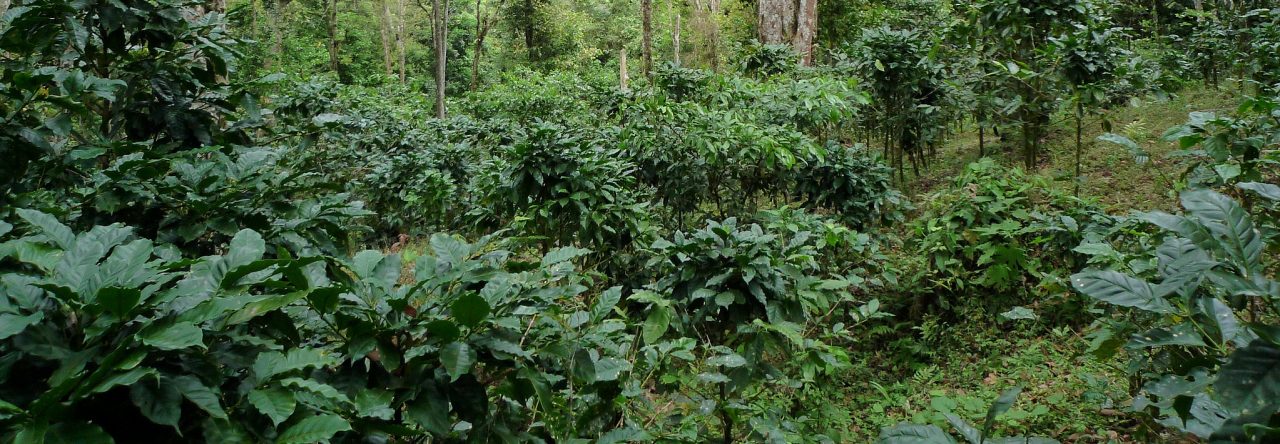
Because of its heat tolerance, and the desire to produce high yields, robusta coffee is often grown at high densities in full sun. Large yields require high inputs of fertilizer and water. In countries where robusta cultivation has been encouraged and expanding, such as Vietnam, shade agroforestry systems and native forests have been removed in favor of growing the coffee in full sun.

History

Native to equatorial Africa, robusta was not really planted until coffee leaf rust wiped out much of the arabica coffee in the world in the late 1800s. Robusta was found to be quite resistant to the fungus, as it is to some other troublesome diseases and pests. Now, robusta is grown in Africa, including in Uganda, CÁ´te d’Ivoire, Cameroon, and the Democratic Republic of Congo; and in Asia, including Java, Timor, Sri Lanka, Sumatra, and above all, Vietnam. India, Mexico, Brazil (where a mild variety called Conilon/Kouillou is cultivated), and Guatemala grow both robusta and arabica. The largest grower is Vietnam, with over a half million ha devoted to robusta coffee, versus fewer than 30,000 ha in the mid-1980s.

Quality

Robusta beans tend to be more bitter and harsher than arabica. Words often used to describe robusta include rubbery, cereal or-grain like, flat, musty, or woody.

There are two primary uses for robusta. One is to add body and crema potential to espresso blends, and the other more widespread use is as a cheap filler in grocery store blends. Since so much is used in blends, yield and low cost are emphasized, not quality. Instead of focusing on only ripe cherries during harvest, robusta is often strip-picked, where all cherries are removed from the tree whether they are ripe or not. Less care is taken in processing; usually cherries are laid out to dry after harvest, without any further sorting.

In order to counter the unpleasant flavors of the robusta used in inexpensive coffee, multinational roasters have devised various methods to treat the beans, such as pre-drying, steaming, mixing it with a fatty material then soaking it in acetone, or roasting it so that “heavy, roasted burnt notes are developed” before blending. Yum.

Another way robusta is used is genetically — to confer some resistance to coffee rust and other pests and diseases into higher-quality arabica coffee. A hybrid between robusta and arabica from Timor, called Hibrido de Timor (HdT), has become the basis of a number of other varieties bred for their resistance to rust and other diseases. Generally, HdT is back-crossed with various arabica varieties such as caturra. Examples of varietals with robusta heritage include Catimor, Colombia, Sarchimor, Costa Rica 95, Castillo, Tabi, Icatu, and Ruiru 11.  Improving the cup quality of robusta-derived hybrids is a major challenge, especially because…

…We may be seeing more of robusta

Climate change may be driving us towards robusta. Unpredictable weather, including more frequent and prolonged rainy periods and higher temperatures, increase the incidence of coffee rust, coffee berry borer, and other pests and diseases. The replacement of heirloom varieties of arabica with disease-resistant varieties is already underway in countries like Colombia and India. Researchers are also exploring drought and heat tolerant coffee — and again, robusta genes play a role.

Further, rising global temperatures also mean that areas that are appropriate today for the cultivation of arabica coffee — cooler, upper altitudes — will likely become unsuitable within a few decades (arabica could move upslope, if land is available). However, these areas may support robusta production. If this conversion occurs, will robusta be grown under shade, or will shaded arabica coffee plantations or forests be replaced by robusta grown in sun monocultures?

So more robusta may be in our future. Some initiatives regarding improving the quality of robusta are already underway. In 2009, a number of workshops were held focusing on establishing standards for high quality robusta. Right now, this initiative is centered around cupping protocol and vocabulary, physical grading, and roasting profiles. Then energy needs to be directed at researching what creates high quality, including growing conditions and husbandry. Hopefully, that will lead to cultivation methods that incorporate biodiversity preservation.

Resources and further reading

DeMatta, F. M. 2004. Ecophysiological constraints on the production of shaded and unshaded coffee: a review. Field Crops Research 86:99-114.

Eakin, H., Winkels, A., and J. Sendzimir. 2008. Nested vulnerability: exploring cross-scale linkages and vulnerability teleconnections in Mexican and Vietmanese coffee systems. Environmental Science and Policy 4:398-412.

Leroy, T., R. Fabienne, B. Benoit, P. Charmetant, M. Dufour, C. Montagnon, P. Marraccini, and D.Pot. 2006. Genetics of coffee quality. Brazilian Journal of Plant Physiology 18: 229-242.

Marsh, A. 2007. Diversification by smallholder farmers: Viet Nam Robusta Coffee. Agricultural Management, Marketing, and Finance Working Document No. 19. FAO, United Nations, Rome.

Van Der Vossen, H.A.M. 2009. The cup quality of disease-resistant cultivars of arabica coffee (Coffea arabica). Experimental Agriculture 45: 323-332.


Flowering robusta in India from Wikimedia Commons; robusta beans by Michael Allen Smith, under a Creative Commons license.

When birders drink Folgers, part 2

(Part 1 here)

Last Saturday was International Migratory Bird Day. This annual event coincides with the peak of spring migration and is intended to increase awareness of birds and their conservation throughout the Western Hemisphere. Lots of organizations, parks, and refuges have birding events. I was reading about one of these celebrations (I later heard 15,000 people showed up) and the author made this comment on a picture of a throng of birders lined up on the trail: “There is tens of thousands of dollars of camera hardware in this photo, and the total value of optics and camera equipment on the trail would be utterly staggering if it could be tallied.”

I immediately wondered how many of these affluent people spent a few extra bucks to make sure that the coffee they drank supported the birds they were photographing, watching, and enjoying so much.

Probably not that many; I’ve written before about how resistant birders can be to changing their coffee-buying habits. The top reasons I’ve heard over and over are that shade-grown/sustainably-grown coffee is too expensive, or too inconvenient (certified shade coffee, in large part due to lack of demand, can be hard to find). The latter is really related to the former. I can’t imagine anything more easy than ordering coffee online to be delivered to my door, and there is plenty of sustainable coffee available this way. But this adds shipping to the cost, so it again comes down to price.

For the most part, this is a flimsy excuse coming from most active birders. Here are some facts:

  • A 1991 profile [1] of American Birding Association members showed that 46% of members responding to the survey had incomes over $50,000.
  • The same study showed that ABA members spent $3,374 annually on birding, with 74% of that total going toward travel to see birds, and 17% on equipment.
  • Around the same time, a survey of active birders [2] in the general public showed 16% had incomes greater than $50,000 (at a time when the average U.S. income was $20,000).
  • That study provided an annual expenditure per birder of $1,852, of which 71% was travel related.
  • A more recent survey by the U.S. Fish and Wildlife Service [3] found that 27% of people who lived in households earning greater than $75,000 identified themselves as bird watchers.

I’ve already pointed out that great, sustainably-grown coffee doesn’t actually cost that much on a per cup basis. How about on an annual basis, to put the expense in line with the figures above?

While your mileage may vary, a pound of coffee generally yields about 40 to 45 eight-ounce cups of coffee. If you drink two cups a day, you go through 18 to 20 pounds of coffee a year. If you buy cheap, unsustainable supermarket coffee you probably pay between $5 and $7 a pound. I’m asking you to buy tasty, sustainably-grown coffee from a smaller specialty roaster, at around $10 to $13 a pound, or somewhere around $100 to $150 more a year.

Another report [4] described birders as “… the major, perhaps only, user-group of neotropical migratory birds.” Many of the active birders I know wouldn’t blink an eye at gassing up the car and taking off to see a rare bird hundreds of miles away, and many I know do this several times a year. But they are unwilling to spend the money to make sure those birds are around in years to come. Maybe the goal is to make all birds rare. If so, by drinking cheap coffee, they are doing a good job.

[1] Wauer, R. 1991. Profile of an ABA birder. Birding 23:146-154.

[2] Wiedner, D. S. and P. Kerlinger. 1990. Economics of birding: a national survey of active birders. American Birds 44:209-213.

[3] Birding in the United States: A Demographic and Economic Analysis. Addendum to the 2001 National Survey of Fishing, Hunting, and Wildlife-Associated Recreation (Report 2001-1). 2003. 24 p. (PDF)

[4] Kerlinger, Paul  1993.  Birding economics and birder demographics studies as conservation tools.   In: Finch, Deborah M.; Stangel, Peter W. (eds.). Status and management of neotropical migratory birds: September 21-25, 1992, Estes Park, Colorado. Gen. Tech. Rep. RM-229. Fort Collins, Colo.: Rocky Mountain Forest and Range Experiment Station, U.S. Dept. of Agriculture, Forest Service: 32-38.(PDF)

When birders* drink Folger’s

An editorial recently appeared in the scientific journal Conservation Biology. It was titled “When swordfish conservation biologists eat swordfish.” As the title implies, it’s a riff on the hypocrisy of avowed conservationists when their own lifestyles are inconsistent with the messages they voice. It struck a big chord with me, so I am going to borrow on its theme and major points.

One of my biggest frustrations is the resistance among many birders to change their coffee buying habits. Most birders I’ve talked to are aware that shade grown coffee preserves habitat and is very important to birds, and that mass produced coffee and grocery store brands are bad for the environment. But the next thing I often hear is some excuse why they still drink unsustainable coffee: they can’t find shade coffee, it’s too expensive, they don’t understand or trust certifications, they don’t like the shade/organic coffee they’ve tried, or…no excuse at all. Just a shrug and an admission of guilt.

Not only is it time for us — birders — to acknowledge that our consumption is often in conflict with our professed beliefs and passions, it’s time to do something about it.

In an ideal world, corporate conscience or government regulations would see to it that our environment is protected and that habitats are not destroyed needlessly. But in reality corporations and elected officials both respond to the values and actions of public consensus.

For coffee, certifications (such as Fair Trade, organic, or Bird-Friendly) help fill a regulatory vacuum. But since they are voluntary and not legally required, they are market-driven. Market forces will favor the standards that are easiest to meet. Participation by producers and distributors is reliant upon them gaining higher prices, better market access, or positive social benefits. Lack of consumer demand for the certified coffees undermines all of these motivations.

Chestnut-sided Warblers used to winter here, once upon a time.

Lack of demand has also contributed to the scarcity of certified coffees in the market. Consumers need to grow this market segment. Seeking out sources of sustainably-grown coffee, even if it lacks a certification seal, sends a message to producers. But it means doing a lot of homework. So no matter how you look at it, it is our responsibility to become informed, and we are left to make hard choices regarding our coffee buying habits ourselves.

Of all people, aren’t we as birders the ones who should be setting the example for others? Certainly we are far more informed about the habits, natural history, and declines in many migratory birds than the general public. If we can’t translate our love for birds into action in our daily lives, who are we to criticize the “drill, baby, drill” mentality of others?

To not make the effort to drink coffee that sustains the habitats not only of the creatures that bring us joy, but also of an enormous chunk of the biodiversity that sustains our planet, is not being a particularly responsible world citizen. It also indicates a belief that the actions of individuals do not matter.

The ConBio editorial ended with a quote from Mahatma Gandhi that I will repeat here:

“You must be the change you want to see in the world.”

I want to see a world filled with birds and tropical biodiversity. I want to support that, even with the small but powerful gesture of the coffee I choose to drink.

(A follow-up to this post is here.)

~*~

*You may substitute “nature lovers”, “conservationists”, “environmentalists”, or other green type and still get the picture.

Photo of Doka Coffee Estate in Costa Rica by Josh Yellin via Flickr under a Creative Commons license.

Bearzi, G. 2009. When swordfish conservation biologists eat swordfish. Conservation Biology 23:1-2.

Fight poverty: Quit drinking corporate coffee

If you are one of the 160 million coffee drinkers in the U.S., you can make a decisive, positive impact on poverty by refusing to buy coffee from, at least, Nestlè, JM Smucker, and Kraft Heinz. They sell over 30% of the retail volume of coffee in North America. Their brands include Folgers, Maxwell House, Nescafe, Gevalia, and others.

Here is how your grocery store coffee perpetuates poverty

  • Over 25 million people are directly dependent on coffee growing for a living, with another 100 million indirectly involved, including seasonal or temporary workers.
  • The majority of the coffee in the world is grown in 50 developing nations by producers that each farm less than 5 hectares of land [1].
  • Under good conditions, it costs a farmer around 30 cents (for the cheapest robusta in Vietnam) to 80 cents (for ordinary arabica from Central America; both are included in grocery store coffee) to produce a pound of coffee [2,3,4,5].
  • In 2007, even if farmers received the full market price for their coffee (and typically they do not), their profits amounted to 20 to 50 cents a pound [6,7].
  • Another way to look at it, is that only 5 to 10% of the retail price of a pound of coffee goes to the farmer [8,9,10], and the average retail price for a pound of ground coffee is well under $4.00 a pound.
  • Remember, this is a crop grown on a small plot of land harvested once a year that is probably the main source of income for an entire family.

The big multinational coffee companies perpetuate low coffee prices. Under the free market system, these four main buyers pit 25 million sellers against each other, creating a race to the bottom. They have funded and encouraged the expansion of the low-cost, low quality robusta coffee, and have spent millions of dollars developing technologies to make this bitter variety palatable. They use increasing amounts of this coffee in grocery store blends, further fueling deforestation and dragging down prices. A Wall Street journal article quoted officials from both Nestlè and Kraft as saying that they believe increasing consumer demand for coffee is the best way to help farmers, rather than paying above-market prices for their beans.

This situation is beginning to worsen, as production costs for coffee farmers around the world are rising due to the skyrocking costs of petroleum-based fertilizers, and the global credit crunch.

The International Coffee Organization notes that low bean prices fueling corporate profits cause “entire rural communities to disappear…forcing desperate peasants into everything from crime and illicit crops to illegal migration.” [3]

Why should you care about the incomes of coffee farmers?

When coffee ceases to be profitable, the coffee fields — which for a large number of small holders are a mix of coffee, food and timber trees, and native shade trees — are cleared. They may be replaced with barren cattle pasture, subsistence crops, or some other crop less eco-friendly than coffee.

There is a direct link between environmental degradation and poverty. There is also a substantial overlap between coffee growing areas and biodiversity hotspots. Deforestation in these areas has severe consequences for loss of biodiversity. Tropical forests, even agroforestry systems, sequester many tons of carbon and help buffer against climate change.

Often the only alternative cash crop is drugs. In Latin America, the crop of choice is coca, the raw material for cocaine.

Efforts to eradicate coca in the coffee-growing nations of Colombia, Peru, and Bolivia are funded by your tax dollar, to the tune of $5 billion so far. This effort has been unsuccessful, and coca production continues to rise. All of the cocaine destined for the U.S. is grown in the Andes, with 90% from these three countries. The cost of drug abuse to society impacts every single one of us.

As coffee prices fall, such as during the coffee crisis in the 1990s, some farmers simply abandoned their land. Some were forced to sell their assets, such as cattle. They took their children out of school. Child malnutrition climbed. Communities wrenched apart by the coffee crisis have not fully recovered. Many farmers that stayed in coffee continue to be in debt.

This was and is a humanitarian crisis. Thousands of impoverished coffee farmers made their way north, with many crossing the border into the U.S. to seek employment.

Can switching the coffee I drink really help?

The U.S. is one of the world’s largest coffee consumers. We can make a difference. Quit supporting the poverty and environmental destruction that cheap coffee from these large multinationals perpetuates.

Good coffee for which a fair price is paid is not too expensive for most Americans. In fact, 45% of Folgers and Maxwell House purchasers have incomes greater than $50,000 a year. Even coffee that costs $15 a pound works out to well under a dollar a cup, tastes great, helps preserve biodiversity, and provides a decent living for coffee farmers.

Drink sustainable coffee!


[1] Fitter, R. and R. Kaplinsky. 2001. Can an agricultural ‘commodity’ be de-commodified, and if so, who is to gain? Institute of Development Study Discussion Paper 380, Brighton, Sussex, England.
[2] Jaffee, D. 2007. Brewing Justice: Fair Trade Coffee, Sustainability, and Survival. University of California Press.
[3] Fritsch, P. 2002. An oversupply of coffee beans deepens Latin America’s woes. Wall Street Journal.
[4] Marsh, A. 2007. Diversification by smallholder farmers: Viet Nam Robusta Coffee. Agricultural Management, Marketing, and Finance Working Document No. 19. FAO, United Nations, Rome.
[5] Anon. 2003. Guatemala Coffee Producers Cautiously Optimistic On Price Bounce, Volcafe Newsletter, Jan. 17023, 2003.
[6] International Coffee Organization. 2008. Coffee  Market Report, September 2008.
[7] Johnston, L. A. 2007. Using a value chain approach to empowering the rural poor in Kenya,Tanzania, and Mozambique.  TechnoServe presentation to Making Markets Work for the Poor, Stellenbosch, South Africa.
[8] Talbot, J. M. 1997. Where does your coffee dollar go?: The division of income and surplus along the coffee commodity chain. Studies in Comparative International Development 32: 56-91.
[9] Talbot, J. M. 2004. Grounds for Agreement: The Political Economy of the Coffee Commodity Chain. Rowman & Littlefield, Lanham, MD.
[10] FAO. 2006. Governance, Coordination, and Distribution along Commodity Value Chains. An FAO Commodities and Trade Division workshop, April 4 and 5, 2006, Rome.

Coffee beans by Rogiro, coffee cup by Chris Campbell.

Page 1 of 4

Powered by WordPress & Theme by Anders Norén