
Coffee-related products

K-Cup recycling: I told you so

Encore! Here’s another piece on K-Cup recycling, published in Grist in December 2024. The (same) beat goes on.

Some years ago, I swore off writing any more about K-Cups, a product line that was antithetical to the concept of sustainable coffee.  A few years later, I did post yet another update on the lack of recyclability of used K-Cups. And here I am again, back to beat the dead horse!

Daily Coffee News reports that K-Cup owner Keurig Dr Pepper (itself owned mostly by JAB Holding and minority holder Mondelēz International) has reached settlements in Canada and the U.S. in lawsuits stemming from false or misleading claims regarding the recyclability of K-Cups. As I described in my last post on the topic, although the K-Cups are (finally) made of a recyclable material, it is #5 plastic (polypropylene), which is not accepted in all communities. The Daily Coffee News piece notes less than 3% of polypropylene plastic is recycled in the U.S., due to both logistical and capacity issues. The Canadian settlement is for US$2.3 million. The U.S. case is class action, the preliminary agreement has not yet been disclosed, and the parties have another month to begin the finalization of the settlement.

These lawsuits are separate from the antitrust/price-fixing settlements agreed to by Keurig in 2021.

Recycling plastics is a failure at best and a big con at worst. There are plenty of no-waste ways to make a single cup or whole pot of exceptional coffee. Since coffee making is often a daily occurrence, kicking the single-use pod/cup is a great step on the road to quitting plastic.

And while we’re on this pony, I have also revised and updated my post on the recycling saga of Nespresso coffee pods. That’s a product made of a completely recyclable material, aluminum, that also has a poor recycling rate for some of the same reasons as K-Cups (consumer inertia, lack of acceptance at recycling centers). I’ve tossed in Nespresso’s dirty little secret that despite all their splashy ballyhoo discussing how great their pods are because they are made of recyclable aluminum, they only just started using any recycled aluminum in their pods. And all the new aluminum they use is supplied by the nasty mining conglomerate Rio Tinto. Ugh.
 

K-Cups: Still trashy after all these years

Update: In early 2016, the New York Times reported on Keurig’s annoucement that they would finally be coming out with a K-Cup made of plastic recyclable by typical municipal facilities. But it also pointed out the continued environmentally-negative aspects of K-Cups outlined below, including high energy costs to produce and potentially low consumer cooperation. It did not address problems with the size of the cups jamming sorting machines at recycling facilities, or potential contamination if consumers don’t remove the lids. Or, oh yeah, the insane cost. See this post for alternatives.

Keurig Green Mountain (KGM) has released its 2014 sustainability report. As far as their progress on reducing waste from K-Cups, the story is much the same as last year… and many previous years.

  • K-Cups are still not recyclable*.
  • The goal is still to make all K-Cups recyclable by the year 2020.
  • The report notes that K-Cups were first introduced in 1998. Thus (if successful), it will have taken KGM 22 years to achieve their goal.

THIS IS CRAZY. First and most obvious, how many K-Cups will have been produced by KGM and sent to a landfill by that point? In  2013 alone, it was estimated at 8.3 billion. What about third-party manufactured packs that are produced now that the original K-Cups are off-patent?   How many of these are and will be produced? Are or will any of them be recyclable?

Second, will there even be any of the brewers around still using the original K-Cups by 2020? It sort of seems as if this exercise will be a moot point by then: the product will have run its course, with billions still sitting in landfills.

Meanwhile, KGMs newer Keurig 2.0 brewer compatible portion packs — the Vue Pack, K-Carafe, and Bolt Pack — are recyclable, sort of. They are made of #5 plastic (polypropylene) and can be recycled according to KGM, in 60% of U.S. communities — although often not curbside. Note that it requires several steps by consumers, and extra effort tends to reduce the number of units actually recycled, especially among uber-convenience oriented Keurig users. The overall recycling rate in the U.S. is only 34%, a low rate of compliance which reduces the significance of single-serve coffee portion packs being made of recyclable material.

Isn’t it so much better for the environment to create a cup of coffee that only produces compostable organic coffee grounds? This can be achieved, for less money and with superior results, with any number of methods, such as a Hario pour over cone  or Chemex and a reusable filter, or a French Press.

And, by the way, the Keurig brewers are manufactured in China and Malaysia.

You can read more about the high cost of K-Cups and other single-serve capsule coffees here, and a summary of reusable alternatives to K-Cups for Keurig brewers here.

_______

*I’m still surprised at how many people say they recycle K-Cups. As I — and KGM — have explained many times they are made out of a plastic that cannot be recycled. It doesn’t matter if you peel off the lids, remove the filter, grounds and all the adhesive, and carry them to your recycling center delivered on a velvet pillow.  The facility will sort them out and send them to the landfill or incinerator. If they don’t and they get mixed in with other plastic, they can potentially contaminate a whole batch as surely as a turd in a punchbowl.

P.S. After I completed this post but prior to publishing it, The Atlantic came out with a great article on the wastefulness of K-Cups. Take a look.

Gold filters versus paper filters

Interesting question! First I will mention that any type of gold filter allows all the flavors of the coffee to come through, because it is chemically inert and does not absorb any oils or flavors. Paper (and other porous material) filters absorb oils that give coffee much of its subtle flavors. They also filter out sediments, which many people find a plus, but which also eliminates some taste. Paper or porous filters can also have subtle chemical reactions with coffee that can alter flavor.

Those features aside, what about environmental impact? There are two types of paper filter. White, bleached filter paper uses a chlorine bleaching process that is terrible for the environment. These are a definite no-no. Some filters are oxygen bleached. There are also brown, unbleached paper filters. Here’s the main issue. Paper mills use huge amounts of water and energy, and tend to be big polluters even if they do not use a chlorine bleaching process. You can read more in this PDF from the Reach for Unbleached organization.

Further, I think many (most?) paper filters are made from virgin paper pulp, and not recycled paper. This may be in part to laws that prohibit items that come in contact with food coming from third parties (post-consumer and therefore unknown sources). I’m not sure if this is the case in the U.S., but I think it is in the E.U. Filters labeled “recycled” may actually only be reused virgin mill scraps, versus post-consumer recycled material. “Totally Chlorine Free” is a designation reserved for virgin pulp only. If anybody knows about a 100% post-consumer waste recycled unbleached coffee filter, I’d be interested in hearing about it!

Gold filters are made of gold-plated metal, usually stainless steel, and are sometimes called gold tone filters. Swiss gold filters use 23-carat gold plating. Gold mining is nasty business, but the amount of gold in a filter is very small. I have found little information specific to the manufacturing process of gold coffee filters and their environmental impact. Even if it is equal to the pollution and energy expended in paper processing, it seems to me that — even though wood is a renewable resource — gold filters are re-usable, and paper filters require regular consumption of trees.

If the average household makes a pot of coffee most days, they use three 100-count boxes of filters a year. A gold filter really never wears out, although coffee makers do. For the sake of being conservative, let’s say you can get 10 years out of a filter. That’s one item being manufactured and shipped, versus 30 boxes of filters. I mentioned sending paper filters to the landfill. You can compost used filters. My guess is that most people who use them use them so they can dump them in the garbage, however.

Then there are some alternatives — such as hemp or bamboo. Life expectancy of fabric filters, I have heard, is only 4 to 6 months. They need to be frequently washed in hot, soapy water and thoroughly rinsed to remove oils that would easily adhere to the fiber and sour. Granted, you rinse a gold filter and/or pop it in the dishwasher. Washing a fabric filter, I believe, would take a lot more water to clean than a gold filter.

You’re paying WHAT for single-serve coffee?

The high cost of K-Cups and pods

There are two reasons people give for using single-serve coffee: convenience and price (the rationalization for the latter is that otherwise too much coffee from a pot is thrown away and wasted).

Here is the straightforward truth about what you are paying by using single-serve. The amount of coffee in a pre-packaged single serving varies; I’ve given some common examples. If your single-serve pod, cup, or pack isn’t listed, dismantle one, weigh the coffee and put the amount in the appropriate cell in the spreadsheet.

Posts summarizing previous years are listed here:

  • 2013 (the year of all certified coffee)
  • 2012 (includes comparison to the high price of K-Cups)
  • 2011
  • 2010
  • 2009

If you don’t feel like looking up the typical box of K-Cups, here are some examples:

Green Mountain Sumatran Reserve Coffee Extra Bold K-Cups- 18 Count – $11.99 at Bed, Bath, and Beyond = $27.47/lb ($0.67 per cup)
Folgers Gourmet Selections Coffee K-Cups, Lively Colombian Regular – 12-Count (Pack of 3) – $22.86 at Amazon = $32.00/lb ($0.63 per cup)
Dunkin Donuts Original blend K-Cups – 14 count – $17.95 at Dunkin Donuts stores = $64.62/lb ($1.28 per cup)
Nespresso capsule variety – 50 count – $50.00 on  Amazon = $82.47/lb ($1.00 per cup)
Maxwell House Mild Morning Tassimo T-Disks – 14 count (pack of 2) – $19.98 = $40.46/lb ($0.83 per cup)

So, the price per pound is ridiculously high (I was astonished to find, when researching this post, that some people buy K-Cups using food stamps!!!). What about the argument that K-Cups are cheaper since no coffee is wasted?

As noted in my latest annual summary of coffee cost for my two-person household, the four-year average — including many great coffees and shipping — is $20.53/lb. If I made two cups of coffee a day at $20.53/lb, at the standard 11 grams per 6-ounce cup, I’d spend $363 a year.  If I used two extra-bold (11 gram) K-Cups a day at the cheapest example above, I’d need forty 18-count boxes and I’d spend $479. I save $116 a year. At $0.50 a six-ounce cup (my four-year average), I’d have to waste nearly 11 gallons of coffee to spend as much as I would on K-Cups in this example. That’s tossing away a cup of coffee from a pot nearly every day 8 months of the year.

What about convenience?

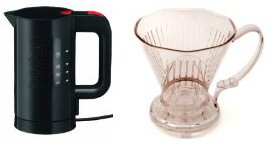
kettle-clever

The solution to the waste issue is, indeed, to brew only the coffee you’ll drink. Rather than buying a $150 Keurig brewer, buy a Bodum 17-Ounce Electric Water Kettle for $40 which boils water in 4 minutes (getting it to the correct temperature, unlike most coffee pots or single-cup brewing machines). Then get a foolproof Clever Coffee Dripper for $22 (you can make up to three six-ounce cups in it, if you wish). A year’s supply of paper filters would set you back less than $50 and can be composted (your 2 K-Cups a day amounts to 8 pounds of crap in a landfill a year).

Is this also a huge hassle? Start to finish, brewing a K-Cup takes about 3 minutes, mostly because the water doesn’t reach a high enough temperature nor is it in contact with the coffee for enough time for proper extraction. To make one to three cups in your Clever takes about 8 minutes (four for the water, four for the brewing). For those extra few minutes, you save money and you get better coffee even if you use pre-ground coffee put in the filter the night before and accidentally let it steep for too long. For every “upgrade” you make (better quality coffee, grinding your own beans, paying attention to timing) the improvement in quality will be substantial.