Coffee news and miscellany

Sips

I’ve been keeping up with many important developments in the world of sustainable coffee. Here are the ones you should be reading:

Regarding coffee certifications:

Regarding shade-grown coffee in particular:

Regarding the dangers of cheap coffee and the current frightening drop in the price of commodity coffee:

We’ve been here before and the results are catastrophic for farmers and have a ripple effect throughout economies. Read my piece about corporate coffee for an overview.

And also:

Sips: Recent coffee-related news

A short round-up of coffee news.

Finca Dos Gatos: 2015 update

Regular readers may recall that I have done a series of posts on my experiment with growing coffee here at home. All of our trees were ready-to-harvestgrown from seed collected at various coffee farms we have visited in our travels. In honor of our two cats, we named our growing collection “Finca Dos Gatos.” Past posts are:

Since that last post, we moved, necessitating some adjustments to our set-up. Mainly, it was getting hard to manage the larger trees. So we have given a number of them away, including a couple to people who have greenhouses. I left myself with a few favorites.

The current inventory consists of:

Recently stumped coffee tree.

Recently stumped coffee tree.

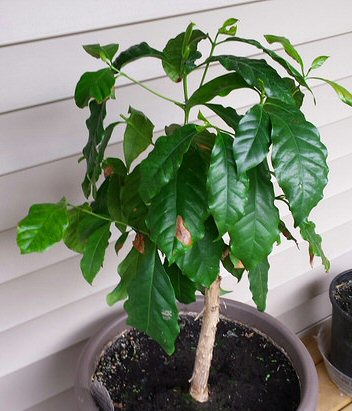
  • Two trees from Finca Hartmann, Santa Clara, Panama, 2008. I have already had to prune (behead) both of these, they were just getting too large. One I’ve done twice, the last time just recently; it is currently a stump. The other I did last year, and it has a lot of new growth.
  • Finca Esperanza Verde, San Ramon, Nicaragua, 2009. One large tree from which we just harvested a crop of cherries.
  • El Jaguar, Jinotega, Nicaragua, 2011. A yellow caturra or catuai.
  • Selva Negra, Jinotega, Nicaragua, 2011. From a feral plant growing in the cloud forest reserve there, along the exact part of the trail where I saw my first Resplendent Quetzals.
  • A stumped tree after about a year of re-growth.

    A stumped tree after about a year of re-growth.

    Near Pico Bonito, outside La Ceiba, Honduras, 2011. This is a catimor that was growing at a lower elevation.

  • A couple of seedlings from some of the fruit I harvested.

Some new lessons

One critical issue I ran into after the move was water. We have well water here with a very high iron and mineral content, so it goes through a water softener. With everything that was going on, I did not give this proper consideration, and after a few months of watering with the softened water, the plants really suffered. I didn’t do lasting damage, but did end up watering only with rain water or jugs of good old Detroit city water I lugged home from work.

New growth on the catimor is a nice bronze color.

New growth on the catimor is a nice bronze color.

We still put the coffee outside in the summer, but our deck faces west and gets sun even under the overhang late in the day. I have learned that just like the veggies started indoors, coffee needs to be “hardened off” when going outside. They need protection from direct sunlight for a couple weeks; the leaves scorch easily. After awhile they can stand more sun, but not for long periods, especially in hot weather.

Finally, they still live under lights from about September through May. My previous system used a four-bulb fluorescent fixture with 6500K blue spectrum lights. To induce blooming, I withheld most water for a few weeks, then watered like crazy, and switched out half the lights to 3000K red spectrum bulbs. Now that I have fewer trees and a nice room that gets good sunlight, I use just a single full-spectrum 60 watt bulb hanging within two feet of the trees. This is a great, inexpensive alternative, especially if you have only a few plants. The four-foot fixture provides more even and brighter light, but my southern exposure makes up the difference.

I’ve had plenty of fruit from these trees, although any given harvest isn’t really enough to roast itself. I’ve accumulated enough now that we could make a couple cups, but given that some of the green beans have been sitting in a cupboard for a couple years, I’m not sure how tasty the final result would be. Once the younger trees start producing good crops in two years, I’ll coordinate the flowering of all of them and see if I can’t do a proper harvest, processing, roasting, and tasting!

cherry

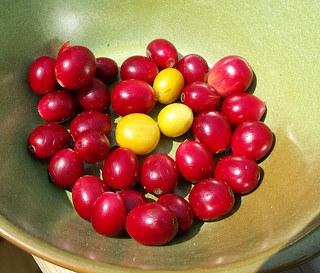
The latest pickings.


The Annual Year in Beans summary

2014mugshotAnnual recap of how much we spend on coffee in a year

Here we are on our 6th year of standardized tracking of how much the two-person Coffee & Conservation household spends on coffee. We keep track of each bag we buy, including shipping, since we purchase the majority of our coffee online. As we’ve noted, we never buy cheap, fast-food, commodity, or mystery coffee. If we don’t know where it comes from, we don’t drink it. Usually, most have eco-certifications.

I’ll cut to the case. In 2014, we bought 61 bags (54 pounds) of coffee and spent $0.46 per six-ounce cup, which includes shipping. We spent a little over $1000 on coffee (also including shipping), and the average price per pound was $19.13.

Our six-year costs are shown in the graphic below.

Over the six years our average price per pound is $19.89 and our average price per cup is $0.48.

2014-summary-costsLast year we wanted to prove that you could buy only certified coffee for reasonable prices, and indeed our year’s supply came out to $0.44 per six-ounce cup. This year, 89% of the coffee was certified, with all but one bag of non-certifed coffee being purchased in the last six weeks. The price of coffee has climbed a bit higher this year, and the availability of certified coffee — particularly organic coffee — has started to decline a little. I think this is likely due to the impacts of the coffee leaf rust fungus crisis; production has been decreasing which can lead to higher prices, and in an effort to combat the fungus some farmers have resorted to non-organic methods and have to give up their certification.

These carefully calculated, long-term results are so consistent, I think my point has been proven: it’s a myth that environmentally-friendly, sustainably-grown coffee is “too expensive.” (Of course, the willingness of people to buy the insanely expensive, poor quality, environmentally destructive K-Cups also proves that high cost is just an excuse when it comes to buying sustainable coffee.) At any rate, the results have been so boringly uniform that I was going to discontinue this exercise…although I am curious how the effects of coffee rust will continue to impact the market. If you think I should carry on for at least one more year, let me know in the comments.

Meanwhile, don’t forget that you can calculate how much a cup of coffee costs, based on the price of a bag of beans, using the spreadsheet below.

Posts summarizing previous years are listed here:

  • 2013 (the year of all certified coffee)
  • 2012 (includes comparison to the high price of K-Cups)
  • 2011
  • 2010
  • 2009

Happy New Year from Coffee & Conservation.

My year in beans: 2013 — all certified coffees

nuthatch-mugAnnual recap of how much we spend on coffee in a year

Here we are on year five of standardized tracking of how much the two-person Coffee & Conservation household spends on coffee. We keep track of each bag we buy, including shipping, since we purchase the majority of our coffee online.

Of course, we never buy cheap, fast-food, commodity, or mystery coffee. If we don’t know where it comes from, we don’t drink it. Usually, most have eco-certifications, but since we have a lot of knowledge on how to research the source of each coffee and gauge sustainability, we have traditionally purchased other coffees that we know are sustainably-grown, but did not carry certification.

Most consumers won’t go through this process, so for 2013, we decided to buy only certified coffees: organic, Rainforest Alliance, Smithsonian Bird-Friendly, or some combination. I confess, a few bags were from farms we knew or discovered did have certification, but were not sold as such.

Of our 79 bags, around 15 were duplicates, sometimes the same farm from different roasters. Sixty-two bags of coffee were certified organic, and 28 were certified Rainforest Alliance; 11 had both certifications. Five were also Bird-Friendly certified (of which organic certification is required).

Despite buying exclusively eco-certified, specialty coffee this year, we paid the lowest price per cup in our five-year tracking history. Let us now put a fork in the myth, once and for all, that high-quality, sustainably-grown coffee “costs too much.”

Here are all the 2013 stats:

  • 79 bags of coffee totaling 65.5 pounds.
  • Total retail price for the coffee only = $1109. This year, we moved to a more coffee-friendly community, so we were able to buy more coffee locally and spend less on shipping, just $74. Our previous 5-year average for shipping was $127.  Our grand total was $1183 for the year.
  • Cost per six-ounce cup: only $0.44 ($0.41 without shipping), calculated using the common industry standard of 11 grams of coffee beans by weight per 6 fluid ounces of water.
  • The average price per pound including shipping this year was $18.08, or $16.95 excluding shipping.

Previous results

The five-year average is 63 pounds of coffee a year at an average of $20.04/lb, and $0.49 per 6-oz cup, including shipping.

year-in-beans-graph

We are not very typical consumers in two cost-inflating ways: 1) We buy most of our coffee online and do not buy more than we can drink in under two weeks, incurring high shipping costs; and 2) we buy from an average of over 20 different roasters each year, in order to try a variety of coffees, nearly always single origin farms and frequently higher priced microlots. Had we only repeatedly purchased our favorite locally-available coffees, our estimated cost for the year would have been around $900 total, and $0.34 a cup.

A rusty nail in the coffin of organic-certified coffee?

Coffee leaf rust (Hemileia vastatrix) is a highly contagious fungal disease that is devastating coffee production in Latin America, with losses estimated at 15 to 70%, depending on the region. One essential component to combating this disease is the use of fungicides. Copper-based fungicides are relatively inexpensive and are permitted under organic certification. However, they must be reapplied frequently (around every three weeks, or more often if it rains and gets washed off) and are not without ecological risk. If used frequently or in excessive amounts, copper can build up in soils and can also be harmful to aquatic organisms. Some types of synthetic fungicides*, not allowable under organic certification,  can be more effective — and in some circumstances may actually be safer for the environment.

Some of the best reporting on the coffee rust crisis is from Michael Sheridan writing at CRS Coffeelands. As I was contemplating writing this post on the connection between coffee leaf rust and organic certification, Michael hit on the topic himself.  He notes that farm management [use of shade, planting density, pruning, proper timing of fungicide applications] has as much or more to do with crop losses from rust as does whether the farmer uses organic or conventional production; this was echoed in survey results gathered by Green Mountain Coffee Roasters. The severity of this disease is also very dependent on climate and weather factors such as wind, moisture, and temperature. Still, Michael notes that the “official response to coffee rust in Central America so far seems to have been heavily skewed toward agrochemical-intensive approaches”.

For example, at a recent coffee rust summit, a representative from PROMECAFE, a Central American coordinator for coffee-related technical training, suggested that in the short term, organic farmers might consider leaving organic for conventional production.

nailCRS Coffeelands quotes Miguel Medina of the Guatamalan national coffee organization Anacafé as saying, ”I don’t know how organic coffee can have a future.  There is nothing that works to control rust in the field and I am not seeing anyone in the market offering more to create additional incentives for organic farmers.”

Despite a strong commitment by farmers in many Latin American countries to preserve their environment and even a suspicion by a few that chemical companies may be behind the rust epidemic, many farmers may feel compelled to give up their organic certification to fight the rust. With the severity of this threat to their livelihoods — and even survival — the choice between trying to salvage their coffee trees with artificial fungicides or stick with organic certification is straightforward. Many will do what they can to keep afloat and give up organic certification. This not only allows them to use more potent artificial fungicides to try to control the coffee leaf rust, but it also frees them to use pesticides and artificial fertilizers that may be considered necessary to protect or help vulnerable or ailing coffee trees.

Over the past few years, some farmers have already abandoned organic certification because the extra money they receive for it simply does not compensate them for the added expense of producing coffee this way. The rust crisis adds to this dilemma. Eventually, coffee fields are likely to be replanted with rust-resistant varieties, but even those in the ground today will take three to five years to produce a crop. Meanwhile, we as consumers need to brace ourselves for higher coffee prices as crop yields decline, and be that much more willing to pay extra for organic coffee.

More reading on the topic:

*Some media mention “Triazaline” as the synthetic fungicide used for coffee leaf rust control. From what I can tell, there is no fungicide named triazaline. However, there is a group of synthetic fungicides called triazoles that are used. Triazaline may be a brand name in this family, or a misinterpretation/misspelling of triazole.

Rusty nail photo by Scott Robinson under a Creative Commons license.

Sips: Coffee rust crisis

320px-Hemileia_vastatrix_-_coffee_leaf_rust

Wikipedia

A round-up of the many stories and news items about the devastating impact of the fungus Hemileia vastatrix (coffee rust, roya). Central and South America are experiencing the worst outbreak in decades.

This crisis has some serious consequences beyond the obvious impacts of increasing consumer prices and endangering the survival of some producers.

One is a decrease in the number of producers that will stay with organic certification. Most of the fungicides that are used to combat rust are allowed under organic certification. However, coffee plants attacked by rust need substantial boosts in nutrients (because they lose their leaves) in order to keep them alive. These levels are often just too hard to achieve at reasonable prices with available organic fertilizers. Recall that in the last few years, many farmers have already given up on organic certification because the price premium is just not enough to justify the extra cost and labor.


Sips: Brain dump from the hiatus

Yes, I’m still around. The last few months I have been not only busy with my real job, but also with buying a house, moving, and selling the old homestead. I’ve still been thinking about (and drinking) coffee; the print on the right is one of the first items I hung in the kitchen in the new abode.

Here is some of the coffee news I have been bookmarking and might have written about, had I had the time.

C&C will be getting back on track with research news, reviews, and the like shortly.

Sips: Vietnam edition

Some news out of Vietnam.

  • Nearly all the coffee Vietnam grows is robusta. They are planning to expand arabica production to 40,000 ha by 2020.  The country is already expanding robusta production, which covers more than a half million hectares.
  • It seems inevitable this may lead to loss of more forests. Which will exacerbate adaptations to climate change — and Vietnam is on a list vulnerable countries. While the composition of compilations like this vary depending on the criteria, what struck me about this list was that at least half are coffee-producing nations, with three (India, Vietnam, Philippines) being major robusta growers. The latter two are big suppliers to companies like Nestle. Wonder how that will go.
  • Speaking of problems with adaptation, several of Vietnam’s major coffee exporters are heavily in debt due to a lack of adaptation to market conditions.
  • But there is a Vietnamese coffee mogul that is doing well.

Sips: Starbucks news

It’s no wonder why news about Starbucks prompts such strong reactions in people. Some weeks there will be an announcement about a really worthwhile initiative, and only a little while later, something sort of repulsive.

  • Awesome: Starbucks will be the first private investor, committing $1.3 million, to the Fairtrade Access Fund. The Fund will provide farmers’ cooperatives with several types of long-term loans needed to renew their farms, adopt new technologies, or purchase equipment, as well as a facility that will allow farmers to get timely information on Fairtrade certification practices, crop management, and localized market information via their mobile phones. The Fund is being established by Incofin Investment Management, Fairtrade International, and the Grameen Foundation.
  • Also pretty cool: In mid-June, Starbucks launched the Indivisible collection, which includes Indivisible Blend Coffee and products such as coffee mugs to support Create Jobs for USA. With every purchase from the Indivisible collection, Starbucks will make a donation to Opportunity Finance Network for the Create Jobs for USA Fund to help create and retain jobs across the country.
  • Modest overall impact, but nice symbolism: a struggling Ohio company was chosen to produce the Indivisible mugs rather than outsourcing to another country.
  • And…just yuck: Starbucks’ Seattle’s Best Coffee division to sell coffee in thousands of Coinstar-owned kiosks in the U.S.

Sips: Climate impact and adaptation, FT4All evaluation

Recent coffee news. (I’m behind. I should just let everybody know that May is a month my day job prevents me from doing anything related to coffee except drinking it!)

Finca Dos Gatos…harvest!

Finally, ripe cherries!

This is my third post regarding my growing (literally) little coffee farm in southeast Michigan. My first post, Growing coffee at home, documented my initial attempts at germinating coffee beans I collected on a trip to Panama in January 2008, one of which flowered in April 2011. My second post, Update on Finca Dos Gatos, covered the bean development, transplanting, and other outdoor accommodations.  Here is one more update.

Panama plants

These were my original plants, which I grew from seed collected around Volcan, Panama. The chronology:

  • Seeds harvested from ripe cherries in January 2008.
  • Seeds germinated in May 2008.
  • First flower buds: 12 April 2011, only on one plant.
  • Flowers opened 25 May 2011.
  • Two fruit begin to develop 15 July 2011.
  • Fruit full size, but green September 2011.
  • Fruit finally begins to ripen mid-February 2012.
  • Fully ripe and harvested by mid-March.

The last interesting thing about this crop was that after I picked the cherries and removed the skin, I discovered that both contained peaberries instead of two flat beans. This occurs due to one of the ovules not developing, usually from lack of fertilization. Arabica coffee is self-pollinating, but perhaps this is to be expected when there are only two flowers! After the two beans dried, I noticed they are much less dense than a normal bean…nearly as light as a roasted bean. My first crop is just souvenirs.

Nicaragua plants

I have collected seeds twice from Nicaragua. My first batch was from Finca Esperanza Verde which I planted in March 2009. These germinated in June 2009, and now have their first flower buds. I have three plants and have given others away.

The second set was collected in March 2011 from El Jaguar and Selva Negra; they germinated in mid-May 2011. I’ve given away some seedlings and have chosen to keep just two plants: one from Selva Negra and one of the yellow catuai variety from El Jaguar.

In November, I performed an experiment where I provided a “dry season” for the Panama and first batch of Nicaraguan plants. I restricted water for a couple weeks, then stop watering for three weeks. Then, I watered like crazy, and began switching over the fertilizer from the Earth Juice ”Grow” to the Earth Juice “Bloom”.  Further, I swapped out half the lights in the system to 3000K red spectrum bulbs instead of 6500K blue lights (Sun Blaze T5 in four-foot fluorescent fixtures).

And sure enough, I have a ton of flower buds, which began to develop in early February. Although the first time around, the buds developed quickly, in a month, so far all the buds I have are growing slowly, and have not yet opened.

Honduras – new additions

In November 2011, I was in Honduras. This trip was not to coffee farms, as we were staying in a lowland area on the northern coast. However, there was coffee growing in the region, and I picked up cherry from a semi-tended plot owned by the Lodge at Pico Bonito that had both coffee and cacao, as well as some at Pico Bonito itself. Traditional old varieties of arabica coffee don’t grown at this altitude with the heat and humidity. I figured it must be some varietal that included robusta heritage, and Daniel Humphries identified it from photos as catimor, a hybrid between caturra and Hybrido de Timor (itself a naturally-occurring hybrid between arabica and robusta).

In Honduras, two lines of catimor are common. One is IHCAFE 90, released in the 1990s and derived from the T5175 line out of Portugal or Brazil. The other is Lempira, from the T8667 line out of Brazil.

I had a bunch of it sprout by mid-January, and gave away some seedlings, saving a couple for myself.

Cacao

Okay, this is a coffee “finca” but I had to see if I could also grow some cacao, which was growing all over the place, including outside our cabin and next to the coffee. Here are some trees at Pico Bonito with their bizarre unripe pods.

These pods are tough and leathery and often have to be opened with a machete, but animals had opened some and we were able to retrieve the large seeds. I read that they must always be kept warm and moist, so I wrapped them in damp paper towels. No long wait like coffee. By the time I got home a few days later, they were beginning to sprout.

By early December, I had little plants about five inches tall.

In order to maintain a little more warmth and humidity, I constructed a little enclosure for the three cacao plants by wrapping overhead transparency plastic around a wire bird feeder squirrel-excluder. It sits on top of a cheap, twelve-inch plastic flower pot saucer. Another saucer went on top.

I look forward to bringing the finca outdoors for the summer, when I know everything will take off; the cacao should especially enjoy our hot, humid Michigan summer.  Perhaps I’ll do one more update with photos of more of my coffee in flower, and any resulting crop.

Additional sustainability-related awards

I previously reported on the Rainforest Alliance Cupping for Quality award that was presented at the Specialty Coffee Association of America’s (SCAA) annual trade show in Portland, Oregon late last month. There were several other awards relating to sustainability handed out at the SCAA meeting, and here are a few of them.

Rainforest Alliance Change Agent Award
This is a new award, and will honor coffee industry sustainability champions. It will be presented at the same breakfast as the Cupping for Quality awards each year at the SCAA event. The first recipient is Chad Trewick, Director of Coffee and Tea for Caribou Coffee. Chad has been a driving force in Caribou’s  encouragement of  farmers worldwide to achieve Rainforest Alliance certification. As reported earlier, Caribou is the first major U.S. coffeehouse to source 100% Rainforest Alliance certified coffee. Here is an interview Chad gave after his award, and another he did earlier with RA.

SCAA Sustainability Award
This is given annually by SCAA’s Sustainability Council, and went this year to Thanksgiving Coffee Company for their project “Responding to Climate Change: Building Community-Based Reliance.”  Thanksgiving worked with Rwanda’s Dukunde Kawa Cooperative, which has over 1800 producers, doing site-specific climate risk assessments, and deploying best practices such as shade intercropping, erosion control, and watershed conservation. A full description of the project is here.

Descriptions of some of the previous winners can be found here, here, and  here.

Best New Product and People’s Choice Award – Equipment for Origin
C-sar Online Tools by Cropster GmbH, for their online database system that helps producers track, manage and improve quality; communicate and collaborate with partners and customers; and assists with certifications, accounting, and other logistics. I’m all for transparency, traceability, and tools for farmers.

The Best New Product – Sustainability was not awarded this year, but the Best New Product – Packaging was sustainability related: the Natural Kraft Biotre Side Gusseted Bag by Pacific Bag. There is a fair amount of both interest and confusion on sustainable (especially biodegradable) packaging products, so I thought it was worth a mention.

This bag is  made of Biotre film 60% (by weight) biodegradable materials made from renewable resources such as wood pulp. Pacific Bag says the outer paper portion will break down in several months in a backyard compost pile. They have a series of videos on YouTube that show the paper portion was gone in about five weeks. The rest of the bag is a polymer film (derived from fossil fuels, unfortunately) that is supposed to take a five to ten years to degrade in a “landfill environment.”

Two things need to be pointed out here. First, if only part of this bag (which also has a degassing valve which is not biodegradable) will break down in your backyard compost pile, why would you put it in there in the first place? Off to the landfill it goes. Second, I think that if it were to go to a large commercial composting unit of a landfill, then the bag might break down in five to ten years. It seems unlikely that it will break down much at all in a typical municipal landfill, which are packed very tightly and do not allow much or any aerobic activity which is required for most biodegradation. So, another product that is a step in the right direction, but no silver bullet.

Congratulations to all individuals and companies working towards sustainability in the coffee industry.


Sips: Vietnam, over-ripes, Wal-Mart, and more

Sips: Big companies, small packages

News from big roasters, about big plans, with some science and sustainability tossed in.