Coffee news and miscellany

Sips: Big companies, small packages

News from big roasters, about big plans, with some science and sustainability tossed in.


Favorite coffees of 2011

I was going to include a briefer version of this list in my post on “My year in beans: 2011,” which focuses on cost. But as I began to compile it, I noticed some common threads regarding the characteristics of my favorite coffees of the year that were interesting enough to warrant a separate post.

These are some of the coffees I considered outstanding in 2011. They are in no particular order. The price is converted to per-pound, and the flavor descriptors were from the roaster or reviews — the opinion of others, not my own.

  • Nombre de Dios, El Salvador (single estate) by Kuma Coffee. Washed, 1500 meters, bourbon. $21.33/lb.  Floral, honey, brightly acidic, citrus, apricot, apples.
  • Capucas, Honduras (cooperative) by Irving Farm. Organic, Rainforest Alliance; washed; 1400+ meters; caturra, pacas, catuai, bourbon; $19.33/lb. Honeysuckle, apple, honey, cashew, pineapple.
  • Carmen Estate 1750 Reserve, Panama (single estate) by Klatch Roasting. Rainforest Alliance; washed; 1750 meters; caturra, catuai, typica; $15.93/lb. Honey, tangy bright, citrus acidity, floral.
  • Cafe Takesi, Bolivia (cooperative) by Zoka Coffee Roasters. Organic; washed; 1900+ meters; $25.33/lb. Citrus acidity, floral, fruit (raisins), honey, graham.
  • La Golondrina, Colombia (cooperative) by Counter Culture. Organic; washed; 1500+ meters; caturra, castillo; $18.07/lb. Bright citrus, fruit (cherry), caramel.
  • El Manzano, Colombia (single estate – microlot from one farmer in a cooperative) by Kickapoo [now Wonderstate] Coffee. Washed; 1700 meters; caturra, colombia; $17.67/lb. Mandrin citrus, caramel, toffee.
  • Haru, Ethiopia (cooperative) by Counter Culture. Organic; washed; 1700+ meters; $17.27/lb. Lemon, honey, tea.
  • Kenya Karibu (specific origins unknown) by Caribou Coffee. Rainforest Alliance; washed; $14.99/lb. Sparkling brightness, blackberry, current.

What does this say about my coffee tastes? I strongly favor washed coffees. In fact, one of my biggest disappointments is the trend to pulped natural (“honey”) and natural process coffees now coming out of Central America. I’m not a big fan of the berry-like fruitiness that tends to be imparted by these types of preparation, except on occasion. I’ve had quite a few of these new preps, and some of them were quiet nice. But my go-to coffees have always been bright Centrals, and I have sometimes found nice washed options hard to find lately.

The high elevations of my favorite coffees also stood out to me. The average elevation of these coffee was over 1600 meters! Higher elevation slows bean development, resulting in a denser bean and typically more well-developed flavors. Alas, we may be seeing more coffee grown at these high elevations in the decades to come. This doesn’t mean there will be a proliferation of coffees with characteristics like that of high-grown coffees today. Climate change will mean the temperatures required by fine arabica coffee will move upslope, but of course conditions at 1600 meters may soon be the same as 1200-1400 meters today. And sooner rather than later, we will run out of “up.”

The average price per pound of these coffees was $18.74 or $0.78 per 6-ounce cup. If I had only purchased these coffees at my typical (family) consumption of 62 pounds a year, I would have been enjoying fantastic, sustainably-grown coffee for $3.18 a day. As I said in my previous post, if only all of life’s simple luxuries were so cheap!

Note that all but two of these coffees had eco-certifications (organic and/or Rainforest Alliance).

A number of flavor characteristics were also common to many of these coffees, in particular bright citrus acidity, and honey or floral tones. Caramel or apple also factored in. So many coffee descriptions use very arcane terminology (which is why we’ve tried to make our reviews here more approachable). Yet these particular descriptors are broad, basic, common, and understandable enough that they can act as a good guide to choosing coffees I know I’ll probably like.

Finally, it’s exciting to me that some of my favorite coffees came from roasters I tried this year for the first time: Irving Farm and Kuma Coffee, and there was a runner-up from Olympia Coffee. Some people find a roaster they like and stick with them, and certainly I have a handful that I turn to frequently. But one of the joys of coffee to me is the discovery of new coffees, and new roasters that are bringing them home. More and more roasters are looking to source great-tasting, sustainably-grown coffee. I love drinking it, and making new friends along the way!

Here’s to more coffee adventures in 2012.

Bean photo by David Joyce under a Creative Commons license.

Sips: Single-serve, Slippery figures, Sbux

News from biggish coffee:

Sips

News from the coffee world.

Update on Finca Dos Gatos

In April, I gave an overview of my home coffee growing project, a.k.a. Finca Dos Gatos, prompted by my discovery of buds on one of my Panama plants, planted from seed collected in 2008. Here is an update.

The plant on which I discovered buds on 12 April, and which I believe to be the only typica variety among 10 other caturra, flowered on 25 May. I think I ended up with four flowers.

The flowers lasted only a couple of days. Meanwhile, some of the coffee beans I had picked up in Nicaragua in March 2011 were starting to germinate. First was a one of two coffee cherries I picked up at Selva Negra. These were not from the production area, but from a plant growing wild in the cloud forest, right next to the spot where I saw my first Resplendent Quetzals. I thought a coffee plant from that location would be a great memento. My germination method is the same as how I sprouted lima beans in elementary school: on a wet paper towel, kept warm in a plastic food container. One bean sprouted which I planted in soil on 7 May.

Bourbon or caturra seedling, from Selva Negra, ready to plant.

At around the same time, on 15 May, I had a number of beans from El Jaguar start to sprout. Although they grow several varieties, I only collected yellow catuai, for the sake of variety. This variety was developed in Brazil and is commonly grown there, and is a cross between caturra and Mondo Novo

Some ripening yellow catuai at Finca El Jaguar.

We had a very rainy spring here in southern Michigan, so I did not put the coffee outside for the summer until June. By mid-summer, it got very hot here, and I do not have enough shady places in our small yard for all the large plants, so I created some. I purchased some 40% shade cloth, and some plastic snap-on grommets. “S” hooks go through the grommets and hook on to the gutters, and the other grommets fit on tree stakes in the lawn. The shade cloth is therefore very easy to take down to mow. A spare piece of shade cloth can be clipped on top to provide some extra protection on really hot days.

I kept the seedlings in a more protected spot. The Selva Negra seedling grew faster than I remember any of the others progressing. By mid-July it already had its first set of true leaves.

Meanwhile, not much was happening on my plant that had flowered. I read it takes some time for beans to begin to develop. Indeed, I did not find any sign of beans until 15 July.

I have a two-bean crop; perhaps they will be ripe by Christmas. One of the other Panama plants also flowered, and had many buds. But the heat and humidity took it’s toll, and I lost most of the buds before they opened. Further, every plant was in dire need of repotting, so on 6 August, I potted up every plant. I used  a good topsoil, plus organic potting soil, all mixed with Espoma Organic Bio-Tone Starter Plus, which contains beneficial bacteria and mycorrhizae. Up to this point, I’d given these plants plenty of root space, using deep, narrow tree pots. The problem at this point was that new containers deep enough for the roots were ridiculously large and heavy. Several Panama plants (3 years old) went into 15″ deep 3.2 gallon tree pots, the last size up that I have.

Not sure how long this one will stay in the larger pot.

The Nicaragua plants (2 years old) are all two growing together. They went into two or three gallon pots. The largest pair posed a dilemma. The little rubber trash can seemed like overkill, so I ended up using a cat litter bucket, after drilling drainage holes in the bottom. What could be more appropriate for Finca Dos Gatos?

I now have a finca too large for the bedroom window, where I overwintered the plants last year. Indoor winter vacation, which began last month, is now in the basement under two four-foot Sun Blaze T5 fluorescent fixtures, each with four 6500K (blue) bulbs (same as before, just an additional fixture). The lights are on a timer, about 12 hours of light a day.

Three Panama plants on the left; six Nicaragua on floor/to the right (I gave away a pair of Nica, and some seedlings). I have a little class: I covered the cat litter bucket with four duct tape sheets. I didn’t even know such a thing existed, but it sure makes for a durable, waterproof covering. I chose black, but they come in all colors and patterns. Those pots are heavy, so they are on rolling stands.

The seedlings are under a smaller set of lights. As of now, late October 2011, here is the  Selva Negra seedling; it’s about six inches tall.

And here is the El Jaguar seedling, about 4.5 inches:

The two unripe cherries survived being transplanted. They are full size, but still green.

I’m happy to report that the two cats for whom the finca is named have stayed out of the pots. Actually, they both like lounging in the bright lights on gloomy days.

Sophie guarding the finca.

This winter, I plan to induce and promote flowering by providing a dry period followed by renewed water, switching out half the bulbs for red spectrum, and changing the fertilizer. I’ll let you know how it goes early next year.

New Kenyan coffee varietal

Last year the Coffee Research Foundation (CRF) in Ruiru, Kenya released a new disease-resistant arabica varietal that has been in development for more than an decade. Named after the highest peak on Mt. Kenya, Batian is resistant to coffee berry disease and coffee leaf rust, the two common fungal diseases affecting coffee in Kenya and much of Africa.

The parentage of Batian is predominantly arabica, and it is closer genetically to the well-regarded SL28 and SL34 varieties than Ruiru 11, the rust-resistant varietal introduced in 1985. Varieties used in the development of Batian include SL4, N39, N30, Hibrido de Timor, Rume Sudan, and K7. They were repeatedly backcrossed with SL28 and SL34. The Hibrido de Timor is the naturally-occurring hybrid of arabica and robusta, and is often used in disease-resistant breeding due to its robusta heritage.

Of course, it is the robusta lurking in the background that tends to lower cup quality. According to the CRF, however, Batian cups far better than Ruiru 11 and even the parental SL varietals. Here’s a slide from a presentation by Dr.  Joseph Kimemia of the CRF (click to enlarge):Should we take that with a grain of salt (so to speak)? A tasting of these four varietals by the guys from Tim Wendelboe at the CRF did find Bastian rising to the top, but the cupping was a little suspect (e.g., poor examples of the SL28, for instance).

Why a new varietal?

Kenyan coffee production has been declining since at least 2001. There are a number of reasons for this, but in recent years part of the problem has been instability in the weather. Drought and heavy rain disrupt flowering and fruiting, and wet conditions also cause an increase in fungal diseases. Thus, a varietal that has more resistance to these diseases is welcomed by farmers.

In the case of Batian, it also matures faster than other varieties — in two years versus three. It is high yield, but Batian’s ability to boost production is in large part due to the fact it can be planted at twice the density of other typical varietals in Kenya, up to 2500 trees per ha. The end result is a yield of up to 5 tons per ha under optimal management, versus an average of 2 tons/ha. Batian also has a large bean size, which must also contribute to yield estimates.

What does this mean for the environment?

On the plus side, if Batian does show good resistance to fungal diseases (one news piece implies Batian has complete resistance), it may reduce the use of copper fungicides. While often considered allowable under many organic standards, their extensive and prolonged use on coffee in Kenya has resulted in soil contamination. Copper fungicides are already applied many times a year on Kenyan coffee. If rain is frequent, it must be reapplied more often because it is washed off (and fungal diseases are worse in wet conditions). If dependence on fungicides can be reduced or eliminated, this would be a huge accomplishment, and very positive for the environment.

There is a growing movement in Kenya, where most coffee is grown in the sun, to plant shade trees and also reforest many areas. I am not sure it is possible to grow many shade trees and also grow Batian at the recommended density, which is essentially a coffee tree every 2 m. But, (as pointed out in the comment section below and amended here) if farmers don’t have to worry about fungal diseases they may be more apt to plant shade trees.  (I will do a post on coffee berry disease and shade similar to the one on coffee leaf rust some time this fall.)

The CRF and government is also encouraging the planting of Batian in areas where it is currently not being grown, particularly in western Kenya.  Bungoma, Kasii, and Nyanza are current western coffee regions and I have not found details on whether these are the areas being targeted, or some other districts. It’s my understanding that west Kenya gets more rain than the central region where most coffee is grown, and that may be why Batian is being pushed there — coffee planted at high densities usually requires more moisture. Unfortunately, densely planted coffee often also requires heavy fertilization and the trees need to be replaced more often.

Combating diseases, declining yield, and climate change while maintaining quality in a sustainable manner is a challenge to coffee growers worldwide. One can hardly fault farmers for wanting to sustain or improve their livelihoods, or governmental agencies for working to stabilize or increase the production of a primary export crop.  Is another potentially sun-grown, high-input varietal the answer, or environmentally sustainable? We will have to wait and see.

Update: Download a PDF of a detailed 2012 presentation from the Coffee Research Institute seminar series.

Sips: Latest corporate coffee news

Some tidbits from the big four:

  • J.M. Smucker Completes Acquisition of Rowland Coffee. Smucker will now own Cafè Bustelo and Cafè Pilon as well as Folgers. Yippee.

    Love the old school can.

  • Sara Lee in talks for Brazil coffee brand. Sara Lee aiming to acquire or merge with Marata. Sara Lee already controls 22% of Brazil’s retail coffee market, and purchased Brazil’s Cafè Damasco last year.
  • How Kraft sells sustainability. Marc Gunther is a fellow member of the Society of Environmental Journalists, and has written a piece on how Kraft is trying to find ways that sustainability can drive growth. The company has determined that over 60% of its environmental impact comes from its supply chain, from the growing of agricultural products, including coffee. Gunther gleans the thoughts of Kraft’s VP of global sustainability (wait for it…) Steve Yucknut. This comes as Kraft announces that they are increasing their sustainability goals for the next few years. These goals include sourcing 100% of European coffee brands sustainably. The latter article again mentioned the 50,000 tons of Rainforest Alliance coffee Kraft purchased in 2010, which I will again remind you represents less than 7% of their total coffee purchases. They have a long way to go.
  • In an effort not to leave out the last, and largest, of the big four corporate coffee roasters, I took a look at Nestlè USA’s 2010 corporate responsibility report. Coffee was not mentioned. I did dig up a a piece on the reduction of the carbon footprint of Nescafè single-serve machines. You can just talk amongst yourselves on this one.

After the Harvest

When discussing the problems associated with commodity coffee, and why you need to pay a little more to make sure people and the environment are protected, I’ve actually had people tell me they have a “right” to cheap coffee. I often hear that certified coffees are too hard to find, and people tell me they’d buy sustainable coffee if only it were at the grocery store.

At least you have access to a grocery store.

There is no such thing as “cheap” coffee.

Please visit the After the Harvest web site to learn more about the large percentage of coffee farmers than do not have enough to eat for a portion of the year, and the organizations that are working on food security in the coffee lands.

A “new” species of coffee from Australia

Media outlets have picked up on a story about a new species of coffee, Coffea brassii, from Australia. In fact, this isn’t a new species, but a plant that has recently been reclassified by taxonomists from the genus Psilanthus. A number of species in that genus have moved around the genera Coffea, Paracoffea, and Psilanthus over the years. This latest reclassification to Coffea comes after recent molecular studies of dried herbarium material and includes five other Psilanthus. The work was part of project to sequence the DNA of the coffee family being conducted at the Royal Botanic Gardens, Kew.

The range of Coffea brassii is northeastern Australia and Papua New Guinea, making it the only known Coffea native to Australia. It grows in monsoon forest, deciduous monsoon scrublands, and stabilized dunes at 15 to 150 meters. It is not kept in cultivation and little is known about it, so there are apparently plans to collect living specimens in Australia. The location is in northern Queensland, west of Cooktown, near Laura.

Here are some photos of other one of the other Psilanthus species being moved (P. bengalensis).

References:

Davis, A. P. 2010. Six species of Psilanthus transferred to Coffea (Coffeeae, Rubiaceae). Phytotaxa 10: 41—45

Davis, A. P. 2003. A new combination in Psilanthus (Rubiaceae) for Australasia, and nomenclatural notes on Paracoffea. Novon 13: 182-184.

Growing coffee at home

People are always interested in the coffee I have grown from seed at 189 meters in southeast Michigan without a greenhouse. Since I’ve just reached a milestone with my oldest plants — flower buds! — I thought I’d show everybody the family album, and provide some tips, for what they’re worth.

I started out by collecting fallen ripe cherries in Panama in January 2008. Some were from Finca Hartmann near Santa Clara in Chiriqui, some from a Starbucks supplier (Finca La Florentina) in Volcan, Chiriqui. I probably had three dozen beans, which I attempted to germinate the way I sprouted lima beans as a kid — in damp paper towels against the side of a clear plastic cup. I’ve refined this a bit to layering them flat between damp paper towels in a covered seed starting tray. I’ve found that perhaps 20% will sprout, but it takes 3 or 4 months. Other folks have had good luck with soaking the beans in water 24 hours, then doing the paper-towel thing.

After a 4-month wait, some coffee sprouted. It seems to take another month or so before the first leaves can finally shed the bean!

Once there was several millimeters of both root and stem, I transplanted them into sterile potting soil mix in peat pots. For future “crops” I have tried to use more compost (coffee has pretty high nitrogen requirements).

The first leaves are round.

The peat pots were prone to falling apart. I placed the peat pots into another tall, deep, clear plastic cup with potting soil cut with a fair amount of coarse sand. I placed marbles in the bottom of the cup, and sliced a bunch of drain holes in the cup. I was worried about drainage, and wanted to keep track of root growth.

Five seedlings went outside against a west-facing wall under shade.

In fall, I brought them in the house, and put them under a grow-light set up. Still, by March they looked really crappy. I think it was both some lack of nutrients, nitrogen, perhaps and not enough light. I had been fertilizing with a weak solution of orchid fertilizer, but apparently that wasn’t doing the job.

This coffee needs some TLC, or maybe N-P-K.

Repotted and back outside, they seemed to recover by mid-summer.

Summer vacation against an east-facing wall, no overhead shade.

Meanwhile, I picked up some more cherries at Finca Esperanza Verde in San Ramon, Nicaragua in March 2009. This time I looked for over-ripe, but not dessicated, fruit. About 30% of the beans sprouted in roughly three months. All the plants came indoors again in the winter. I don’t have a lot of windowsill room, but the Panama plants and some of the Nicaragua seedlings got moved around to various sills, and some of the Nicaragua plants went under lights. They all made it through the winter, not as anemic as the winter before, but without having grown much at all

Smaller Nicaraguan plants had been on a windowsill, the one on the right under the lights.

The Panama plants wintered in front of a west-facing window.

Once again, lots of growth in the summer. In fact, I had a hard time finding pots deep enough for the roots that weren’t equally as wide. I finally ordered these “tree pots” from a nursery supply company. Cheap, lightweight, available in many sizes, they were perfect. When I repotted, I used organic potting soil with NO additives (so many come with time-release fertilizer) and at least 30% sand.

All the coffee, plus an orchid, on summer vacation.

Late last fall, I decided that the plants were doing too well to let them decline over the winter. I purchased a good lighting set up: One four-foot Sun Blaze T5 fluorescent fixture with four 6500K (blue) bulbs. It was ready to hang, and allows for expansion (daisy-chaining additional fixtures). I also purchased two four-foot T5 fluorescent 3000K (red) bulbs, which I figured I’d use next winter to induce blooming. I put the fixture on a timer for 12 hours of daylight a day. At the same time, I started using Earth Juice “Grow” fertilizer/micro-nutrient nearly every time I watered. Prior to this, I usually only fertilized with organic fertilizer or worm/compost “tea” in the summer when the plants were outside, or orchid fertilizer or house plant fertilizer inside.

The results were amazing, and I attribute it to both the light intensity and hitting on the right fertilizer. Lots of lush growth — I had to prune several of them.  We have a whole-house humidifier, but I still worry about humidity under these lights, which do get pretty warm. I try to spray-mist them every day.

We don’t even need to close the bedroom curtains in the winter! The farm now has a name, in honor of Sophie and Juniper, the feline caretakers.

Last week when I was rotating their positions, I noticed several of the Panama plants were starting to bud!

Buds! Present on three of the five Panama plants so far. Conceivably, these could be leaf buds, but I’ve never had leaves emerge from the axils before.

Uno gato (Juniper) for scale. She has munched her share of coffee leaves, and I have to take care to keep her off the finca. Naughty girl.

I’m pretty sure these are all caturra, except one tall, rangy plant that may be typica or even geisha. It was from an area where all three varieties were being grown. However, this plant is growing in a heavier garden soil (I ran out of potting soil when I was transplanting) and also spent one winter on the windowsill versus under lights. Not sure that would account for the different growth style or not. Opinions welcome!

Typica rather than caturra? I had already pruned off about 8 inches from the top and some of the side branches prior to this photo.

Last month, I picked up more cherry in Nicaragua. Since I’m running out of room here at Finca Dos Gatos, I decided to only try starting some yellow cataui from El Jaguar. I also picked up only a couple of cherries I found from coffee growing wild in the forested part of Selva Negra, right next to the spot where I saw my first Resplendent Quetzals. I thought a coffee plant from that location would be a great memento.

Tom Owen at Sweet Maria’s has a nifty guide to coffee growing at home.

UPDATE: I’ve given a photo update in late October 2011.

Sips: Speculation, shares, sharp words

Recent noteworthy news pertaining to sustainable coffee:

  • Someone worked out how a coffee CSA can work: pick some farmers, buy some shares, enjoy coffee you invested in.
  • The last word on Keurig single-cup brewers and why they and their ilk pose a real danger to specialty (and sustainable) coffee, from Jim Pellegrini of Muddy Dog Roasting. The post is a little profane, but please digest the background, get to the part about patent expiration, and read the comments. My feelings about these brewers and the issues around them have evolved quite a bit over the past few years, and Jim’s thoughts really bring on a new perspective.
  • A lucid post on how speculation works in the coffee commodity markets from the Equal Exchange blog Small Farmers, Big Change.
  • A quick compilation of coffee production: 74 countries ranked at Environmental Geography.

Coffee berry borer: feature, lecture

The featured insect of the week at the North Carolina State University Insect Museum blog is the coffee berry borer (Hypothenemus hampei, a.k.a. “la broca”), the extremely tiny insect with the enormous impact on coffee worldwide. The post outlines the life cycle of the CBB, which is frankly fascinating, from an evolutionary and entomological perspective.

Featuring the CBB also serves to announce that Fernando Vega, an expert on the CBB at the USDA Agriculture Research Service will be giving a talk next week entitled, An emerging threat to our morning brew: The coffee berry borer. It will be held on the NCSU campus at the David Clark Labs at 3:30 PM on April 14. Dr. Vega’s research involves an ecosystem approach to CBB control, and includes investigating fungal and nematode enemies and relationships.

More here at C&C on the CBB:

Photo of a hole in a coffee cherry made by a coffee berry borer by rooracer under a Creative Commons License.

Sips

We have just returned from a 10-day trip to Nicaragua, where we did insect and bird surveys, and bird banding, at two great coffee farms, Finca El Jaguar in Jinotega, and  Finca Esperanza Verde in San Ramon. I’ll be posting about that soon. Meanwhile, some coffee news from when I was away.

  • FLO (Fairtrade International, the standards-setting organization) has responded to skyrocketing market prices for coffee with adjustments to Fair Trade pricing. As of April 1, 2011, the Fair Trade minimum price will increase by $0.15, to $1.40 per pound for washed Arabica and to $1.35 for Arabica naturals. The organic premium will increase from $0.20 to $0.30 per pound. The community development premium goes from $0.10 to $0.20 per pound, and $0.05 of that must be invested in quality improvement programs at the farm and/or cooperative level.
  • A great new website on sustainable agriculture has just rolled out, with a focus on India’s coffee and tea plantations: Ecoagriculture. I especially like the visualization of the Rainforest Alliance/Sustainable Agriculture Network’s certification principals.
  • The mainstream media is printing more and more about the effect of climate change on coffee growing. Here are two recent examples, from the Miami Herald (Costa Rica) and the New York Times (Colombia). Note both discuss the introduction of heat-tolerant and disease-resistant varieties (which may not be as high quality as heirloom types).
  • What does all this mean? Debating the fate of coffee.
  • Mermaid in a K-Cup: Starbucks and Green Mountain Coffee Roasters strike a deal.

Sips: Corporate coffee news

Kraft’s Maxwell House coffee concentrate earns Rainforest Alliance seal. First of all, this product is a “premium roast frozen liquid coffee concentrate blend.” Blech. Second, once again only 30% of the beans are Rainforest Alliance certified, 70% mystery beans. Third, Kraft gets to boost its “green” image when 96% of the coffee they buy comes from uncertified sources. I don’t like to poo-poo any sort of sustainability effort, but this may leave a bad taste in many a mouth.

JM Smuckers, which acquired the coffee division of Procter & Gamble (Folgers, Millstone, Dunkin Donuts grocery store offerings) has been posting strong earnings, thanks to the blind loyalty people have for cheap, unsustainable coffee. It makes up 35% of the company’s sales and 50% of its profits.

Later this month, I’ll have further information on corporate coffee’s “sustainability” efforts. It’s not pretty.

My year in beans: 2010

This has become something of a tradition: how much I spend on coffee each year — good, often great, sustainably-grown coffee. I’m not a typical coffee drinker, in that I get nearly all my coffee online (and so pay shipping charges) and 95% of it is single-origin. I prefer single origins because it enables me to do research on the source and gauge sustainability. Most average coffee consumers will be able to bring this price down substantially without compromising sustainability.

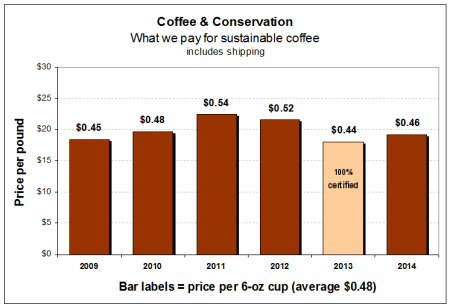
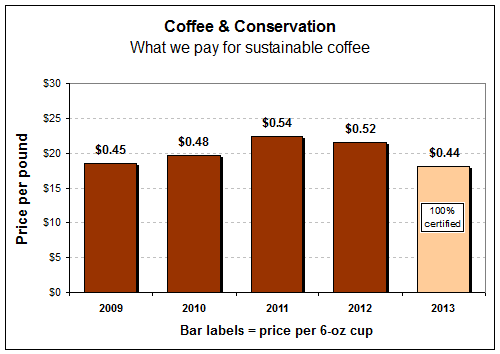
I started in 2008 with an annual coffee expense of $987, including shipping, which worked out to $2.70 a day.

In 2009, I kept more precise figures, calculating $1031 for beans plus $129 for shipping, for a total of $1160 for the year. This was $0.45 per 6-oz cup.

Here are my 2010 stats:

  • 78 bags of coffee totaling 61 pounds.
  • Total retail price = $1064. I purchased very few bags locally, so I also spent $143 on shipping, for a grand total of $1207 for the year.
  • This still works out to only $0.48 per six-ounce cup ($0.42 without shipping).
  • I buy a lot of really high-quality coffee, much more than the typical consumer. The average price per pound (not including shipping) this year was $17.57. The big outlier was Counter Culture’s Hacienda Esmeralda Mario San Jose which retailed at the equivalent of over $69/lb. Including that coffee, I purchased 16 bags of coffee that retailed for over $20/lb.

I have a three-year average of around 60 pounds a year, from 20 roasters. Usually, about half the roasters are new ones that I try out.

So, no excuses — great coffee that helps support ecosystems and rural communities worldwide is not too expensive for all of us to enjoy.

I’ve posted this before, but if you’d like to calculate how much a cup of coffee costs, based on the price of a bag of beans, just punch in the price and weight of the bag here: