Coffee news and miscellany
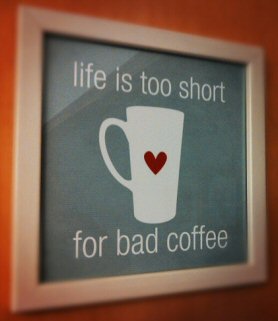
 Yes, I’m still around. The last few months I have been not only busy with my real job, but also with buying a house, moving, and selling the old homestead. I’ve still been thinking about (and drinking) coffee; the print on the right is one of the first items I hung in the kitchen in the new abode.
Here is some of the coffee news I have been bookmarking and might have written about, had I had the time.
- CRS Coffeelands is one of my go-to coffee blogs. Author Michael Sheridan has been tackling a subject I have only touched upon, but considered writing about more extensively: the relationship between water and coffee, a critical part of the ecology of coffee and coffee sustainability. Take a look at the series of posts where Michael has explored this topic, especially the post on the water footprint of coffee and why it’s important.
- CRS Coffeelands has also produced a series of posts on robusta coffee; my overview and crystal-ball-peering on robusta appeared last year.
- I’ve written a series of posts on illegal coffee growing in a Sumatran national park, first described in a report by the World Wildlife Fund in 2007. A recently published paper in Conservation & Society states that “Park rangers have proved unable to control the flow of newcomers or expel long time encroachers.” The paper only provides data on habitat occupied through 2006, so nothing new, but it does give a socio-economic analysis of the issue. A post at Mongabay provides more background and startling photos. Don’t forget who purchases this coffee — and don’t be one of the final consumers.
- Last year, I wrote about an endemic species of Tanzanian coffee threatened by a dam. This project also endangered a tiny amphibian, the Kihansi Spray Toad. An update on the status of the toad was recently published. Can’t find any info on what’s going on with the coffee.
- I’ve also written some posts on the dreaded coffee berry borer, including its growing resistance to pesticides and how climate change will alter its range. A new project by the non-profit Centre for Agricultural Bioscience International (CABI) is addressing borer control in Indonesia, with an eye to preventing it from spreading to Papua New Guinea and Sulawesi, where the insect does not yet occur.
C&C will be getting back on track with research news, reviews, and the like shortly.
Some news out of Vietnam.
- Nearly all the coffee Vietnam grows is robusta. They are planning to expand arabica production to 40,000 ha by 2020. The country is already expanding robusta production, which covers more than a half million hectares.
- It seems inevitable this may lead to loss of more forests. Which will exacerbate adaptations to climate change — and Vietnam is on a list vulnerable countries. While the composition of compilations like this vary depending on the criteria, what struck me about this list was that at least half are coffee-producing nations, with three (India, Vietnam, Philippines) being major robusta growers. The latter two are big suppliers to companies like Nestle. Wonder how that will go.
- Speaking of problems with adaptation, several of Vietnam’s major coffee exporters are heavily in debt due to a lack of adaptation to market conditions.
- But there is a Vietnamese coffee mogul that is doing well.
It’s no wonder why news about Starbucks prompts such strong reactions in people. Some weeks there will be an announcement about a really worthwhile initiative, and only a little while later, something sort of repulsive.
- Awesome: Starbucks will be the first private investor, committing $1.3 million, to the Fairtrade Access Fund. The Fund will provide farmers’ cooperatives with several types of long-term loans needed to renew their farms, adopt new technologies, or purchase equipment, as well as a facility that will allow farmers to get timely information on Fairtrade certification practices, crop management, and localized market information via their mobile phones. The Fund is being established by Incofin Investment Management, Fairtrade International, and the Grameen Foundation.
- Also pretty cool: In mid-June, Starbucks launched the Indivisible collection, which includes Indivisible Blend Coffee and products such as coffee mugs to support Create Jobs for USA. With every purchase from the Indivisible collection, Starbucks will make a donation to Opportunity Finance Network for the Create Jobs for USA Fund to help create and retain jobs across the country.
- Modest overall impact, but nice symbolism: a struggling Ohio company was chosen to produce the Indivisible mugs rather than outsourcing to another country.
- And…just yuck: Starbucks’ Seattle’s Best Coffee division to sell coffee in thousands of Coinstar-owned kiosks in the U.S.
Recent coffee news. (I’m behind. I should just let everybody know that May is a month my day job prevents me from doing anything related to coffee except drinking it!)
 Yes, I’m still around. The last few months I have been not only busy with my real job, but also with buying a house, moving, and selling the old homestead. I’ve still been thinking about (and drinking) coffee; the print on the right is one of the first items I hung in the kitchen in the new abode.
 there will be an announcement about a really worthwhile initiative, and only a little while later, something sort of repulsive.