Know Your Coffee Birds series

Know Your Coffee Birds: Red Siskin

Male Red Siskin. Photo by Linda De Volder under a Creative Commons license.

Here’s a entry in the occasional Know Your Coffee Bird series, which profiles birds that utilize shade coffee farms. This post is about a species people might not immediately connect with coffee. It is a finch, related to more familiar goldfinches (both American and European), and like them primarily eats seeds and favors a variety of open or semi-open habitats. This is in contrast to the insect- and fruit-eating birds inhabiting tropical forests that we tend to associate with coffee farms. Let’s talk about the endangered Red Siskin (Spinus [formerly Carduelis] cucullatus).

The Red Siskin never had a large range, being primarily found along the northern coast of Venezuela, just edging into Colombia. Once common, populations are now critically fragmented across this area and it is estimated that somewhere between 1500 to 7000 birds (at best) remain in the wild; this includes a relatively recent location found in Guyana. Red Siskins are considered so iconic in Venezuela that they are depicted on the country’s currency. Streets, a park, and even the country’s Little League team is named for them (“cardenalito” in Spanish).

Habitat loss has played a role in the decline of the Red Siskin, but unsustainable trapping for the cage bird trade is a major reason for the near-disappearance of this species. Males are prized for their bright coloration (females are duller) and their ability to mate with the common canary, introducing their red coloration to future generations of canaries. Because Red Siskins can be harder to raise in captivity, wild birds are continually captured to maintain the red genes in canaries — which is actually unnecessary from a genetic standpoint. Although trapping in Venezuela has been illegal for decades, the increasing rarity of these birds, the poverty-inducing economic crisis and political upheaval in Venezuela combine to make illegal trade in the birds lucrative for both greedy poachers and desperate citizens.

In 2015, the Red Siskin Initiative was established among many partner organizations to address the precipitous declines. Strategies include research, captive colonies with the aim to breed siskins for reintroduction, reducing overexploitation, and public education. An important component of this initiative is habitat preservation and income security through coffee farming.

Venezuela once had a thriving coffee industry which was eclipsed by the oil economy and grew out of favor due to government price controls that make coffee farming unprofitable and unsustainable. However, Bird-Friendly coffee certification (which requires organic certification) qualifies the coffee as gourmet, exempt from the price controls, and allows it to be sold at a premium. In addition to organic farming methods, Bird-Friendly certification has requirements regarding shade cover and composition, native tree diversity, and other criteria that provide habitat for birds, including Red Siskins. Partners also provide technical assistance and help producers with capacity-building.

In 2019, nearly 40 farms occupying 165 ha, members of the AsociaciÁ³n Civil de Productores Agroforestales—Piedra de Cachimbo y Florida (ACAFLO), obtained organic certification, with 13 also gaining Bird-Friendly certification. The goal is to expand the certified production area to 400 ha by the end of 2021. Venezuela exports little or no coffee these days, and the situation is dire there. I really hope for the success of this project, and look forward to being able to purchase this coffee to support this great conservation initiative. The establishment of Bird-Friendly certified coffee farms will provide a sustainable livelihood for farmers and preserve habitat for Red Siskins and many other bird and wildlife species.

Pair of Red Siskins. From a plate in Bird Notes, scanned by the Biodiversity Heritage Library.

More reading:

Know Your Coffee Birds: Elfin-woods Warbler

Elfin-woods Warbler. Photo by Mike Morel/USFWS under a Creative Commons license.

Elfin-woods Warbler. Photos by Mike Morel/USFWS under a Creative Commons license.

It has been awhile since I have posted an entry in the Know Your Coffee Bird series, which profiles birds that utilize shade coffee farms. This post is about a species that was not on my short list for an upcoming account, but has a very special, recently defined connection to coffee.

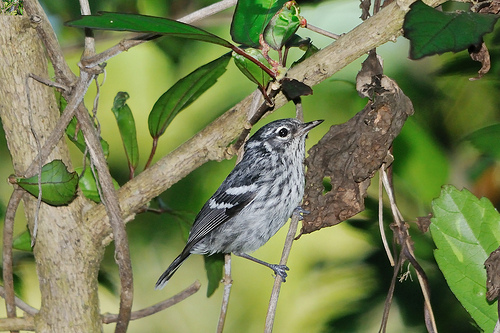
The Elfin-woods Warbler (Setophaga angelae) is one of over 100 species of warblers found in the New World, and is only found in Puerto Rico. Discovered and described less than 50 years ago, it is named for a unique habitat it favors — elfin woods. High humidity and rainfall, strong winds, and nutrient-poor soils result in the short, often twisted trees (dominated by only a few species) that are characteristic of these forests, found between 750-850 meters. More recently, the warbler has also adapted to lower wet forests at 600-900 meters. This bird may have eluded discovery for so long due to being very similar in appearance to another species I have profiled as a coffee bird, the Black-and-white Warbler, which nests in North America but winters in Puerto Rico.

The Elfin-woods Warbler was likely always rare, and it was proposed for listing under the Endangered Species Act in 1982. Habitat loss and degradation due to development, agriculture, and hurricanes are among the factors that drove population declines in the following decades. The current estimate is fewer than 2000 individuals in two populations: in the El Yunque National Forest in the eastern part of the island, and in Maricao Commonwealth Forest and adjacent private lands in the west. Part of the latter is an Important Bird Area designated by BirdLife International.

Earlier this month, after years of languishing as a candidate, the warbler was finally designated as Threatened under the Endangered Species Act.

Elfin-woods Warbler. Photos by Mike Morel/USFWS under a Creative Commons license.

Elfin-woods Warbler. Photos by Mike Morel/USFWS under a Creative Commons license.

When a species is afforded protected status under the Act, “critical habitat” is designated. These are areas that are essential to conservation and which may require special management efforts. Critical habitat for the Elfin-woods Warbler is largely public land, but does contain private holdings including coffee farms and potential coffee-growing land adjacent to the Maricao Commonwealth Forest. The warblers have been detected in shade coffee plantations, but not in sun coffee farms. Thus, in the critical habitat areas, conversion of shade coffee to sun coffee will be prohibited. Conversely, the planting of shade trees on sun coffee farms is encouraged. Provisions for coffee growers in this area also allow for pruning of shade and coffee trees, but only outside of the nesting season. Herbicides and pesticides may be used, but only during the first two years or so while the coffee and shade trees are becoming established (a time in which the warblers are not likely to use the farm).

Previous research has indicated that much of Puerto Rico’s coffee is not grown under shade, but that farmers are willing to convert to shade if they were encouraged to do so by incentives such as being supplied with shade trees to plant.  Since 2010, the US Fish and Wildlife Service has been working on habitat restoration initiatives in the Maricao coffee growing area through the Partners for Fish and Wildlife program. This has included technical and financial assistance to landowners to establish and restore shade coffee.  The listing of the Elfin-woods Warbler will likely provide more incentive and opportunity for farmers to create and enhance shade coffee, to the benefit of this interesting bird and other biodiversity associated with its habitats.

Read more:


Know your coffee birds: American Redstart

I have yet to meet someone who has seen an American Redstart (Setophaga ruticilla) who was not charmed by this bright, energetic little bird. Redstarts are warblers, but like many New World birds bear the name of similar-appearing (though unrelated) Old World birds. In this case, the original redstarts are flycatchers that often have patterns in black and red. Likewise, male American Redstarts that are at least two years old are jet black and vivid orange. Younger males and female American Redstarts are gray and salmon or yellow, but no less beautiful.

American Redstarts breed across much of eastern North America and western Canada, and winter in the West Indies, southern Mexico, Central America, and northern South America. Like other warblers, they feed primarily on insects, and may flush them from foliage by spreading and flashing their tails. This has earned them several other names, particularly in the tropics, including candelita (“little candle” or “little flame”) or mariposas (the same word used for butterflies).

In winter, redstarts can be found in a variety of forested habitats. They are particularly well-studied in the West Indies, where they are most often found in mangroves, coastal scrub, and shade coffee. In Jamaica, redstarts have been found to greatly benefit coffee farmers by providing pest control, especially against the hard-to-control coffee berry borer, one of coffee’s most dreaded pests. To reap these benefits, however, farmers needed to provide habitat for the birds, either via shade trees or adjacent forest patches. Another vote for shade-grown coffee!

In the Dominican Republic, redstarts returned annually and stayed put overwinter on shade coffee farms at rates similar to natural forest [1]. Other studies have specifically documented shade coffee use by redstarts in Mexico, Venezuela, and Guatemala; and I have recorded them myself in coffeelands in Panama and Honduras.

A recently published paper [2] presented data on a very rigorous study of wintering migrant birds in Puerto Rico that began in 1973, in which American Redstarts are among the three most common species (the other two are also “coffee birds”: Ovenbird and Black-and-white Warbler). All three species have shown population declines, even though overwinter survivorship has remained the same for the birds that do winter there. The most dramatic declines have occurred over the last decade, but the authors cannot pinpoint an explanation. They concluded with words seldom found in academic publications:

“Given the patterns shown by our data, we now join with those who earlier proclaimed that ‘the sky is falling’ for Neotropical migratory birds, even though we lack a ready explanation for these declines.”

Please see this as a call to action. This is one of many studies that have documented the loss of migratory bird species. These “birds of two worlds” have very complex life cycles, and many things impact their survival. Some of these factors are within our control, and they include habitat loss due to agriculture — such as coffee.  You can help by choosing your coffee carefully and being willing to pay more for organic and eco-certified coffee that encourages the preservation of habitat and enhancement of coffee farms with shade trees. Seldom is so simple an individual action apt to lead to such positive results for redstarts, other warblers, and the biodiversity and health of our planet.

See more in the ”Know your coffee birds” series.

Photo of male redstart by Laura Gooch under a Creative Commons license; female redstart banded at the Rouge River Bird Observatory by Julie Craves, all rights reserved.

[1] Wunderle, J and SC Latta. 2000. Winter site fidelity of Nearctic migrants in shade coffee plantations of different sizes in the Dominican Republic. Auk 117:596-614.

[2] Faaborg J, WJ Arendt, J D Toms, KM Dugger, WA Cox and MC Mora. 2013. Long-term decline of a winter-resident bird community in Puerto Rico. Biodiversity and Conservation 22:63-75.

Know your coffee birds: Ovenbird

The Ovenbird (Seiurus aurocapillus) is often heard before it is seen, a loud ringing “tea-cher, TEA-cher, TEA-CHER!” broadcast from close to the forest floor through much of the eastern U.S. and Canada during the nesting season. Ovenbirds are large warblers, no relation to the Ovenbird family Furnariidae found in the tropics. However, both the warbler and the family share a basic brown color palette, and are named for their curious domed, Dutch oven-like nests which, in the case of the warbler, are build on the ground.

Ovenbirds winter primarily in the Caribbean and Central America. There, they forage on or close to the ground, where much of their diet is comprised of ants. This habit of scratching and leaf-flicking on the forest floor has earned them the name “Betsy Kick-up” in Jamaica! Ovenbirds are frequently found in shade coffee plantations, where they may also feed on female coffee berry borers that are laying eggs in fallen coffee cherries, thus performing a great service to coffee farmers.

Migrant (and resident) bird species have been monitored in Puerto Rico since 1973 in a study where Ovenbirds have been one of the most common species. Their numbers have declined to less than 20% of their original abundance. Some of the declines are related to variable rainfall patterns (which will be exacerbated by climate change), and some to conditions on their breeding grounds (see below). But similar declines in resident Puerto Rican birds in the same study indicate there are undiscovered factors occurring on the wintering grounds as well.

On their North American breeding grounds, Ovenbirds need large forests to breed in, and habitat loss and fragmentation has taken its toll. Even in large forests in northern regions, declines in reproductive success are tied to, believe it or not, earthworms.

Due to the last glaciation, Canada, the upper Midwest, and New England have no native earthworms — all of the worms are introduced. Their efficient consumption of leaf litter on the forest floor has greatly altered many forests. Plants that require a thick organic layer in some forests have declined, leaving less cover for Ovenbird nests, which then fall to predators. Ovenbirds also rely on the insects and invertebrates that live in leaf litter, which are also far less abundant in habitats invaded by non-native worms. These factors are thought to be driving declines in some breeding populations of Ovenbirds.

Ovenbirds found on shade coffee farms help farmers by eating pests, and have found safe haven in winter. Choosing shade-grown coffee can help support populations of this charismatic songbird so that future generations can enjoy its distinctive summer song.

More coffee birds here.

Ovenbird photo by Julie Craves, all rights reserved. Banded by the Rouge River Bird Observatory, Dearborn, MI.