December 2009

New coffee species from Madagascar

Earlier this year, the news of the “discovery” of a caffeine-free species of coffee from the Cameroon created a bit of a stir. This species was actually first collected in 1983, but remained unstudied and not described to science until 2008 [1], at which point it made headlines when it made a 2009 top ten list of new species. I wrote about it here.

Similiarly, the Royal Botanical Gardens at Kew just announced some recent achievements, among which was the “discovery” of new species in the genus Coffea from Madagascar. Again, these species were not necessarily just discovered but were described in a paper published in 2008[2].  Coffea ambongenis, for example, was first collected in 1841 but not described, was rediscovered in 1999, and is now published as a new species.

There are 103 described species of Coffea in the world, and the Madagascar species are part of the Coffea subgenus Baracoffea, which now stands at 9 species. In addition to species in this subgenus being deciduous rather than evergreen like all other coffee species, some have unusual morphological characteristics. Here is a very brief run-down.

  • C. ambongensis and C. boinensi: Very large fruit, in C. ambongensis often larger than 2.5 cm long. C. boinensi was first collected in 1994.
  • C. bissetiae: Underside of leaves and fruit hairy.
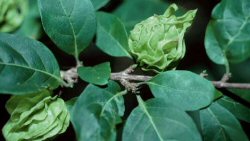
  • C. labatii and C. pterocarpa: Unusual winged fruit. C. labatii, first collected in 1992, has 12 to 18 “wings” per fruit. C. pterocarpa (first collected in 1954) has 16 to 20 wings, and is pictured at right in a photo by Aaron Davis from Kew; an informative accompanying article is here. One theory as to the function of the wings is that it helps the fruit float, and these species occur in regularly-flooded karst limestone habitats.
  • C. namorokensis: First collected in 2000, but not identified as a new species. Also has hairy fruit and leaves.
None of the new species have been tried as a beverage, and it is unlikely they will ever be commercialized.  All are rare: near-threatened to critically endangered, and Madagascar forests are among the most exploited and threatened in the world today.

[1] Stoffelen, P., M. Noirot, E. Couturon & F. Anthony. 2008. A new caffeine-free coffee from Cameroon. Botanical Journal of the Linnean Society 158: 67-72.

[2] Davis, A. P, & F. Rakotonasolo. 2008. A taxonomic revision of the baracoffea alliance: nine remarkable Coffea species from western Madagascar.
Botanical Journal of the Linnean Society, 158 (3), 355-390 DOI: 10.1111/j.1095-8339.2008.00936.x

EPA bans pesticide carbofuran on coffee imports

In May, the U.S. Environmental Protection Agency (EPA) announced its decision to ban any residue of the pesticide carbofuran on food. The rule becomes effective December 31, 2009.

Carbofuran (sold under the name Furadan) causes neurological damage in humans, is extremely deadly to birds and fish, and is highly toxic through ingestion and inhalation. It is used on numerous crops, including coffee. It tends to be used on various types of mealy bugs that infest the roots of coffee plants, coffee root nematodes, and on the coffee leaf miner (Leucoptera coffeella). Coffee leaf miners have natural enemies in Latin America, so carbofuran is used against them mainly in Africa.

Earlier in the process of reviewing carbofuran uses, the EPA rules allowed the importation of rice, coffee, bananas, and sugarcane with carbofuran residues. This final decision reverses that, and countries exporting coffee into the U.S. must stop using carbofuran on their crops. While little pesticide residue remains on green or roasted coffee, the direct threats to coffee workers, wildlife, and the millions of migratory and resident birds from the application of carbofuran to coffee make its use dangerous.

The Food and Drug Administration is responsible for enforcing EPA regulations on food imports. Carbofuran residue on food has been banned in the EU for some time, so testing protocols are established. Exporting countries, and coffee exporters and importers, often engage testing and certification labs to insure there are no violations that could lead to rejected shipments or, worse, a ban on imports.

FMC Corporation, the Pennsylvania-based company that manufactures Furadan, recently announced that they are challenging the EPA’s decision on some technical and administrative grounds. They have contended that the chemical is safe, despite well-documented impacts on birds, lions, hippos, other wildlife, and humans. Reports are still surfacing about illegal use of Furadan by poachers to kill vultures (which attract attention to illegal kills) and small birds which are then sold for human consumption.

Improper pesticide usage (whether unwitting or purposeful), export of domestically banned pesticides to other countries, and the fact that we are just beginning to understand the dangers of cumulative and synergistic effects of multiple pesticides in the environment to wildlife and humans, all argue for support of non-chemical-based pest management. And that includes growing coffee under diverse shade with its biodiversity-based pest control benefits.

Update: In 2010, courts ruled the EPA had to once again establish residue tolerances for imported foods, including coffee.

Happy holidays from C&C!

The highly-caffeinated main tasting panel at Coffee & Conservation wishes you a happy holiday and many excellent, sustainable coffees in the New Year! Standing are Mike, my better half Darrin, and Rick; yours truly is seated with our newest regular panelist Dana on my lap. Honest, I did have a coffee mug in my other hand!

New award for biodiverse coffee farms

A new award for coffee farmers is being initiated by Cooper Ecological Monitoring, Roast Magazine, and Birder’s Exchange (a program of the American Birding Association). The Coffee Conservation Award will be presented annually to recognize farms making a significant contribution to global biodiversity preservation. The award is a $1000 cash prize, to be used to further meaningful, science-based conservation practices on the winning farm.

This award is intended to not only to reward and encourage producers to grow coffee in a sustainable manner, but to help document and promote the benefits of these types of agroforestry systems to birds and wildlife.

Coffee certifications, for instance, often only measure the potential for biodiversity preservation by assessing the elements required for bird and wildlife habitat. The criteria for the Coffee Conservation Award will focus on actual wildlife use of the farms, and preservation of existing forests will be emphasized over tree-planting in production areas. Target wildlife species will be developed for various regions — the current application (PDF) lists target species for Honduras, Guatemala, Nicaragua, and El Salvador. The bird list includes both Neotropical migrants (birds that breed in North America which winter in the tropics) like the brilliant and declining Painted Bunting (above), and rare or endemic tropical species like the Azure-rumped Tanager. The application also requests information on monkeys and frogs.

ominations each year will be restricted to a particular country, and the 2010 award will go to a producer in El Salvador. This is a great choice to start with, as coffee plantations provide so much of the of the remaining “forested” areas in the country. Judges will include the award partners and sponsors, as well as representatives of local conservation organizations, if possible. The 2010 award local partner is SalvaNatura, El Salvador’s excellent conservation organization. Their director of conservation science, Oliver Komar, is an old friend of mine and has written numerous papers on shade coffee and Neotropical bird conservation.

In addition to the cash prize, the Coffee Conservation Award includes promotion of the farm in trade publications (both coffee- and nature-related) and in the marketplace. The 2010 award is being sponsored by Cafe Imports, and the deadline for submissions will be December 31st, 2009. The winner will be announced in May 2010 in the May/June 2010 issue of Roast Magazine.

Painted Bunting photo by Francesco Veronesi under a Creative Commons license.

The bird pictured in the logo of the award is a White-eared Ground-Sparrow (Melozone leucotis), a restricted-range Central American species.

Update on eco-friendly coffee market share

UPDATE: A thorough report with detailed breakdowns of producing and consuming countries, certified roasters and importers, major retailers, and other information is now available on the SMBC web site.

The Smithsonian Migratory Bird Center announced that sales of Bird-Friendly coffee in 2008 were $3.5 million, with 61% being sold in the U.S.[1]

For the 2007-2008 crop year, 6 million pounds (2700 metric tons) of Bird-Friendly certified coffee was produced. This certification is at the farm level, with 1400 farms and 5000 ha (12,000 acres) under certification [2].

Nearly all Bird-Friendly certified farms are in Latin America, since the research that led to the launching of the certification took place there and was developed for Neotropical habitats. Peru, Guatemala, and Mexico account for 77% of Bird-Friendly coffee, with Peru producing 39% of the total.

More recently, Bird-Friendly standards have been adopted for Africa, and now about 5% of Bird-Friendly certified coffee comes from Ethiopia. Efforts are continuing to expand criteria and certification to other areas, including other African countries, Papua New Guinea, and Indonesia (certified coffee from Sumatra should be available within the next year, according to the report).

You can find a current list of certified farms on the SMBC site.

Growth in other certification schemes
All Bird-Friendly coffee is certified organic, and organic coffee market share has also been growing. North American sales of organic coffee reached $1.3 billion in 2008, up from $1 billion in 2007.  This represents 89 million pounds (40,000 metric tons) versus 84 million (38,000 MT) in 2007.

Rainforest Alliance reports that their certified coffee sales in 2008 totaled 62,296 metric tons (137 million pounds), up from around 40,000 metric tons 89 million pounds) in late 2007. I’ve not found corresponding figures for the number of Rainforest Alliance certified farms/acreage, but when I last reported these figures they were 200,000 ha of coffee on nearly 17,000 farms as of late 2007.

Despite the growth in eco-friendly coffee certifications and sales, this is still a very niche market. Total world production in 2008 was 7.6 million metric tons, making these certified coffees only about 1% of the total produced. U.S. imports of coffee in the first quarter of 2008 were 387,000 metric tons, which means organic coffee imports were under 10% of the U.S. market.

[1] This figure represents coffee actually sold as certified but not all coffee produced under any given certification gets sold as such. Some may be blended with non-certified coffee, the buyer may be interested in other attributes besides the certification and purchases it without intending to market it as certified, or other reasons. In 2006, only about 6% of coffee produced on Bird-Friendly certified farms was sold as such. This situation also occurs with organic, Fair Trade, and other certifications.

[2] When I calculated these figures from the SMBC web site in May 2008, I came up with 28 producers growing on 7200 ha, with production of approximately 3100 metric tons.

Know your coffee birds: Wood Thrush

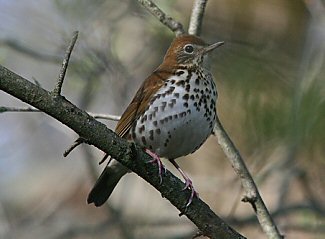
The Wood Thrush, a relative of the familiar American Robin, is often considered a symbol of the population declines of birds that nest in North America and winter in the tropics. This species has been declining since the mid-1960s, and is on the National Audubon Society’s 2007 WatchList of declining birds.

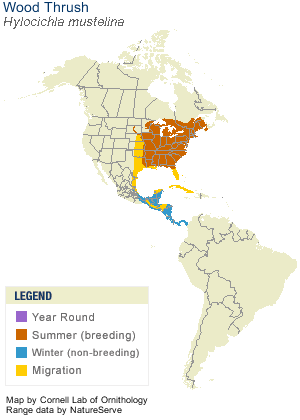
Wood Thrushes nest in forests over much of the eastern U.S. Like most other songbirds, they migrate at night. These thrushes travel an average of 2200 km between their nesting areas and wintering grounds in Central America.

In the winter, Wood Thrushes are most common in primary and mature second growth forests, and they can be a familiar site on polyculture shade coffee farms from Mexico to Panama. For instance, they are the most commonly banded species at the gorgeous shade farm Finca Esperanza Verde in Nicaragua — we caught and saw a number of them when we were there in March 2009.

One reason for Wood Thrush declines may be tropical deforestation. At least one study has found a correlation between reduced numbers of Wood Thrushes and reduction in forest cover in the northern portion of their wintering range [1].

Wood Thrushes will choose and defend a territory in the winter, much as they do when they are nesting. However, as forests are destroyed in the tropics (including for sun coffee), Wood Thrushes are forced to become nomadic — a case of too many Wood Thrushes and other species, and not enough space. These thrushes must move from place to place, or settle in habitat that is low quality. These birds are less likely to survive the winter than individuals who have territories in a good forest patch [2].

Here in North America, habitat fragmentation is considered another cause of Wood Thrush population declines. As in the tropics, Wood Thrushes can be found in small woodlots or low quality habitat, but their chances of successfully raising a brood are greatly diminished in these situations. In fragmented forests, predators are more common, as are Brown-headed Cowbirds, which lay their eggs in the nests of other birds, often targeting Wood Thrushes. These factors contribute to dramatic rates of nest failure in some locations.

The Wood Thrush and coffee connection is so iconic that this bird has been found on the coffee packages or web sites of Birds and Beans, Coffee for the Birds, Audubon Coffee, and Counter Culture Sanctuary Coffee, to name a few. Wood Thrushes are considered “area sensitive,” needing good, intact forests throughout their annual cycle. High-quality shade coffee plantations represent essential habitat for this species, and your choice of coffee has a direct impact on the survivorship of Wood Thrushes and other birds that rely on tropical forests.

Wood Thrush photo by Eddie Calloway under a Creative Commons License.

[1] Rappole, J. H., G. V. N. Powell, and S. A. Sader. 1994. Remote-sensing assessment of tropical habitat availability for a nearctic migrant: the Wood Thrush. In Miller, R. I. (ed.). 1994. Mapping the diversity of nature. Chapman & Hall, London, England.

[2] Deinlein, M. 1998. A “Sing”-ular Sensation. Wood Thrush: Bird of the Month. Smithsonian Migratory Bird Center.