May 2006

Coffee growing in Asia

Since shade certification is not available for coffee grown outside of Latin America, it can be helpful to understand coffee cultivation practices in the Old World. (Click on the Coffee Regions category for other posts in this series.)  This can help consumers choose sustainable coffees.  Certified organic is a good choice where available, although in many Asian countries, it is grown organically by default because small farmers cannot afford chemicals and fertilizers (“passive organic”) and may not be certified.

The whole concept of “shade grown” and what it means to biodiversity is different in Asia (and other Old World countries) than it is in Latin America, in particular as it relates to birds.  But as always, coffee grown in situations amongst a diverse variety of other trees and shrubs will mean a higher diversity of other organisms, and a closer match to native ecosystems. If anybody has further information on biodiversity issues in Asian coffee plantations, drop me a line at coffeehabitat AT gmail.com.  Meanwhile, let’s look at coffee growing methods in some major Asian countries.

Sumatra – Sumatra grows a lot of robusta, but the arabicas grown in the mountainous regions are some of the most distinctive in the world.  The best are from northern Sumatra, and marketed as Lintong or Mandheling. They are often grown in the shade, and/or organically. The Gayo region in Aceh Province, in the far north, tends to be small-farm holdings, also often shade or organically grown.  On the other hand,  Sumberjaya is a coffee-farming area within Lampung Province in southern Sumatra, and is one of the world’s biodiversity hotspots.  About 60% of this once-forested area has been converted to coffee plantations.  Sun coffee is more common in the south, and state-run plantations tend to clear forest and create sun monocultures.

Smithsonian (certifiers of Bird-Friendly coffee in Latin America) is now doing research on biodiversity in Sumatra coffee farms.  Info on the coffees from Coffee Review.

Papua New Guinea. PNG is the eastern half of this large island; the western half, Irian Jaya, is Indonesian. PNG is often considered one of the “last frontiers” of intact, biodiverse rainforest, with many endemic species. Coffee is an important export crop, and much of PNG coffee is rustically grown in the highlands, and organic beans are readily available.  Aim for these small-holding coffees if available from a specialty roaster.  Estate coffees may not be grown as sustainably.

Java – Most of Java grows robusta, after arabicas were wiped out by rust many years ago. Arabicas are grown in eastern  Java in a volcanic region where four farms originally established by the Dutch government (Kayumas, Blawan, Djampit, Pancoer) are part of the “government”  estate, which produces about 85% of Javan coffee, and which is considered superior to private estate coffee.  This volcanic valley is forested, and I have seen coffees from these estates marketed as shade grown.

Sulawesi (Celebes) – Best beans come from a mountainous region called Toraja, which is also marketed as Celebes Kalossi. Coffee in this area is frequently grown under shade.  A little background from the U-Roast-Em blog.

Timor/East Timor – Coffee is a critical crop in this very poor country, it is home to a cooperative that is one of the largest single source producers of certified organic coffee in the world (both arabicas and robustas are grown organically). Coffee grows under a tall canopy of shade on old plantations, and much is literally wild.  Recently disease has severely damaged or killed a common shade tree species in Timor, and alternatives will need to be planted; meanwhile, coffee yields are reduced. Purchasing specialty coffee from Timor supports struggling farmers after a battle for independence, and environmental restoration.

Vietnam – Vietnam is the epicenter of robusta production, funded at a furious pace by the big corporate coffee buyers, which helped create the “coffee crisis” (more background on the coffee crisis here, with many links). Forests are cleared for these sun coffee monocultures. More than 182,000 acres of forest have been cleared in Dac Lac province alone; water shortages and soil erosion have been problems in coffee-growing areas.

A small percentage of the crop is arabica, and there is some effort to increase that percentage.  It’s difficult to recommend Vietnam coffees if one is concerned about biodiversity, considering that forest may still be cleared for arabica coffee start-up plantations. It’s a tough call, because encouraging sustainable practices in this country facing difficult times could be beneficial.

IndiaIndian coffees are often grown on terraced mountainsides. Indian arabicas (about half the crop) are known as “plantation coffee,” while the robustas are “parchment coffee.” Most is grown in the Karnataka (Mysore) region, but Kerala and Tamil Nadu (Madras) are other main regions.  Most of India’s shade coffee comes from Karnataka, but the majority of India’s arabicas are shade grown.  Article on Indian eco-friendly coffee growing from INeedCoffee here and some reviews of Indian coffees from Coffee Review here.

One interesting type of coffee from India should be mentioned. Monsooned coffees are green beans left exposed to monsoon rains in open warehouses.  The beans turn tan colored, the acidity is reduced, and the beans are sweeter, according to the hype.  For the full story, read “Daddy’s socks or fancy cheese” at Coffee Review.

Meet the C&C tasting panel

I’ve done a few reviews here at C&C, but admit that I have a pretty untrained palate.  So my reviews have none of the sophistication and elegant adjectives found on major coffee review sites.  On the other hand, I think I represent most coffee drinkers, who would also struggle attempting to describe the subtle flavors in coffee.

I do want to provide reviews of sustainable coffees.  I’d like them to be honest, yet accessible to the average coffee drinker.  So I have assembled a panel of coffee tasters, folks who really like coffee, but have no particular expertise.  We’ll review various beans, earnestly trying to incorporate some standard taste descriptors, as well as our own impressions.  I’ll link to more elaborate and advanced reviews for balance.  With any luck, we will at least be able to discern obvious flavor flaws, such as those caused by, say, toe jam*.

This panel is drawn from coworkers and friends.  We’re all professional or volunteer field biologists, naturalists, and the like. Our hours are often very early or odd, so we not only love coffee, we rely on it. Oh, and we have a weird sense of humor.  We’ll try to be serious.  Without further ado… Introducing the C&C coffee tasters:

  • Yours truly, Julie (“BirdBarista”).  I’m an ornithologist, and have evolved from a dark roast to a light roast fan. I love a sweet, classic, Latin American coffee, as well as a nice Kenyan.
  • Greg (“The Star[bucks]ling”). College student, my right-hand field assistant, and a barista at The Mermaid.
  • Mike (“Risky Kingbird”). Environmental center manager/naturalist. Home roaster, and probably the most serious coffee guy among us.
  • Fred (“Con Leche”).  Volunteer field assistant.  Earned his nickname during a recent trip in a Latin American country that was experiencing a milk shortage, therefore pissing off everybody with his persistant cafe con leche requests.
  • Rick (“Nighthawk”).  Natural areas supervisor.  More of a fan of light roasts.
  • Darrin (“Kingfisher”).  Volunteer field assistant. Resident expert on lattes, caps, and other concoctions.

We may be joined by others at times (e.g., whoever is handy).  Our first group review is coming up, so stay tuned!

Poverty and conservation, how coffee fits

The current issue (summer 2006) of the Nature Conservancy magazine has several articles on the poverty and conservation equation.  When I posted on “What is Fair Trade?” I wrote,

Worldwide, habitat destruction is the leading cause of bird population declines and loss of biodiversity. The link between poverty and environmental degradation is inescapable. Making sure that coffee farmers receive a living wage is one way to help preserve habitat — both by  encouraging sustainable coffee farming methods that produce the highest quality coffee, and by empowering farmers economically and reducing their need to exploit the environment for survival.

These points are expanded upon in the Nature Conservancy pieces. They give an example of coffee farming in the Dominican Republic:

Today, the farmers in this idyllic mountain community [Los Dajaos] in the Dominican Republic’s central highlands no longer denude the hillsides to plant beans and graze cattle. Instead, they tend organic shade coffee beneath a canopy of flowering guama trees. … After once clearing thousands of acres of habitat critical to preserving biodiversity and the island watershed, they have come to view the forest as a friend.

These articles surely help elucidate why sustainable agriculture is important to biodiversity, and it’s not hard to understand how sustainable coffee — as one of the world’s top commodities — can fit into this equation.

Colombia to produce more RA coffee

According to this article in Financial Express, by 2007, ten percent (about 1 million 60 kg bags) of Colombia’s coffee will be certified by social and environmental programs. One of these programs is the Rainforest Alliance sustainable agriculture program (my overview here).  Colombia is one of Latin America’s top producers of sun coffee, so this is a step in the right direction.  Meanwhile, look for Colombia’s Mesa de los Santos coffee, which is certified organic and shade grown (by both Smithsonian and Rainforest Alliance). Review at Coffee Cuppers, and carried by a number of the roasters in the sidebar.

Starbucks responsible coffees

Under the Starbucks category, you can read more about the company’s struggles with committing to Fair Trade and environmentally-responsible coffees.  In particular, Green LA Girl has two posts (here and here) regarding the Starbucks point-based CAFE Practices as they compare to Fair Trade. (Update: an in-depth overview of the latest version of CAFE Practices and their environmental standards here.)

Many people go to Starbucks and want to know — or should know — about which coffees are their most responsible. Here is a run-down on their current offerings.

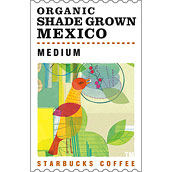
  • Organic Shade Grown Mexico.  Medium roast, origin Chiapas, Mexico.  Grown near the El Triunfo Biosphere Reserve, a park threatened in part by coffee plantations. This is one of the coffees produced in partnership with Conservation International, their “Conservation Coffee.”  Although the description on the Starbucks web page says “traditional shade-growing,” as noted in the post about the partnership, it does not appear that these coffees are grown with any specific or enforced rules regarding degree of shade management or level of organic practices.  Therefore, it does not seem that this coffee is comparable to coffees that are certified organic or bird-friendly. (Update: review and background of this coffee here.)
  • Shade grown Mexican decaf. Medium roast, origin Chiapas, Mexico. Description makes it sound like the same coffee as above, yet it is not labeled organic.
  • Serena Organic. Medium roast, origin Latin America and east Africa. No indication what organization, if any, certifies this as organic.  Coffee Review review.
  • Cafe Estima. Bold roast, origin not specified.  Their featured “Good Coffee, Doing Good” blend.

Starbucks has a line of Black Apron limited edition coffees. They give $15,000 to the farmers of each Black Apron coffee for community projects.  These beans are pricey, and $3 of each half pound must go into producing the fancy laser-cut box.  I just tried the Rwanda Blue Bourbon Black Apron, which is just about at the end of its run, and liked it quite a bit.  But then, I’m a fan of Rwandan coffees.

On the one hand, I give Starbucks some credit for attempting to buy and market responsible coffees; the fact they do it is what counts for me, I don’t care whether they are dragged into it kicking and screaming.  On the other hand, I personally am not a Starbucks fan and think a lot of their coffee is over-roasted.  Click on the Starbucks category for more on the company’s coffees and policies.

Caribou Coffee and Rainforest Alliance

Caribou Coffee, based in Minneapolis with stores in 15 states, announced last July that it was partnering with Rainforest Alliance (RA) to provide certification for much of their coffee.  They expected 20% of their coffee to be certified by the end of 2006, with a goal of half of all the green beans purchased to be RA certified by 2008.  The phase-in is necessary because Caribou wants to preserve existing relationships.  This has an upside in that new producers will be adhering to certification standards.  Considering that a number of Caribou offerings are from Africa and Asia, which are not eligible for shade certification and which often are grown under shade as a matter of course, this means that well over half of Caribou’s coffees will represent shade coffees, in one shape or form.

(Update: 100% of all Caribou coffees will be 100% Rainforest Alliance certified by 2011. More on this here.)

As the second largest U.S. specialty coffee company, selling over 4 million pounds of coffee annually, the purchase of half their beans from certified sustainable sources is nothing to sneer at, and it makes Caribou one of the only big coffee houses where this kind of sustainable coffee will be readily available.

Caribou has a commitment to responsible coffee sourcing, social responsibility (including work in coffee growing areas) and frequently donates to local communities and charities.