February 2013

You’re paying WHAT for single-serve coffee?

The high cost of K-Cups and pods

There are two reasons people give for using single-serve coffee: convenience and price (the rationalization for the latter is that otherwise too much coffee from a pot is thrown away and wasted).

Here is the straightforward truth about what you are paying by using single-serve. The amount of coffee in a pre-packaged single serving varies; I’ve given some common examples. If your single-serve pod, cup, or pack isn’t listed, dismantle one, weigh the coffee and put the amount in the appropriate cell in the spreadsheet.

Posts summarizing previous years are listed here:

  • 2013 (the year of all certified coffee)
  • 2012 (includes comparison to the high price of K-Cups)
  • 2011
  • 2010
  • 2009

If you don’t feel like looking up the typical box of K-Cups, here are some examples:

Green Mountain Sumatran Reserve Coffee Extra Bold K-Cups- 18 Count – $11.99 at Bed, Bath, and Beyond = $27.47/lb ($0.67 per cup)
Folgers Gourmet Selections Coffee K-Cups, Lively Colombian Regular – 12-Count (Pack of 3) – $22.86 at Amazon = $32.00/lb ($0.63 per cup)
Dunkin Donuts Original blend K-Cups – 14 count – $17.95 at Dunkin Donuts stores = $64.62/lb ($1.28 per cup)
Nespresso capsule variety – 50 count – $50.00 on  Amazon = $82.47/lb ($1.00 per cup)
Maxwell House Mild Morning Tassimo T-Disks – 14 count (pack of 2) – $19.98 = $40.46/lb ($0.83 per cup)

So, the price per pound is ridiculously high (I was astonished to find, when researching this post, that some people buy K-Cups using food stamps!!!). What about the argument that K-Cups are cheaper since no coffee is wasted?

As noted in my latest annual summary of coffee cost for my two-person household, the four-year average — including many great coffees and shipping — is $20.53/lb. If I made two cups of coffee a day at $20.53/lb, at the standard 11 grams per 6-ounce cup, I’d spend $363 a year.  If I used two extra-bold (11 gram) K-Cups a day at the cheapest example above, I’d need forty 18-count boxes and I’d spend $479. I save $116 a year. At $0.50 a six-ounce cup (my four-year average), I’d have to waste nearly 11 gallons of coffee to spend as much as I would on K-Cups in this example. That’s tossing away a cup of coffee from a pot nearly every day 8 months of the year.

What about convenience?
kettle-clever

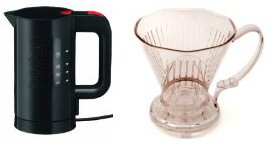
The solution to the waste issue is, indeed, to brew only the coffee you’ll drink. Rather than buying a $150 Keurig brewer, buy a Bodum 17-Ounce Electric Water Kettle for $40 which boils water in 4 minutes (getting it to the correct temperature, unlike most coffee pots or single-cup brewing machines). Then get a foolproof Clever Coffee Dripper for $22 (you can make up to three six-ounce cups in it, if you wish). A year’s supply of paper filters would set you back less than $50 and can be composted (your 2 K-Cups a day amounts to 8 pounds of crap in a landfill a year).

Is this also a huge hassle? Start to finish, brewing a K-Cup takes about 3 minutes, mostly because the water doesn’t reach a high enough temperature nor is it in contact with the coffee for enough time for proper extraction. To make one to three cups in your Clever takes about 8 minutes (four for the water, four for the brewing). For those extra few minutes, you save money and you get better coffee even if you use pre-ground coffee put in the filter the night before and accidentally let it steep for too long. For every “upgrade” you make (better quality coffee, grinding your own beans, paying attention to timing) the improvement in quality will be substantial.

Sips: Coffee rust crisis

320px-Hemileia_vastatrix_-_coffee_leaf_rust

Wikipedia

A round-up of the many stories and news items about the devastating impact of the fungus Hemileia vastatrix (coffee rust, roya). Central and South America are experiencing the worst outbreak in decades.

This crisis has some serious consequences beyond the obvious impacts of increasing consumer prices and endangering the survival of some producers.

One is a decrease in the number of producers that will stay with organic certification. Most of the fungicides that are used to combat rust are allowed under organic certification. However, coffee plants attacked by rust need substantial boosts in nutrients (because they lose their leaves) in order to keep them alive. These levels are often just too hard to achieve at reasonable prices with available organic fertilizers. Recall that in the last few years, many farmers have already given up on organic certification because the price premium is just not enough to justify the extra cost and labor.


Nestlé: Saying no to coffee certifications

Nestlé is the world’s largest food company, with 2011 sales of $94 billion. Some of the most popular of their many coffee brands are Nescafé , Nespresso, and Taster’s Choice. The company buys upwards of 850,000 tons of coffee annually, of which less than 1% is eco-certified.

Nestlé’s most recent corporate responsibility report, Creating Shared Value 2011 (PDF), makes some specific statements about what this big multinational company thinks about sustainability certification.

The company presents its overall position in a section titled Third-party certifications and Responsible Sourcing: “Certification is not an end point in itself, and only one of several ways of Creating Shared Value, promoting sustainable rural development and progressing other development goals in an effective and holistic way.”

In the section specifically devoted to coffee, there is a sub-section titled Marketing certified coffee to consumers. Here’s what it says:

Currently, there are no plans to market certified coffee to consumers (ie, coffee carrying a certification seal on the label). We believe that our own Responsible Sourcing Platform, which combines in-house codes and guidelines, capacity-building teams for key commodities and suppliers, NGO and industry partnerships and third-party certifications, offers a more targeted approach than certification alone.”

Unfortunately for consumers, Nestlé offers few details on their “Responsible Sourcing Platform” so that we can judge whether we think their coffee is really grown in a sustainable manner. They do mention that the “Nestlé Supplier Code is an integral part of any green coffee contract.” This document is publicly available (PDF). It’s easy reading. In fact, it’s only 6 pages, three of which are the covers and title page.  Here are the sections on Sustainability and Environment, in their entirety:

  • Sustainability Nestlé supports and encourages operating practices, farming practices and agricultural production systems that are sustainable. This is an integral part of Nestlé’s supply strategy and supplier development. Nestlé expects the Supplier to Nestlé to continuously strive towards improving the efficiency and sustainability of its operations, which will include water conservation programs.
  • Environment The Supplier must operate with care for the environment and ensure compliance with all applicable laws and regulations in the country where products or services are manufactured or delivered.

That’s it. Nothing specific, no standards, guidelines, or benchmarks. In contrast, the basic farm standard of Rainforest Alliance runs 49 pages. Starbucks CAFE Practices has 7 pages of criteria just devoted to environmental leadership for its coffee suppliers.

Nestlé states that “For coffee, biodiversity issues are managed primarily through the use of the 4C Coffee Code and the Nespresso Sustainable Quality AAA programme for coffee sourcing.” Please read this post to learn how 4C compliance merely indicates marginal standards of human and environmental decency. As for the AAA Sustainable Quality program, see this post for an overview of the environmental and social requirements for producers in the Nespresso AAA Sustainable Quality Program, with its low bar for inclusion.

Maybe there’s more to their sourcing guidelines, and they include fabulous safeguards for the environment. I assume if that were the case they’d be making sure we know every last detail, and their coffee would easily qualify for various certifications that consumers would recognize and understand. But Nestlé has made it clear they are not interested in these certifications, and that their way is better. Whatever that is; we’re supposed to take their word for it.