December 2007

Green Earth Coffee: A cautionary tale

[July 2008 update at bottom of post] I recently received an inquiry about Green Earth Coffee Company, which sells several varieties of Costa Rican coffee promoted as eco-friendly. This struck a reader as at odds with my post on how coffee is typically grown in that country. All of Green Earth’s Costa Rican coffees are noted as being organic and eco-friendly or shade grown (a term with no legal definition). The Dota coffee is listed as being certified as Bird-Friendly by the Smithsonian Migratory Bird Center (SMBC), but according to SMBC, it is not.

There are no Costa Rican producers now certified by SMBC. I double-checked with SMBC regarding the Green Earth coffee, and was told that they “had never heard of this company.” SMBC proceeded to send two or three e-mails asking for proof of certification to Green Earth, but after over two weeks had gotten no response. So, the source for the Green Earth coffee being advertised as certified Bird-Friendly either never had certification, had certification that has lapsed, or has been certified by one of SMBC’s certifying partners who in turn did not notify SMBC. The latter is unlikely as it is a big no-no, risking the reputation of the agency, and not useful to the farm if they aren’t listed as being certified.

Another thing I discovered: Green Earth actively seeks donations and notes that a portion of the profits from some of their coffees go to humanitarian causes. It turns out that all of the non-profit partners and projects I could find connected to this company are evangelical Christian missionary organizations. Green Earth owner Randy Sperger is referred to on the Adventures in Missions web site as “our missionary friend” working on providing basic medical care to some indigenous people in Costa Rica. The post went on to say “Over the longer term the goal is to provide housing and start the process of sharing the gospel.”

I could find no reference on the Green Earth web site is Christianity, religion, or missionary work mentioned. If they want to promote their brand of religion by selling coffee, donating profits, and soliciting donations, fine. But personally I think it’s dishonest or misleading to not explicitly indicate the strong religious component to much of their work, especially when they are working with tribes such as the Maleku, who are struggling to hold on to their original traditions and culture, which surely does not include Christian religious practices.

I will amend this post should I receive an update on the status of the certification. This situation is a reminder that if you are unsure about the certification claims, you should check with the certifier:

  • Smithsonian “Bird-Friendly” — The list of certified producers on the SMBC web site is kept current.  The term “Bird-Friendly” is trademarked by SMBC, and coffee advertised as Bird-Friendly must carry their seal.
  • Rainforest Alliance — This page lists the crops, including coffee, certified by Rainforest Alliance (RA), and you can download all the certified producers of each crop. The lists are updated monthly.

If you have any questions about a particular source and are having problems verifying claims, drop me a line and I will do my best to help.

UPDATE: On 31 July 2008, I received information from Randolph Sperger of Green Earth Coffee. Here are the portions of his email that explained why his Dota coffee was advertised as Smithsonian Bird-Friendly when it was not listed on the Smithsonian web site as such:

We purchased our Dota — Tarrazu from Arturo Segura at the Sol Colibri farm.  Their coffee is certified organic and I was informed by him that it was Smithsonian certified. I told him upon purchase  that if I could not say that in my advertising, I didn’t want to buy the coffee because we wanted Bird-Friendly coffee. He said it was. I believed him.

According to Mr. Segura when I called him about the problem he confessed to me that he had let his certification expire.  He assured me that he would take care of it.  I  believed him. [When I contacted him] he said that indeed the coffee he sold us and his farm, though qualified in 70% as Bird-Friendly, is not certified.  He decided not to go through with the certification process due to expense and burrocratic [sic] compliances. That leaves us with the proverbial egg on the face. As a result I have made the first steps in changing our web page. I am very ashamed of this error and have learned a great lesson about requiring paper work.

I appreciate your concern regarding the possible lack of certification of our coffee. That has forced me,  in the middle of an extremely busy schedule to follow through with Mr. Segura. Thanks for that.

As of 12 August 2008, the Dota coffee is referred to as mostly “Eco-Friendly” with a stray instance of “Bird-Friendly,” but there is no mention of Smithsonian certification any longer.
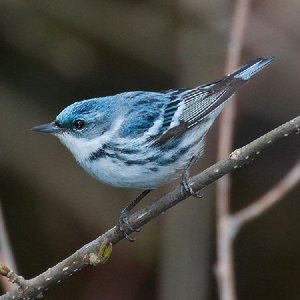

More shade coffee farms for Cerulean Warblers

If there is a single bird strongly associated with shade coffee right now, it’s the Cerulean Warbler. I’ve written about the connection between coffee and Cerulean Warblers in the past. I’ve also discussed the Save the Cerulean Warbler Campaign by the American Bird Conservancy (ABC). That post mentioned the Cerulean Warbler Bird Reserve in the Rio ChucurÁ­ basin of Santander department, Colombia.

The latest news is the ABC and their Colombian partner ProAves have acquired another 3300 acres (1335 ha) of forest and shade coffee plantations just 8 miles (13 km) across the valley from the original reserve. The new preserve will be called Pauxi Pauxi, which is the scientific name for the Northern Helmeted Curassow, one of the threatened species that occurs there. Of course, the preserve is significant wintering habitat for the Cerulean Warbler, as well as other North American migrants.

Earlier this year, ABC was working with Thanksgiving Coffee Company who roasted and sold Cerulean Warbler Conservation Coffee, which I wrote about here. The plans were to begin using coffee that came from in and around the original reserve, with plans to acquire more land and farms and utilize that coffee as well. Right now, I don’t see any mention of the coffee on either web site. Perhaps they are working on the logistics. I look forward to trying some coffee that comes from land that supports these beautiful birds.

Photo: Wikimedia Commons

Solstice greetings from C&C

Warm wishes on the winter solstice, from the main jury members of the Coffee & Conservation tasting panel.

Mike (Risky Kingbird), Greg (Star[bucks]ling), Terry (Coal Tit), Julie (BirdBarista), and Darrin (Kingfisher).  Ordinary people!

Coffee review: Counter Culture Holiday Blend 2007

Plainspoken Coffee. A Coffee Review for Ordinary People by Ordinary People, #31.

We don’t review many blends here at C&C (yet), mostly because it is easier and clearer to provide background and information on single-origin coffees. But we were fascinated by the 2007 Holiday Blend from Counter Culture Coffee. The coffee is a single origin, from the 21st de Septiembre co-operative in Oaxaca, Mexico. The “blend” is actually the use of different roasts of this same coffee, mixing and blending them in an old European technique called Vienna MÁ©lange. More on that in a moment.

The 21st de Septiembre co-op consists of over 950 small family farms (all under 3 hectares) growing certified organic coffee. Over 40% of the coffee comes from the vicinity of the small mountain town of Zaragoza, but there are over 20 communities contributing to the co-op. These farmers were once all part of a larger co-op, but broke away in order to market their higher quality crop alone rather than have it intermixed with lesser beans. Counter Culture buys nearly all of its coffee lots from Zaragoza; as the highest-altitude community (around 1800 meters) it tends to have the best beans.

And, as in much of Oaxaca, the coffee is grown in a fairly traditional manner, in small plots under shade. You can plug in the coordinates of Zaragoza (16.670, -97.793) to see how forested the area is, also shown in the photo at right. The forests of this region, the Sierra Madre del Sur, are considered important endemic bird areas by BirdLife International. This conservation organization lists deforestation from agriculture, including coffee, as one of the threats to the area, so supporting farmers who grown coffee under shade and are able to make a living from their coffee is a way to help preserve this area. The White-throated Jay, shown here, is one of the restricted-range birds found only in the Sierra Madre del Sur.

Counter Culture has developed a direct relationship with the 21st de Septiembre co-op, providing them with generous fair prices for their beans. Additionally, Counter Culture will donate $1 of each pound of the Holiday Blend to the women of the co-op to help them diversify through raising small livestock, and increase their income via a tortilla-making business. Around the world, empowering women is one of the fastest ways to help eradicate poverty. Not only does this buoy entire communities, it goes a very long away in preserving biodiversity and ecosystems. I wrote about the connections between poverty, biodiversity, and coffee here.

On to the coffee itself!

As mentioned above, the Holiday Blend used a roast style called vienna mÁ©lange, mixing and blending different roasts of the same bean selection. I thought this might be something like the “black and tan” blends I’ve seen before, but really the Holiday Blend looked more uniform than expected. In fact, I found it difficult to pick out notable color differences in the beans. This makes sense, as dark roasting Mexican beans would stamp out their delicate sweetness. I’ve done a little coffee roasting in my time, and one reason I quit was because there was no way I would ever be able to figure out whichever precise roast level brought out the very best in each type of bean. I leave that to the experts. So my/our inability to discern subtle differences in the light roasts just proves that we are indeed ordinary people and not coffee experts. Counter Culture isn’t talking smack here — there are really two distinct roasts that each have their own cupping profile in this blend.

Nutty was a word that popped up in descriptions of both the aroma and the flavor of the Holiday Blend. Honey and caramel, and a buttery smoothness were initial impressions, with the nuttiness becoming more pronounced as the cup cooled. Everybody seemed to have had a different nut in mind: peanuts, hazelnuts, almonds, or “anonymous nuts” (trust me, those were in the room that day!). Without having a one-roast-level sample of this coffee to compare it with, it’s hard to say if the vienna mÁ©lange technique added a lot to the coffee. However, the Holiday Blend is mild and mellow, silky and sweet, and I think it would be hard to find anybody that wouldn’t like it. Ergo, it would surely be a great coffee to serve guests. It earned 3.5 motmots, with bonus points for the coffee being organic, Counter Culture’s direct relationship with the 21st de Septiembre co-op, and the financial support empowering women in the community. That all adds up to a great sustainable coffee story.

Habitat still destroyed for cheap corporate coffee

Nearly a year ago, I wrote a post discussing a World Wildlife Fund report revealing that robusta coffee was being illegally grown in southern Sumatra, with most being purchased by large coffee producers such as Kraft and Nestlè (press release here, full PDF here). That report focused on coffee being grown inside Indonesia’s Bukit Barisan Selatan National Park in Lampung province.

Earlier this week, ABC News carried a report on the plight of wild elephants in Sumatra. The story updated the situation at Bukit Barisan, and reported that only 4 elephants out of 60 still survive there. ABC said:

The national park is a protected forest, but a lot of it has been burned and cleared to grow Robusta coffee beans. These beans are commonly used in Europe and North America to make instant coffee.

Nestlè, which makes Nescafe, buys coffee from the region — 40 percent of it from local traders.

A Nestlè spokesman told ABC News, “It might come — we have no way of  knowing — from illegal sources. Law enforcement is not our task.”

In a follow-up post, I provided and update, in which Nestlè admitted the “difficulty of determining the precise origin” of its coffee. The company promised a year ago to increase the scrutiny of its Indonesian sources to make sure it didn’t buy illegally grown beans and launch an effort to clean up its supply chain.

If Nestlè hasn’t bothered to clean up its act, there’s a good reason: consumers are not penalizing them for their poor behavior. For the first nine months of 2007, since the first reports about the illegal coffee came to light, the Nestlè division that includes Nescafe and other coffees grew 10%, with sales — just in this division — of over US$11 billion.  It’s not just Nestlè, Kraft’s North American beverage division also posted a 5.3% gain in net revenues in the third quarter of 2007.

As long as people buy these coffees, they will continue to be produced, no matter how much habitat and wildlife gets destroyed, or how many growers become impoverished. The large multinational corporations that bring us our dirt cheap coffee are motivated by profits. Do you buy this coffee? What motivates you?

Photo of robusta coffee growing in the sun in southern Sumatra, from Smithsonian Migratory Bird Center.

Five great charitable donations related to sustainable coffee

Looking for a holiday gift idea related to sustainable coffee? Here are my five top picks of where to direct your charitable giving. These organizations either directly help coffee farmers or their communities, or support bird research in coffee growing areas. Happy holidays.

  1. Coffee Kids — International non-profit organization established to improve the quality of life for children and families who live in coffee-growing communities. Now operating under a larger foundation.
  2. Smithsonian Migratory Bird Center — Establishing criteria and certifying Bird-Friendly coffee is not the only function of the SMBC. They have many other very important and worthwhile research projects. The donation form directs funds to the parent organization, Smithsonian’s National Zoo and Conservation Biology Institute.
  3. MoSI — Sponsor a bird banding station in the tropics. The Institute of Bird Populations (IBP) coordinates a series of bird research stations across the American tropics, many of which are on or near coffee farms. They provide absolutely vital information on how birds use these habitats in areas where this kind of research is still uncommon and underfunded. MoSi comes from the Spanish “Monitoreo de Sobrevivencia Invernal” or Monitoring Overwintering Survival. You can support the research either by joining IBP at various membership levels, or adopt an entire station for only $300.
  4. TechnoServe — This organization helps people in developing countries launch and build businesses that create income, opportunity, and economic growth. They have an entire agriculture sector that has done solid work specifically on coffee projects, often working with farmers and co-ops, in Nicaragua, El Salvador, and other countries.