July 2007

Quick look at differing shade criteria

[NOTE: Rainforest Alliance standards have undergone several revisions since this post was first written. There is now no criteria for canopy cover and tree diversity, and native vegetation criteria do not have to be met for six years. The Bird-Friendly standard outlined below has been slightly revised, in part to align with requirements for certifying chocolate; while the older criteria are listed the new standard is still much more stringent than the RA standard. This post should only be for historical reference.]

I recently reviewed a paper, Field-testing ecological and economic benefits of coffee certification programs, that included a  summary table of the criteria used for shade certification by Rainforest Alliance, and Smithsonian Migratory Bird Center (under the “Bird-Friendly” trademark).  I thought it would be useful to post a summary here, with a little commentary.

SMBC’s criteria are mandatory, while RA has no required criteria for shade management — the standards below are one of the optional criteria (more on the RA standards and scoring can be found here).


Criteria SMBC RA
No. tree species >10 >12/ha*
No. trees/ha (mean) na >70*
% allowed to be Inga trees <60 na
% shade cover >40 >40*
No. of shade layers 3 2
% leaf volume in each shade layer
….. >15 m (emergent) >20 na
….. 12 to 15 m (backbone) >60 na
….. <12 m (understory) >20 na
Epiphytes required? Yes na

*As of April 2009, standards were modified from the previous version, February 2008. In the old standards, one requirement was for at least 12 native tree species and at least 70 trees per hectare; now it is an average of 12 native tree species, with no minimum number of trees per hectare. Previous criteria stated a minimum of 40% shade cover, now the standard specifies this minimum only on cultivated land.

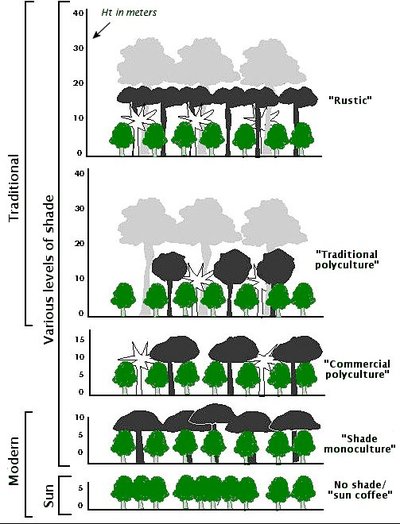
As noted in the previous post, the criteria having to do with vertical stratification — the number of layers of vegetation and the leaf volume in each — are critical components for preserving a rich mix of species.  Many ecological studies support the key role of structural diversity (sometimes referred to technically as floristic heterogeneity) in increased biodiversity — of many types in many ecosystems well beyond the realm of coffee growing. This is the classic schematic illustrating the various coffee production systems and their layers of shade diversity, from a paper by Patricia Moguel and Victor Toledo [1].
Here is a new graphic from SMBC that also illustrates this continuum:

As you can see from the table above, Rainforest Alliance requires (if this criteria is used) only two layers of shade, while Smithsonian requires three. RA has no standards for leaf volume in the shade layers. In short, RA certified farms that use these criteria would have still have structurally-simpler habitats (closer to commercial polyculture) that would likely not support as much biodiversity as farms that met SMBC criteria (closer to traditional polyculture).

A further note. SMBC inspectors visit farms and set up a number of plots and measure various vegetation parameters following methods used in typical ecological studies. The aforementioned paper reports that “Rainforest Alliance inspection auditors rely heavily on data provided by farm managers” (who are not ecologists), and confirm data provided during visits by various estimates and extrapolations.

As an ecologist myself, I am more comfortable that SMBC offers the more stringent, reliable assurance that coffee is grown sustainability if one is comparing certification schemes. And not to beat a dead horse, but the usual caveats apply: there are pros and cons of certification, and many uncertified farms grow coffee sustainably, meeting or exceeding the strongest criteria.

More on SMBCs criteria here, and in the “certifications” category of C&C.

[1] Biodiversity Conservation in Traditional Coffee Systems of Mexico. 1999. Conservation Biology 13:11—21.

Research: Evaluating benefits of coffee certification programs


Field-testing ecological and economic benefits of coffee certification programs.
S. M. Philpot, P. Bichier, R. Rice, and R. Greenberg. 2007. Conservation Biology 21:975-985.

This study looked at the ecological (vegetation, ants and birds) and economic (yield, revenue) aspects of coffee growing for eight cooperatives in Chiapas, Mexico. Farms were certified organic, organic and Fair Trade, or uncertified. None were certified shade-grown, so farms were examined to see if they would meet shade certification criteria.

The authors found no significant differences in vegetation, bird or ant diversity, or percent of forest fauna on farms based on what type of certification they had. While none of the farms had the necessary complexity of vegetation layers that shade certification required, but the other vegetation criteria met by those farms nonetheless corresponded with higher ant and bird diversity. I think this emphasizes the importance of the specific criteria known as “vertical stratification,” or the percent of leaf volume in each of the three layers of vegetation in shaded coffee. I’ll talk a bit more about this in a follow-up post.

Organic farms had a higher number of tree species, and shared more tree, bird, and ant species with forests than uncertified farms or (curiously) those that were certified both organic and Fair Trade.

There was no difference in yield based on certification, contradicting a common perception that without chemical pesticides and fertilizers, yield will decrease.

Farmers with organic or organic and fair trade certification did not always have higher revenues than uncertified farms. Partly this was due to the costs associated with certification programs. Another factor was the differing market prices between the two years of the study. When market prices increased, the premiums for organic coffee rose, but the premium for Fair Trade coffee did not. This can dilute the relative increase for farmers in Fair Trade co-ops, and exposes a previously-discussed weakness in the Fair Trade model. I think the overall lack of substantially higher revenues in certified organic coffee also illustrates the need for some type of a) reform in the cost of certifications and/or b) an increase in the premiums paid to farmers for sustainable coffee — which would require willingness by consumers to pay more.

Coffee review: Papua New Guinea coffees

Recently, I posted a backgrounder on Papua New Guinea coffee. One of my favorite coffees is Allegro Coffee Roaster’s PNG Sigri Estate, which is not reviewed here because the crop ran out and it was unavailable at my local Whole Foods Market. In fact, it’s my understanding that PNG coffees are best when the beans come from the peak of harvest. So these reviews should perhaps be taken with a grain of salt, as this time of year last year’s crop (2006) would be a bit long in the tooth anyway.

First up is The Roasterie’s Kimel Estate, from the Eastern Highlands. This coffee was closest to a Sumatran of the three we tried. It was fairly heavy, sort of tannic and earthy, but not quite as in-your-face as a Sumatran. Very hot, it had sharp notes, but as it cooled the dull leathery tones emerged; I describe these woody/earthy flavors as wet cardboard, which sounds a little more unpleasant than it is.  We found this wasn’t a subtle, sweet coffee, and would be more of a hit with people who like more aggressive tastes. We gave it 2.5 motmots, but our take on this was at complete odds with the description at Coffee Review. Take two reviews and call us in the morning.

Ecco Caffe’s Purosa Estate is an organic coffee that is not technically from a single estate, but from small holders in Western Highlands. This coffee was very bright with a surprising citrus zing when hot.  It was full-bodied, and as it cooled it got a bit syrupy, rustic, and earthy. We found this generally very interesting, with many little flavors hitting the tongue throughout. 3.25 motmots.

Last up was Counter Culture’s Red Mountain, from the Waghi Valley in the Western Highlands. (Caveat: I know this was the last batch from the crop.) The most curious thing about this coffee was that the taste gave us no hint of origin. It was closest to a classic Central American, pleasant and subtle, but with few other distinguishing characteristics. All of us got a fleeting zesty sparkle on the first hot sip; like a shooting star it quickly faded into the dark night. Like the other PNGs, it was medium-bodied, but a bit lighter than the others, further obscuring a sense of source. 2.75 motmots.

These coffees were all over the page. It’s actually one of the things a couple of us really like about PNG coffees — they are a bit mysterious and hard to pin down, you just don’t know what you might get in the cup.  But given the age of the coffees in these reviews, we’re going to revisit PNG coffees when roasters start getting their 2007 crop because none of these lived up to what we have enjoyed in PNGs in the past. Stay tuned.

Quality, price, and sustainability

I made this comment on my post about Counter Culture’s “Source” initiative:

Fair Trade is such a darling of the green set, but it’s certification is restricted to cooperatives, and does little to address quality.

It’s come to my attention that there is a more profound disconnect between price, quality and sustainability by the public than I first suspected. Although I’ve tried to address these issues here at C&C, perhaps I should be more explicit.

First, the connection between price and quality should be self-evident: you get what you pay for. Cheap (= grocery store, mass-marketed) coffee is never going to be great coffee. Coffee is a living crop; it responds to many environmental variables, not the least of which are altitude (generally, the higher it’s grown, the harder and better the bean) and shade (older varieties will only grow well under shade, and shade coffee matures more slowly, which is believed to intensify flavors in the cup). Coffee is also not a direct plant-to-table crop, and the best coffees are hand-picked and initially processed in a labor-intensive manner. Hence, there is no way to efficiently mass-produce coffee in a mountainous terrain with lots of various shade trees “in the way” by using machinery.

Second, high quality coffee promotes environmental sustainability. No farmer receiving premium prices for his coffee — nor any roaster — wants to see the land depleted and crop quality decline. Coffee grown under sun requires high inputs of fertilizers, herbicides, and pesticides, and land is subject to erosion and soil loss. Coffee grown in the shade gets nutrients from fallen canopy leaves, has fewer weeds, attracts birds and other wildlife that reduce pests, and maintains soil integrity. Obviously, it also maintains biodiversity. Coffee farmers who care about their land invariably grow coffee in ways that echo natural ecosystems.

Coffee farmers who receive a higher price for their quality coffee are also less likely to exploit their land for other purposes — whether it is turning to less environmentally-friendly but higher paying crops (including drugs), logging, or pasture.

Finally, there is little incentive to producers to grow high quality coffee except price. Let’s see how our buying practices influence prices, and therefore quality, and ultimately sustainability.

  • If you are buying coffee at a grocery store at around US$6/lb., it was purchased as green beans from producers at between US$0.80 to $1.12/lb [1] on the commodity market. These prices are often lower than the cost of production, a sure path to poverty for farmers. Also, it tastes like crap.
  • If you buy Fair Trade coffee, the producers (which are cooperatives, NOT single farmers or estates, which do not qualify for Fair Trade certification) receive US$1.26/lb. The cooperative decides how the money is distributed to member farmers (or if; it may be reinvested in the capital of the co-op, or community projects). Quality and taste will vary. This price is not a hell of a lot higher than the current commodity price [2], and no matter how brilliant the quality, there is no mechanism built into the Fair Trade model that rewards a farmer for it. Great quality Fair Trade coffee is great not because of Fair Trade, but in spite of it.
  • If you are buying a Cup of Excellence or another award winning coffee, farmers are typically getting over US$5.00/lb. Examples of average prices for the top ten coffees received per pound by farmers or cooperatives from recent CoE auctions are $7.40 for the top El Salvadors, and $9.64 for the top Guatemalans. You’ll pay about $15.00/lb for these carefully-grown, artisan-roasted beans — that’s still less than $0.70 per 6 ounce cup! You can often find beans from the same winning farms that were not part of the CoE auction lot which are usually just as good and cost far less.

The connections between price, quality, and sustainability are much more deep and complex than this (or at 200+ posts I wouldn’t still be at the “scratch the surface” level of this blog). But if you are buying Fair Trade coffee because you believe it is the best mechanism to insure that farmers are paid a fair price or even a living wage, you may want to consider a broader picture, do some research, and try buying the best quality coffee you can afford.

[1] Cost pass-through in the U.S. coffee industry/ERR 38. Economic Research Service, USDA. (PDF).

[2] The day I wrote this in early July 2007, the composite indicator price on the New York Board of Exchange for green commodity coffee was US$1.06.