Ethiopia is the birthplace of coffee. Coffea arabica originates in and still grows wild in Ethiopia in areas which are included in the Eastern Afromontane Biodiversity hotspot. This hotspot — which also covers areas in the coffee-growing regions of Kenya, Tanzania, Rwanda, Burundi — has been reduced to 10% of its original extent. In Ethiopia, only about 2000 sq km of high-quality forest with wild arabica coffee remains.
As coffee consumers, we often hear about this “wild” coffee, or the generally rustic way in which coffee is typically grown in Ethiopia, and so we generally feel good about enjoying Ethiopian coffee from an ecological point of view. Technically, coffee is wild if it grows and reproduces or regenerates on its own within natural habitats.
How much Ethiopian coffee is grown in forests? Is it really coming from a pristine environment? Is this method of coffee production really preserving biodiversity?
 A number of publications over the past few years help shed some light on this topic, and the results are a bit surprising. The diagram at right is one I constructed using data from several sources (list at end of post). It indicates the different methods of coffee cultivation in Ethiopia, with rough approximations of the frequency of occurrence of each. Below are the characteristics of each method. This is all necessarily simplified, but most sources are in general agreement.
Plantation coffee (10%). This is the most intense method of coffee cultivation, where land is cleared and planted with coffee and managed for yield, which ranges from 450 to 1200 kg per ha annually (around 750 seems “average”). This includes larger estates, but may also involve small holders.
Garden coffee (or “semi-forest plantation”) (50%). Here coffee plants are transplanted to gardens around farmers’ homes. These plants might come from nearby forest, or farmers may exchange seedlings best adapted to an area or microhabitat; some may originate from a different region. Coffee is typically interplanted with other crops and fruit trees. Garden coffee is found most frequently in southern Ethiopia, including Sidamo, and well as Harerge/Harrar. Yields range from 200 to 700 kg/ha/yr.
Forest coffee (5%). I think this is what most people probably envision when they hear about “wild” coffee. Here, coffee is harvested from trees growing in the forest, with virtually no management of the surrounding forest or vegetation, except perhaps some removal of undergrowth to facilitate access to the coffee trees. However, it should be noted that several authors have stated that coffee is managed in some way virtually wherever it occurs. Even among locals, “forest coffee” is broadly and variously defined. It may mean old overgrown plantations, or a single coffee tree in a pasture that was once forest. In any event, yields are well below 200 kg per ha, often between a mere 7 to 30 kg.
The Abyssinian Ground-thrush (Zoothera piaggiae) is a very secretive montane forest bird of the Bonga forest, thought to be declining due to habitat loss. Image: Wikimedia Commons.
Semi-forest coffee (35%). Most “forest coffee” is probably really in this category, termed semi-forest coffee. Here, the forest is altered and managed, often quite substantially. The canopy is thinned once to several times a year to allow more light to reach the coffee and increase yields (which vary greatly depending on the extent of management, but are under 400 kg per ha per year). Trees with open, wide-spreading canopies are favored since fewer trees are needed to provide the preferred amount of shade. Undergrowth, competing shrubs, and emerging seedlings of other plants are removed to make harvesting easier and to make room for more coffee. The coffee grows wild, but is also supplemented by shrubs transplanted from elsewhere. Usually this means from a nearby forest, but occasionally even government-supplied cultivars are utilized.
While semi-forest coffee is better than a coffee monoculture with no canopy cover, several studies have shown that the managing of these forests does have serious consequences. Schmitt et al. (2010) found that in the Bonga region, 30% of canopy trees and most undergrowth was removed in these systems, severely disturbing forest structure. Although the overall number of plant species increased by 26% in comparison with intact forest, it was due to secondary and pioneer species, mostly herbaceous species and vines. Forest species declined. Of special concern is the reduction in the number of tree ferns, an ancient family of plants which require shady, moist conditions that are becoming rare in some locations. In Jimma, Aerts et al. (2011) found a near-absence of a true upper canopy >15 m tall, and many climax forest species have nearly disappeared, as they are removed and seedlings are not allowed to regenerate.
Increasingly, forest coffee is being managed as semi-forest coffee, and semi-forest coffee is being managed and harvested with increasing intensity as coffee prices rise. The increasing management intensity has profound impacts on the forest and biodiversity. This diversity includes the genetic resources of wild races of Coffea arabica, as the practice of swapping and transplanting coffee, and any interbreeding, erodes the integrity of wild genotypes.
Volkmann (2008) did an analysis of the areas used by two dozen cooperatives that are part of the Kafa Forest Coffee Farmers Cooperative Union, and concluded that the designation “forest coffee” was probably inappropriate for the output of almost half of them, as they are highly degraded forests, or mostly garden coffee. However, in 2010, this area was designated as UNESCO biosphere reserve. Like other biosphere reserves, the goal is to have a core area that is protected, and buffer zones in which sustainable practices are allowed. Planned projects include reforestation.
Coffee is a main source of income in for people who live in regions where it grows wild. The solution isn’t prohibition, but probably some sort of incentive or compensation to manage the coffee in such a way that forest integrity and species are conserved. One idea being explored is some sort of certification that includes a production ceiling (so that managing for higher yields is not encouraged). The International Standards for Sustainable Wild Collection of Medicinal and Aromatic Plants might be a starting point.
There is much more on the coffee forests of Ethiopia at the web site of the Conservation and use of wild populations of Coffee arabica in the montane rainforests of Ethiopia project web site.
Papers cited and additional resources:
Aerts, R., Hundera, K., Berecha, G., Gijbels, P., Baeten, M., Van Mechelen, M., Hermy, M., Muys, B., and Honnay, O. 2011, in press. Semi-forest coffee cultivation and the conservation of Ethiopian Afromontane rainforest fragments Forest Ecology and Management DOI: 10.1016/j.foreco.2010.12.025
Gole, T.W., T. Borsch, M. Denich, and D. Teketay. 2008. Floristic composition and environmental factors characterizing coffee forests in southwest Ethiopia. Forest Ecology and Management. 255: 2138-2150.
Gove, A.D., K. Hylander, S. Nemomisa, A. Shimelis. 2008. Ethiopian coffee cultivation — Implications for bird conservation and environmental certification. Conservation Letters 1:208-216.
Hylander, K., and S. Nemomissa. 2008. Home garden coffee as a repository of epiphyte biodiversity in Ethiopia. Frontiers in Ecology and the Environment. 6: 524-528.
Labouisse, J., Bellachew, B., Kotecha, S., and Bertrand, B. 2008. Current status of coffee (Coffea arabica L.) genetic resources in Ethiopia: implications for conservation Genetic Resources and Crop Evolution 55:1079-1093. DOI: 10.1007/s10722-008-9361-7
Schmitt, C., Senbeta, F., Denich, M., Preisinger, H., H. Boehmer. 2010. Wild coffee management and plant diversity in the montane rainforest of southwestern Ethiopia African Journal of Ecology 48: 78-86. DOI: 10.1111/j.1365-2028.2009.01084.x
Volkmann, J. 2008. How wild is Ethiopian forest coffee? The disenchantment of a myth. Conservation and use of wild populations of Coffee arabica in the montane rainforests of Ethiopia (CoCE) Project Report, Subproject 5.4. Center for Development Research (ZEF), University of Bonn, Germany.
Wiersum, K.F., T.W. Gole, F. Gatzweiler, J. Volkmann, E. Bognetteau, and O. Wirtu. 2008. Certification of wild coffee in Ethiopia: experiences and challenges. Forests, Trees, and Livelihoods. 18: 9-22.
 Sara Lee and Kraft both announce increases in purchase of certified coffees: what does this mean?
 I’ve written about
 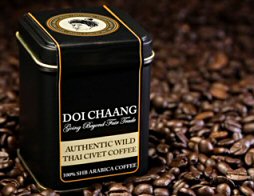 Doi Chaang provided us with a tin of the “spat” wild civet coffee for us to try. Because these are wild civets, the coffee is very limited. This year it is available in 50-gram tins, so we were unable to have a lot of people taste the coffee, so we won’t provide a motmot rating as we usually do. We prepared the civet coffee as a simple pour-over, side by side with their medium roast single estate variety. Later, we also made the medium roast peaberry variety as a drip, and compared notes with another round of the civet as a pourover. We were going to use the peaberry for the side-by-side comparison, but the standard bean version seemed closer in roast level to the civet variety. The latter was, visually, perhaps just a tad lighter.
 A number of publications over the past few years help shed some light on this topic, and the results are a bit surprising. The diagram at right is one I constructed using data from several sources (list at end of post). It indicates the different methods of coffee cultivation in Ethiopia, with rough approximations of the frequency of occurrence of each. Below are the characteristics of each method. This is all necessarily simplified, but most sources are in general agreement.