Get Bird-Friendly coffee at Whole Foods
Two Smithsonian Bird-Friendly certified coffees are now available at Whole Foods Markets nationwide, offered by their wholly-owned subsidiary Allegro Coffee Roasters.
 Early Bird Blend
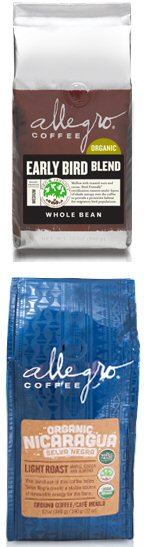 Early Bird Blend
The first is the Early Bird Blend, a special coffee Allegro will keep in rotation to feature Bird-Friendly certified coffees. Currently, it comprised of a blend of Selva Negra from Nicaragua (see below) and the GRAPOS (Grupo de Asesores de Produccion Organica y Sustenable S.C.) co-operative in Chiapas, which is in the buffer zone of the El Triunfo Biosphere Reserve. The Reserve contains the northernmost cloud forests in the world and is considered as one of the greatest biodiversity sites of North America. It’s one of the best of only a few places in the world to see the spectacular and critically endangered Horned Guan.
Allegro plans to utilize other Chiapas farms in the blend, as well as the famous Colombia El Roble (Mesa de los Santos), an origin we first reviewed here, and which has also been used by Birds & Beans in their Chestnut-sided Warbler variety.
Organic Selva Negra
The other is their most recent Origin Direct coffee, Nicaragua Selva Negra. This is the same program that featured the farm El Jaguar earlier this year, where my husband and I did a bunch of bird-banding and insect survey work a couple of years ago. The Origin Direct program (formerly Special Reserve) picks an outstanding source every quarter and awards the producers $10,000 to support community projects.
Selva Negra (the name of the farm is actually La Hammonia) is located near Matagalpa, Nicaragua, and I wrote about it when overviewing that country’s Bird-Friendly certified farms. They also hold Rainforest Alliance and organic certification (the latter necessary for Bird-Friendly certification as well). I have been to Selva Negra twice, and can attest that the 150 ha of preserved cloud forest is fabulous, and contains many unique and rare birds among 280 or so species, plus orchids and other biodiversity. I had two great birding milestones there: my first Resplendent Quetzal, a near threatened species, and my 1000th life bird, a Ruddy Woodcreeper at an ant swarm, which are kind of unusual at high elevations.
Roast and taste
We’ve had an opportunity to try both of these coffees. The Selva Negra is designated as a light roast, although it comes with just a bit of sheen to the beans. The Early Bird Blend is medium. Fans of Birds & Beans light or medium roasts, or generally more robust coffees will find the Early Bird Blend very much to their liking, and it will hold up well to milk and/or sweeteners. The Selva Negra is a bit more subtle, but a perfect every day breakfast coffee. We found both extremely smooth, with several layers of creamy, understated complexity building as they cooled. This was more pronounced with the Selva Negra, which was therefore probably responsible for this characteristic. This quality gave both coffees some of the most lustrous, almost velvety mouthfeels I think I have ever experienced in any day-to-day coffee, versus some much more expensive boutique selections.
Support the Bird-Friendly Early Bird Blend!
There are over 350 Whole Foods Markets; these coffees are currently available bagged and (if there is an Allegro roastery in one of your local stores) fresh in bins ready to be scooped up an enjoyed. This should reduce the number of people I hear saying that Bird-Friendly coffee is too hard to find. You can also buy online from Allegro.
But here is the important part — Allegro is launching the Early Bird Blend to gauge how much this certification resonates with customers. Do you care about the availability of this blend, and want to support the birds and biodiversity emblematic of and the purpose behind Bird-Friendly certification? If so, PLEASE make sure your Whole Foods store manager knows how you feel. Try out the Early Bird Blend and provide feedback to Whole Foods and/or Allegro.
Coffee drinkers have the potential to make a huge impact on the environment and economies of coffee growing nations. This is a terrific opportunity for coffee drinkers concerned about sustainably-grown coffee to stand behind our beliefs.
 All of this increased production takes lots of land, of course. Experts quoted in the Global Coffee Review piece expressed concern about the environmental impacts of all this planting, as well as a flooding of the market with so much coffee when the plantings being to yield fruit. I’d like to give an update country’s coffee production which fuels both China’s increasing domestic consumption as well as exports.