November 2006

Quick shot: Caffe Pronto Guatemalan Maya Ixil

Caffe Pronto Guatemalan Maya Ixil.  I received this coffee from Caffe Pronto just before the holidays, so I did not have a chance to let the panel taste it, so I can’t provide the usual review.  But this coffee’s sustainability begs to have it mentioned here at C&C.  This is bourbon variety coffee, grown organically under native shade trees, and certified Fair Trade.

The Maya Ixil cooperative is located in Quiche Dept. (map), east of the popular Huehuetenango, north of Atitlan, sort of out of the way.  The coop was formed in 1998, and now 124 families have improved both the quality of their coffee and the quality of their lives. The Cuchamatanes montane areas in this region are known for their endemism, especially of amphibians.

I’m very fond of the chocolately tones in Huehues; I had a hard time detecting chocolate in this coffee. It was mild, with a distinctively silky, creamy mouthfeel, and when made in a French press, revealed just a flash of some sort of sweet, fruity taste which did not strike me as a berry flavor.  It was also very nice brewed, and maintained a pleasant taste even when cooled off. If you are looking for a very approachable, environmentally-friendly coffee that also supports indigenous people who have suffered through years of conflict in this relatively remote region, give this a try!

Research: Nesting birds in shade coffee

Gleffe, J.D., J. A. Collazo, M. J. Groom, and L. Miranda-Castro.  2006.  Avian reproduction and the conservation value of shaded coffee plantations.  Ornitologia Neotropical 17: 271-282.

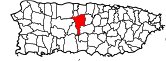
Most of the research on birds and coffee farms focuses on migrant birds which breed in North America and winter in the tropics.  This is the first study to examine the nesting success of resident birds in shade coffee plantations compared to secondary forest.  The study took place in north-central Puerto Rico, and the shade coffee farms were in the Ciales area (map).

The majority of bird nests (72%) were found in shade coffee, and 26 species were recorded in coffee, versus 22 in secondary forest. Six species were found only in coffee, two only in forest.

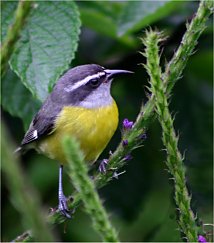
Thirty-two different plant species were used as nest sites in coffee, with the two most common plants used for nesting Inga vera and Andira inermis.  Coffee trees themselves were host to 26% of the nests, many of which were of the Bananaquit (Coereba flaveola), shown here at right. However, it was the canopy trees that were the most important and harbored most of the bird species in both the coffee and forest habitats. The stunning Puerto Rican Woodpecker (Melanerpes portoricensis), an endemic species, is one example of a bird that needs mature canopy trees for nesting. These canopy trees, of course, would not be present in sun coffee plantations, and the authors emphasize that it is the value of shade coffee plantations for preserving birds depends on the shade canopy layer, not the coffee itself.

The study also looked at reproductive success, and discovered that it was similar between coffee and forest, an important finding.  The authors suggest restoration of native shade canopy in existing and new coffee farms to conserve avian diversity in Puerto Rico.  This is especially important because Puerto Rico is experiencing both deforestation due to urban sprawl and development, and the majority of coffee grown there (59%) is sun coffee, with more being converted.  Consumers should choose their Puerto Rican coffee very carefully.  One source I found from the area where the study took place was Finca Cialitos (web site in Spanish, store in English).

Coffee review: Novo Coffee’s Ethiopians

Plainspoken Coffee. A Coffee Review for Ordinary People by Ordinary People, #11

Three Ethiopian selections from Novo Coffee.

In my post about Starbucks Black Apron Ethiopia Gemadro Estate, I suggested Denver’s Novo Coffee as a source for a great variety of Ethiopian coffees.  We tried three Novo Ethiopians, and here’s what we thought.

Hache — The Hache Coop is located in Sidamo. This was one of the lightest roasts we have tried, and certainly lighter than any African coffee we have seen.  We’d describe the color as on the light side of  medium-brown, yet a few showed tiny pinpricks of oil.  The beans were fairly small, and we tried this at 9 days past the roast date, so my guess is that the oil emerged post-roast.

The smell of the beans was far less fruity than we’d expected from an Ethiopian, with only a teasing hint of fruit that is usually so characteristic of this region. Two of us thought it had a woody smell — not woodsy, but like very pleasant fresh-cut lumber, juniper was suggested by one person.  Another pegged it as smelling nutty.  With that, another panelist commented, “I don’t smell enough nuts, dare I say.”

This was a wonderfully full-bodied coffee, velvety and smooth.  Most Ethiopians are very bold and have a lot going on.  This was a less complicated coffee, but still had a background of cherry cordial candies and, when it cooled, just a hint of citrus.  Novo describes flavors of caramel, lingenberry, walnut oil, and cocoa.  None of us had ever seen a lingenberry — maybe that was the “cherry cordial” taste we picked up, and the nutty aromas were the walnut oil.

It did not mention on the Novo site whether this is a dry (natural) or wet (washed) processed bean.  Other roasters have advertised natural beans from the Hache Coop.  We usually associate dry process with a much wilder and more pronounced fruity taste, so I don’t know what to attribute the quiet elegance of this coffee to — a different process, masterful roasting, or an exceptional crop. Whatever the reason, a solid winner, and the favorite Ethiopian any of us had ever tasted.  It would make an excellent choice for somebody’s first foray into the coffees of this country, as it is restrained but still possesses the unique character of Ethiopia. 4 motmots.

Abeba — A member of the Yirgacheffe Union, Adado Coop sits close to the town of Dilla, around 400 km south of the capital of Addis Ababa. As far as we know, this is a dry process coffee. This was the coffee with the most going on, first tried 7 days after the roast date.  Like the Hache, it was a pretty light roast, with small beans.  They had the distinctive berry aroma one expects from an Ethiopian — this was tart and tangy.  There was also a spicy or peppery smell, especially when brewed.  One taster said, “My nose is tingling.”

We did not get the very citrusy pizzazz that we expected from a Yirg (described by Novo as “brilliant tangerine citrus”). The flavor remained stable from hot to cool, was medium to full bodied, with a delicate citrus flavor as well as an interesting floral tone we liked very much and struggled to identify. Novo suggests jasmine, and we also thought perhaps bergamot (although we may have been mixing up our Chinese restaurant and Earl Gray teas!). There was a lingering aftertaste which Novo described as honeydew melon, and we could in fact pick up a little Jolly Rancher flavor there. It was pretty intriguing.

The Abeba had a distinct character and was subtly assertive while still being (if we can trot out this language) approachable. A good choice for an established Ethiopian fan or an adventurous beginner. 3 motmots.

Wild Forest Tega — Kaffa.  This is the birthplace of coffee. Novo states, “As far as we know, this is the first exemplary wild forest coffee available in the U.S.”

We tried this first 11 days after roasting, the last of the three as we expected this to be the most untamed and complex of our choices, and didn’t want to go from the mellow, simple coffees of Latin America that we’d been drinking to something well removed from their straightforwardness.

With some anticipation, we opened the bag. These were larger beans, and roasted slightly darker than the other two.  To our surprise, there was no bold aroma or big fruity smells.  When ground, these beans had a rather unusual golden-orange color which also translated into the cup. The ground beans gave off a sharp, piquant smell, a bit floral?  A couple people noted a chocolate smell. I kind of thought I smelled the forest in the beans.  Sounds hokey, but it was the image that flashed in my head when I smelled them.

This coffee totally surprised us.  It was clean and bright, with no aftertaste. It was exceptionally mild, boring actually.  We tried it stronger, both in the Cafe Solo and in a French press.  It remained consistent from batch to batch; we thought a wild coffee like this might vary from pot to pot. Disappointingly, the constant was unremarkable. It was thin-tasting, with little body (sort of like tea).  It wasn’t bad, just dull. Coffee Review tasted Paradise Roasters Tega and Tula farm forest coffee, and described flavors such as orange, lavender, and pipe tobacco, none of which were evident in this coffee, presumably from nearby.  However, the reviewers also noted another lot from same farm last year was not nearly as distinctive, so perhaps there is a lot of variability. 2.25 motmots.

Novo also sells espresso roasts of the three coffees above, as well as another selection, Addis Katema from Yirgacheffe.  Novo features another origin, Panama, with nine choices, more from this country than I’ve seen offered at any other single place.  Enjoy!

Interactive roaster map!

One of my main goals here at C&C is not only to provide background information so that consumers can choose coffee that does not harm biodiversity, but to do some of the heavy lifting myself. I’ve been as conscientious as possible in researching roasters that carry sustainable coffees.  There is a drawback to mail ordering coffee, and that is shipping costs and, something that personally bothers me a lot, the environmental costs of the fossil fuel use required for the shipping.  This is especially onerous with coffee, because unless you buy green beans, you can’t buy much more coffee than you can drink in two weeks or so.  It just defeats the purpose to buy freshly roasted coffee and not drink it at peak freshness.

So, I’ve tried to research and try out roasters from far and wide.  Below is an interactive map to the roasters I’ve examined so far that meet the criteria described in a previous post; not every coffee from each roaster is sustainable, but all have at least a few offerings that come from biodiversity-friendly sources.  If there are multiple qualified roasters in the same city, I’ve only listed the ones I’ve tried, or that have the highest-rated coffee.

Hover over the markers for the name of the roaster, click on the markers for name, location, web site, and notes. If it’s an orange marker, a street address is given, and it’s a location you can visit (retail store or cafe), mail order only places are green.  If there are multiple locations, that’s noted, too (the note will say "retail" if the coffees are available at grocers, coops, etc.). You can zoom and pan.  You can also visit the map at Zee Maps, and click on "List" in the upper right corner for a color-coded list of names.

Explore and choose a roaster near you!  (I know I have quite a few readers in Europe and Australia…I’ll try to add some more roasters in those regions in the future.)

Coffee review: Counter Culture Honduras El Puente “The Purple Princess”

Plainspoken Coffee. A Coffee Review for Ordinary People by Ordinary People, #10

Counter Culture Honduras El Puente – Marysabel Caballero.  Counter Culture’s Peter Giuliano calls this coffee the Purple Princess “because its perfume and silkiness seem feminine and regal, and the aromas and flavors of the cup—lavender, plum, grape, incense—all seem purple.” I was eager to try this coffee.  Not only did the description seem intriguing (especially for a Central American coffee), I had not yet tried a Honduran.  Importantly, it was also shade grown — and farm owner Marysabel Caballero fosters a hectare of native forest for each hectare of shade coffee she grows.  She has 17.5 ha in coffee at this time.

Caballero’s farm, Finca El Puente, is in southwestern Honduras, La Paz department, near the city of Chinacla; coffees in this vicinity are often marketed under the name of another nearby municipality, Marcala (see map, click to enlarge).  Cataui is the variety grown.

El Puente has a great pedigree in the Cup of Excellence competitions.  It garnered third place in 2004 (under Dulce Nombre) and moved up to second place in 2005.  It slipped to 8th in 2006 (although still scoring 88.91), yet it went for a higher price at auction than any of the other winners.

This was the most subtly complex and distinctive Central American coffee we’ve tasted.  The beans smelled of chocolate — very specifically milk chocoloate, like a Hershey bar — and delicate floral tones. Like many of the coffees we’ve tried, the chocolate doesn’t come through in the cup.  Instead there is a honey-like sweetness and most interesting winey/plum/berry notes after it cools briefly.  This reminded us of African coffees.  I posed this question to Peter, and he told me that Marysabel believes her beans get this unique taste from the repeated washings she gives them with fresh, natural spring water.  Peter notes that “it is common in Kenya to soak coffee in manychanges of fresh water, and coffees that are treated this way frequently have asilky, fruity flavor not unlike the Purple Princess.”  Alas, he says this is speculation, and the mystery of the Purple Princess endures.The Purple Princess comes in at just a feather under 4 motmots, and is easily my most favorite Central American coffee so far.  Highly recommended!

Speaking of motmots, the Blue-throated Motmot, which has the smallest range of the motmots, is found in La Paz dept. Other interesting or restricted range birds found in the vicinity of El Puente are Bushy-crested Jay, Blue-and-white Mockingbird, and the spectacular Resplendent Quetzal.  The (U.S.) federally endangered Golden-cheeked Warbler winters in Honduras, including in La Paz.  The preservation of forest at El Puente takes on added importance in light of the rich bird life of the area.

You can read a review of Counter Culture’s 2005 El Puente crop at Coffee Review.

Map adapted from those at Wikipedia.

Research: The value of wild coffee

Hein, L. and F. Gratweiler. 2006.  The economic value of coffee (Coffea arabica) genetic resources. Ecological Economics 60:76-185.

This fascinating paper is not about the sort of ecological research I usually summarize here, but absolutely keeps with the theme of preserving biodiversity, as well as the recent Ethiopian thread that has come up here lately.

First, the authors introduce the importance of ancestral/wild genetic resources in agricultural crops, since careful breeding can impart in existing cultivars genes that can increase yields, confer disease resistance, and improve quality.  Wild coffee, and therefore its genetic resources, are only found where the species originated, in the highland forests of Ethiopia.  The paper highlights two urgent facts:

  • These forests are disappearing at an alarming rate, a rate at which, if it continues, will eliminate the forests in fewer than ten years.
  • Unlike many other plant seeds, coffee seeds are sensitive to cold and maintain their germination potential for only a couple of months.  Therefore, wild varieties are not candidates for seed banks. They must be preserved growing in the wild.

Although the benefits of preserving genetic resources is widely acknowledged, putting a monetary figure on these resources is difficult. The authors of this paper examined the potential economic benefits of preserving the genetic resources of coffee by looking at several characteristics that are known to occur in wild Ethiopian coffees: resistance to three major coffee pests/diseases, a variety with a lower caffeine content, and a higher yield variety.

They concluded that the economic value of Ethiopian coffee genetic resources is between US$420 million up to $1.45 billion (the variation reflects uncertainty in the coffee markets over the period of time it would take to incorporate wild genes into cultivars).  This does not take into account other beneficial characteristics that might be found in wild coffees, such as heat resistance that will be needed in the face of global climate change.

Current inventories of the genetic diversity in Ethiopian forests are inadequate to determine how much forest needs to be preserved in order to maintain the coffee gene pool, conclude the authors.  Certainly, we do not need to be replacing native forest and wild coffee with large plantations of nursery-grown plants. This paper provides significant economic evidence that preserving Ethiopian forests, and their wild coffee resources, are nearly priceless.