
October 2011

Update on Finca Dos Gatos

In April, I gave an overview of my home coffee growing project, a.k.a. Finca Dos Gatos, prompted by my discovery of buds on one of my Panama plants, planted from seed collected in 2008. Here is an update.

The plant on which I discovered buds on 12 April, and which I believe to be the only typica variety among 10 other caturra, flowered on 25 May. I think I ended up with four flowers.
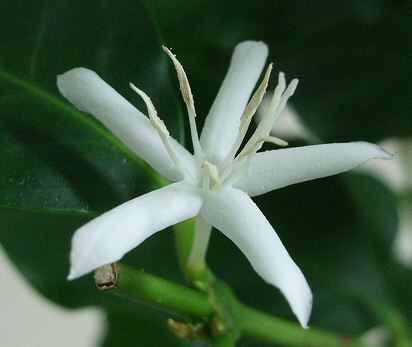
The flowers lasted only a couple of days. Meanwhile, some of the coffee beans I had picked up in Nicaragua in March 2011 were starting to germinate. First was a one of two coffee cherries I picked up at Selva Negra. These were not from the production area, but from a plant growing wild in the cloud forest, right next to the spot where I saw my first Resplendent Quetzals. I thought a coffee plant from that location would be a great memento. My germination method is the same as how I sprouted lima beans in elementary school: on a wet paper towel, kept warm in a plastic food container. One bean sprouted which I planted in soil on 7 May.

Bourbon or caturra seedling, from Selva Negra, ready to plant.

At around the same time, on 15 May, I had a number of beans from El Jaguar start to sprout. Although they grow several varieties, I only collected yellow catuai, for the sake of variety. This variety was developed in Brazil and is commonly grown there, and is a cross between caturra and Mondo Novo

Some ripening yellow catuai at Finca El Jaguar.

We had a very rainy spring here in southern Michigan, so I did not put the coffee outside for the summer until June. By mid-summer, it got very hot here, and I do not have enough shady places in our small yard for all the large plants, so I created some. I purchased some 40% shade cloth, and some plastic snap-on grommets. “S” hooks go through the grommets and hook on to the gutters, and the other grommets fit on tree stakes in the lawn. The shade cloth is therefore very easy to take down to mow. A spare piece of shade cloth can be clipped on top to provide some extra protection on really hot days.
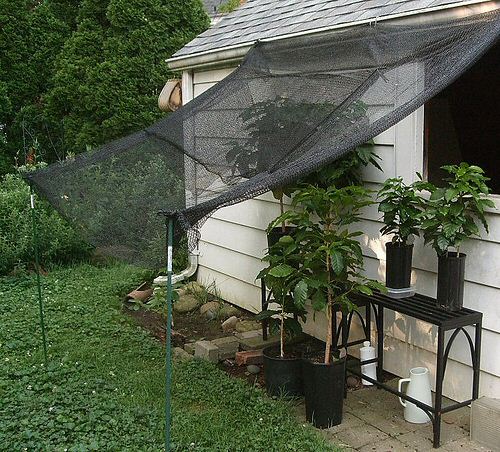
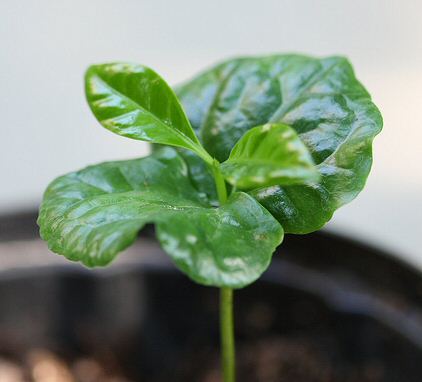
I kept the seedlings in a more protected spot. The Selva Negra seedling grew faster than I remember any of the others progressing. By mid-July it already had its first set of true leaves.
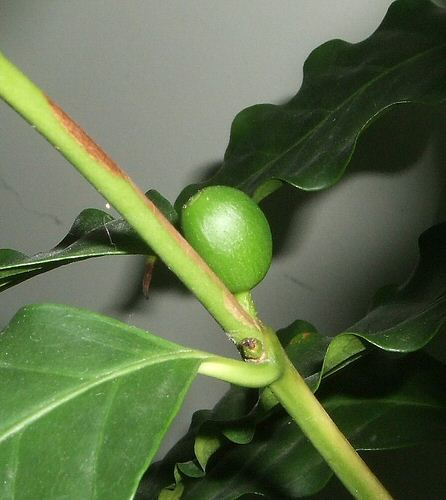
Meanwhile, not much was happening on my plant that had flowered. I read it takes some time for beans to begin to develop. Indeed, I did not find any sign of beans until 15 July.
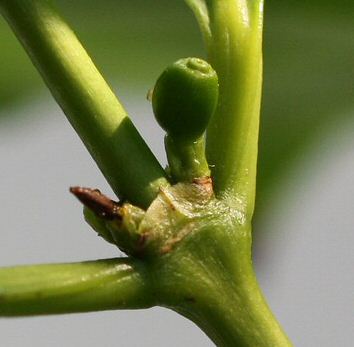
I have a two-bean crop; perhaps they will be ripe by Christmas. One of the other Panama plants also flowered, and had many buds. But the heat and humidity took it’s toll, and I lost most of the buds before they opened. Further, every plant was in dire need of repotting, so on 6 August, I potted up every plant. I used  a good topsoil, plus organic potting soil, all mixed with Espoma Organic Bio-Tone Starter Plus, which contains beneficial bacteria and mycorrhizae. Up to this point, I’d given these plants plenty of root space, using deep, narrow tree pots. The problem at this point was that new containers deep enough for the roots were ridiculously large and heavy. Several Panama plants (3 years old) went into 15″ deep 3.2 gallon tree pots, the last size up that I have.

Not sure how long this one will stay in the larger pot.

The Nicaragua plants (2 years old) are all two growing together. They went into two or three gallon pots. The largest pair posed a dilemma. The little rubber trash can seemed like overkill, so I ended up using a cat litter bucket, after drilling drainage holes in the bottom. What could be more appropriate for Finca Dos Gatos?
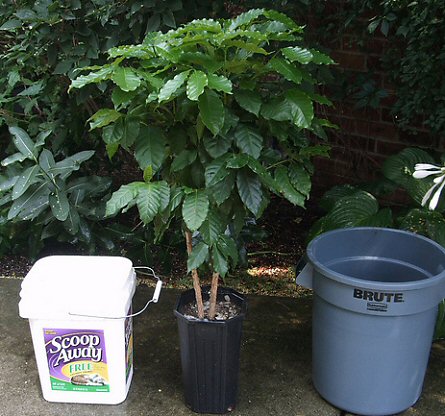
I now have a finca too large for the bedroom window, where I overwintered the plants last year. Indoor winter vacation, which began last month, is now in the basement under two four-foot Sun Blaze T5 fluorescent fixtures, each with four 6500K (blue) bulbs (same as before, just an additional fixture). The lights are on a timer, about 12 hours of light a day.

Three Panama plants on the left; six Nicaragua on floor/to the right (I gave away a pair of Nica, and some seedlings). I have a little class: I covered the cat litter bucket with four duct tape sheets. I didn’t even know such a thing existed, but it sure makes for a durable, waterproof covering. I chose black, but they come in all colors and patterns. Those pots are heavy, so they are on rolling stands.

The seedlings are under a smaller set of lights. As of now, late October 2011, here is the  Selva Negra seedling; it’s about six inches tall.
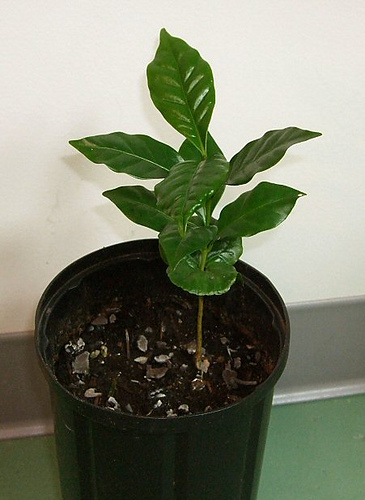
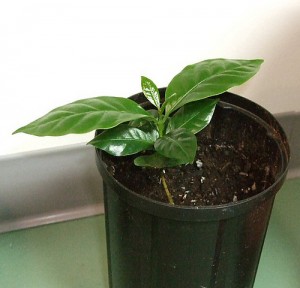
And here is the El Jaguar seedling, about 4.5 inches:
The two unripe cherries survived being transplanted. They are full size, but still green.
I’m happy to report that the two cats for whom the finca is named have stayed out of the pots. Actually, they both like lounging in the bright lights on gloomy days.
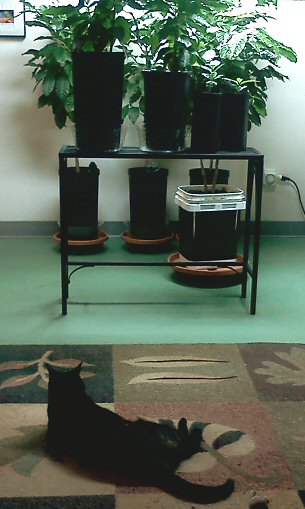
Sophie guarding the finca.

This winter, I plan to induce and promote flowering by providing a dry period followed by renewed water, switching out half the bulbs for red spectrum, and changing the fertilizer. I’ll let you know how it goes early next year.

Coffee growing in India

Legend has it that coffee was smuggled into India around 1600, spread around the region by Dutch traders, but not commercially grown until the early 1800s when the British began establishing coffee plantations. Today, India produces approximately 300,000 metric tons of coffee annually; around 30% is arabica, while the rest is mostly robusta. Kents and S795 are two popular arabica varieties grown in India.

Southern India; Western Ghats in pink. Click to enlarge.

Nearly a quarter of the coffee that is exported from India goes to Italy (no doubt largely robusta that is a component in espresso blends). The United States receives only about 1% of India’s coffee exports. Frequently what ones sees offered in the U.S. is “monsooned” coffee — green coffee stored in open warehouses and subjected to wet monsoon wind, simulating ocean-going ship conditions of yore. This hardly represents the many interesting and varied coffees grown in India — and we’ll be reviewing several in a follow-up post. First, let’s take a look at how coffee is grown in India, with an eye towards biodiversity.

Indian coffee growing regions

Nearly 390,000 ha are planted in coffee in India, 70% of which are small farms of less than 10 ha. The vast majority of coffee is grown in the three southern states of Karnataka (71%), Kerala (22%), and Tamil Nadu (5%). Eighty percent of India’s arabica coffee is grown in Karnataka. In this region, arabica coffee is grown at elevations of 1000 to 1500 m, with some production up to 2000 m. Robusta, of course, is grown at lower elevations. Some familiar regional designations are Chikmagalur, Coorg, and Mysore (all in Karnataka), and Madras (Tamil Nadu).

These southern coffee growing regions are in the Western Ghats mountain range, a biodiversity hotspot that runs some 1450 km along India’s southwest coast. Over a third of the region’s 5000 plant species are found no place else on earth. BirdLife International has also designated a Western Ghats Endemic Bird Area, as it has 16 restricted-range species confined to this region. Among them is the engaging little Black-and-rufous Flycatcher (Ficedula nigrorufa), right. This species lives only in the Western Ghats, and can be found in coffee plantations, but only if there is dense undergrowth. Another near-threatened flycatcher endemic to the Western Ghats is the Nilgiri Flycatcher (Eumyias albicaudatus), below right. This bird is declining due to habitat destruction, but it can be found on shaded coffee plantations, and this is important to its conservation.

And I usually don’t mention insect diversity here because it is so under-studied in general in these areas. However, in addition to birds I do a fair amount of insect work, especially with dragonflies and damselflies. The IUCN (International Union for Conservation of Nature) just released a report, The Status and Distribution of Freshwater Biodiversity in the Western Ghats, India which notes that this area has 174 species of dragonflies and damselflies, 69 of which are endemic. Ten species are of conservation concern,and they, like many other aquatic organisms discussed in the report, are threatened by agricultural pesticides present in the waterways; coffee farms are specifically mentioned. These insects make excellent environmental indicators because of their aquatic and upland life stages that are often tied to specific types of habitat and their sensitivity to water conditions.

Most Indian coffee is shade coffee

Most in coffee in India is grown under shade; pepper and cardamom are frequently planted with coffee as supplemental crops. Not all shade is the same quality. Up to 50 species are used as shade trees, and while they may be comprised of native tree species (various Ficus spp., Syzigium spp., and Artocarpus integrifolia),  increasingly farmers look to supplement their income with fast growing timber species, especially silky oak/silver oak, Grevillea robusta, a tree native to Australia. Various studies

have shown that silver oak is not preferred by birds, and an increase in its use corresponds to a decrease in bird diversity. Some estates severely prune their shade trees, destroying much of the canopy, and it is often timed to coincide with post -harvest — and bird nesting.

Typical arrangement: coffee in the understory, peppercorn vines growing up the trunks of shade trees.

Relatively little coffee grown in India is certified organic. According to the Coffee Board of India, only about 2600 ha of coffee are organic, occurring mostly in Tamil Nadu and Kerala. A number of pests and diseases of coffee in India are fought with chemicals, although integrated pest management is also increasingly used. For example, one prominent pest, mostly of arabica, is the white stem borer (Xylotrechus quadripes), a fairly large beetle. Pesticides once popular for control are now banned, but since the beetle likes to lay its eggs in sunny positions, shade trees are a control option, as are pheromone traps in development.

As in Latin America, various studies have indicated that many bird species can be found in shaded coffee farms in India, although the number of species was slightly lower than in forests and the diversity in farms leaned towards those species that were more adaptable, favored more open or disturbed areas, and that did not depend exclusively on a diet of insects.

Coffee plantations in India are often surrounded by native forests or preserves, and insects, birds, and other wildlife can move between and among the forests and coffee farms. This is extremely valuable for conservation, particularly if the farms are using few chemicals and growing coffee under high quality, native shade.

The C&C tasting crew will be dipping in to some Indian coffees in the coming weeks. Look for a post or two with short reviews of a number of coffees representing the variety that India has to offer. I hope doing a series of mini-reviews will inspire American consumers in particular to expand their coffee horizons and seek out some offerings from this interesting origin.

Links to more information:

  • The articles on the I Need Coffee web site written by coffee farmers Dr. Anand Titus and his wife Geeta Pereira include many profusely illustrated posts on all aspects of coffee growing, biodiversity, climate change, and related topics. You can, and perhaps should, spend hours reading through their detailed information.
  • Ecoagriculture is a relatively new site promoting sustainable agriculture, focusing on coffee and tea, in India. Rainforest Alliance and the Sustainable Agriculture Network are part of the initiative, so it includes resources on RA certification. There is also an associated blog.
  • India, through a birder’s eyes (New York Times)
  • Nature Conservation Foundation

My posts on research studying coffee and biodiversity in India:

Rufous-and-black Flycatcher image from Wikimedia Commons; Nilgiri Flycatcher photo by Sandeep Somasekharan; coffee plantation from INeedCoffee/Michael Allen Smith; all under Creative Commons licenses.

Research: Borer-eating warblers may need nearby forests

Roosting behaviour of a migratory songbird on Jamaican coffee farms: landscape composition may affect delivery of an ecosystem service. Jirinec, Campos, and Johnson 2011. Bird Conservation International.

This is another paper from Matt Johnson and his students from Humboldt State University (CA) who study how birds provide pest control on coffee farms in Jamaica.  Previous papers summarized here include the primary research on which species of North American-breeding birds prey on coffee berry borers on Jamaican farms, and an analysis of how birds controlled the borers on shade and sun farms, and the economic value of the pest reduction.

This study looked at the most important bird species preying on the borers, the Black-throated Blue Warbler. This species was profiled here as part of our Know Your Coffee Birds series.

Researchers captured warblers on two farms in cultivated coffee patches. The birds were fitted with tiny radio transmitters, and the movements of 21 warblers were followed for 7 to 10 days with radio telemetry.

While the birds spend most of their days in the coffee cultivation areas, most (81%) birds roosted (spent the night) in nearby forested habitat patches, not on the coffee farms. Even if a bird roosted within the boundaries of the farm, it was usually in large shade trees or vegetated non-cultivated areas. The average distance between the daytime range and the roost sites was 119 m.

The structure of the vegetation on the farms where the birds foraged was quite different from where the warblers spent the night. Roosting sites had more canopy cover (averaging 94% closed) than the shaded coffee (36% closed). Roosting areas were also very dense. Thus, the Black-throated Blue Warblers in this study appear to choose coffee farms for their good food supply — which includes the coffee berry borer — and forests with dense protective cover to safely spend the night.

This implies that preserving forests, which provide safe haven for roosting birds, in or near coffee farms may encourage them to remain in an area. For farmers to benefit from the pest control services of migratory and resident birds, as well as other ecological services such as pollination provided by other fauna, local land use must be taken into account.

Male Black-throated Blue Warbler banded at the Rouge River Bird Observatory, photo by Julie Craves. All rights reserved.

JIRINEC, V., CAMPOS, B., & JOHNSON, M. (2011). Roosting behaviour of a migratory songbird on Jamaican coffee farms: landscape composition may affect delivery of an ecosystem service Bird Conservation International, 1-9 DOI: 10.1017/S0959270910000614

Endemic Tanzanian coffee threatened by dam

Coffea kihansiensis from Davis and Mvungi 2004.

In 2001, an endemic coffee species, Coffea kihansiensis, was discovered in the Kihansi River gorge in the Udzungwa Mountains of Tanzania. The entire range of this species is estimated at about 17 ha between 775 and 950 m. The habitat was shaped by huge amount of spray from an 800-meter-high waterfall which stabilized temperature and humidity.

A hydroelectric project completed in 1999 diverted over 90% of the flow of the river, severely altering the spray-dependent ecosystems and threatening a range of plant and animal taxa, many of which are unique to this gorge. Prior to the diversion, average temperature and humidity was 70° F and 77% respectively; in 2007 after diversion it was 75° F and 69%. The environmental assessment performed prior to the project initiation only  looked impacts on habitat inundated by the reservoir. It wasn’t until 2001, after completion of the diversion, that monitoring of species at risk from the loss of spray was initiated. This was when Coffea kihansiensis was discovered.

A just-published three-year study (2007-2009)  looked at the health of the coffee trees in the gorge. Because the species was only discovered after completion of the project, pre-diversion parameters are not available. However, field observations made in the immediate years after diversion (2000-2003) found no evidence of insect or other parasitic infestation. In the recent study, over half of the sampled coffee trees had either insect damage (aphids, beetles, or crickets/grasshoppers) or a heartwood-boring insect larva that was usually lethal. The worst infestations were at sites closest to the river which had formerly been constantly drenched in spray. This suggests that the stress of increased temperatures and decreased humidity is making the coffee susceptible to these pests.

Since the general ecology of the area has changed dramatically, it is possible that conditions are now also favorable to the increase in pests; perhaps they were not even present prior to diversion. At least one fruit-eating bird has declined in the gorge, which may have negative effects on the dispersal of Coffea kihansiensis seeds in the area. The reduced flow of the river has also changed the water chemistry and quality. For example, dam releases have resulted in pulses of pesticides from upstream maize farms. The long-term effects of these changes on soils, nutrient dynamics, and the coffee are still not known.

Kihansi Spray Toad, wiped out in the wild by a dam that also threatens an endemic coffee species. Photo Copyright © 2005 Dennis Demello.

Sadly, Coffea kihansiensis is not the poster-child for the environmental damage caused by this project. The Kihansi Spray Toad (Nectophrynoides asperginis) was first described in 1998. It was also endemic to the gorge and dependent on the spray, with a population estimated at nearly 20,000 in a 2-ha range. By 2004, after the diversion, fewer than 5 individuals were found, and it is now extinct in the wild. Fortunately, a group was taken into captivity in 2001, and after much trial and error is now being bred in several zoos.

Ironically, the hydro project was funded by the World Bank and several other development agencies, and now the World Bank is funding much of the spray toad preservation efforts. The World Bank also funded an elaborate, gravity-fed sprinkler system in the gorge designed to mimic the spray from the waterfall. The system has failed at least once due to silt clogs, and it is not known if the toads can be re-introduced in the area because the vegetation changed significantly when the area dried out.

Nobody can begrudge a developing country an opportunity to produce much-needed clean energy. But when can we learn it is less expensive — monetarily and for the environment — to perform due diligence and minimize our impact?

Davis, A., and Mvungi, E. 2004. Two new and endangered species of Coffea (Rubiaceae) from the Eastern Arc Mountains (Tanzania) and notes on associated conservation issues Botanical Journal of the Linnean Society 146:237-245. DOI: 10.1111/j.1095-8339.2004.00328.x

Krajick, K. 2006. The Lost World of the Kihansi Toad Science 311: 1230-1232. DOI: 10.1126/science.311.5765.1230 (PDF)

Rija, A. A., Mwamende, K. A., and Hassan, S. N. 2011. The aftermath of environmental disturbance on the critically endangered Coffea kihansiensis in the Southern Udzungwa Mountains, Tanzania. Tropical Conservation Science 4:359-372. See summary here.