March 2008

Coffee growing in Kenya

Kenyan coffees are distinctive in (at least) two ways.  They have a unique, wine-like flavor, and they are produced and marketed under a government-controlled auction system. Samples are available to bidders prior to the weekly auction, and the highest bidder gets the lot. This means quality is rewarded, and the careful consumer can also be rewarded with great coffee.

Most coffee in Kenya is grown on small farms, organized into co-ops. According to the Coffee Board of Kenya, as of 2005 there were 700,000 smallholders organized into nearly 600 co-ops, and nearly 3300 estates of 2 to 20 ha each. This plethora of tiny plots makes it difficult for consumers to pinpoint the source of their Kenyan coffee, which is often only labeled as “AA” — the highest grade sold at auction. Sometimes it may be labeled with a regional, estate, or co-op name, but finding information on these is nearly impossible for the average consumer. It has only been recently that direct relationships between growers and roasters has been allowed, and the information specialty roasters provide on their producers is a welcome source of crucial information for consumers.

The primary growing regions (included on the map) are those surrounding Mt. Kenya (Nyeri, Murang’a, Kirinyaga, Embu and Meru), Nakuru, Machakos, and Kiambu (mostly estates, includes towns and coffees labeled Ruiru, Thika, Juja and Makuyu).

Biodiversity in coffee areas
Some of these areas coincide with biodiversity hotspots. Mount Kenya is considered an Important Bird Area, and agricultural expansion and intensification is considered an important threat. The Kenya Mountains are also classified as an important Endemic Bird Area, with seven of the nine restricted range species being found on Mt. Kenya.

Forest covers only less than 2% of the land area in Kenya (around 5% counting modified forests), a loss of 80% of its original extent. These montane forests, in addition to being critical for birds and wildlife, are equally important to people: the forests on Mt. Kenya feed rivers that supply 40 to 50% of the country’s fresh water, which also produce 70% of its hydroelectric power. Around 8% of Kenya’s land is arable, and 4% of that is planted in coffee. Farmers of all types have been using more water for irrigation, creating shortages downstream.

I was frustrated in my attempts to find information on how coffee farming has impacted birds in the country. I was pleased to find a very recent paper on a related topic [1], but was surprised to read “Information on bird communities in Afrotropical agroecosystems is particularly scarce and, to our knowledge, only two studies have been conducted in eastern Africa.” I have no direct information, then, on how coffee growing has influenced biodiversity in Kenya. Coffee is obviously an important crop, grown in sensitive areas that are facing numerous pressures.

Environmental sustainability
The coffee varieties grown in Kenya are often Bourbon types with alpha-numerical names, all beginning “SL”. This stands for Scott Laboratories, the developer of the strains (SL28 and SL34 are high-quality names you may have heard). Despite the Bourbon heritage, usually a shade grown variety, most Kenyan coffee is grown in sun. The climate in the Kenyan highlands (cooler temperatures, humidity, even rainfall) often makes shade unnecessary. However, many farms did have shade trees, which were removed when coffee prices dropped in the 1980s and 1990s with the hope of increased yields. As we know, sun coffee requires more chemical inputs, and these expenses hampered rather than helped small farmers. Some are now replanting their shade trees. Photos of estates that I have seen, though, appear to still be acres of sun coffee, and look as if they have little or no habitat for native species.

There isn’t much certified organic coffee from Kenya. Although many small farmers can’t afford chemicals and may be passive organic, much of Kenya’s coffee is doused with pesticides [2]. And, given the pooled system, any untreated coffee will be mixed with chemically-grown coffee, and it will be nearly impossible to know what is what. As I’ve discussed elsewhere, this isn’t much of a risk to consumers, but harms the environment and the farmers themselves.

Most estates use pesticides, herbicides, and fungicides. I saw a slide in a presentation by the Coffee Board of Kenya shows the essentials of planting out young coffee trees: top soil, sub soil, manure, and furadan (carbofuran). Yikes!  Coffee rust (Hemileia vastatrix) is a common problem, and is treated with copper fungicides; copper builds up in soils after years of treatment. This can create toxic levels in other food crops planted with the coffee [3]. Pesticides have also been found in water supplies in coffee-growing communities [4].

Conclusions
I often feel uncertain considering coffee from Kenya, and my research hasn’t clarified too much for me. I certainly recommend avoiding generic “Kenya AA” coffee, and those grown on estates. Look for Kenyan coffee labeled with the name of a cooperative, not just a regional name. Even better, aim for a micro-lot or sub-lot of coffee from a particular cooperative; these will sometimes be labeled with the name of the co-op, and an auction lot number, or the co-op and the “factory” name (the mill or what would be called the beneficio in Spanish). Counter Culture Coffee has offerings such as this, and product descriptions include a link to a Google Map of the source.

With the liberalization of the Kenyan coffee market, more and more specialty roasters are buying small lots directly from farmers, often providing detailed information on the farms. This is a terrific best option. The only single-farm source I’ve seen is from Terroir Coffee Company — Mamuto Farm from the Kirinyaga region. It got an incredible — and well-deserved — 97 points from Coffee Review. It is one the best coffees I have ever tasted, and there is a link in the description to farm photos.

I’m excited about seeing more direct trade relationships between Kenyan farmers and roasters. It will vastly improve transparency, has the potential for really improving the lives of the farmers, and gives consumers a chance to motivate and encourage the production of coffee grown with fewer chemicals in conditions that favor the return of biodiversity to their land.

[1] Laube, I., N. Breitbach, and K. Bohning-Gaese. 2008. Avian diversity in a Kenyan agroecosystem: effects of habitat structure and proximity to forest. Journal of Ornithology 149:181-191.

[2] Nyambo, B. T., D. M. Masaba, and G. J. Hakiza. 1996. Integrated pest management of coffee for small-scale farmers in East Africa: needs and limitations. Integrated Pest Management Reviews 1(3):125-132.

[3] Loland, J., and B. R. Singh. 2004. Copper contamination of soil and vegetation in coffee orchards after long-term use of Cu fungicides. Nutrient Cycling in Agroecosystems 69:203-211.

[4] Mwanthi, M. W. 1998. Occurrence of three Pesticides in community water supplies, Kenya. Bulletin of Environmental Contamination and Toxicology 60:601-608.

Photo by 60mls; thanks for publishing under a Creative Commons license.

New Cerulean Warbler coffee available

You’ve followed the saga of the flagship shade-coffee bird, the Cerulean Warbler, on these pages. If you need to catch up:

  • An introduction to the declining Cerulean Warbler, and its connection to shade coffee on its Colombia wintering grounds.
  • Discussion of the American Bird Conservancy’s (ABC) Cerulean Warbler campaign. ABC partnered to purchase warbler habitat in Santander, Colombia which included shade coffee farms, and also began promoting a Cerulean Warbler coffee, roasted by Thanksgiving Coffee Company, which was sourced in Antioquia, another important warbler wintering region. ABC added more land to the original reserve late last year.
  • News from a bird conference I attended in February was that a new shipment of coffee from Antioquia would be offered by Thanksgiving in March, the plan was to begin importing coffee from the Santander preserve soon. I just browsed through all the coffees at Thanksgiving, and found no Cerulean Warbler coffee, nor did a search turn it up.  There are no direct links on the ABC site either, but a search there provides this page, which  does link to a page to an order page at Thanksgiving.

Sweet Maria’s, North America’s best source of green coffee for home roasters, just received a small lot from Antioquia, I believe the same co-op Thanksgiving sources from (although the lot may be a subset of farmers working on the Cerulean Warbler project). Tom gave this coffee a really good review, which is really encouraging. If you are a home roaster, I encourage you to give this coffee a try — at $5.50/lb. green it’s cheaper than Folgers!

What does a great cup of coffee cost?

The biggest obstacle, in my experience, in getting people to switch from crappy grocery store coffee to sustainable coffee is price. Even people who profess to be bird lovers, concerned with the environment, and aware of the issues surrounding sun and technified coffee frequently default to price. This, it seems, is the American way.

Is really great coffee really that expensive?
I recently decided to splurge on some expensive coffee just for myself (while many of the Coffee & Conservation tasting panel is on spring break). I ordered a half-pound bag of the #2 coffee in the 2007 Bolivian Cup of Excellence competition, Juana Mamami Huanca’s San Ignacio farm, from Terroir Coffee Company. It was $34.95. That is high-dollar coffee. But based on two tablespoons of coffee per six-ounce cup, it still works out to less than $3 for a cup of fantastic coffee.

Most of the specialty coffee that is reviewed here costs in the range of $9.95 to $14.95 for a 12-ounce bag. That works out to $0.32 to $0.48 a cup. A pound of coffee from Caribou or Starbucks runs about $13 a pound, or $0.32 a cup. This is at least six times cheaper than a couple of shots of decent scotch or a glass of wine from a $15 bottle, not to mention less than the cost of a cup of (unsustainable) coffee at McDonald’s or Dunkin Donuts.

It might be a little less convenient to make coffee at home, but it’s obviously economical. In fact, I think this little exercise demonstrates that the excuse that specialty coffee is too expensive is a bit far-fetched. Do the math: Folgers is about $0.25 a cup, or you can enjoy this sweet, fantastic, organic shade-grown coffee for $0.55 a cup. All things considered, drinking the grocery store coffee just doesn’t add up.

Photo by Scott Feldstein; thanks for publishing under a Creative Commons license.

Coffee growing in Australia

Coffee in Australia?
Coffee was first grown in Australia over a century ago, without much economic success. The high cost of labor made commercial coffee growing unprofitable until mechanical harvesting became common in the 1980s.

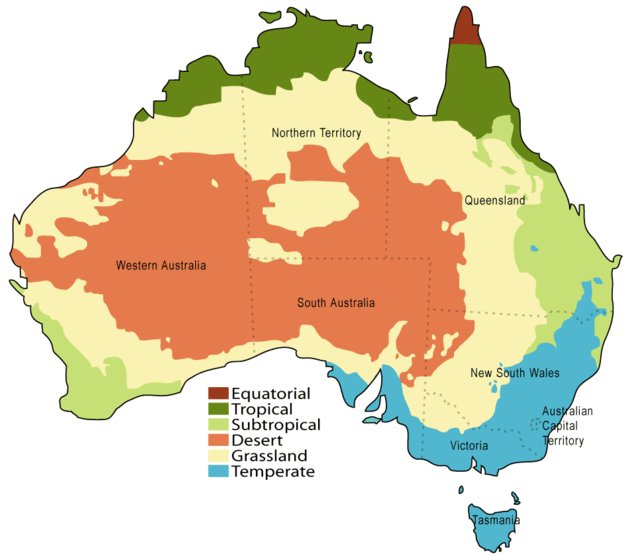
Today, coffee is grown mostly in the far eastern part of the country, corresponding to the light green subtropical regions on the map (click to enlarge). Two important areas are the Atherton Tablelands in northern Queensland outside of Cairns, with about 30 large growers on over 700 ha, and in northern New South Wales (NSW) just south of the Queensland border, where there are around 170 growers on 500 ha. If you have some sense from the vague atlas in your head that these areas are not high elevation, you’d be correct. Australian coffee is a rule breaker. Not only is the country outside the tropics, but coffee is typically grown at 200-400 meters, not infrequently lower, and rarely much above 900 meters.

Despite the low elevations, Australia grows arabica almost exclusively. The typica variety is grown, but also catuai, Mundo Novo (hybrid of bourbon and typica), and especially Kenyan varieties more suited to the drier Australian climate such as K7 and SL6. Coffee is processed every which-way: some wet processing, some semi-washed (pulped natural), some dry processed (full natural), and a unique method developed by the Mountain Top Coffee Company called “double pass.” This is where a full natural process bean (dried on the tree) is rehydrated before being pulped.

Australia currently produces 200 to 600 tons of coffee annually, half of which is exported, an amount so low it does not even get listed in the International Coffee Organization’s production statistics. It’s rarely seen in the United States, but there has been considerable investment in the specialty coffee industry in Australia along with increasing market presence.

Sustainability
I mentioned the advent of mechanized harvesting helping the Australian coffee industry turn the corner. Mechanical harvesting reduces or eliminates the need for workers to hand-pick beans, which can account for 50% of labor costs. It also requires coffee to be grown on flat land in rows in a monoculture. Thus, all the mechanized coffee in Australia (which is most of the commercial crop) is grown in full sun (an example here).

Mechanical harvesting also works best when the beans ripen simultaneously rather than over an extended period of time. The Australian climate, with pronounced dry seasons, lends itself to this as well. As in Brazil, coffee is irrigated after a dry period — sometimes water is deliberately withheld — in order to induce a bloom.

It’s often written that Australian coffee is grown without pesticides, as most of the usual coffee pests are not present Down Under. However, some have been recently introduced (e.g., green scale), and others are a problem as well (brown scale, avocado leaf-rollers, and mealy bugs). Insecticides are in fact used for these insects by some growers. Further, sun coffee usually needs a lot of fertilizer. I have had trouble finding any Australian coffee that is actually certified organic. The Australian Coffee Traders Association even notes, “There are many Australian brands which claim to be 100% organic but the certification is questionable.”

Habitat loss in Australian coffee-growing regions
According to the Australian Natural Resource Atlas (ANRA), 30-70% of subregional ecosystems are at risk in the coffee-growing areas of Australia, with higher instances in NSW. The major growing areas have different types of native vegetation. The major Queensland native type in the coffee-growing highlands is eucalyptus woodlands (pdf), and a good deal of it remains. The New South Wales north coast area is slightly different, with eucalyptus open forest (pdf), although far less native vegetation remains in this region. This loss of habitat contributes to the fact that the NSW coffee areas also have many threatened plant and animal species; it is considered one of the richest bioregions for birds in the country. Although traditionally the area with smaller coffee farms, it is the NSW region that is pushing for a major expansion in coffee production.

The map (click to enlarge) shows the change in breeding bird species reported during the last 20 years. The Queensland coffee area shows no significant change, but the NSW area has a significant decrease. The super-cool endemic Crested Tit-Shrike (Falcunculus frontatus, pictured) is considered an indicator species in both areas, as it is found in both characteristic types of eucalyptus forests. The Black-breasted Button-quail (Turnix melanogaster)
is an example of an endemic bird that is under severe threat from land-clearing due to agriculture; its range is restricted to coastal and near-coastal regions of southeastern Queensland and north-eastern NSW.

In contrast with researching how agriculture and coffee might impact biodiversity in some areas of the tropics, there is an abundance of information on habitats and threats in Australia (almost too much data to digest!), although nothing specific to coffee, given the relatively small footprint. You can read biodiversity assessments for the NSW North Coast and the Einasleigh Uplands of Queensland, which cover the important coffee-growing areas in Australia.

Bottom line
Overall, I was not left with a great feeling about compatibility of natural habitats and biodiversity and the coffee industry in Australia. Australian coffee is not common in the U.S., but the one bag we tried — from a leading Australian brand and a U.S. roaster with a very good reputation — was nothing special. In fact, nobody liked it. It was flat, and the most frequent adjectives were “ashy,” “tobacco,” and “coal.” Should we be able to taste a wider sampling, we will post some reviews, but I’m really not motivated or inclined to seek them out. There are plenty of great coffees from that part of the world that are grown more harmoniously with native ecosystems.

Kangaroo crossing sign by Casa de Queso; thanks for publishing under a Creative Commons license;
Climate map from Wikipedia; bird map from the Australian Natural Resource Atlas; Crested Tit-Shrike from the Australian Museum.

Allegro/Whole Foods shade coffee promotion

It was nice to be in a Whole Foods Market today and see some of their Allegro Coffee varieties in a display featuring birds and their “Caffeinate Your Conscience with Shade Grown Coffee” promotion, going on through early April. The web site has a brief but accurate blurb about the importance of shade coffee to birds, and a number of species are portrayed on the in-store display. A few were odd choices to represent shade coffee, especially the two shorebirds (Solitary Sandpiper and Lesser Yellowlegs). These shorebirds are definitely long-distance migrants which winter in the tropics, but obviously do not use forested habitats.

On the plus side, Allegro’s three featured shade coffees do come from sustainable sources. All are organic.

  • El Salvador, Santa Adelaida Cooperative. Also Rainforest Alliance certified. You can read my review of this coffee here.
  • Guatemala, Lake Atitlan, La Voz Cooperative. This co-op (full name: La Voz qui Clama en el Desierto), which began growing coffee in 1985, now comprises 120 families. Coffee is grown at 1500 meters in the district of San Juan La Laguna, SololÁ¡ near Lake Atitlan. I believe at one time this was Smithsonian Bird-Friendly certified, but it is not currently on their list. If so, it’s more likely this has to do with economics (the expense of renewing certification) versus a change in ecological management.
  • Mexico, Zaragoza, 21st of September Cooperative. Fair Trade certified. This is the same source that was used in the 2007 Counter Culture Holiday Blend, and you can read that review here. I also gave Allegro’s a try. It was a light roast somewhere in between the two roast levels Counter Culture used in their blend, and it was outstandingly sweet and candy-like. Really an exceptional example of a chocolatey classic Latin American coffee.

Kudos to Whole Foods and Allegro Coffee Roasters for bringing the birds and coffee connection to the attention of the public.

Coffee farms and carbon sequestration

In my post, “Why certifying shade coffee is so complex,” I ended with a comment regarding the upside-down nature of shade (or organic) certification. That is, the burden of certification costs are on the producers who are doing the right thing, rather than on the producers who are damaging the environment. Small producers, who are more likely to preserve forests and grow coffee under diverse shade (both of which enhance biodiversity) and are less likely to use chemicals, are the least able to afford certification.

I’ve been ruminating about this ever since, and wondered if some sort of “cap and trade” system might be helpful. What I had in mind were “credits” for forest or habitat preservation and enhancement small eco-friendly farms could “sell” to naughty sun coffee growers. This was inspired by a similar system: carbon credits. So while I let this idea simmer, it’s worthwhile to briefly discuss the role of carbon credits themselves, and their potential to generate income for farmers practicing sustainable agriculture, including shade coffee.

Quick primer on terrestrial carbon sequestration
Trees (and other plants) sequester carbon by removing it from the atmosphere through photosynthesis and incorporating into their tissues. Existing forests are carbon sinks (or ”carbon storage units”) and contain over half of the terrestrial carbon in the world. Carbon remains stored in plant tissues until released, in this case most often by burning and decomposition.  Agroforestry systems, including shade coffee farms, that preserve forest are therefore acting as carbon sinks.

Reforestation also contributes to the sequestration of carbon, although the rate in which carbon is taken up and stored by plants varies among species, as well as where they are grown and if and how they are managed. This means that sun coffee farms converted to shade in which the appropriate tree species are planted and managed have the potential to effectively sequester carbon.

Carbon is also stored in leaf litter and other organic matter in the soil. Sustainable coffee agrosystems frequently rely on fallen leaves from their shade trees as well as the application of coffee skins and other organic matter for soil moisture retention and fertilization, providing another means in which these farms can contribute to carbon sequestration.

How much carbon can coffee farms store?
Although measuring carbon storage is difficult due to the multiple variables involved (even plots in the same region with similar tree species composition can vary in their storage capacity depending on microclimate, soil types, etc.), recent research has revealed some encouraging facts. A few examples:

  • In the tropics, potential carbon sequestration rates for smallholder, sustainable agroforestry systems range from 1.5 to 3.5 megagrams (tonnes) per hectare per year, or 2.1 billion megagrams annually worldwide.
  • It has been estimated that each hectare of sustainable agroforestry in the tropics could potentially offset 5 to 20 ha of deforestation.
  • Models have estimated a 5-year-old coffee farm shaded with two common Latin American tree species (Erythrina poeppigiana and Cordia alliodora) could sequester 5.3 megagrams per hectare.
  • Soil carbon stocks in shade coffee were 60% of that expected in primary forest in Sumatra, versus 45% for sun coffee.
  • In El Salvador, carbon sequestration values for various types of shade coffee management were estimated (in tons per ha per year): 174 for rustic shade to 77 for shade monoculture.
  • A study of carbon stocks in Costa Rican coffee farms calculated aerial (above ground) carbon stocks ranging from 11 megagrams per ha for simple shade (one heavily pruned shade species) to nearly 32 for diverse shade.
  • Using these figures, a farmer with 10 ha in diversified shade coffee could receive a one-time $3000 payment (based on previously carbon transactions for the country), as well as a reduction in expenses from chemical inputs and have timber and fruit for additional income. The payment is over three times greater than would be obtained for the carbon stocks in simple shade coffee systems.

The non-profit TechnoServe is exploring the use of carbon credit trading for promoting sustainable agroforestry, using a Guatemalan coffee cooperative (more here). Small holders in Oaxaca and Chiapas, Mexico, are gaining access to carbon credit funds to pay for sustainable agroforestry there, where a great deal of coffee is grown (more here).

It appears sustainable coffee agroforestry can play a role in helping to mitigate global climate change through carbon sequestration, and in the process also provide additional income and further incentive to growing shade coffee. I have a feeling we’ll be hearing much more about this in the future.

More reading, including sources for the figures above:

  • Smallholder agroforestry projects: Potential for carbon sequestration and poverty alleviation. O. J. Cacho, G. R. Marshall, and M. Milne. 2003.  ESA Working Paper No. 03-06. Agricultural and Development Economics Division, The Food and Agriculture Organizationof the United Nations.
  • Carbon sequestration in tropical and temperate agroforestry systems: a review with examples from Costa Rica and southern Canada. M. Oelbermann, R. P. Voroney, and A. M. Gordon. 2004. Agriculture, Ecosystems and Environment 104: 359-377.
  • Carbon sequestration: An underexploited environmental benefit of agroforestry systems. F. Montagnini and P. K. R. Nair. 2004. Agroforestry Systems 61:281-295.
  • Carbon stock assessment for a forest-to-coffee conversion landscape in Sumber-Jaya (Lampung, Indonesia): from allometric equations to land use change analysis. M. van Noordwijk, S. Rahayu, K. Hairiah, Y. C. Wulan, A. Farida, and. B. Verbist. 2002. Science in China (PDF here).
  • Carbon sequestration in coffee agroforestry plantations of Central America. 21st International Conference on Coffee Science, 2006.
  • Sustainability in the coffee sector: exploring opportunities for international cooperation. U.N. Conference on Trade and Development. 2003. (PDF here)
  • Carbon Storage in Coffee Agroecosystems of Southern Costa Rica: Potential Applications for the Clean Development Mechanism. C. Polzot. 2004. M.S. thesis, York University, Toronto.  Includes excellent cited information on the mechanisms of carbon sequestration in agroforestry systems, and Costa Rica’s Payment for Environmental Services programs.