 The beautiful Baltimore Oriole (Icterus galbula) is a familiar summertime sight across eastern North America (as is its western counterpart, the Bullock’s Oriole, I. bullockii; the two were once considered the same species). Their cheerful whistled notes and distinctive bag-like hanging nests are characteristic of woodland edges, open areas with scattered tall trees, and mature suburban neighborhoods. The brilliant orange and black plumage of adult males (young males, females, and juveniles are all duller) make the Baltimore Oriole one of the most colorful and arresting species of songbird in North America.
One reason these orioles are so beloved is that they are easily attracted to feeding stations which offer grape jelly or oranges sliced in half. Baltimore Orioles are also conspicuous in spring and early summer as they feed on the nectar and pollen of the blossoms of flowering trees. Although during most of the nesting season they feed on insects, as do most songbirds, it is this affection for fruit and nectar that hint at the habits of orioles on their Latin American wintering grounds.
Trees in the large genus Inga are popular shade trees in Latin American coffee farms. They are fast-growing, evergreen, easy to prune, and fix nitrogen in the soil. While their overuse generally does not benefit biodiversity if they are planted at the expense of a variety of other trees, Ingas do have wildlife value. They produce an abundance of flowers in the dry season (our winter) to which many birds are attracted. Nectar and pollen are important food sources for birds during the dry season, when fewer insects are available.
The nearly ubiquitous presence of Inga on coffee farms almost always assures the presence of Baltimore Orioles on these farms in their wintering range as well. In fact, surveys in Chiapas, Mexico found more Baltimore Orioles in coffee farms containing Inga than in farms with more extensive tree cover or in mature forest.
In areas where coffee farms have been converted to sun coffee, Inga-shaded farms have become important refuges for orioles as well as other species. Small flocks of Baltimore Orioles, working their way through coffee farms in the mid-canopy of Inga are a frequent sight from Mexico through Central America. Other flowering trees that are often grown as shade trees in coffee farms, such as Erythrina and Gliricidia, are also visited by orioles and other birds. Many of these trees are pollinated only by birds and provide farmers with fuelwood and fruit in addition to shading their coffee. A fine example of the interconnectedness of coffee, shade trees, birds, and people in Latin America.
Top oriole photo from Wikimedia Commons, bottom by JimGuy, used with permission; map by Cornell Lab of Ornithology.

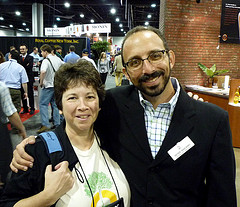 The Kojo Nnamdi show, out of WAMU in Washington, DC, had a segment on specialty coffee this week. Guests were Counter Culture’s Peter Giuliano (gratuitous photo of Peter and I at right; I’ve been waiting for an excuse to post this); Ric Rhinehart, Executive Director of the Specialty Coffee Association of America; Ryan Jensen, owner of Peregrine Espresso in DC; and Dale Roberts, owner of Java Shack in Arlington, VA.


