December 2008

Not-quite-coffee review: Finca Mauritania Cascara

Just to end the year on a unique note, we decided to try an interesting and unique coffee product, cascara. This is dried coffee cherry, and can be prepared as an infusion like tea.

Something old is new again
Although unfamiliar to most Westerners, this is an ancient beverage in Yemen — it may have even pre-dated the actual roasting and brewing of coffee beans. There, and in a few other countries where it is prepared, it’s known as qishar (or qishr, quishar, quishr, keshir, etc.). In Yemen qishar is often made with ginger, sugar, and cinnamon (although many recipes you’ll find will substitute the coffee “husks” with ground coffee).

Enter Aida Batlle!
If anybody in the New World was going to produce and market qishar to the specialty coffee world, it was going to be Aida Batlle, proprietor of three outstanding El Salvador coffee farms — Los Alpes, Finca Kilimanjaro, and Finca Mauritania. She’s committed to quality, sustainability, and innovation.

Coffee is rarely dry processed in Central America due to the damp climate which is so much in contrast with the arid origins of most dry processed beans. But Aida has been experimenting with both dry process and pulped naturals for some time. For her dry process coffee, which she calls “pasa” (“raisin” in Spanish), she leaves the cherries on the tree after they ripen until they dry out and look like raisins. The beans are hulled from the cherries. Normally coffee pulp and skins — from either wet or dry processing — are composted and used for fertilizer. In this case, the dried cherry is used for cascara.

Aida produced around 225 pounds of cascara from her Finca Mauritania harvest. I obtained my cascara from James Hoffman‘s Square Mile Coffee Roasters in the UK, and from Counter Culture Coffee. Square Mile is sold out for the year; I don’t think Counter Culture offered it for sale but used it at tastings and as gifts.

During a visit to Yemen last year, Thom Owen of Sweet Maria’s took a photo of some qishar. It appeared not very uniform, with hunks of hulls and crusty pulp, and it looked dry and flaky. The Finca Mauritania cascara looks much like tree bark, was a rich reddish-brown color, and had a pliable texture.

This bark-like appearance no doubt gave this product its name, as “cascara” refers to tree bark in Spanish. This coffee cascara should not be confused with cascara sagrada, the dried bark of the California buckthorn tree, Rhamnus purshiana. Nearly all Rhamnus have phytochemicals that act as laxatives, and Rhamnus purshiana has long been used as an herbal laxative. Be forewarned that at least in North America, if you Google “cascara” you get lots of hits on the constipation cure, not the coffee tea!

Preparation and taste
The aroma of the raw cascara is powerful and intoxicating. Nearly every person who stuck their nose in the bag said “Wow!” Two descriptions for the smell of the raw cascara came up frequently: raisins and pipe tobacco. The latter aroma sent me back 40 years to sitting on my grandfather’s lap as he smoked a fragrant pipe. Both my husband and I, the only ones from our tasting group that had ever been near coffee mills at harvest time, also recognized the familiar sweet smell of slightly fermented coffee pulp. Licorice came up a couple times, and others detected wine, apple chips, or dried cherries. A few of us tried just chewing on a pinch of the stuff. I thought it was quite good, and the flavor lasted until the chips were well masticated. (This might be the non-liquid solution to a caffeine fix in the field. Bonus: fiber!)

Cascara is brewed like tea. No additional prep is needed — just use the cascara straight from the package. Square Mile recommends a ratio of 20 to 25 grams per liter of water and a 4-minute steep time. Sweet Maria’s advised using the same proportions as brewing coffee, with a steeping time of 4 to 12 minutes, with 8 to 10 minutes being best. Experiment! Your mileage may vary.

Upon brewing, the first thing you’ll notice is that the aroma of the beverage is not like the aroma of the raw material. It has a sort of vaguely grassy smell. One person thought it smelled like wet dog. Nor does it taste like it smells. With lesser quantities or shorter steep times, it is very lightly sweet; all flavors intensify if more cascara is used or it steeps longer.

The first, hottest sip has a citrusy tang; several people said it was orange-toned. Overall, the flavor is somewhat rustic or earthy. It reminded two people of rooibos (except cascara does have caffeine). Rose petal or rose hip tea was also mentioned more than once. If you’ve ever tasted a ripe coffee cherry, that mild sweetness was, as you might expect, there as well. Everybody could find some sort of grassy, green vegetative taste. For me, it was celery. One person said it was like sweetened water from a can of bean sprouts or bamboo shoots!  A couple of us thought it had a sort of odd, syrupy aftertaste (it reminded me of sticky coffee pulp). After it had steeped to the color of strong coffee, one person thought it was robust enough to remind them of beef bouillon.

There was some experimentation with milk or sugar, but nobody said additives made a huge difference in how they felt about it. Some people took to the cascara right away, especially if they were regular drinkers of herbal teas. I prefer refined black teas such as darjeelings, but I liked the cascara better after drinking it a few times, so it may be an acquired taste for some people. Everyone was anxious to try it and glad they did, even if they weren’t coffee drinkers — it was just that singular an experience. If you have an opportunity to try some, let me know what you tasted and how you liked it!

And with this last review, I’ll close out 2008. Happy New Year to all C&C readers!
Research: Shade coffee promotes genetic diversity of native trees

Shade coffee farms promote genetic diversity of native trees. 2008. Jha, S. and C. W. Dick. Current Biology 18:R1126-1128.

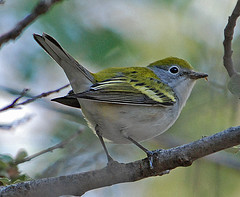
Chestnut-sided Warbler in winter plumage.

This study looked at genetic differences and gene flow in an understory shrub, Miconia affinis, in a 1200  ha matrix of forest and shade coffee farms in Nueva Alemania, Chiapas, Mexico. Birds are extremely important as agents of seed dispersal in tropical ecosystems. The authors wanted to explore how shade coffee farms — with their attendant suite of vertebrate seed dispersers such as birds, bats, and mammals — might act as corridors or reservoirs promoting healthy gene flow in trees. Other studies have indicated that limited seed dispersal in fragmented landscapes results in inbreeding and demographic declines in tree populations.

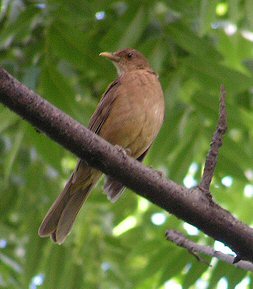
Clay-colored Thrush.

Genetic analyses showed that the Miconia in the coffee farms were genetically diverse, and came from multiple source populations. Clusters of Miconia in the forest were actually more closely related to each other than the clusters on coffee farms. The authors speculated that this may be due to the short foraging ranges of birds that specialize in forest habitats, versus the birds found in shade coffee, which are often wide-ranging generalists. [Note that the interpretation of this aspect in the Science Daily article is somewhat misleading. The paper stated that Miconia seeds are spread by birds such as the resident Clay-colored Robin (Turdus grayi) and the migrant Chestnut-sided Warbler (Dendroica pensylvanica), a North American breeder than winters in the tropics. The SD article said that the warbler is a short-ranging forest specialist responsible for limited seed dispersal in forests; this was not stated in the paper.]

The authors conclude that “[S]hade coffee farms support extensive dispersal processes crucial for the connectivity of remnant forest and agricultural habitats…[and they play a role] as potential foci of native forest regeneration.”

Chestnut-sided Warbler by Jerry Oldenettel. Clay-colored Robin by Arthur Chapman.

S. Jha, C. Dick. (2008). Shade coffee farms promote genetic diversity of native trees. Current Biology, 18 (24) DOI: 10.1016/j.cub.2008.11.017

Coffee at Panera Bread

Update April 2024: For those of you visiting from Chowhound, welcome. I offer a word of caution regarding the sustainability of coffee at Panera. The post below was written before the chain was purchased by JAB Holding — the private German company that began swallowing up coffee companies 12 years ago, including Caribou Coffee, Peet’s, Keurig, and others. As a private entity, JAB does little to truly disclose details on sourcing; my post on the lack of real transparency at Caribou provides detail. I used to be able to slice and dice sourcing data from the major coffee buyers and frequently updated the information — but the consolidation of corporate coffee, in particular companies that are not publicly-traded, has made this effort futile. I would never make the assertion that Panera’s coffee is or is likely to be “100% sustainably grown.” That term alone is loaded and unstandardized; you can learn more about it here on Coffee & Conservation.

Panera Bread is a chain of over 1,200 bakery-cafes in the U.S. and Canada; stores in the St. Louis area operate as the St. Louis Bread Company. Panera started out as Au Bon Pain Co., but by 1999 Au Bon Pain divested itself of other brands to concentrate on the Panera concept. Personally, I love the food at Panera. But despite my obvious love of coffee, I rarely drink it at restaurants because it’s either lousy, unsustainable, or both. At Panera, I noted that urns at their coffee station are marked with brew times to indicate freshness, and each of the three daily offerings actually notes an origin and source that were more specific than generic. After a bit of digging, I discovered that Panera serves coffee that is roasted and sourced in a way that is far more transparent and responsible than any other non-specialty coffee chain I’ve encountered.

Panera’s roaster
Way back when, Au Bon Pain’s coffee was roasted by the Coffee Connection,which was George Howell’s gig at the time. You know him now from my reviews of his great coffees at his Terroir Coffee Company. George was and is a pioneer in specialty coffee, and has had a long relationship with another trailblazer, Bill McAlpin, best known for his model Costa Rican coffee farm, La Minita. La Minita was the main bean at Au Bon Pain. After George sold Coffee Connection to Starbucks, Au Bon Pain changed roasters until they settled on Distant Lands Coffee in Tyler, Texas — whose chairman is Bill McAlpin.
In addition to La Minita, McAlpin now owns, manages, or partners with a number of other farms and mills in Costa Rica and other countries. Therefore, Distant Lands is able to grow/source, process, and roast, providing clients with quality coffee at very competitive prices.

Understand McAlpin and La Minita, and you understand the philosophy of Distant Lands, and much about the coffee Panera serves. On the environmental side, La Minita is a large estate in the Terrazu region — over 500 ha — but nearly 20% is set aside in forest reserves, including primary forest and forested corridors for wildlife movement. The production areas are shaded, in typical Costa Rican style, with pruned PorÁ³ (Erythrina poeppigiana) trees. No pesticides or herbicides are used. Some fertilizers and fungicides are applied, so the farm is not certified organic. On-site generated hydroelectric power is used in the mill, and coffee parchment is recycled for use in fueling dryers. La Minita workers are extremely well provided for, in pay, benefits, and amenities. This successful model has been used in other McAlpin farms and mills. You can read more about Distant Lands sustainability efforts here.

McAlpin has what is said to be an obsessive attention to detail and quality, so his coffees are meticulously harvested and processed. Only 15-25% of the production is exported with the La Minita name. Other beans from the farm, as well as other farms and mills managed by McAlpin, are marketed under other “marks” or brands. McAlpin’s style of careful processing of beans from other farms often goes by the moniker “La Minita prep.”

Panera’s coffees
Panera typically offers three coffees daily, often a light or medium roast, a decaf, and either a dark roast or flavored coffee. The coffees within each category are not static — a good sign that the company wishes to use beans that are seasonal. The urns are not merely labeled “light roast” or “Costa Rican” but provide a more specific source; they were what helped me track down Distant Lands. Here are a few of the La Minita/Distant Lands sourced coffees I’ve seen offered at my local Panera recently (some included in blends).

Costa Rica El Indio Terrazu. El Indio is the mark used by CoopeTarrazu located in San Marcos. In past years, most of this went to European roasters, but I’ve seen it with increasing frequency here in the U.S.

Guatemala Arte Maya, El Oriente. A blend of beans sourced from Antigua and Huehuetenango. No doubt carefully processed at Distant Lands/McAlpin supervised partner mill, Beneficio de Cafe Pastores.

Colombia Reserva del Patron. Selected beans (larger than 18 screen size, I believe; slightly smaller are marketed under McAlpin’s Narino Del Abuelo brand) from one of McAlpin’s mills processing coffee from small farms in the Narino region. Mostly typica and caturra.

Brazil La Minita prep. I know Distant Lands has Brazilian partners, but I don’t have any more specific information. From what I gather, I am pretty sure this originates in the cerrado region.

Conclusion
Most big bakery/restaurant/fast food chains (Wendy’s, Dunkin Donuts) source coffee from one of the big multinational corporate coffee giants, or don’t disclose their sources at all (Tim Hortons). They tend to use cheap beans — and we know cheap means poverty, environmental destruction, and low quality. Panera has apparently made a decision to stick with a coffee provider that is committed to quality and sustainability. This in spite of the fact that in 2001, coffee only made up 4% of Panera sales and the company admitted that they could not compete with the likes of Starbucks or Caribou. In 2009, they plan to further upgrade their coffee menu.

Yes — I tried their coffee, the light roast. I was really pleased. No surprises, just a fresh, nicely sweet, very well balanced, bright cup of coffee with a classic Central American profile. Plus free refills and wireless Internet in their stores.

Kudos to Panera!

Know your coffee birds: Black-throated Blue Warbler

The North American Wood Warblers are known for their colorful beauty. The male Black-throated Blue Warbler (Dendrioca caerulescens, left) is one of the most beautiful. This species is one of the most sexually dimorphic as well — the female is not blue at all — and was not even recognized as the same species until the late 1800s. The pale “hanky” showing on the lower edge of her wing, which matches that of the male, is the only giveaway.

This eastern warbler nests in large forests in the northeastern United States and southern Canada and in higher elevations of the Appalachian Mountains. They spend the winter mostly in the West Indies, as well as along the Caribbean coast of the Yucatan, Belize, and Honduras. New techniques using a simple laboratory test of the molecular composition of feathers has revealed that Black-throated Blue Warblers from the northern part of the breeding range winter mostly in Cuba and Jamaica, and birds that nest in the Appalachians winter mostly in Hispaniola and Puerto Rico [1].

A common species in shade coffee ecosystems
Wintering Black-throated Blue Warblers are frequently found on coffee farms, with studies noting them using these plantations in Jamaica, Puerto Rico, the Dominican Republic, Haiti, and Chiapas, Mexico. These studies often note that Black-throated Blue Warblers are one of the most common migrants found on the farms.

While wintering in coffee farms, Black-throated Blue Warblers consume primarily small insects, many of which are coffee pests. In Jamaica, Black-throated Blues were the number one predator recorded on the dreaded coffee berry borer.

Like some other species of wintering migrants, Black-throated Blues tend to segregate themselves by sex on their wintering grounds. Males tend to be found in tall, mature forest habitat, and females in shorter, shrubby habitat. Research has shown that in the Dominican Republic, shade coffee farms had more males than females [3,5], indicating that shade coffee farms were a good substitute for tall forest habitats.

Many bird species return to the same places to nest each year, and some also return to regular wintering areas. Black-throated Blue Warblers are very faithful to their wintering sites [2,3]. In fact, they have a stronger fidelity to their winter territories than their nesting territories, making the health of the habitats on coffee farms critical to their survival [4]. Declines in abundance of breeding populations in the southern Appalachians of over 2% a year the last two decades may be linked to severe habitat degradation in parts of the winter range, particularly Haiti [1] where deforestation is particularly severe.

The Black-throated Blue Warbler’s song is sometimes described as sounding like a buzzy “beer-beer-beer!” From its strong affiliation with shade fincas in the winter, we know what it really means is “coffee-coffee-coffee!”

[1] Rubenstein, D. R., C. P. Chamberlain, R. T. Holmes, M. P. Ayres, J. R. Waldbauer, G. R. Graves and N. C. Tuross. 2002. Linking breeding and wintering ranges of a Neotropical migrant songbird using table isotopes. Science 295: 591-593.

[2] Wunderle, J. M., Jr. 1995. Population characteristics of Black-throated Blue Warblers wintering in three sites in Puerto Rico. Auk 112: 931-946.

[3] Wunderle, J. M., Jr. and S. C. Latta. 2000. Winter site fidelity of nearctic migrants in shade coffee plantations of different sizes in the Dominican Republic. Auk 117: 596-614.

[4] Holmes, R. T. and T. W. Sherry.  1992.  Site fidelity of migratory warblers in temperate breeding and Neotropical wintering areas: Implications for population dynamics, habitat selection, and conservation. pp. 563-575. In: J. M. Hagan III and D. W. Johnston (eds.). Ecology and Conservation of Neotropical Migrant Landbirds. Smithsonian Institution Press.

[5] Wunderle, J. M., Jr. and S. C. Latta. 1996. Avian abundance in sun and shade coffee plantations and remnant pine forest in the Cordillera Central, Dominican Republic. Ornithologia Neotropical 7: 19-34.

Top male Black-throated Blue Warbler by Jerry Oldenettel; bottom by Julie Craves.

Bird-friendly Galapagos Island coffee

The Smithsonian Migratory Bird Center has just announced that it has certified Hacienda El Cafetal coffee from the Galapagos Islands as Bird-Friendly, the most eco-friendly certification for coffee. Galapagos coffee has been on my “to try” list for quite awhile. SMBC has just given me more impetus to get some and give it a sip.

This is obviously an exotic origin, and the story is interesting. Hacienda El Cafetal is grown on the easternmost Galapagos island, San Cristobal. With around 7,000 people, San Cristobal has the largest population, and is also the only island with fresh water springs. Hacienda El Cafetal grows arabica coffee of the heirloom bourbon variety at the unimpressive altitude of 500 meters. However, the microclimate there offers conditions that are equivalent to 1200 to 1300 meters elsewhere, owing to the cold Humboldt ocean current which sweeps past the islands. Of course, the soils are volcanic on the Galapagos, some of the best for growing coffee.

Coffee was brought to the Galapagos Islands around 1870 — and these are the some of the same trees that are still producing beans. Hacienda El Cafetal covers about 400 ha within the small area — roughly 3% of the entire archipelago — that is not within the boundaries of the national park and thus where agriculture is allowed. As most chemicals are prohibited anywhere in the archipelago, the coffee is certified organic (which is also a required criteria for Bird-Friendly certification).

Hacienda El Cafetal is not the only coffee producer in the Galapagos; coffee  is also grown on the island of Santa Cruz. Typically about 200 metric tons of coffee are produced annually (although not all is specialty-grade), and the legal limit is 300 metric tons. Organic agriculture is an important source of income for island residents, especially as fisheries become depleted, and organic crops help reduce the need to import so much fresh food and minimize the introduction of invasive species that arrive in these shipments. Conservation organizations also hope that diversified organic agriculture can help with native plant restoration. Coffee grown under native shade trees is a perfect fit for this goal. A short article on the sustainability of the coffee industry in the Galapagos is available in the spring 2008 newsletter (pdf) of the Galapagos Conservancy.

Galapagos coffee isn’t too terribly hard to find, but not all of it is great, and it is often a bit expensive. Most is certified organic, but so far Hacienda El Cafetal is the only farm certified Bird-Friendly. Our friends at Barrington Coffee Roasters have carried Hacienda El Cafetal in the past but it is currently out of stock. A Google search for it should turn some up, though. We’ll review it here in the future!

Coffee review: BuyWell International Fair Trade Organic coffees

Plainspoken Coffee. A Coffee Review for Ordinary People by Ordinary People, #40.

BuyWell is a relative new-comer to the sustainable coffee arena, established in Colorado Springs in fall 2007. They focus exclusively on certified organic, Fair Trade coffees. BuyWell purchases Green-e certified renewable energy certificates from 3Degrees
to offset 100% of the electricity used for their entire operation. Further, they support a number of coffee-related charities such as Coffee Kids, Cafe Femenino, and Roots and Wings International.

Roots and Wings was a new one for me — a secular organization working to provide university scholarships in southwest Guatemala. I was impressed with this program; please visit their web site for more on what they do and how you can make a direct donation. You can also do it through coffee purchases: BuyWell donates $3 per bag of coffee sold online when customers type ”RootsAndWings” in the coupon/promotion code.

We tried out several of their coffees.

Nicaragua Picaflor — These beans come from the 100-plus-member Cooperativa 5 de junio, in the the Las Sabanas region of Madriz department (a.k.a., Segovias coffee-growing area), in northern Nicaragua. The coop is part of a larger farmers association,  Aldea Global (AssociaciÁ³n Aldea Global Jinotega), which practices sustainable agriculture and has other Fair Trade products.

In 2006, Cooperativa 5 de junio scored an 84.46 in the Cup of Excellence competition. They grow mostly Caturra and Maracatu at 1200 to 1400 m in “extensive shade.” (Maracatu is a Caturra x Maragogype hybrid.)

The Picaflor is billed as a light roast. I was really pleased to see that “light” meant “light” for BuyWell. A gentle roast is often best for these more delicate Central American beans. A nearly unanimous flavor reported by tasters was “caramel”. There was also some citrus when piping hot, leaning towards orange for one taster. It had a silky mouthfeel, and was my personal favorite of the three coffees. 3.25 motmots.

Guatemala Fuego — These beans are sourced from the NahualÁ¡ cooperative (Cooperativa de Servicios Varios Nahuala) in the Quetzaltenango region of southwest Guatemala near the city of Pasac. Ninety percent of the 126 members are organic, and they also produce organic bananas and honey. The members have been working on a riparian reforestation project as well. The coffee varieties Catuai, Bourbon, and Caturra are grown at 1200 to 1500 m.

This was a medium roast — not too dark for a Central. It had an interesting aroma, which reminded me of American Robins (I know this is odd, but remember, I’m a bird bander, and I’ve handled tens of thousands of birds…some do have distinctive odors), sort of organic and leafy. Having made this rather esoteric comment aloud, a coworker actually agreed with me, in a more generic way: “Yeah, like the apartment I shared with Dale and Edgar the Crow. Sometimes we’d take in a starling or two.” Okay, strange descriptions of what are actually nice smells aside, we also had some consensus on taste, with three people volunteering they got a subtle cherry flavor. Nutty was also mentioned more than once. It had a creamy mouthfeel, also described as “round” and “smooth.” 3 motmots.

Sumatra Canopy — The Canopy coffee is from the Gayo Organic Coffee Farmers Association (Persatuan Petani Kopi Gayo Organik, or PPKGO) near Takengon in Aceh province, Sumatra. This is a big co-op, with nearly 2000 members, and all are organic. The farms are located at between 1100 and 1500 m in the buffer zone to Gunung Leuser National Park. Shade grown coffee in Sumatra is especially important because illegal logging threatens remaining forests, including those in protected areas. The demand for timber has been particularly acute since the 2004 tsunami. PPKGO grows a number of varieties of coffee: Bergendal (they typica variety most often grown in Sumatra), Sidikalang (I presume this is another typica cultivar from the named region near Lake Toba), and the hybrids Catimor and Caturra.

This was a medium-dark roast. It’s been awhile since we’ve reviewed a dark roast, and a long while since we’ve done an Indonesian coffee. The origin was instantly recognizable earth (one person specified loam), leather, pepper or spice, and resin. I liked it much more than I expected I would, given that this isn’t my favorite flavor profile. But the roast was handled correctly, so the characteristic Sumatran taste came through without being all about a “rich” or burnt taste. The score of 2.75 motmots in part reflects one taster who just couldn’t come to grips with an Indonesian coffee; she described it as tasting like “those little hard sesame breadsticks.” I’m going to temper that comment by saying that this coffee will please anybody who does like Indonesian coffees, as it’s probably one of the most approachable I’ve had.

Overall, I was pleased with BuyWell’s selections, the information on their web site, and their commitment to sustainability in their business practices. I was also impressed with the way their roaster handled each bean. I think sometimes working with beans from co-ops, which are likely to vary in quality because they come from so many producers, leads some roasters to over-roast to cover up or even out the impact of the lowest-quality beans. I thought BuyWell honored the origin and the bean and did a really nice job.

You can also check out BuyWell’s blog, Screaming Monkey.