May 2008

Coffee review: Larry’s Beans Organic Barahona

Plainspoken Coffee. A Coffee Review for Ordinary People by Ordinary People, #35.

To follow up on the post on coffee growing in Hispaniola, here is our second review of a Dominican Republic coffee (the first was Café Alta Gracia). Here wer have Organic Barahona from Larry’s Beans. Fair Trade and Certified organic.

Larry’s Beans is one of the members of Cooperative Coffees, a group of 23 roasters who have banded together in a green coffee bean buying cooperative. They directly source coffees from small-scale farms at or above Fair Trade price. You can read about their producers (which provide beans to the member roasters), and best of all, you can access all the purchasing documents — complete transparency. Not every lot is acquired through Cooperative Coffees, but access to the paper trail from outside purchases will also be available as the kinks are worked out of the system.

Cooperative Coffee’s DR producer is the Federation de Caficultores de la Region Sur (FEDECARES), covering 13 provinces in the DR with over 170 member organizations and 7600 farmers. This particular lot came from the El Polo Cooperative, one of the new member organizations, based in the southwestern DR town of Polo, in Barahona province. I believe this puts the elevation of the coffee at 800 to 1200 m.

The beans were a medium roast, with a sheen of oil and some pinpricks. Nobody could adequately agree on much about this coffee. One smelled honey and tasted honey, and was quite emphatic about it — and this is a flavor highlighted by the roaster that is noted on the bag. Another found it nutty, and I thought it had a woody or earthy taste. It was one of the few coffees I’ve had that I thought tasted better cool.

There was no roast date on the bag, but it did have a use-by date. Use-by dates are “X” number of months from the roast date; presumably the day of the month of the roast date and “expiration” date are the same. This would indicate I received the coffee when it was already almost three weeks old. The less-than-vigorous bloom seemed to back this up. I think this coffee would have been much better freshly roasted, or at least we would have been able to tease some more flavors out of it.

Overall, a soft, laid-back sort of coffee, pleasant but unremarkable, coming in at 2.5 motmots. If you’ve tried to convert a grocery-store coffee drinker to specialty coffee via a really refined and elegant bean and been disappointed that the person found the good coffee to be too different or just “didn’t get it,” this DR coffee might be a better place to start. It won’t be offensive,off-putting, or weird — just a big step up and a good price and ahead in sustainability.

UPDATE! Jonathan Bonchak, Goodwill Ambassador from Larry’s Beans, sent me a fresher bag of this coffee. Indeed, it had a much better bloom, and it was pleasantly sweeter than the last bag. Two people gave it substantially higher ratings — “It was delicious!” — and in this set of tastings it earned just over 3 motmots.  Thanks, Jonathan!

International Day for Biological Diversity

Today is International Day for Biological Diversity and the theme for this year is Biodiversity and Agriculture. The sponsor is the Convention on Biological Diversity, an international treaty initiated at the 1992 Earth Summit in Rio de Janeiro.

This year’s theme highlights the importance of sustainable agriculture to the preservation of biodiversity. While agriculture contributes significantly to conservation and sustainable use of biodiversity, it has also been a major driver of biodiversity loss primarily through land-use conversion, which is expected to remain the largest cause of biodiversity loss beyond 2010 to at least 2050. Agriculture also contributes to dwindling biodiversity through intensification of agricultural production systems, excessive chemical and water use, nutrient loading, and pollution — all issues relevant to technified sun coffee production.

The Santa Marta Sabrewing (Campylopterus phainopeplus) is an endangered hummingbird that is only found in the Santa Marta mountains of northeast Colombia. In the dry season, it is often found in shade coffee plantations, but the number of shade farms is decreasing, and along with them, birds and other wildlife that depend on them.

This species is included in the recently released 2007 IUCN Red List of Threatened Species, the authoritative global database of the world’s most vulnerable species. You can help by making a donation to support the IUCN’s conservation efforts, or the work of one of its partners, BirdLife International.

And, as always, drink sustainably-grown coffee.

SMBC certifies its first African coffees

Smithsonian Migratory Bird Center (SMBC) recently certified its first Bird-Friendly coffee outside of Latin America: Anfilo Specialty Coffee Enterprise (SCE). This group of 118 farmers in the district of Wollega, in the sub-districts of Anfilo and Gidami in far western Ethiopia, grows nearly 600 ha of “forest coffee.” This coffee grows in natural forest at elevations of 1800 to 2400 m near the Gerjeda Forest Reserve (which I’m unable to find information about). These areas are crucial to preserve wild genetic coffee resources.

Coffee from this part of the country (also marketed as Lekempti or Nekempt coffee) generally has large beans, mild fruit flavors (less berry, more stone fruit), and medium body. You can view a professional, 15-minute video about coffee growing in this rather removed area of the country at this site. This video was produced by the brother of the man who owns and manages Afilio SCE.

I see that the SMBC site also now lists a second Ethiopian producer, Mullege PLC. As far as I know, this is an export company with at least ten wet mills in a number of regions.

Caribou Coffee wins Roaster’s Choice award

In a previous post, I mentioned that one of my favorite aspects of the recent SCAA conference was tasting the ten finalists in the Roasters Guild 2008 Roasters Choice Tasting Competition. The theme was Single Origin coffees, and 36 members of the Roasters Guild participated in the event by submitting roasted coffee. Voting was open to all conference attendees (nearly 8000!).

The winner: Caribou Coffee’s Roastmaster’s Reserve: Ethiopia Yirgacheffe. When I tasted this coffee (blind) I knew it was an Ethiopian, and I enjoyed the understated berry notes. And although I like Ethiopian coffees, I wouldn’t opt to drink one daily, which I considered a requirement for my vote. With so many great artisan roasters participating, many with very special microlots, I couldn’t help but be surprised that Caribou took top honors. I think this says a lot about this company. I’m not the only person who thinks Caribou does a fine job and is underappreciated for it. Check out these posts from the Coffeed forum, from both late last year and after the competition. Congrats, Caribou!

The full list of the winners is below.

I mentioned that #103 was my favorite, my second pick was #111. I knew 103, a Colombian microlot, was a classic from Latin America, but I thought that 111 was also. For a Rwandan, 111 was quite sweet and chocolately. I also love Kenyan coffees, but have to admit that 109, the third place Kenyan from The Roasterie, was one of the most difficult to categorize coffees I’ve tasted lately, and we tried it over three days. I thought it might be Sumatran, because for me it had some sort of vaguely sour earthy flavor. I wrote on my sheet “What is this?!”  Kingfisher’s top pick was #104, the Tanzania (I pegged that origin blind, too!).

  1. RC102 — Caribou Coffee — Ethiopian Organic Yirgacheffe
  2. RC106 — Sweet Maria’s — Rwanda Gkongoro Nyarusiza
  3. RC109 — The Roasterie — Kenya Jambo Estate
  4. RC104 — Berres Brothers Coffee Roasters — Tanzania Peaberry — Songea
  5. RC105 — Dolce Gourmet Gelateria & Café — Panama — City Roast
  6. RC103 — Tony’s Coffees and Teas — Colombia — Tolima Microlot — Gaitania Cyerposo
  7. RC108 — Lexington Coffee Roasting Company — Rwanda Bufcafe
  8. RC107 — Bear Creek Coffee — Papua New Guinea
  9. RC110 — Vermont Artisan Coffee & Tea — Ethiopian Sidamo — Organic Fairtrade
  10. RC111 — Cuvee Coffee Roasting Company — Rwanda – Bucafe

Meanwhile, in an adjacent room, judges were cupping the entries in the 2008 Roasters Guild Coffee of the Year Competition.

The winner list is after the jump. A Colombian entry won first place, bumping Hacienda La Esmeralda to second place after winning the competition the last three years. I was pleased to see a Domincan Republic coffee in the top ranks. I would provide more links and information about the winners, but the list is so generic that I am unable to get more specifics.

1. C.I. Racafe & CIA S.C.A., Colombia (placed 11th last year)
2. Hacienda La Esmeralda, Panama
3. Volcafe Specialty Coffee, Ethiopia
4. Sidama Coffee Farmers, Co-Op Union, Ethiopia
5. San Rafael Pacun/ Cafetalera El Tunel S.A., Guatemala
6. Agropecuaria Salfar S.A./ San Sebastian, Guatemala
7. Agoga Plantation Limited, Papua New Guinea
8. Finca La Ilusion-Café de El Salvador, El Salvador (2008 Cup of Excellence winner)
9. Federacion Nacional de Cafeteros de Colombia, Colombia
10. San Jose Ocana, Guatemala
11. Big Island Fine Coffee, Hawaii
12. Kona Coffee Plantation, Hawaii
13. Consejo Dominicano Del Café (Natura Bella), Dominican Republic.

"Best of" the SCAA conference

I have a lot to report on sustainability and certification issues from the SCAA conference, but it will be doled out over the coming weeks. Here, I thought I’d like to give some quick impressions of some of the most notable things we encountered.

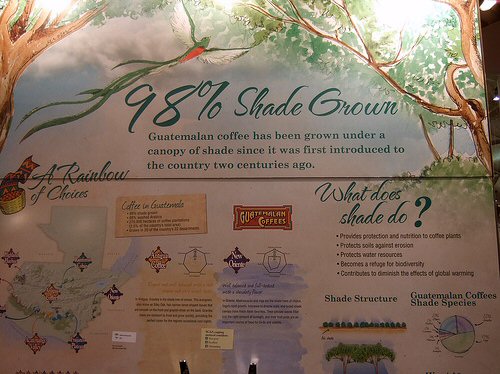
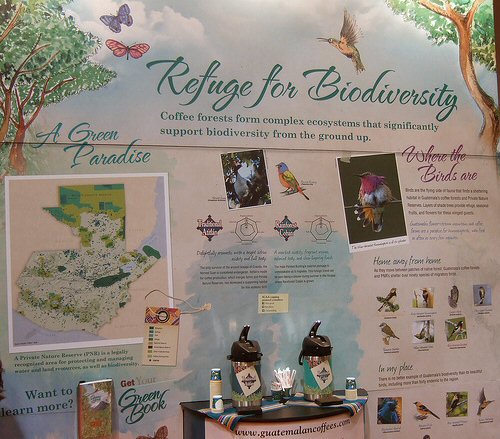
Best origin booth: Guatemala. Many origins had booths, most with green or brewed coffee samples and lots of literature. The biggest, most colorful, and most informative was, hands down, Guatemala’s. The display really focused on the fact that nearly all of their coffee is shade grown, and preserves biodiversity and birds. This information is duplicated in a terrific book available at the display called The Green Book. Here are a couple of the display panels.


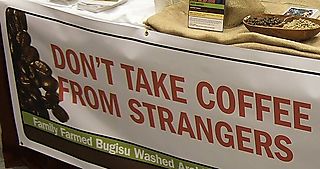
Best tag line: “Don’t take coffee from strangers” — Crop to Cup. That sums up a piece of advice every consumer should take to heart. Crop to Cup Coffee Company is a small coffee roaster with really direct relationships with farmers; on their web site you get very thorough information.

Coolest people I finally got to meet: Peter Giuliano and Kim Elena Bullock from Counter Culture Coffee. I’ve had so many good conversations and learned so much from the folks at CCC, it was a great pleasure to finally meet Peter and Kim in person.

Best coffee I tried: Mystery Coffee #103 from the Roaster’s Guild Coffee of the Year competition. Yesterday alone, I tried at least 20 coffees. And I don’t mean tasting and spitting out, I mean drinking. I can’t say I really recommend this strategy (I ended up both overtired and jittery), but it was interesting! The coffee I liked the best, as far as one I would like to drink daily, was #103 at the coffee of the year competition. Conference attendees got to sample and vote on the top ten finalists.

With all this coffee, perhaps this category deserves a couple of subcategories.

Best Coffee I Tasted Made on a Clover: Intelligentsia’s Organic Anjilanaka, Bolivia. There were three Clover coffee brewers at the show, and we tried coffees made on all of them.

Best espresso shot: Finca Vista Hermosa at the Barista Guild’s booth. Light roast and crazy citrus zing made this not your usual espresso.

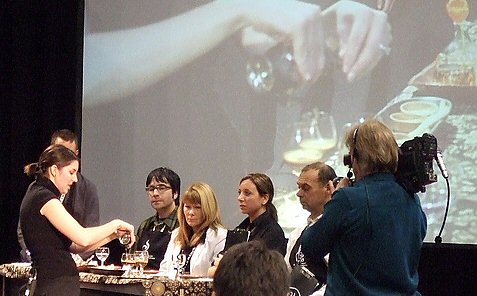
Most interesting thing that I didn’t think I’d care about: U.S. Barista Championships. Once you started watching baristas compete, it was kind of addictive. Beats watching a poker championship. This is Belle Batista of Aldo Coffee, the Mid-Atlantic Regional winner. She didn’t make the finals.

Best non-coffee product name: Two Leaves and a Bud. I used to be an avid tea drinker.

Best authentic character: Wicha Promyong, Doi Chaang Coffee (which we reviewed here). After posing for the shot, he whipped out a nice business card and spoke perfect English!

There will be more forthcoming on what I learned in the sustainability and agroecology lectures, additional sustainability and other awards, and more. It has been a great experience.

SCAA Sustainability Awards

The Specialty Coffee Association of the Americas (SCAA) presented its annual awards last night. One is the Sustainability Award, which honors individuals, businesses or organizations in the coffee industry that have created innovative projects to expand and promote sustainability.

And the winners are…

Essent Energy Trading and Solidaridad (The Netherlands) — for their partnership to use coffee husks (compressed into pellets) as biofuel. I wrote about this initiative late last year. At the time I wondered about the energy efficiency of shipping the pellets from Brazil to the Netherlands, where the biofuel is used. At the awards ceremony, it was explained how innovate this idea was to begin with, so the best source for this Dutch company (which originated the idea) was large producers in Brazil. It has been so successful that they did, in fact, state that in the future they hope to be using coffee husk biofuel to produce electricity in Brazil and other places in Latin America.

Another clarification: in the previous post I surmised that by “coffee husk” they meant just the parchment. From the short infomerical shown and the acceptance comments, it appears they mean the whole coffee skin and pulp. They mentioned how piles of coffee residue produces high pH leachate that can contaminate water and soil, and that the rotting piles produce methane, a greenhouse gas. Those facts, in addition to the fact that coffee pulp is not an animal feedstock or human feed source, makes it a really “green” biofuel with a lot of potential. Congrats to Essent and Solidaridad.

Alianza para la Sostenibilidad (APS) / Sogimex SA / Ecom Agroindustrial Corp Ltd. (Honduras) — for their efforts to increase sustainability efforts among specialty coffee producers in Honduras. The goals was to achieve overall sustainability throughout the coffee chain in Honduras, obtain critical certifications, and offer technical assistance to impact producers in the region. It’s been a huge success.

Honorable mentions went to Finca Selva Negra in Nicaragua for their waste water program, and Brazil’s Fazenda Ambiental Fortaleza for their overall focus on sustainability.

Past winners:

2007 — Poabs Organic/Biodynamic Estates, India; Selva Negra Coffee Estate, Nicaragua; International Paper Company and Green Mountain Coffee Roasters; SOPPEXCCA, Jinotega, Nicaragua.

2006 — Sustainable Harvest Coffee Importers; Timothy’s World Coffee & Embera-Chami Coffee Community.

2005 — Las Nubes Coffee; Portland Roasting Company; Starbucks.

2004 — Thanksgiving Coffee Company; Dean’s Beans; ForesTrade;
PPKGO.