Tag: best1 Page 2 of 4

Quick look at differing shade criteria

[NOTE: Rainforest Alliance standards have undergone several revisions since this post was first written. There is now no criteria for canopy cover and tree diversity, and native vegetation criteria do not have to be met for six years. The Bird-Friendly standard remains the same, as outlined below. This post should only be for historical reference.]

I recently reviewed a paper, Field-testing ecological and economic benefits of coffee certification programs, that included a  summary table of the criteria used for shade certification by Rainforest Alliance, and Smithsonian Migratory Bird Center (under the “Bird-Friendly” trademark).  I thought it would be useful to post a summary here, with a little commentary.

SMBC’s criteria are mandatory, while RA has no required criteria for shade management — the standards below are one of the optional criteria (more on the RA standards and scoring can be found here).


Criteria SMBC RA
No. tree species >10 >12/ha*
No. trees/ha (mean) na >70*
% allowed to be Inga trees <60 na
% shade cover >40 >40*
No. of shade layers 3 2
% leaf volume in each shade layer
….. >15 m (emergent) >20 na
….. 12 to 15 m (backbone) >60 na
….. <12 m (understory) >20 na
Epiphytes required? Yes na

*As of April 2009, standards were modified from the previous version, February 2008. In the old standards, one requirement was for at least 12 native tree species and at least 70 trees per hectare; now it is an average of 12 native tree species, with no minimum number of trees per hectare. Previous criteria stated a minimum of 40% shade cover, now the standard specifies this minimum only on cultivated land.

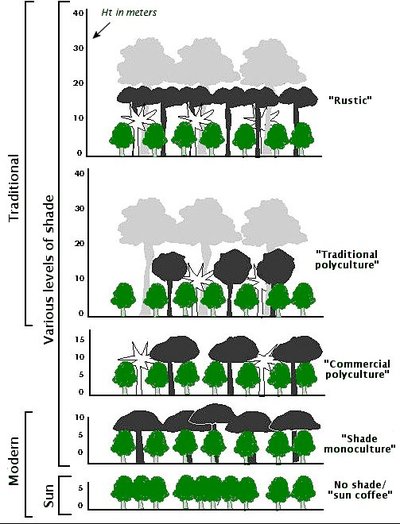
As noted in the previous post, the criteria having to do with vertical stratification — the number of layers of vegetation and the leaf volume in each — are critical components for preserving a rich mix of species.  Many ecological studies support the key role of structural diversity (sometimes referred to technically as floristic heterogeneity) in increased biodiversity — of many types in many ecosystems well beyond the realm of coffee growing. This is the classic schematic illustrating the various coffee production systems and their layers of shade diversity, from a paper by Patricia Moguel and Victor Toledo [1].
Here is a new graphic from SMBC that also illustrates this continuum:

As you can see from the table above, Rainforest Alliance requires (if this criteria is used) only two layers of shade, while Smithsonian requires three. RA has no standards for leaf volume in the shade layers. In short, RA certified farms that use these criteria would have still have structurally-simpler habitats (closer to commercial polyculture) that would likely not support as much biodiversity as farms that met SMBC criteria (closer to traditional polyculture).

A further note. SMBC inspectors visit farms and set up a number of plots and measure various vegetation parameters following methods used in typical ecological studies. The aforementioned paper reports that “Rainforest Alliance inspection auditors rely heavily on data provided by farm managers” (who are not ecologists), and confirm data provided during visits by various estimates and extrapolations.

As an ecologist myself, I am more comfortable that SMBC offers the more stringent, reliable assurance that coffee is grown sustainability if one is comparing certification schemes. And not to beat a dead horse, but the usual caveats apply: there are pros and cons of certification, and many uncertified farms grow coffee sustainably, meeting or exceeding the strongest criteria.

More on SMBCs criteria here, and in the “certifications” category of C&C.

[1] Biodiversity Conservation in Traditional Coffee Systems of Mexico. 1999. Conservation Biology 13:11—21.

Top 5 Indicators of Sustainable Coffee

Coffee is grown in over 60 tropical countries, with most of it still produced on small family farms, but adding up to tens of millions of acres. Coffee growing supports 25 to 100 million people around the world. In the last decade, a huge worldwide surge in demand for coffee has had two profound consequences.  It caused a rapid worldwide expansion in production, largely of cheap beans that flooded the market and contributed to plummeting prices. And in the rush to increase production, it caused a shift from traditional, sustainable coffee growing methods (with coffee plants grown in the shade of diverse native trees) to intense monocultures that require large inputs of fertilizer and pesticides which bring about a loss in biodiversity and quickly deplete the land.

If choosing sustainable coffee was easy for consumers, there would be no need for a blog like Coffee & Conservation. Here is a look at the top five indicators of sustainable coffee:

1. Certification. Because of the substantial costs of certification — to the farmer and/or the roaster — not all sustainable coffees necessarily carry a seal.  And if they do, it could be one of several. Here at C&C we have an excellent guide to the environmental standards of the five common coffee certifications. It includes links to more information and on the standards used by biodynamic farmers, Starbucks, and Nespresso. Meanwhile, here are three common certifications associated with sustainably-grown coffee:

  • If a coffee is certified as Bird-Friendly by the Smithsonian Migratory Bird Center, it is grown under the most stringent environmental standards of any certification system, and it is also required to be certified organic. If you see this seal, it is one of the best assurances that the coffee was grown with biodiversity and sustainability as top priorities.
  • Organic certification, by the USDA and its accredited agencies, is an important indication that many (but not necessarily all) chemical inputs have been eliminated or reduced. Generally, coffee that is organic is grown under at least some shade cover (which preserves biodiversity).
  • Rainforest Alliance also has environmental criteria, but the standard has been seriously watered down in recent years and this certification is no longer assurance that coffee was grown under shade or in a way that is beneficial to birds or wildlife. Also, coffee may carry the seal and only contain 30% certified beans.

2. Country of origin. Some countries still grow much of their coffee under shade, preserving native forest and biodiversity and using few if any chemicals.  Other countries have removed shade trees or cut down areas of native forest and planted sun-tolerant coffee varieties.  These countries are more likely to grow shade coffee:

  • Mexico (also largest area in organic coffee in the world)
  • El Salvador
  • Nicaragua
  • Guatemala (Huehuetenango has the most diverse shade cover; other regions, especially Antigua, do not use as much high-quality shade)
  • Honduras
  • Bolivia
  • Papua New Guinea
  • Ethiopia (large percentage grown organically)
  • Peru (second-largest organic origin)
  • India

These counties are more likely to grow sun coffee, and unless they are Smithsonian Bird-Friendly certified, it’s probably best to avoid them:

3. Botanical variety. There are two species of coffee used commercially: Coffea arabica or arabica coffee, and Coffea canephora, or robusta coffee.  Arabica is high quality. Robusta coffee is nearly always low quality, mass produced in deforested sun coffee monocultures with lots of chemicals, and is used in most supermarket coffees. You won’t see “robusta” on the label, so look for “100% arabica.”

There are also many different cultivars of arabica coffee. “Bourbon” and “typica” are older types that need at least some shade, so seek those out. “Catuai”‘ and “Caturra” are varieties that are often grown as sun coffee.

Learn more about botanical varieties of coffee.


4. Roaster.
Buy coffee from a small, specialty roaster. A good roaster develops a relationship with the farms and co-ops that grow their coffee — it’s in everybody’s best interest for the coffee to be grown sustainably. The farmer gains by having a reliable buyer and a safe, healthy environment, and the roaster gains by having a reliable source of quality coffee. A conscientious roaster will have very specific information on the precise origin of each coffee it sells, and you can determine how the coffee was grown to guide your purchase.

My list of recommended providers of sustainable coffee is at the bottom of every page here (click to refresh, there are more than what shows at one time; criteria for inclusion is here), with more on my interactive map of roasters. A list of online retailers that regularly sell Smithsonian Migratory Bird Center Bird-Friendly®-certified coffee is here.

5. Price. This is nearly a given: cheap coffee is not sustainable. Not for the farmer, not for the environment. People who are used to paying less than $5 a pound for grocery store coffee shudder at the idea of paying $10 or more for a pound of coffee from a specialty roaster.  Ounce for ounce, it’s still cheaper than a good bottle of wine or scotch or many other beverages.

The farmers that grow grocery store coffee get less than $0.25 a pound for it; obviously this is not a living wage. Impoverished farmers are more likely to exploit the environment, convert their coffee to other less ecologically-friendly crops, or abandon their land altogether (contributing to illegal immigration into the U.S. from south of the border). Coffee is often the most important source of income for nations that produce it; if it is no longer profitable, it creates social and economic crises, and impacts governments and democracy. (Read more about how cheap coffee contributes to poverty and why you should care here.)

And trust me when I tell you — you get what you pay for! A year ago you couldn’t have told me that there were so many incredible, distinctly unique coffees out there, an entire world to explore! We’ve only scratched the surface in our reviews.

Learn more in the corporate coffee category, in particular about the coffee crisis and why you shouldn’t buy coffee from the big commodity coffee providers.

~~~

Coffee drinkers have the potential to make a huge impact on the environment and economies of coffee growing nations. If we understand the stakes, we can make a significant difference, and enjoy our favorite beverage at the same time!

Pesticides used on coffee farms, part 2: Common coffee pests

Coffee is equipped with an excellent defense against herbivory: caffeine. Caffeine is one of many alkaloids that evolved in various plants to prevent them from being eaten by insects.  Evolution doesn’t stand still, however, and some insects have fought back. Coffee is attacked by several pests and diseases. Here are the most important, the ones that are most frequently combated with pesticides.

Coffee cherry/berry borer or “Broca” (Hypothenemus hampei). Native to Central Africa, but now found in many coffee-producing nations. The female of this tiny beetle (shown here on a green coffee bean) bores into the coffee cherry and lays about 15 eggs; the larvae feed on the developing bean. Usually, the cherry drops from the tree. The best defense is making sure there are no unpicked beans left on the trees or laying on the ground. Because they spend much of their life inside the cherry, controlling borers with insecticides can be difficult or downright ineffective. (Update: both Back to the Grinder and jimseven have nice photos of green beans with broca damage.)

Coffee leaf miner or “bicho mineiro” (Leucoptera coffeella). The leaf damage from the larvae of this small moth means less leaf surface is available for photosynthesis, resulting in stunted plants and reduction in yield. Native to Africa, but now found in many coffee-producing nations. This insect has developed resistance to insecticides in some areas.

Other insect pests include root nematodes (Meloidogyne spp.), green scale (Coccus viridis), and twig borers (Xylosandrus compactus).

Although not an insect, the next pathogen also prompts chemical onslaughts:

Coffee rust (Hemileia vastarix). A fungus that causes yellow spots on leaves, reduced photosynthetic ability, and eventually leaf drop. This causes a lack of nutrients going to growing shoots, and so can impact future growth of the plant. Spores require rain to germinate (high humidity is not adequate). Disease spreads more quickly in dense plantings and is less severe in shaded plantings, as the spores require a certain light intensity to germinate. Temperatures at farms at higher elevations are often too cool for the fungus.  Native to Africa, but now found in many coffee-producing nations. Some coffee cultivars have resistance, notably the catimor variety, and also catuai and mundo novo.

Next in this series: Common pesticides used on coffee farms.

Coffee berry borer on bean photo by P. Greb.

Botanical varieties of coffee

There are over 100 species of coffee (Coffea) in the world, and all are native to tropical Africa and some Indian Ocean islands (Madagascar, Macerenes). Most have very limited distribution, and over 70% are threatened with extinction.

Usually only two species, C. arabica and C. canephora, are commonly grown commercially.  They are described below, along with a few other interesting species, and the most common commercial varieties of these species.  Because certain types grow best in the shade and others in the sun, knowledge of these names can be a convenient clue as to how your coffee may have been grown.

Don’t confuse these botanical varieties with coffees named for their growing regions, such as Ethiopian Harrar, Guatelmalan Antigua, or Hawaiian Kona.

  • Coffea arabica. This is the highest quality coffee, used by specialty roasters. It grows best at higher altitudes — 3000 to 6500 feet — and because it grows slowly the flavors are more concentrated. This species tend to be susceptible to various diseases, and has a lower caffeine content than C. canephora (below). Arabica is a deep-rooted shrub. Unlike other coffee species, arabica has two sets of chromosomes. Arabica has two common varieties, typica and bourbon. These traditional, older varieties are the types most often grown in the shade. Because arabica is self-pollinating, these varieties are stable, but sometimes do mutate into strains that are then cultivated. Just a few of the most common are described.
    • Coffea arabica var. typica.
      • Maragogype — large-beaned (“elephant bean”) Brazilian mutation. Porous beans are not especially flavorful, and low-yielding. (Roasting a larger bean correctly takes some finesse, so buy from a specialty roaster.)
    • C. a. var. bourbon. Old variety originating on the Indian Ocean island of Bourbon (Reunion) with broad leaves, and small fruits. In Kenya, bourbons are sometimes called “French mission ” or “Scottish mission.”
      • Catuai — cross between Mundo Novo and Caturra. There are red (rojo) and yellow catuais, named for the color of the cherries. High yield and hardy. Often grown as sun coffee.
      • Caturra — compact, multiple-branching form of bourbon, common in Brazil and Colombia. Disease resistant and fast-maturing, the higher yield of Caturra apparently comes at a cost to good taste. Considered lighter-bodied and more acidic than traditional bourbons. Often grown as sun coffee, it requires a lot of management and fertilizer.
      • Mundo Novo — cross between typica and bourbon, high yield, popular in Brazil.
      • Paca — a high yielding cross between bourbon and Caturra.
      • Pacamara — cross between Maragogype and the Paca variety of Caturra.  Not considered very flavorful, as neither parent is especially revered for taste.

If you’d like to see a “family tree” of some of the arabica coffee varietals, check out this post by Jim Hoffman and a table of coffee genotypes from a paper published in the Brazilian Archives of Biology and Technology. More less-commonly referred to arabica varieties are described in the coffee glossary.

  • Coffea canephora.  This species is more commonly referred to as “robusta,” although this actually refers to the upright variety of canephora; there is a spreading variety known as nganda.  Robusta is a lower-growing and shallow-rooted, harsher and more bitter variety that is used in cheaper coffees, or as fillers.  Robusta tends to be more hardy and disease-resistant, will grow better in the sun than arabica, and tends to have higher yields. It has a higher caffeine content than arabica. I’ve written an entire post about robusta here.Although there is such a thing as a decent quality robusta, Kenneth Davids at Coffee Review sums up the problem with most robustas in today’s market:

    Apparently with the support of the World Bank, robustas recently have been planted in very large quantities in Vietnam. These are mass-produced coffees at their most dramatic: stripped from the trees, leaves, unripe, ripe and overripe fruit and all, and dried in deep piles. All of which means the essentially bland, grainy robusta character is topped off with an assortment of off-tastes, mainly musty/mildewed and fermented. These coffees sell for considerably less than all other coffees, including better quality robustas. I am told that production costs for Vietnamese robustas are about 20 cents per pound or less, compared to, for example, production costs of 80 to 90 cents per pound for the excellent “100% Colombia” coffees competing in the supermarket. And now the current episode: Commercial dealers and roasters have learned to steam the often foul-tasting Vietnamese robustas, removing the waxy covering of the bean and muting (but not entirely eliminating) the offensive flavor notes.

There are some hybrids between arabica and canephora. They include:

  • Hibrido de Timor — a natural hybrid, with two sets of chromosomes like arabica.
  • Icatubackcrosses of Hibrido de Timor with Mundo Novo or Caturra.
  • Catimor — cross between Caturra and Hibrido de Timor. High yields, often grown as sun coffee, with a reputation for inferior quality.

One other species is grown commercially:

  • Coffea liberica. Similar to robusta, grown at low altitudes in Malaysia and West Africa, it accounts for less than 1% of commercial trade. In the cup, it is thick and pungent, but has its fans in some countries.  It is known as Barako in the Phillipines.  Two subspecies are commonly recognized, C. liberica var. liberica, just called “Liberica” or “Liberian” coffee, and C. liberica var. dewevrei, known as “Excelsa.”

There are a number of varieties in Madagascar and the Mascarene Islands that have little or no caffeine, including C. kianjavatensis, C. lancifolia, C. mauritiana, C. macrocarpa and C. myrtifolia. These species are in the taxonomic section Mascarocoffea; this is not a genus as is frequently reported on the Internet. Arabica and robusta coffees are in the section Eucoffea, and attempts to breed Eucoffea varieties with caffeine-free traits from Mascarocoffea types has not been successful.

Finally, peaberry (“caracol”) coffee is not a botanical variety, but a bean mutation where the cherry produced one small, rounded, fused bean rather than two flat-faced beans. May occur in any botanical variety, usually accounting for about 10% of the crop.  Some think peaberries have a superior taste, but choose a roaster widely, since peaberries roast quickly and are easily charred.


Page 2 of 4

Powered by WordPress & Theme by Anders Norén