Retail and specialty roasters

Birds&Beans: a new Bird-Friendly coffee initiative

A new initiative to featuring Smithsonian Bird-Friendly certified coffee is being launched next week in the New England and New York area. “Birds&Beans: the good coffee” will be sold by subscription, and promoted via “Voices for the Birds” talks by several leading names in bird conservation.

The coffees, all Smithsonian Bird-Friendly certified (and therefore also certified organic) will be available in three varieties:

  • Scarlet Tanager will be the dark/bold roast from Peru, and will also be Fair Trade certified.
  • Chestnut-sided Warbler will be a medium roast Colombian (also Rainforest Alliance certified).
  • Wood Thrush will be the light/mild roast Mexican, also be Fair Trade certified.

The coffee will be roasted and distributed by Capitol Grounds Café and Roastery in Montpelier, VT and Wicked Joe in Brunswick, ME. The standard subscription will run $18.50 for two pounds, plus shipping and handling.  Initially, orders will only be taken from customers in New England and New York; there are also plans to have it available in regional food cooperatives. The hope is to expand nationwide.

(Canadian consumers can get Smithsonian Bird-Friendly certified coffee through the Toronto cafe and roastery Birds & Beans — which has actively promoted and sold Bird-Friendly coffee in Canada for years. In fact, the roaster/owner there, David Pritchard, has licensed the Birds & Beans name to the U.S. initiative and is cooperating to help raise the profile of Bird-Friendly coffee. I have visied Birds & Beans in Toronto and can attest to David’s skill as a roaster and dedication to Bird-Friendly coffee and migratory birds.)

Three very well known bird conservationists and experts in migratory birds will be promoting Birds&Beans coffee by giving talks to educate consumers about the bird and coffee connection. “Voices for the Birds” lectures will discuss the birds that nest in New England — in particular the three species featured on the Birds&Beans packages — and the importance of shade coffee farms to their survival. Kenn Kaufman is an artist, naturalist, and the author of a number of bird books, including Kingbird Highway and the Kaufman Field Guide series. Scott Weidensaul is a prolific natural history writer often focusing on birds; his excellent book on migratory birds, Living on the Wind, was a Pulitzer Prize finalist. Bridget Stutchbury is a professor of biology and Canada Research Chair in Ecology and Conservation Biology at York University in Toronto. In addition to a large body of scientific work, her book Silence of the Songbirds explained threats faced by songbirds, including loss of winter habitat due to the proliferation of sun coffee. Russ Greenberg, head of the Smithsonian Migratory Bird Center, will also be participating. A number of regional organizations will help support and promote the talks and the coffee, including Audubon Vermont, New Hampshire Audubon, Audubon Connecticut, the Vermont Center for Ecostudies, Vermont’s North Branch Nature Center, and Audubon chapters in New York.

The Birds&Beans web site (www.birdsandbeans.com) is scheduled to go live early next week. That’s where you’ll be able to find details on the coffee and subscriptions, as well as a list of events and talks. As a certification program run by a scientific research center, the Bird-Friendly certification generally lacks marketing, so this is a really positive step in raising awareness of sustainable, shade coffee in general and the strength and benefits Bird-Friendly certification in particular.

If you are in the New England/New York area, I encourage you to check out the coffee and the talks, and send me some feedback.
Coffee at Panera Bread

Update April 2024: For those of you visiting from Chowhound, welcome. I offer a word of caution regarding the sustainability of coffee at Panera. The post below was written before the chain was purchased by JAB Holding — the private German company that began swallowing up coffee companies 12 years ago, including Caribou Coffee, Peet’s, Keurig, and others. As a private entity, JAB does little to truly disclose details on sourcing; my post on the lack of real transparency at Caribou provides detail. I used to be able to slice and dice sourcing data from the major coffee buyers and frequently updated the information — but the consolidation of corporate coffee, in particular companies that are not publicly-traded, has made this effort futile. I would never make the assertion that Panera’s coffee is or is likely to be “100% sustainably grown.” That term alone is loaded and unstandardized; you can learn more about it here on Coffee & Conservation.

Panera Bread is a chain of over 1,200 bakery-cafes in the U.S. and Canada; stores in the St. Louis area operate as the St. Louis Bread Company. Panera started out as Au Bon Pain Co., but by 1999 Au Bon Pain divested itself of other brands to concentrate on the Panera concept. Personally, I love the food at Panera. But despite my obvious love of coffee, I rarely drink it at restaurants because it’s either lousy, unsustainable, or both. At Panera, I noted that urns at their coffee station are marked with brew times to indicate freshness, and each of the three daily offerings actually notes an origin and source that were more specific than generic. After a bit of digging, I discovered that Panera serves coffee that is roasted and sourced in a way that is far more transparent and responsible than any other non-specialty coffee chain I’ve encountered.

Panera’s roaster
Way back when, Au Bon Pain’s coffee was roasted by the Coffee Connection,which was George Howell’s gig at the time. You know him now from my reviews of his great coffees at his Terroir Coffee Company. George was and is a pioneer in specialty coffee, and has had a long relationship with another trailblazer, Bill McAlpin, best known for his model Costa Rican coffee farm, La Minita. La Minita was the main bean at Au Bon Pain. After George sold Coffee Connection to Starbucks, Au Bon Pain changed roasters until they settled on Distant Lands Coffee in Tyler, Texas — whose chairman is Bill McAlpin.
In addition to La Minita, McAlpin now owns, manages, or partners with a number of other farms and mills in Costa Rica and other countries. Therefore, Distant Lands is able to grow/source, process, and roast, providing clients with quality coffee at very competitive prices.

Understand McAlpin and La Minita, and you understand the philosophy of Distant Lands, and much about the coffee Panera serves. On the environmental side, La Minita is a large estate in the Terrazu region — over 500 ha — but nearly 20% is set aside in forest reserves, including primary forest and forested corridors for wildlife movement. The production areas are shaded, in typical Costa Rican style, with pruned PorÁ³ (Erythrina poeppigiana) trees. No pesticides or herbicides are used. Some fertilizers and fungicides are applied, so the farm is not certified organic. On-site generated hydroelectric power is used in the mill, and coffee parchment is recycled for use in fueling dryers. La Minita workers are extremely well provided for, in pay, benefits, and amenities. This successful model has been used in other McAlpin farms and mills. You can read more about Distant Lands sustainability efforts here.

McAlpin has what is said to be an obsessive attention to detail and quality, so his coffees are meticulously harvested and processed. Only 15-25% of the production is exported with the La Minita name. Other beans from the farm, as well as other farms and mills managed by McAlpin, are marketed under other “marks” or brands. McAlpin’s style of careful processing of beans from other farms often goes by the moniker “La Minita prep.”

Panera’s coffees
Panera typically offers three coffees daily, often a light or medium roast, a decaf, and either a dark roast or flavored coffee. The coffees within each category are not static — a good sign that the company wishes to use beans that are seasonal. The urns are not merely labeled “light roast” or “Costa Rican” but provide a more specific source; they were what helped me track down Distant Lands. Here are a few of the La Minita/Distant Lands sourced coffees I’ve seen offered at my local Panera recently (some included in blends).

Costa Rica El Indio Terrazu. El Indio is the mark used by CoopeTarrazu located in San Marcos. In past years, most of this went to European roasters, but I’ve seen it with increasing frequency here in the U.S.

Guatemala Arte Maya, El Oriente. A blend of beans sourced from Antigua and Huehuetenango. No doubt carefully processed at Distant Lands/McAlpin supervised partner mill, Beneficio de Cafe Pastores.

Colombia Reserva del Patron. Selected beans (larger than 18 screen size, I believe; slightly smaller are marketed under McAlpin’s Narino Del Abuelo brand) from one of McAlpin’s mills processing coffee from small farms in the Narino region. Mostly typica and caturra.

Brazil La Minita prep. I know Distant Lands has Brazilian partners, but I don’t have any more specific information. From what I gather, I am pretty sure this originates in the cerrado region.

Conclusion
Most big bakery/restaurant/fast food chains (Wendy’s, Dunkin Donuts) source coffee from one of the big multinational corporate coffee giants, or don’t disclose their sources at all (Tim Hortons). They tend to use cheap beans — and we know cheap means poverty, environmental destruction, and low quality. Panera has apparently made a decision to stick with a coffee provider that is committed to quality and sustainability. This in spite of the fact that in 2001, coffee only made up 4% of Panera sales and the company admitted that they could not compete with the likes of Starbucks or Caribou. In 2009, they plan to further upgrade their coffee menu.

Yes — I tried their coffee, the light roast. I was really pleased. No surprises, just a fresh, nicely sweet, very well balanced, bright cup of coffee with a classic Central American profile. Plus free refills and wireless Internet in their stores.

Kudos to Panera!

Two roasters, two new marketing approaches

Two of my favorite responsible roasters have come out with new tools to market their coffees.

Intelligentsia has launched In Season, a web site emphasizing that coffee is a seasonal crop, and highlighting the coffees that are currently within 10 months of harvest, and which are upcoming. Clicking on each coffee provides a flavor description; the name of the farm, producer, and region; varietal, altitude, and harvest season.

The Roasterie has set up a cool tool called My Blend. Answer 10 questions about your coffee preferences, and a blend will be developed for you. You can even design the label. I thought the questions were both straightforward and the “right” questions to ask. I’m going to have to try this out! If you give it a try, let me know how your blend turned out.

Coffee review: Caribou Colombia Timaná

Plainspoken Coffee. A Coffee Review for Ordinary People by Ordinary People, #38.

Pursuant to our backgrounder on Colombia, here’s another review of a Colombian coffee, one which is quite readily available, Caribou Coffee Colombia Timaná.

This is Caribou’s regular Colombian offering. It is Rainforest Alliance certified (100% of the beans), and comes from the the area near the southern town of Timaná in the Huila department (coordinates 1.983,-75.95). It is primarily of the Caturra variety, and grown at 1600 meters.

Caribou sources this coffee from a cooperative called Asociacion de Productores Agricolas de Timaná or ASPROTIMANA. In late 2005 ASPROTIMANA started the process towards Rainforest Alliance (RA) certification, with 26 growers participating. Now all 52 members (with 53 farms averaging about 6 ha) have received RA certification. As I mentioned in the previous post, there are many growing areas in Colombia at high altitude in which clouds provide shade. Growing coffee under additional cover in these areas creates problems with very low yields and sometimes issues with pathogens such as fungi.  Farmers in these areas often preserve adjacent forest plots. This is the case with the ASPROTIMANA growers. Almost 250 ha are in coffee grown in semi-shade (fulfilling RA requirements of 70 trees per ha of a dozen species), with another 35 ha being set aside for conservation.

This was a light roast with a really pleasant aroma; one taster found it “buttery and complex.” This was a very nice middle-of-the-road coffee, and we agree with Caribou when it says that it is “the perfect beginner’s coffee” or “perfect everyday coffee.” I have to say that (in keeping with making coffee like an ordinary person) that I prepared it one day in a French press a bit too strong. It was even better like this: more richly-bodied and robust, another reviewer that day described it as “resonant.” Another was extremely enthusiastic and rushed down the hall, cup in hand, to my office to ask me what he was drinking. We gave this coffee 3.5 motmots.

In 2007, Coffee Review gave it 88 points. It’s also one of the coffees available in several of Caribou’s Roastmaster’s Choice Clubs.

I also tried the Colombia Timaná Reserve, one of Caribou’s Origins Select coffees. It is from the same producers, but only from 6 select growers. This was also very nice coffee, but I honestly could not detect a significant difference from the regular Timaná, although more discerning tasters might very well be able to. Anyway, kudos to Caribou for this tasty, sustainable selection.

Counter Culture Coffee’s Direct Trade program

Counter Culture Coffee recently launched its Direct Trade program. It is a natural progression from their Source project, and is a robust example of similar models employed by other roasters, most notably Intelligentsia. Counter Culture is a pioneer, however, in that their Direct Trade coffees are certified by a third party (Quality Certification Services, paid for by Counter Culture).

Here are the standards:

  • Fair and sustainable prices. Counter Culture works with each farmer to determine their production costs and begins price negotiations accordingly. This is the beauty of a direct relationship: many farmers really don’t know how to determine or track their productions costs, and therefore accept pricing that may not realize a profit for themselves. A direct relationship like this Counter Culture model is a true partnership, with the roaster assisting the farmers in calculating, forecasting, and streamlining their production costs. The result: farmers make a good living, roasters have reliable sources of great coffee.Currently, CCC pays a minimum of $1.60/lb. for green coffee; this is expected to rise in 2009. There are also quality-based financial incentives paid to growers on top of this (see below), designed to encourage ecologically-responsible cultivation methods and sustained quality improvement over time.
  • Personal and direct communication. Counter Culture visits grower partners on a biennial basis, at minimum. CCC has an entire section on their web site devoted to posts on trips to origin.
  • Exceptional quality. Direct Trade coffees have scored at least 85 on a 100-pt. cup quality scale. The highest quality coffees are rewarded with higher prices paid to the grower.
  • 100% Transparency. All relevant financial information is is available to all parties — growers, buyers, seller, intermediaries, customers — always.

I think this is a superior model to that of Fair Trade certification in a number of ways. First, of course, is that FT certification only applies to small farmers organized into cooperatives, it is not available to family-owned farms or plantations or single producers. Farmers themselves also do not necessarily receive all or a large portion of any price premiums; this is decided by the cooperative. Second, FT pricing does not take into account any differences in cost of production or cost of living in different regions. Third, FT certification does not certify or verify relationships or communications between producers and roasters or retailer, they only certify the financial transactions between them. Finally, FT does not certify, reward, or incorporate quality into their standards.

Some of Counter Culture’s coffees are also Fair Trade certified, but not labeled as such. And not all Counter Culture coffees will be Direct Trade certified, as it takes some time to work with farmers to get to that level. But the sourcing and purchasing philosophy behind Direct Trade at Counter Culture applies to all their coffees. Congratulations to Counter Culture for this progressive move, which I hope is the future of all coffee sourcing!

Caribou Coffee wins Roaster’s Choice award

In a previous post, I mentioned that one of my favorite aspects of the recent SCAA conference was tasting the ten finalists in the Roasters Guild 2008 Roasters Choice Tasting Competition. The theme was Single Origin coffees, and 36 members of the Roasters Guild participated in the event by submitting roasted coffee. Voting was open to all conference attendees (nearly 8000!).

The winner: Caribou Coffee’s Roastmaster’s Reserve: Ethiopia Yirgacheffe. When I tasted this coffee (blind) I knew it was an Ethiopian, and I enjoyed the understated berry notes. And although I like Ethiopian coffees, I wouldn’t opt to drink one daily, which I considered a requirement for my vote. With so many great artisan roasters participating, many with very special microlots, I couldn’t help but be surprised that Caribou took top honors. I think this says a lot about this company. I’m not the only person who thinks Caribou does a fine job and is underappreciated for it. Check out these posts from the Coffeed forum, from both late last year and after the competition. Congrats, Caribou!

The full list of the winners is below.

I mentioned that #103 was my favorite, my second pick was #111. I knew 103, a Colombian microlot, was a classic from Latin America, but I thought that 111 was also. For a Rwandan, 111 was quite sweet and chocolately. I also love Kenyan coffees, but have to admit that 109, the third place Kenyan from The Roasterie, was one of the most difficult to categorize coffees I’ve tasted lately, and we tried it over three days. I thought it might be Sumatran, because for me it had some sort of vaguely sour earthy flavor. I wrote on my sheet “What is this?!”  Kingfisher’s top pick was #104, the Tanzania (I pegged that origin blind, too!).

  1. RC102 — Caribou Coffee — Ethiopian Organic Yirgacheffe
  2. RC106 — Sweet Maria’s — Rwanda Gkongoro Nyarusiza
  3. RC109 — The Roasterie — Kenya Jambo Estate
  4. RC104 — Berres Brothers Coffee Roasters — Tanzania Peaberry — Songea
  5. RC105 — Dolce Gourmet Gelateria & Café — Panama — City Roast
  6. RC103 — Tony’s Coffees and Teas — Colombia — Tolima Microlot — Gaitania Cyerposo
  7. RC108 — Lexington Coffee Roasting Company — Rwanda Bufcafe
  8. RC107 — Bear Creek Coffee — Papua New Guinea
  9. RC110 — Vermont Artisan Coffee & Tea — Ethiopian Sidamo — Organic Fairtrade
  10. RC111 — Cuvee Coffee Roasting Company — Rwanda – Bucafe

Meanwhile, in an adjacent room, judges were cupping the entries in the 2008 Roasters Guild Coffee of the Year Competition.

The winner list is after the jump. A Colombian entry won first place, bumping Hacienda La Esmeralda to second place after winning the competition the last three years. I was pleased to see a Domincan Republic coffee in the top ranks. I would provide more links and information about the winners, but the list is so generic that I am unable to get more specifics.

1. C.I. Racafe & CIA S.C.A., Colombia (placed 11th last year)
2. Hacienda La Esmeralda, Panama
3. Volcafe Specialty Coffee, Ethiopia
4. Sidama Coffee Farmers, Co-Op Union, Ethiopia
5. San Rafael Pacun/ Cafetalera El Tunel S.A., Guatemala
6. Agropecuaria Salfar S.A./ San Sebastian, Guatemala
7. Agoga Plantation Limited, Papua New Guinea
8. Finca La Ilusion-Café de El Salvador, El Salvador (2008 Cup of Excellence winner)
9. Federacion Nacional de Cafeteros de Colombia, Colombia
10. San Jose Ocana, Guatemala
11. Big Island Fine Coffee, Hawaii
12. Kona Coffee Plantation, Hawaii
13. Consejo Dominicano Del Café (Natura Bella), Dominican Republic.

Allegro/Whole Foods shade coffee promotion

It was nice to be in a Whole Foods Market today and see some of their Allegro Coffee varieties in a display featuring birds and their “Caffeinate Your Conscience with Shade Grown Coffee” promotion, going on through early April. The web site has a brief but accurate blurb about the importance of shade coffee to birds, and a number of species are portrayed on the in-store display. A few were odd choices to represent shade coffee, especially the two shorebirds (Solitary Sandpiper and Lesser Yellowlegs). These shorebirds are definitely long-distance migrants which winter in the tropics, but obviously do not use forested habitats.

On the plus side, Allegro’s three featured shade coffees do come from sustainable sources. All are organic.

  • El Salvador, Santa Adelaida Cooperative. Also Rainforest Alliance certified. You can read my review of this coffee here.
  • Guatemala, Lake Atitlan, La Voz Cooperative. This co-op (full name: La Voz qui Clama en el Desierto), which began growing coffee in 1985, now comprises 120 families. Coffee is grown at 1500 meters in the district of San Juan La Laguna, SololÁ¡ near Lake Atitlan. I believe at one time this was Smithsonian Bird-Friendly certified, but it is not currently on their list. If so, it’s more likely this has to do with economics (the expense of renewing certification) versus a change in ecological management.
  • Mexico, Zaragoza, 21st of September Cooperative. Fair Trade certified. This is the same source that was used in the 2007 Counter Culture Holiday Blend, and you can read that review here. I also gave Allegro’s a try. It was a light roast somewhere in between the two roast levels Counter Culture used in their blend, and it was outstandingly sweet and candy-like. Really an exceptional example of a chocolatey classic Latin American coffee.

Kudos to Whole Foods and Allegro Coffee Roasters for bringing the birds and coffee connection to the attention of the public.

Einstein’s Bros. and Noah’s coffees

[This post for background only: Einstein and allied stores were acquired by JAB Holding in 2014 as part of a large buy-up of coffee companies.]

In honor of leap day/year, Einstein Bros. Bagels and Noah’s Bagels, both owned by Einstein Noah Restaurant Group, Inc., are offering regular coffee for 29 cents on February 29 only if you say “Happy Leap Day” to the person taking your order.

Researching corporate coffee sourcing is difficult and generally unrewarding, although my goal is to eventually cover as many of the popular chains as I can. This promotion prompted me to take a look at Einstein’s. Einstein Noah Restaurant Group has five independent brands and 600 stores in the U.S. The most numerous are Einstein’s (300 locations) and Noah’s, and I’ll concentrate on those since they are offering the cheap coffee promotion.

Background and suppliers
ENRG acquired Willoughby’s Coffee & Tea in 1996, which served as the company coffee supplier. However, it was sold in 2004. (The ENRG corporate site briefly mentions that the company has its own coffee roasting plant; I believe this was the Willoughby’s plant and that the information is out-of-date.) The latest annual report states that “all our coffee is purchased through a sole-sourced third party provider.” A later quarterly SEC filing notes that this source was under contract through 2007, and a second supplier is contracted for 2008.

The first supplier is Coffee Bean International. CBI is an Oregon-based supplier to coffee houses and retailers across North America. Last year, CBI was acquired by Farmer Bros. Co., an institutional coffee supplier. They describe themselves as a high-volume roaster, not a specialty coffee roaster, hence the CBI acquisition. CBI is to remain independent (ergo, Farmer Bros. may be the “second” supplier”). Farmer Bros. I’m less impressed with. There is not much detail on their coffee sourcing on their web site aside from the usual uninformative “Colombian blend” and “100% arabica” descriptions. Nothing about organic, Fair Trade, or other sustainable or certified coffees. In their investor information, they list their main competition as the nasty multi-nationals, which puts them in a different (and worse) league as CBI.

Farmer Bros. declared it won’t change the way CBI sources its coffee. The question is how much more Einstein’s and Noah’s will purchase from the lower-end Farmer Bros. offerings, versus CBI.

The bottom line on sustainability
CBI, apparently the main supplier of Einstein’s and Noah’s coffees, has a decent level of transparency. Granted, a number of the sources are highly likely to be sun-coffee growers, such as the Colombia and Costa Rica. Others in CBI’s organic line are likely to be more sustainable, such as their Mexican and perhaps Guatemalan coffees. The trouble is, of course, that you have no idea which source goes into the typical offerings at the retail level. Einstein’s has five daily brews, including their Neighborhood Blend and similarly generic-named coffees. Noah’s has four daily offerings, all unhelpfully named after New York neighborhoods.

However, each has a Fair Trade/certified organic coffee (which I believe is the same blend): Global Village at Einstein’s and Tribeca Blend at Noah’s. They are created by CBI, from Latin American, African, and Asian coffees. Cross-referencing that with CBI’s organic selections, we can guess that the Latin American component is from Mexico, Guatemala, or Peru (the latter grows a lot of sun coffee, even organic). The Asian is almost surely Sumatran. There are no organic African coffees listed, but of their conventional African sources the most likely country they’d obtain FT/O from would be Ethiopia.

Thus, the Global Village/Tribeca FT/O coffee seems to be the most sustainable choice, certainly better than whatever Dunkin’ Donuts or 7-Eleven is dolling out.  Whether these blends will be available as a 29 cent selection tomorrow, I don’t know. I suggest asking for it, and encouraging both Einstein’s and Noah’s to offer more sustainable coffees on a daily basis. Let them know it’s important to you!

Green Earth Coffee: A cautionary tale

[July 2008 update at bottom of post] I recently received an inquiry about Green Earth Coffee Company, which sells several varieties of Costa Rican coffee promoted as eco-friendly. This struck a reader as at odds with my post on how coffee is typically grown in that country. All of Green Earth’s Costa Rican coffees are noted as being organic and eco-friendly or shade grown (a term with no legal definition). The Dota coffee is listed as being certified as Bird-Friendly by the Smithsonian Migratory Bird Center (SMBC), but according to SMBC, it is not.

There are no Costa Rican producers now certified by SMBC. I double-checked with SMBC regarding the Green Earth coffee, and was told that they “had never heard of this company.” SMBC proceeded to send two or three e-mails asking for proof of certification to Green Earth, but after over two weeks had gotten no response. So, the source for the Green Earth coffee being advertised as certified Bird-Friendly either never had certification, had certification that has lapsed, or has been certified by one of SMBC’s certifying partners who in turn did not notify SMBC. The latter is unlikely as it is a big no-no, risking the reputation of the agency, and not useful to the farm if they aren’t listed as being certified.

Another thing I discovered: Green Earth actively seeks donations and notes that a portion of the profits from some of their coffees go to humanitarian causes. It turns out that all of the non-profit partners and projects I could find connected to this company are evangelical Christian missionary organizations. Green Earth owner Randy Sperger is referred to on the Adventures in Missions web site as “our missionary friend” working on providing basic medical care to some indigenous people in Costa Rica. The post went on to say “Over the longer term the goal is to provide housing and start the process of sharing the gospel.”

I could find no reference on the Green Earth web site is Christianity, religion, or missionary work mentioned. If they want to promote their brand of religion by selling coffee, donating profits, and soliciting donations, fine. But personally I think it’s dishonest or misleading to not explicitly indicate the strong religious component to much of their work, especially when they are working with tribes such as the Maleku, who are struggling to hold on to their original traditions and culture, which surely does not include Christian religious practices.

I will amend this post should I receive an update on the status of the certification. This situation is a reminder that if you are unsure about the certification claims, you should check with the certifier:

  • Smithsonian “Bird-Friendly” — The list of certified producers on the SMBC web site is kept current.  The term “Bird-Friendly” is trademarked by SMBC, and coffee advertised as Bird-Friendly must carry their seal.
  • Rainforest Alliance — This page lists the crops, including coffee, certified by Rainforest Alliance (RA), and you can download all the certified producers of each crop. The lists are updated monthly.

If you have any questions about a particular source and are having problems verifying claims, drop me a line and I will do my best to help.

UPDATE: On 31 July 2008, I received information from Randolph Sperger of Green Earth Coffee. Here are the portions of his email that explained why his Dota coffee was advertised as Smithsonian Bird-Friendly when it was not listed on the Smithsonian web site as such:

We purchased our Dota — Tarrazu from Arturo Segura at the Sol Colibri farm.  Their coffee is certified organic and I was informed by him that it was Smithsonian certified. I told him upon purchase  that if I could not say that in my advertising, I didn’t want to buy the coffee because we wanted Bird-Friendly coffee. He said it was. I believed him.

According to Mr. Segura when I called him about the problem he confessed to me that he had let his certification expire.  He assured me that he would take care of it.  I  believed him. [When I contacted him] he said that indeed the coffee he sold us and his farm, though qualified in 70% as Bird-Friendly, is not certified.  He decided not to go through with the certification process due to expense and burrocratic [sic] compliances. That leaves us with the proverbial egg on the face. As a result I have made the first steps in changing our web page. I am very ashamed of this error and have learned a great lesson about requiring paper work.

I appreciate your concern regarding the possible lack of certification of our coffee. That has forced me,  in the middle of an extremely busy schedule to follow through with Mr. Segura. Thanks for that.

As of 12 August 2008, the Dota coffee is referred to as mostly “Eco-Friendly” with a stray instance of “Bird-Friendly,” but there is no mention of Smithsonian certification any longer.

Book review: Starbucked

I’ve just finished Starbucked: A Double Tall Tale of Caffeine, Commerce, and Culture by Taylor Clark, just released by Little Brown. It’s an entertaining, well-written and researched “biography” of the genesis and rise of Starbucks, and the concurrent/coincident specialty coffee scene in the U.S. Anyone interested in Starbucks (love, hate, or neutral) or the genius of retail marketing will really get into this book. Those intrigued with American culture will also find ponderable material here, and it will be valuable for readers who want to understand the post-1970s history of coffee in the U.S. (for the most thorough overall history of coffee, you can do no better than Mark Pendergrast’s Uncommon Grounds).

Clark leaves few stones unturned, especially when discussing the evolution of the Starbucks marketing strategy. The one thing that was barely discussed was sustainability. The closest is an entire chapter on Fair Trade which correctly points out that low-quality robusta coffee is the enemy of struggling coffee farmers, whose

“…fortunes rise and fall on the world’s demand for good coffee beans, and no one has done more to generate an insatiable global thirst for high-quality coffee than Starbucks.”

We can quibble about the quality of Starbucks beans, but the distinction here is between the quality of the big grocery store brands versus Starbucks. While exploding the myth that Starbucks harms independent coffee houses, Clark makes a point I have made here several times: that Starbucks has drawn out people who never strayed from Folgers, and these converts go on to explore other coffee venues.  And with any sort of luck, these converts don’t turn back to grocery store brands. Clark also echoes one of my mantras:

Helping lift farmers from poverty, then, isn’t so much a matter of hectoring companies like Starbucks (even if the company isn’t the human rights champion it claims to be) as it is of making sure people never drink the cheap and exploitive coffee offered by conglomerates like the Big Four.

Not only lifting farmers from poverty, but also preserving biodiversity.

Starbucked will help readers understand why we owe Starbucks quite a bit of credit for transforming coffee culture and triggering a chain of events that is helping consumers realize their own transformative power via the choices they make for their daily cup.

Roast Magazine’s 2007 Roasters of the Year

The November/December issue of Roast Magazine includes their picks for roaster of the year. (You can check out my posts on previous winners here and here.)

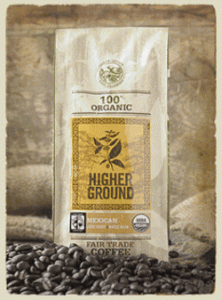
In the micro-roaster category (annual output less than 100,000 pounds) is Higher Ground Roasters.

Last May, C&C reviewed three of their selections and I discussed how impressed I was with their wide-ranging and thoughtful sustainability efforts. Roast was also impressed, especially taking into account the considerable challenges faced by Higher Ground on their home turf in Alabama, where specialty coffee is still a bit of a novelty.

The Roast article notes that because the company doesn’t have a retail location,

“Perhaps the biggest challenge Higher Ground faces is getting the coffee into people’s hands for the first time.”

Let me give them a hand and tell you that this is a great small company that deserves this honor, and you should certainly give them a try.


Roast awarded their macro-roaster award to Zoka Coffee Roaster and Tea Co. We have not reviewed any of Zoka’s coffees yet here at C&C, although I have tried a couple of them. Whereas all Higher Ground coffee is certified organic and Fair Trade, and shade-grown, Zoka does not restrict itself to certified coffees. But Zoka does carry a number of certified organic coffees (7 right now), strives for full traceability, and the Roast article goes on to say,

“…the buyers do make a conscious effort to visit farms and verify firsthand that the producers: 1) maintain a diverse and multi-level shade canopy (when appropriate) on their farms; 2) use natural, worm-generated compost made from cherry pulp at a micro-mill; 3) when necessary, use only parabolic dryers fueled by renewable sources rather than timber from surrounding forests; and 4) safely neutralize all the wastewater from wet mills.”

Congratulations to both of these worthy roasters!

Starbucks Black Apron Costa Rica

Plainspoken Coffee. A Coffee Review for Ordinary People by Ordinary People, #29.

Starbucks Black Apron Exclusive: Organic Lomas Al Rio (Costa Rica).

This review is a tad out of the ordinary for two reasons. First, I don’t buy coffee from Costa Rica. For the most part, they have gone in for sun coffee and chemicals and the Costa Rican marketing model makes it very difficult to identify where and how a particular bean was grown. You can read all the details in my post on coffee growing in Costa Rica. Second, I don’t buy coffee from Starbucks. Not because I dislike the company, but I just find most of their coffee overroasted, not very fresh, and in the case of the Black Apron line, outrageously overpriced ($14/half pound). Nonetheless, the back stories of the Black Apron coffees have been so interesting (e.g., Gemadro, Terranova) that I always see what’s new and what I can find out about it.

The latest Black Apron Exclusive is Organic Lomas Al Rio. Lomas Al Rio is not an estate, farm, or co-op, but a coffee mill in the Central Valley. This area is known for its sun coffee. To its credit, Starbucks makes no claim that this is shade coffee, and clearly states Lomas Al Rio is a mill. This source is not new to Starbucks, which has been purchasing Lomas Al Rio coffee since 1998; it is an intregal part of its Cafe Estima blend.

The Lomas Al Rio mill receives coffee from well over a hundred small and medium farms. It doesn’t process exclusively organic coffee, in no small part because so little organic coffee is produced in Costa Rica (less than 1% of the crop). Many farms in Costa Rica that were once organic have given up on it and gone back to using chemicals (non-organic nitrogen fertilizers in particular). The reason often given is that quality can’t be sustained organically. This is inaccurate in general, but in the case of large areas of sun coffee, it may be true. Sun coffee monocultures strip the soil of nutrients, and pests are more prevalent without the predators (birds, lizards, other insects) found in more forested coffee farms. The long route to high quality organic coffee in Costa Rica would probably involve re-planting a lot of native shade trees. Obviously, it’s easier to just start using non-organic means instead.

Around 2002, Lomas Al Rio was Costa Rica’s first Smithsonian Bird-Friendly certified coffee. Alas, it is no more, having let certification lapse.

No doubt this coffee is Catuai and/or Caturra, as these sun-tolerant varieties are very dominant in Costa Rica. If the “use by” date on the packaging is 6 months out from roasting, we sampled this coffee at two months old, rather long in the tooth. It produced a weak bloom, so I’d guess the we’re pretty close on the age. As I mentioned, most Starbucks coffees are roasted too dark for my taste. This wasn’t too bad, a medium-brown with a sheen, but no spots of oil. But I was dismayed at the pieces and shards in the bag, and the tell-tale missing divots on many beans, a sign that the coffee was roasted too fast. This is a sign of carelessness, but may only affect a given batch. At $14 a box, I was not about to buy another to see how common this error might be. So my expectations were not high. I was very happily surprised.

This coffee had great balance, with a medium body, a pleasant, soft mouthfeel, and a nice finish. It was wonderfully sweet when hot, and it had a distinct flavor than none of us (amateurs) could identify. Marzipan popped into my head — some sort of carmelized sugary almond flavor. Another taster also felt strongly about an almond note. This intriguing mystery flavor meant we tried it repeatedly with different people. Just about everybody liked it, and nobody came any closer to really nailing the sweet taste. Once the coffee really got cool, it took on a sort of odd flavor. But, what do you know, it got a solid 3.25 motmots.

Coffee Review tasted Lomas Al Rio from two different roasters in 1998 and 2002.

Starbucks and Ethiopia: investigative report

The Sacramento Bee has published an in-depth report by Pulitzer Prize-winning journalist Tom Knudson exploring Starbucks and its Ethiopian relationships.

Of particular interest to C&C readers will be the information on Ethiopia’s Gemadro Estate, the source of one of their Black Apron exclusive coffees. I reported on the Gemadro Black Apron when it was being offered (Starbucks Ethiopia Gemadro Estate: Corporate greenwashing?). One thing I discussed was the extent of the land clearing on the estate and its implications for the environment.

Knudson goes over this point (and many others) in greater detail. He interviewed Tadesse Gole, an Ethiopian ecologist who did his PhD work on the preservation of wild coffee and the author of a study on the environmental and cultural impacts of coffee and tea plantations in Ethiopia, including Gemadro. He found an annual deforestation rate of 12.2% in the Gemadro area, the highest in the Sheka Zone. A spokesman at Ethio-Agri CEFT, which manages the estate, says that much of the land was cleared before Gemadro obtained it, and that conservation practices include reducing erosion by planting grasses and reeds, establishing shade trees over the coffee, and leaving 3,200 acres untouched for wildlife.

Gole countered this by pointing out that many of the plants and trees are not native to Ethiopia, which changes forest composition. Knudson points out confirmation on Gemadro’s web site (which says crops planted there include some from South America, Mexico and India).

Finally, Knudson uncovered the fact that the estate was certified under Starbucks’ own CAFE Practices but that nobody from Starbucks or their certification auditor (Scientific Certification Systems, SCS) had actually visited the estate. The inspector at another firm employed by SCS was fired for poor performance, and SCS would not release the inspection report to the Sacramento Bee. This demonstrates a weakness in certification schemes in general, which often rely on third parties for inspections.

While the article comes down hard on Starbucks, it does offer some pros along with the cons, and admits,

“No coffee company claims to do more for the environment and Third World farmers…In places, Starbucks delivers on those promises, certainly more so than other multinational coffee companies.”

I will add that Starbucks has also been the forerunner in waking up Americans to “specialty” coffee, or at least that there is an alternative to Folgers and Maxwell House. Frankly, every former grocery store/big four coffee drinker that converts to Starbucks is a step in the right direction towards sustainability. And no other company has spawned more converts than Starbucks.

The article is Investigative Report: Promises and poverty. Check out the sidebar: a large aerial photo showing the estate and surrounding area, highlighting areas of forest and development. The article has also been reprinted in its entirety at the web site of the Organic Consumers Association.

Coffee review: Caribou Coffee Roastmaster Reserve Panama Maunier

Plainspoken Coffee. A Coffee Review for Ordinary People by Ordinary People, #27.

Caribou Coffee’s latest Roastmaster Reserve is Panama Maunier, from Panama’s Boquette region in Chirqui province.

Caribou indicates this is an estate coffee, named for French flower grower and former owner Monsieur Gilbert Maunier de La Espriella. Things have become a bit more complicated since Maunier sold the farm in 1985 to Plinio Ruiz, founder of Casa Ruiz SA, a well-known producer, processor, and coffee exporter in Panama.  Other Casa Ruiz brands include La Berlina or Finca Berlina and Panamaria.

Ruiz added more land adjoining the Maunier Estate, as well as processing beans from neighboring farms. From the multiple sources I consulted, including the Casa Ruiz site itself, “Maunier Estate” coffee comes from a number of farms, not just one estate. The last several years, Maunier Estate coffee has placed in the Best of Panama competition. It’s possible these competition/auction lots are isolated from the original Maunier farm, but given Caribou’s volume, the Roastmaster’s Reserve is no doubt the standard multi-farm blend sold under the “Maunier Estate” brand.

Maunier grows 40% caturra, 30% bourbon, and 25% typica at 1400 to 1700 meters. Much of Panama’s coffee is grown in a fairly sustainable manner. Another Casa Ruiz web site states that their coffees are grown in an environmentally-friendly manner under shade with little or no chemicals (several of their brands are, in fact, organic). I was not able to unearth any specific further details on their growing methods.

On to the coffee. This is a light roast (a “3” on Caribou’s 1-10 scale), a wise choice for Central American coffees, whose delicate flavors are easily erased by more aggressive dark roasts. Even so, I braced myself to distinguish and describe yet another mild-mannered Central American. Other than the crazy geisha, we haven’t had much to say about most Panamanian coffees, which have the “classic” coffee profile.

Caribou’s Maunier is no exception. In a nutshell, it was actually more boring than many other Centrals; I would describe it as fairly one-dimensional. It wasn’t bad, really, it just didn’t have any spark to speak of and not many sweet chocolately tones one usually finds in these coffees.

Also unlike any Central I can recall, rather than a bright, light body, the Maunier seemed much heavier, nearly syrupy when prepared in a French press. Clearly, this wasn’t a result of a dark roast. We thought perhaps instead we’d been a little careless in preparation, but this was one characteristic that stood out over repeated tastings. Later, I reviewed the various cup profiles on Maunier, which described it as floral, herbal, somewhat spicy or winey, and acidic — and with heavy body. While we got some interesting floral and “bubble gum” aromas from the beans and ground coffee, in the cup the Maunier was rather generic, save for this full-bodied mouthfeel.

It is this rich body that I think will appeal to many ordinary American coffee drinkers, who tend to not appreciate subtlety and seem to like sturdier coffees. There’s nothing offensive about the Maunier. Folks not looking for anything intriguing or unique will find Caribou’s Maunier to be a classic, straightforward coffee with a body that will stand up to cream, sugar, or other additives. We were a little uninspired, and gave it 2.5 motmots.

Caffe Pronto goes Bird-Friendly

One of C&C’s favorite roasters, Caffe Pronto in Maryland, has just received Bird-Friendly certification from the Smithsonian Migratory Bird Center. Most people associate the SMBC certification with farms, but roasters may also participate. Obviously, they need to sell SMBC certified coffee (although not exclusively), and contribute $0.25 per pound of certified SMBC coffee to Smithsonian, which goes to support the certification program.