Category: Housekeeping Page 1 of 2

15 years of Coffee & Conservation

I made the first post on this website on this day in 2005. I initially envisioned a modest collection of resources explaining the importance of “shade-grown coffee” to biodiversity, birds in particular. As an ornithologist, I knew how critical wintering habitats in the tropics are to the birds that I studied here in North America. As a coffee drinker, I was frustrated and surprised that there was no single go-to place for consumers that would enable them (us!) to make an informed choice about what coffees were grown under ecologically-responsible methods. I thought I would just whip one up!

Here I am, fifteen years and hundreds of posts later. There were so many layers of nuance to explore: not only ecology, but also agronomy, economics, marketing, and the social and cultural aspects of coffee. I attended trade shows, and visited coffee farms. And drank a lot of coffee.

There has been so much evolution in the coffee world over these years. Consolidation among the big players in coffee buyers (often to private ownership) has made it nearly impossible for me to provide what I considered to be some of the most valuable data on this site: which corporations owned which brands, and how much certified or eco-certified coffee they purchased. A proliferation of certifications or sustainability claims, with increasingly copious criteria and similar but unequal definitions, has made my other crucial task — attempting to explain what these labels, standards, and seals mean to the consumer — tedious at best.

The coffee and product reviews have been fun, and I have especially enjoyed writing about birds and biodiversity. But the difficulty in updating information on certification standards and corporate ownership, purchasing, and sustainability issues that I consider the core of my mission has me uncertain as to the future of this site. So I’ve while had some long dry spells without posting, depending on what was going on in my own life, now I feel I am at a crossroad.

I welcome constructive comments on what direction this website should take as I ponder the future. Just leaving the site here indefinitely is likely not an option. Although I am now accepting donations, I haven’t tried very hard to monetize this site because my emphasis was on providing information, not making money. As a recent semi-involuntary retiree, I don’t think I can commit to supporting the site long-term.

Thank you, readers and friends, for this interesting journey. We’ll see where the future takes us.

2016 status update

Things have been quiet up front here at C&C. My work situation has changed in the past year, and I have not had much time to work on coffee matters. I’ve spent the time I have had working behind the scenes. I’ve made some site improvements (especially combatting an unreal level of brute force attacks), fixed broken links, etc. so that the current content on the site is kept available and updated. For example, I always make sure to refresh the data in the tables at Eco-certified coffee: how much is there? and Corporate coffee: how much is eco-certified?  I’ve also been trying to keep up with major developments in the coffee industry related to sustainability efforts. I have simply not had the hours to devote to the research involved in presenting the depth, quality, and perspective that I feel comfortable publishing.

I hope to find a happy medium with some upcoming posts in the coming days and weeks.  I appreciate that readership here has not declined but remained strong as people continue to use the site as a resource. Thank you for your support!

Site updates

In addition to making minor changes and updates on many individual posts, I have recently updated and overhauled several important pages here at Coffee & Conservation.

Quick Guide to Coffee Certifications — I’ve updated the information, and added graphs that illustrate the number of environmental criteria/requirements and number of biodiversity criteria/requirements for many of the certifications.

Eco-friendly coffee: How much is there? — How much of the world’s coffee is grown and sold under the standards of the major eco-certification programs? Data from multiple sources covers ~2006 to 2013.

Corporate coffee: How much is certified? — how much eco-certified coffee is purchased and sold by the biggest corporate coffee buyers? Data from multiple sources covers ~2007 to 2013.

Coffee bibliography — This is my curated list of peer-reviewed literature on sustainable coffee production and certifications. There are nearly 400 papers in the list.


Coffee agroforestry course

earthinstlogoA new course, Agriculture & Wildlife Conservation: Coffee Agroforestry, is being offered at the Earth Institute Center for Environmental Sustainability (EICES) at Columbia University in New York City.  I  was really pleased to learn that instructor Dr. Amanda Caudill, a postdoctoral research scientist at the Smithsonian Conservation Biology Institute, is utilizing materials from Coffee & Conservation in the course.

Classes are held in the evenings at Columbia University, or are available via Distance Learning. The Coffee Agroforestry course can be taken alone or as part of the Certificate Program in Conservation and Environmental Sustainability. More info here.

Here’s the course description:

Habitat destruction threatens wildlife existence worldwide. While preserving tropical forests is a necessity for biological conservation, this must be coupled with other conservation strategies to provide a sustainable solution for wildlife conservation. Coffee agroforestry, the intentional management of shade trees within coffee farms, has shown promise as a conversation strategy to support wildlife diversity. This course explores the relationship of coffee agroforestry and wildlife conservation. We will examine coffee farms as habitat through case studies, learn about socio-economics and environmental issues associated with coffee, and assess coffee certifications such as shade grown, organic, Rainforest Alliance, and Smithsonian Bird Friendly.

I’ve linked to Dr. Caudill’s work on biodiversity on coffee farms when it was featured in the New York Times in their Scientist at Work series. This sounds like a terrific course!

My year in beans: 2012

Annual recap of how much I spend on coffee in a year

I started this five years ago: I was curious about the variety of coffees I consumed, and particularly about how much I spent on coffee since price seems to be such a driving force when consumers are faced with choosing between cheap coffee and slightly higher priced certified/sustainable coffee. My recording method has been standardized since 2009, but I have refined the method used to calculate price per cup. I was basing it on tablespoons per bag and cup, and I prefer a ratio of coffee to water that is higher than typically recommended. I’ve now gone to using the common industry standard of 11 grams of coffee beans by weight per 6 fluid ounces of water. I have amended my previous calculations, too. Here are my 2012 stats (coffee for a 2-person household):

  • 87 bags of coffee totaling 65 pounds.
  • Total retail price for the coffee only = $1293. I buy most of my coffee online, so I spent $113 on shipping, for a grand total of $1406 for the year.
  • Cost per six-ounce cup: only $0.52 ($0.48 without shipping).
  • The average price per pound (not including shipping) this year was $21.60. This includes four bags of really high-quality coffee which each cost over $45/lb. Most average coffee consumers will be able to bring even this price down substantially without compromising sustainability, or taste.
  • 77% of the coffees were certified organic, Rainforest Alliance, Smithsonian Bird-Friendly, or some combination. This is not to say the remainder were not sustainably-grown. I am do my best to research the source of each coffee and gauge sustainability, since not all farmers can afford certification. I’ve found that the last couple of years some of my favorite producers have dropped organic certification, and other coffees are produced under certification but not sold as such. So while I’ve tried to buy only certified coffees, some were not, but none were cheap, fast-food, commodity, or mystery coffee. If I don’t know where it comes from, I don’t drink it.

Previous results

My four-year average (discarding 2008 stats) is 63 pounds of coffee a year at an average of $20.53/lb, and $0.50 per 6-oz cup, including shipping. This has been remarkably consistent over the years.

Some price comparisions and the price of convenience:

If I drank the same amount of coffee, but used only K-Cups, my annual cost would go from $1300 (average including shipping and some very high-priced, award winning coffees) to just over $2000! This was calculated using inexpensive Folgers K-Cups priced in bulk at Amazon (not only cheap, but one of the worst coffees you can buy in terms of sustainability). The cost only goes up with “better,” organic, or bold (stronger) K-Cups*. So if you are using K-Cups because it’s convenient, you are not only paying through the nose, you are producing landfill-choking waste one little non-recyclable K-Cup at a time. That’s asinine. And please don’t tell me you use a single-cup brewer so you don’t waste coffee. If you are wasting $700+ worth of coffee a year, something is seriously wrong.

I think I’ve shown that “But I can’t find organic/Bird-Friendly/Rainforest Alliance/etc. coffee around here” is a poor excuse for not drinking it. My shipping costs — with nearly all my coffee purchased online — have averaged less than $130 a year (or $2.50/wk). It’s not hard to find free or reduced shipping specials, or flat rate shipping, online. You could get Smithsonian Bird-Friendly/organic certified coffee automatically delivered to you once a month from Birds and Beans for $105/year (even more variety from Birds and Beans Canada). Or design your own monthly coffee delivery from any of Caribou Coffee’s 100% Rainforest Alliance certified varieties for $75/year. Or buy more coffee locally than I do. For example, Birds and Beans is expanding nationwide, and if you don’t have a Caribou store near you, many retailers like Target carry it.  Ask your local retailer to carry your own favorite eco-certified coffees!

Great coffee that helps support ecosystems and rural communities worldwide is not too expensive for all of us to enjoy. You can calculate how much a cup of coffee costs, based on the price of a bag of beans, using the spreadsheet below.

*You can fiddle with the math yourself. Regular K-Cups hold 9 grams, other types hold varying amounts. There are about 454 grams in a pound, so about 50 K-Cups to a pound.

Site updates

I’ve recently done some tweaks and improvements of the foundation and background information on the site:

My year in beans: 2011

Annual recap of how much I spend on coffee in a year

I started this several years ago, and I think the method has now been more or less standardized. See below for previous results and caveats.

This year, coffee prices were higher, but I was able to spend a little less on shipping due to taking advantage of specials, or buying more bags per order. Here are my 2011 stats:

  • 89 bags of coffee totaling 63 pounds.
  • Total retail price for the coffee only = $1297. I buy most of my coffee online, so I spent $123 on shipping, for a grand total of $1420 for the year. It’s not too hard to find free or reduced shipping specials online.  Note that my shipping costs only work out to $1.38 a bag.
  • Cost per six-ounce cup: only $0.54 ($0.49 without shipping).
  • I buy a lot of really high-quality coffee. The average price per pound (not including shipping) this year was $22. The big outlier was a half-pound of Finca La Valentina Geisha from PT’s Coffee, which retailed at the equivalent of almost $120/lb. Including that coffee, I indulged in 23 bags of coffee that retailed for over $20/lb. If only all of life’s simple luxuries were so cheap!
  • This year, I took a closer look at the top ten or so coffees that I had flagged as my favorites this year. The list revealed some interesting trends — I’ll be doing a separate post on them shortly.

Previous results

My three-year average (discarding 2008 stats) is 62 pounds of coffee a year at an average of just over$20/lb, and $0.49 per 6-oz cup, including shipping.

Other facts about my 2011 coffee:

  • I purchased from 25 roasters, 8 of which were new to me.
  • All but two bags were from single-country origins, representing 20 countries.
  • I buy mostly single-estate coffee so that I can do research on the source and gauge sustainability, as not all farmers can afford certification. At some point in the fourth quarter of the year, I began recording certifications, and tried to go back and look them up for older coffees (not all of which were still available). Of my 89 bags, 31 were certified organic, with some of those having additional certifications; another 8 were certified by by Rainforest Alliance only.

As I’ve said previously, great coffee that helps support ecosystems and rural communities worldwide is not too expensive for all of us to enjoy.

I’ve posted this before, but if you’d like to calculate how much a cup of coffee costs, based on the price of a bag of beans, just punch in the price and weight of the bag here:

2011’s most popular posts

What might a stroll through the Coffee & Conservation 2011 referrer logs and stats tell us about what coffee readers are interested in ?

Here are the top 10 posts of 2011:

  1. Keurig reusable coffee filter for single cup brewers
  2. Refilling Keurig K-cups
  3. Solofill Reusable coffee filter for Keurig K-Cup brewers
  4. McDonald’s coffee in the U.S.
  5. What is shade grown coffee?
  6. Refilling K-cups, take 2: The My-Kap reusable lid
  7. What does a great cup of coffee cost?
  8. Coffee growing in China
  9. Top 5 indicators of sustainable coffee
  10. Trader Joe’s coffee

Okay, so people who come here are obsessed with Keurig brewers, and ways to avoid K-Cups. Not apparent until you click through to the posts is the fact that none of them was actually written in 2011. I’ll take that as a sign that I have a deep bench. Considering more recent history, here are the most popular posts I wrote this past year:

  1. Ekobrew: another alternative to K-Cups
  2. K-Cups are now recyclable! Not really.
  3. Greenwash alert: Nespresso capsule recycling
  4. How ”wild” is Ethiopian forest coffee?
  5. Coffee growing at home

Hopefully, the cost-conscious, single-serve brewer folks pick up some other worthwhile information while they are here. The following list is what I consider to be the most important or interesting of 2011, the ones I hope people read:

  1. 4C Code of Conduct: marginal standards for corporate coffee
  2. Cloud forest coffee at Finca El Jaguar
  3. How much does eco-certification cost?
  4. Folgers owner: not waking up to sustainability
  5. What does “organic” really mean?

I have a couple more lists coming up: my annual review of the cost of all the great coffee I drank in 2011, and my favorite coffees of the year and what they told me about my tastes.

Happy New Year!

Site updates

I’ve snuck in a few updates under the radar that are worth a look:

  • I’ve updated the table of market shares of eco-friendly coffee with the latest data from Smithsonian’s Bird-Friendly program. The annotated table shows, where data is available, hectares certified, production, and sales of five coffee certifications from about 2006 through 2010 in standardized format.
  • I’ve also updated the list of peer-reviewed literature on sustainable coffee issues. While I review some research articles here, the bibliography lists many more that are published on coffee pests and diseases, shade management, biodiversity on coffee farms, the economics of various certifications, climate change and coffee, and related topics. You can always access it via the “References” tab at the top of the page. If you have a paper you are especially interested in that you can’t access without an academic account, write to me and I can probably get you a copy.
  • I’ve been working on our interactive map of recommended coffee roasters. The link is always available in the middle column of the page here at C&C, or directly at ZeeMaps. I’ve now added more Canadian and European roasters. You can click on the individual markers, or “View List” at the top of the map page to see all the roasters. Not everybody gets to be on the list; here are the criteria.
  • Finally, I’ve been adding links to additional information on the post about the TransFairUSA resignation from FLO.

New readers: start here!

One of my fellow Audubon Guides bloggers, Laura Kammermeier, has jumped on the sustainable-coffee bandwagon, and has been encouraging her readers, including those of the American Birding Association blog, to do so as well.

If you landed here at Coffee & Conservation from Laura’s efforts, welcome!  There is a lot of information on this site about the complex issue of sustainable coffee production. Here’s a quick guide to some of the areas you might want to start exploring:

No excuses. Here’s where you can get certified Bird-Friendly coffee. Yes, it costs a little more (why should we expect farmers in the developing world to help preserve biodiversity and not be willing to pay for it?). But even if you have to pay shipping, it’s still very inexpensive — calculate it yourself right here. If you’re a birder, you probably routinely buy optics, field guides, go on bird trips, or even hop in the car to chase a new bird across the state. How can we not afford cup of coffee that won’t doom the birds we love to see?

For more links to background information, click on the User Guide tab at the top of the page.

New resources posted

I’ve updated a couple of important resources.

First, have a look at “The ecological benefits of shade-grown coffee: the case for going Bird-Friendly,” a report by Robert Rice of the Smithsonian Migratory Bird Center issued in September. It reviews more than 50 mostly peer-reviewed studies performed on shade coffee farms, and summarizes the findings and benefits of this mode of coffee production. It is in Word format, and the link can also be found in the “Related links” section of the left sidebar under “Eco-benefits of shade coffee: scientific case studies.”

I’ve also updated my bibliography of peer-reviewed research on relevant coffee issues, which can be accessed through the “References” tab at the top of the page.

New and updated updates

Here we are at the new web host. Goodbye and good riddance to my hostage situation at Typepad, what a PITA. I still have some housekeeping to do here, mostly fixing some wacky image placement and broken links.

I mentioned at the old site that I taped a segment of PRI’s “The World” on biodiversity and coffee a week or so ago. I talked about coffee certifications and what consumers need to be aware of when looking for sustainably-grown coffee. This followed a long conversation I had with award-winning journalist Diane Toomey. She followed up with me the other day and was working on the script — distilling a number of interviews and a lot of acts into a five-minute piece!

I’ll let you know when the piece is to air on your local NPR station, and provide a link to the audio.

Happy holidays from C&C!

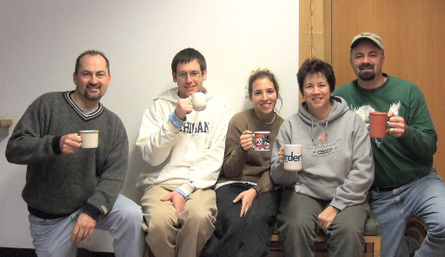
The highly-caffeinated main tasting panel at Coffee & Conservation wishes you a happy holiday and many excellent, sustainable coffees in the New Year! Standing are Mike, my better half Darrin, and Rick; yours truly is seated with our newest regular panelist Dana on my lap. Honest, I did have a coffee mug in my other hand!

Welcome ProBlogger readers!

Darren Rowse ran a little experiment on his excellent site, ProBlogger, last weekend. He invited folks to promote their blogs in 140 characters or less. There were 1400 responses, and Darren picked 10 of his favorite pitches. First on his list was…

Are your beans for the birds? Learn about eco-friendly, sustainable coffee, and how your morning cup can change the world.

If you are reading this because you were also intrigued by my pitch, welcome! I know Coffee & Conservation can be a little daunting. How could there be so much material on sustainable coffee?! Where should you begin?

First, a brief bit about why I believe that making the choice to drink sustainable coffee can bring real change to the world. Then please visit the User Guide for a list of background posts that help you understand what defines sustainable coffee. They include What is shade coffee? and What is sun coffee and why is it a problem? You may also want to check out the post on the coffee crisis (why cheap coffee is being grown on sun plantations) and how this cheap coffee perpetuates poverty. If you only read one post here and put what you learn into action, make it The Top 5 Indicators of Sustainable Coffee.

I hope ProBlogger readers find this site useful — and I welcome feedback.

Coffee cup photo based on an image by Klaus Post.

Shade coffee at Dave’s Garden

Dave’s Garden is an enormous web site that covers every issue of interest to gardeners. The site just had a feature article on shade coffee by Marna Towne. Marna hits all the high points to introduce DG users to this important issue. And this is no small audience: DG has over 400,000 registered users and can get nearly 2 million hits a month! Many thanks to Marna for doing this piece, and asking me to provide some information and photos.

So welcome Dave’s Garden readers! Please visit the User Guide for a list of the important background posts. If you only read one post here, make it The Top 5 Indicators of Sustainable Coffee.

Marna’s article covered some of the information in What is shade coffee? and What is sun coffee and why is it a problem? You may also want to check out the post on the coffee crisis (why cheap coffee is being grown on sun plantations) and an example of illegal coffee growing in a national park (how it ends up in common grocery store brands).

I hope Dave’s Garden readers find this site useful — and I welcome feedback — and that Coffee & Conservation readers head over to DG to check out all the incredible resources there!

Page 1 of 2

Powered by WordPress & Theme by Anders Norén