K-Cups/Keurig brewers: alternatives

K-Cup recycling: I told you so

Encore! Here’s another piece on K-Cup recycling, published in Grist in December 2024. The (same) beat goes on.

Some years ago, I swore off writing any more about K-Cups, a product line that was antithetical to the concept of sustainable coffee.  A few years later, I did post yet another update on the lack of recyclability of used K-Cups. And here I am again, back to beat the dead horse!

Daily Coffee News reports that K-Cup owner Keurig Dr Pepper (itself owned mostly by JAB Holding and minority holder Mondelēz International) has reached settlements in Canada and the U.S. in lawsuits stemming from false or misleading claims regarding the recyclability of K-Cups. As I described in my last post on the topic, although the K-Cups are (finally) made of a recyclable material, it is #5 plastic (polypropylene), which is not accepted in all communities. The Daily Coffee News piece notes less than 3% of polypropylene plastic is recycled in the U.S., due to both logistical and capacity issues. The Canadian settlement is for US$2.3 million. The U.S. case is class action, the preliminary agreement has not yet been disclosed, and the parties have another month to begin the finalization of the settlement.

These lawsuits are separate from the antitrust/price-fixing settlements agreed to by Keurig in 2021.

Recycling plastics is a failure at best and a big con at worst. There are plenty of no-waste ways to make a single cup or whole pot of exceptional coffee. Since coffee making is often a daily occurrence, kicking the single-use pod/cup is a great step on the road to quitting plastic.

And while we’re on this pony, I have also revised and updated my post on the recycling saga of Nespresso coffee pods. That’s a product made of a completely recyclable material, aluminum, that also has a poor recycling rate for some of the same reasons as K-Cups (consumer inertia, lack of acceptance at recycling centers). I’ve tossed in Nespresso’s dirty little secret that despite all their splashy ballyhoo discussing how great their pods are because they are made of recyclable aluminum, they only just started using any recycled aluminum in their pods. And all the new aluminum they use is supplied by the nasty mining conglomerate Rio Tinto. Ugh.


K-Cups: Still trashy after all these years

Update: In early 2016, the New York Times reported on Keurig’s annoucement that they would finally be coming out with a K-Cup made of plastic recyclable by typical municipal facilities. But it also pointed out the continued environmentally-negative aspects of K-Cups outlined below, including high energy costs to produce and potentially low consumer cooperation. It did not address problems with the size of the cups jamming sorting machines at recycling facilities, or potential contamination if consumers don’t remove the lids. Or, oh yeah, the insane cost. See this post for alternatives.

Keurig Green Mountain (KGM) has released its 2014 sustainability report. As far as their progress on reducing waste from K-Cups, the story is much the same as last year… and many previous years.

  • K-Cups are still not recyclable*.
  • The goal is still to make all K-Cups recyclable by the year 2020.
  • The report notes that K-Cups were first introduced in 1998. Thus (if successful), it will have taken KGM 22 years to achieve their goal.

THIS IS CRAZY. First and most obvious, how many K-Cups will have been produced by KGM and sent to a landfill by that point? In  2013 alone, it was estimated at 8.3 billion. What about third-party manufactured packs that are produced now that the original K-Cups are off-patent?   How many of these are and will be produced? Are or will any of them be recyclable?

Second, will there even be any of the brewers around still using the original K-Cups by 2020? It sort of seems as if this exercise will be a moot point by then: the product will have run its course, with billions still sitting in landfills.

Meanwhile, KGMs newer Keurig 2.0 brewer compatible portion packs — the Vue Pack, K-Carafe, and Bolt Pack — are recyclable, sort of. They are made of #5 plastic (polypropylene) and can be recycled according to KGM, in 60% of U.S. communities — although often not curbside. Note that it requires several steps by consumers, and extra effort tends to reduce the number of units actually recycled, especially among uber-convenience oriented Keurig users. The overall recycling rate in the U.S. is only 34%, a low rate of compliance which reduces the significance of single-serve coffee portion packs being made of recyclable material.

Isn’t it so much better for the environment to create a cup of coffee that only produces compostable organic coffee grounds? This can be achieved, for less money and with superior results, with any number of methods, such as a Hario pour over cone  or Chemex and a reusable filter, or a French Press.

And, by the way, the Keurig brewers are manufactured in China and Malaysia.

You can read more about the high cost of K-Cups and other single-serve capsule coffees here, and a summary of reusable alternatives to K-Cups for Keurig brewers here.

_______

*I’m still surprised at how many people say they recycle K-Cups. As I — and KGM — have explained many times they are made out of a plastic that cannot be recycled. It doesn’t matter if you peel off the lids, remove the filter, grounds and all the adhesive, and carry them to your recycling center delivered on a velvet pillow.  The facility will sort them out and send them to the landfill or incinerator. If they don’t and they get mixed in with other plastic, they can potentially contaminate a whole batch as surely as a turd in a punchbowl.

P.S. After I completed this post but prior to publishing it, The Atlantic came out with a great article on the wastefulness of K-Cups. Take a look.

You’re paying WHAT for single-serve coffee?

The high cost of K-Cups and pods

There are two reasons people give for using single-serve coffee: convenience and price (the rationalization for the latter is that otherwise too much coffee from a pot is thrown away and wasted).

Here is the straightforward truth about what you are paying by using single-serve. The amount of coffee in a pre-packaged single serving varies; I’ve given some common examples. If your single-serve pod, cup, or pack isn’t listed, dismantle one, weigh the coffee and put the amount in the appropriate cell in the spreadsheet.

Posts summarizing previous years are listed here:

  • 2013 (the year of all certified coffee)
  • 2012 (includes comparison to the high price of K-Cups)
  • 2011
  • 2010
  • 2009

If you don’t feel like looking up the typical box of K-Cups, here are some examples:

Green Mountain Sumatran Reserve Coffee Extra Bold K-Cups- 18 Count – $11.99 at Bed, Bath, and Beyond = $27.47/lb ($0.67 per cup)
Folgers Gourmet Selections Coffee K-Cups, Lively Colombian Regular – 12-Count (Pack of 3) – $22.86 at Amazon = $32.00/lb ($0.63 per cup)
Dunkin Donuts Original blend K-Cups – 14 count – $17.95 at Dunkin Donuts stores = $64.62/lb ($1.28 per cup)
Nespresso capsule variety – 50 count – $50.00 on  Amazon = $82.47/lb ($1.00 per cup)
Maxwell House Mild Morning Tassimo T-Disks – 14 count (pack of 2) – $19.98 = $40.46/lb ($0.83 per cup)

So, the price per pound is ridiculously high (I was astonished to find, when researching this post, that some people buy K-Cups using food stamps!!!). What about the argument that K-Cups are cheaper since no coffee is wasted?

As noted in my latest annual summary of coffee cost for my two-person household, the four-year average — including many great coffees and shipping — is $20.53/lb. If I made two cups of coffee a day at $20.53/lb, at the standard 11 grams per 6-ounce cup, I’d spend $363 a year.  If I used two extra-bold (11 gram) K-Cups a day at the cheapest example above, I’d need forty 18-count boxes and I’d spend $479. I save $116 a year. At $0.50 a six-ounce cup (my four-year average), I’d have to waste nearly 11 gallons of coffee to spend as much as I would on K-Cups in this example. That’s tossing away a cup of coffee from a pot nearly every day 8 months of the year.

What about convenience?

kettle-clever

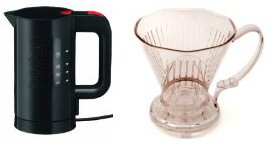
The solution to the waste issue is, indeed, to brew only the coffee you’ll drink. Rather than buying a $150 Keurig brewer, buy a Bodum 17-Ounce Electric Water Kettle for $40 which boils water in 4 minutes (getting it to the correct temperature, unlike most coffee pots or single-cup brewing machines). Then get a foolproof Clever Coffee Dripper for $22 (you can make up to three six-ounce cups in it, if you wish). A year’s supply of paper filters would set you back less than $50 and can be composted (your 2 K-Cups a day amounts to 8 pounds of crap in a landfill a year).

Is this also a huge hassle? Start to finish, brewing a K-Cup takes about 3 minutes, mostly because the water doesn’t reach a high enough temperature nor is it in contact with the coffee for enough time for proper extraction. To make one to three cups in your Clever takes about 8 minutes (four for the water, four for the brewing). For those extra few minutes, you save money and you get better coffee even if you use pre-ground coffee put in the filter the night before and accidentally let it steep for too long. For every “upgrade” you make (better quality coffee, grinding your own beans, paying attention to timing) the improvement in quality will be substantial.

K-Cup alternatives: summary and parting thoughts

Updated December 2018

I wrote my first post on an alternative for throwing away those wasteful, pesky not-really-recycled/recyclable K-Cups in 2007.  Since then, I have reviewed a number of alternatives. I’ve even reviewed another single-cup brewer. However, now that some of the patents on K-Cups have expired, we have more variations and and alternatives to Keurig brewers and single-cup pods, cartridges, and capsules than Carter has little pills.

Avoiding sending coffee-related trash to landfills (and using much more sustainably-grown coffee than is typically available in pre-packaged single-cup coffee products) is certainly within the purvey of a web site on coffee sustainability. But it’s come to the point that if I were to review, or even mention, half of the K-Cup alternatives flooding the market this site would veer away from an emphasis on the ecological effects of coffee growing.  I am going to semi-retire from discussing or reviewing these types of products, unless there is some sort of remarkable innovation or noteworthy news.

For my finale, here is a table that summarizes the popular products currently on the market which are reusable alternatives to K-Cups which allow for the use of a consumer’s own coffee that are compatible with many of the original Keurig brewers.

Reusable alternatives to K-Cups

Product
Approx. Price
Capacity in grams*
Notes
My K-Cup Reusable Filter$13, original. $23 for a universal model that fits older AND newer (2.0) Keurig brewers.15 or 17Best to have at least two so that you aren't cleaning one over and over. The best deal is a pack of 4 universal stainless steel version.

My review here.
ekobrew


$1514My review here.


2nd-most popular with C&C readers.
Solofill

See also gold versionthat has less potential to alter flavor.
$1511My review here.


Most popular with C&C readers.
The My-Cap (also known as My-Kap) was a simple and inexpensive ($7 for 3 caps plus a cleaning brush) for refilling used K-Cups. They went out of business, but a similar product is the Recycle A Cup, a product I've not tested.$12 for 29, or however much you can fit into an old K-CupUsed to refill old K-Cups.

My post of the old product here. I haven't tested the replacement.
EZ Cup by Perfect Pod which requires proprietary filters, approximately $12 for 100.


There is a newer product, the Cafe Fill Value Pack by Perfect Pod that includes two reusable filters and a special scoop with a funnel allowing for the correct amount of coffee easily placed in the pod. Very popular.
$9.90 for original, $13 for new pack.Around 9Requires proprietary filters, approximately $12 for 100. Only for older Keurig brewers.

I’m not sure, given the fact that there are so many competitors and K-Cup brands, that K-Cups themselves will ever be truly eco-friendly.  Here is what Keurig owner Green Mountain Coffee Roasters (GMCR) had to say in their 2011 CSR document:

Widespread adoption of the Keurig® single cup brewing system raises some important — and complex — environmental challenges. To better understand the impact of our products and guide our efforts to address those challenges, we conducted a life cycle analysis comparing single cup brewing systems to drip-brewing systems. We learned that the cultivation of coffee beans, operation of brewing systems, and use of materials in product packaging all represent significant impacts on the environment. The study revealed that packaging disposal represents a fraction of a product’s environmental impact across its entire life cycle.

Literally billions of K-cups ending up in a landfill may be just a “fraction” of this product’s environmental impact, but it is huge in and of itself. With the alternatives listed above, there’s no excuse for using this wasteful product.

*I’ve included the capacity as stated in promotional material, user reviews on outside web sites, and/or my own testing, if available. The volume of coffee grounds that will fit in something that goes in the original Keurig brewers is, in my opinion, the biggest limitation to coffee quality to those machines. The Specialty Coffee Association of America recommends 10 grams of coffee per 6-ounce cup; most people drink larger mugs of coffee and may also prefer a stronger cup. A regular K-Cup can hold about 9 grams of coffee. Despite “bold” selections and brewers that make various cups size, the physical capacity of the older (not the new “Vue” brewers) machines is difficult to overcome. Therefore, getting a well-crafted cup of coffee from a Keurig brewer (and many other brands I have seen or used) is hit or miss.

Review: Melitta JavaJig

Yet another player in alternatives to K-Cups market, this one by the century-old German company Melitta.  As the story goes, the company was founded by the inventor of the paper coffee filter. The Melitta Javajig is, in fact, as straightforward, reliable, and effective as one would expect from this well-respected company.

I’ve reviewed other reusable-and-use-your-own-coffee K-Cup replacements. The JavaJig is so simple, easy to use, and easy to clean that you immediately wonder why someone else didn’t immediately come up with this design.

The JavaJig has three BPA-free plastic reusable parts, plus a fluted paper filter that looks like a mini muffin tin liner. You place a filter paper over the upside-down black frame, slip the green outer sleeve over the frame, turn it over, add coffee (Melitta suggests an espresso grind), pop on the cap, and you have a pseudo-K-Cup ready to place in one of the many original style (not Vue) Keurig brewers. You do not need to remove the brewer’s filter assembly as you do with Keurig’s My K-Cup.

After brewing, the coffee and filter can be composted, the other parts rinsed, and you are ready to create another cup. Not only is this nearly foolproof, but it is dead easy to keep clean and there is no hinged lid that might snap off, as has been reported with the ekobrew or Solofill. The package includes two units, and they are inexpensive enough to have spares on hand if you feel lids may go missing.

I was able to get 12 grams of finely ground coffee in the JavaJig with a little tamping, but not packing. This is more than the insufficient 9 grams used in a standard K-Cup. There is space between the bottom of the green filter and the filter paper (thus, it does not get pierced like the bottom of a K-Cup). I tried a little manipulation of the filter to see if I could get it far away enough from the needle not to pierce the paper, but still allow for more coffee. It was too difficult to get the paper to cover the prongs, so grounds would easily leak out. Using a piece of regular coffee filter failed as it was too flimsy. By this time I realized that this amount of farting around spoiled the ease of use of the JavaJig.

Using fine grounds in some other devices causes back-up or overflow, but not in the JavaJig. The finer grounds also allow for more extraction. This is important not only because the older Keurig brewers just don’t have enough room or a long enough brew time for proper flavor development, but because the entire bottom of the JavaJig is the paper filter. Under the pressurized brewing, water goes through the grounds and filter faster than it would in a more enclosed environment, such as in some of the other K-Cup alternatives. I tried the JavaJig with 9 grams of coffee and two filters, with a 6-ounce cup; it worked, but did not slow down the brew time enough to make a difference.

Ergo, the JavaJig makes a cup of coffee comparable in strength and body to a K-Cup or similar substitute. It just suffers from the physical limitations and brewing method of the Keurig brewers themselves.

However, the resulting cup is much cleaner than the alternatives that use metal filters, since the paper filter helps eliminate sludge and small fines (for purists who can taste paper — not that they’d be likely users of this product — the assembled JavaJig and filter can be rinsed before filling with coffee).

The beauty of the JavaJig, and the reason I recommend it over all the other devices I’ve used so far, is its simplicity, cleanliness, and excellent value compared to the others. The starter outfit includes two JavaJigs and 30 filters. The filters are around $0.07 each, versus $0.16 each for the other competitor that uses filters. It can also be used with loose tea with very good results.

Alas, this will likely be my last review of any sort of K-Cup or Keurig brewer alternative. I will post an explanation, as well as a summary, in an upcoming post.

Re-purposing used K-Cups

Well-established fact: K-Cups are wasteful, and are difficult to and usually are not recycled. While there are many alternatives to them if you must use a Keurig brewer, some people will continue to use them.

I’ve provided instructions on how to refill used K-Cups; not a truly tasty option in my opinion, but no worse than the original. In that post, I even came up with an unusual use for them once you’ve decided they have no business being filled with coffee again.

I recently came across a post on “Can I Recycle This?” which had many ideas for re-purposing used K-Cups, including tiny freezer Popsicles,  bead storage, and many craft items. If nothing else, the whole site is worth a look for ideas on how to recycle or repurpose just about anything, from eyeglasses to medical tubing.

New Keurig brewers, K-Cups won’t fit

Key patents on K-Cups, the single portion packs used in Keurig brewers, are expiring this year. Rather than lose market share to the competition, Keurig is countering by coming out with new brewers. The upcoming “Vue” brewers will offer a wider range of brew sizes and beverage types as well as temperature control and other features. The list price of the Vue V700 brewer is $249.99

Importantly, the Vue brewer is not compatible with K-Cups — they will use new Vue Packs.

On the bright side, the Vue Packs are made of #5 plastic, which can be recycled once the foil lid, inner paper filter, and contents are removed by many recycling programs.

K-Cups are now recyclable! Not really.

Update: In early 2016, the New York Times reported on Keurig’s announcement that they would finally be coming out with a K-Cup made of plastic recyclable by typical municipal facilities. But it also pointed out the continued environmentally-negative aspects of K-Cups outlined below, including high energy costs to produce and potentially low consumer cooperation. It did not address problems with the size of the cups jamming sorting machines at recycling facilities, or potential contamination if consumers don’t remove the lids. 

Green Mountain Coffee Roaster’s Keurig division has announced a “recovery” program for their naughty little K-Cups (already incorrectly being referred to in the media as a recycling program). I’ve talked about the waste issue surrounding these single-serve coffee portion packs specifically, as well as posted two ways to re-use them, and three different products that allow you to use the Keurig brewers and avoid the K-Cup dilemma altogether.

In response to the environmental impact of K-Cups, Keurig has launched the Grounds to Grow On program. This sounds like a great idea, but it has some limitations.

  • It is only available in some (22) states. This program is in a testing phase with an intention to go national next year.
  • It is only available for business locations. Only about 10-11% of Keurig brewer sales are to “away-from-home” locations, based on 2006-2008 data.
  • It costs $59.75  for five small “recovery bins” which hold 175 K-Cups each, or $114.75 for larger bins which hold 450 K-Cups.  Shipping to and fro is included in the cost.
  • The K-Cups aren’t recycled. The grounds are composted, while the K-Cups themselves are burned to produce steam energy by partner Covanta Energy. This is referred to as “renewable energy” a few times. I have a hard time seeing how waste-to-energy could be considered renewable, and I’m not the only one.  The irony, of course, is that recycling is the enemy of the never-ending stream of garbage needed to feed waste-to-energy facilities. Covanta is one of the companies pushing to have waste-to-energy defined as renewable, as it would make the company eligible for subsidies. Keurig’s choice of Covanta as a partner in the Grounds to Grow On venture is unfortunate. Multiple Covanta incinerator facilities have been fined in several states for emissions violations, including Connecticut (twice), New Jersey, Pennsylvania, and Massachusetts. Further, they have a history of labor relations problems.

I certainly love the idea of all the coffee grounds being made into compost. As for the K-Cups, perhaps burning them is better than having them end up in a landfill, providing you believe waste-to-energy is clean and safe. Even if this aspect weren’t a topic of debate, the success of Grounds to Grow On depends on participation. This program was rolled out after a pilot test in 2010, but I have seen no figures on the participation rate for the pilot.

Purchasing the bins is pretty expensive, and adds 5 to 7 cents, or about 10%, to the cost of each K-Cup. Once a supply of bins has been returned, more will have to be purchased. How many businesses and consumers will make this investment?

Even in a bin is available, it is not a sure bet that everyone will drop in their K-Cups.  An EPA study of found that participation in voluntary residential curbside recycling without incentives averaged around 68%.  With the disincentive of having to purchase the bins, I’m not sure how many K-Cups will be actually be removed from the traditional waste stream with this program.

Finally, some of the patents on K-Cup technology are due to expire next year.  This may mean others will manufacture K-Cups with different materials that cannot enter the Grounds to Grow on recovery program.

It looks like a lot of effort went into this program, and I don’t want to seem like too much of a curmudgeon. As my mom would have said, it’s better than a sharp stick in the eye, but perhaps not quite as rosy as first meets the unpoked eye.

In an upcoming post, I’ll be looking at the recycling of Nespresso coffee capsules. Due to a stunning bit of greenwashing, not nearly as many capsules are being recycled as Nespresso/Nestle would have you believe.

ekobrew: another alternative to K-Cups

I have mixed feelings about writing about Keurig single-cup brewers and K-Cups. Yet single-cup brewers are wildly popular, and Keurig owns 80% of the North American market share. If I’m going to talk about consumer coffee choices and how they impact the environment, I feel I should talk about Keurig and K-Cups.

Over the years, I have written about how to minimize or eliminate the waste in the disposable K-Cups themselves:

In the past I’ve stated that I believed that K-Cups are the most environmentally-friendly product in the single-use arena because of the strong corporate responsibility and environmental record of Keurig parent Green Mountain Coffee Roasters. However, now that Folgers, Millstone, and Dunkin Donuts coffees are available in K-Cups and GMCR seems willing to license to anybody, no matter how bad or mysterious the sourcing, I no longer have this view. Ergo, it’s even more important to emphasize ways to use your own carefully chosen sustainably-grown coffee if you have a Keurig brewer.

A new contender

This brings us to the latest generation of reusable coffee filters/brew baskets to use in (most) Keurig brewers: the ekobrew Cup. [Note – product is now discontinued, but company still survives and makes ancillary products]. I’ve not yet tried this product, as it was just released, but it is receiving very favorable reviews and has a number of benefits over competitors which are obvious to those of us who have fiddled with the various alternatives:

  • It has a larger capacity than the others. It can hold up to 14 grams of coffee (versus 9 grams of a regular K-Cup, and around 11 for Solofill). You may not want to jam the max in there, though, but take advantage of the fact that the extra room will provide for more complete infusion of the coffee and get you a stronger brew, especially for < 8-ounce cup settings. Weak coffee is a major complaint with many of the K-Cup alternatives (and K-Cups themselves).
  • It has a flat bottom, and is easy to fill. The Solofill has a big “nipple” on the bottom and won’t stand up by itself. Also, that depression can hold wet grounds and make the Solofill harder to clean than the smooth interior of the ekobrew.
  • It is BPA-free. So is the Solofill. The My-Kap is not.
  • You don’t have to remove the holster in the brewer to use the ekobrew (or Solofill) as you do with the Keurig My K-Cup.

Other reviewers have commented on the overall positive design aspects and durability of the ekobrew, including details of the brew basket, hinge, and stay-cool handles. There have been a few other products in the interim between the Solofill debut and the ekobrew, but the ekobrew seems to be the most significant recent step forward in this product arena, having improved on the few shortcomings of the well-liked Solofill.

This product could lure me into plugging in my Keurig at the office once again.

The future

I have been a fan of Green Mountain Coffee Roasters and their effort to source coffee sustainably, their support of farmer communities, and other green initiatives.  But Keurig brewers and K-Cups are now making up 88% of the company’s revenues, and most of this is from the K-Cups. Their willingness to license to big corporate coffee roasters is seemingly profit-driven; they receive $0.064 for every K-Cup sold. In my eyes, and to others I’ve talked to, this seems like a contradiction of Green Mountain’s values.

Further, when I first wrote about K-Cups in 2007, Keurig was working on sustainable (recyclable/renewable/biodegradable) packaging. There has been no meaningful progress on this front (I don’t consider the release of one flavor of one brand of tea in a paper K-Cup truly significant). Currently, three billion K-Cups head to the landfill a year.

The patent on the K-Cup runs out in 2012, ushering in the era of even more crappy, cheap coffee being available in these dreadful little cups. Will there be any incentive for other manufacturers of K-Cup clones to develop sustainable packaging? Of course not. They’ll all be competing for a slice of the market, and cheap will win out. This cheapifying of coffee has broader implications, and I can do no better than to refer you to Jim Pellegrini’s excellent blog post on the topic, Why the Keurig K-Cup is the beginning of the end for great coffee.

My final recommendation is at least use your own coffee if you already own a Keurig brewer. Use a good product in place of K-Cups, like the ekobrew. Even better — go for the dead-easy way to craft excellent single cups of coffee tweaked to your individual taste with your own beautiful, sustainably-grown beans: try a Clever Coffee Dripper. Low initial investment, low tech, great coffee.

Used K-Cup photo adapted from a Creative Commons photo by Randy Read.

Solofill Reusable coffee filter for Keurig K-Cup brewers

I’ve written about less-wasteful alternatives to the single use K-Cups used in Keurig K-Cup brewers. Each allows you to use your own coffee with the Keurig brewers. There are two routes.

One is to reuse a used K-Cup. I described step-by-step how you can refill used K-Cups, which is rather labor intensive. I also wrote a detailed review of the the My-Kap Kaps for Keurig K-Cup Brewers, a lid that fits on a used K-Cup. This does cut down on the labor of refilling a bit, but either way, you can only reuse a used K-Cup a limited number of times, and eventually it ends up in a landfill.

The other route is to use a device that takes the place of the K-Cup. Up until recently, the only option was Keurig’s own refillable filter basket, the My K-Cup reusable coffee filter. You can read my review of it here. Then along came the EZ-Cup By Perfect Pod. I have not tried this particular product, as some reviews indicated it could be a bit fiddly, and it also requires the use of proprietary paper filters, which did not appeal to me. Given that most other brands of pods are made from cheap coffee by the big corporate coffee roasters (Senseo = Sara Lee, Tassimo = Kraft), that isn’t even an option in my book.

Now we have another K-Cup replacement. The Solofill Cup, Reusable coffee filter cup. This invention appears to have resolved a number of the shortcomings of other methods.

  • The Solofill drops right into the Keurig brewer’s holder, just like a K-Cup, so there is no need to remove the filter holder assembly, as required by the My K-Cup (which is an inconvenient step).
  • The lid is attached and the stainless steel basket is integrated. With this one-piece design, no parts should go missing.
  • The whole she-bang is dishwasher safe.
  • The plastic is recyclable.  It’s made from BPA-free plastic, which the My-Kap is apparently not.
  • It’s “self-tamping” and water is dispersed through the coffee, versus just being shot through a single hole, as in most other alternatives.

The Solofill holds roughly 11 grams of coffee. This is about the same amount of coffee that is in an “extra bold” K-Cup, and so may also satisfy people who find regular K-Cups produce weak coffee. Or, to look at it another way, the Specialty Coffee Association of America, recommends 10 grams of coffee per 6 oz cup. Obviously, how the coffee turns out also depends on the brew size setting of the Keurig brewer — for the Solofill’s 11 grams the brewer should be set to brew a 7.25 oz cup, or even 5.25 oz (brewers vary in their brew size settings). For the sake of comparison, I found that the My K-Cup holds right around 14.5 to 16 grams of coffee.

The Solofill is compatible with 11 Keurig brewer models, two Brevilles, and one Mr. Coffee.  However, an enterprising user has provided a simple modification for the Solofill that allows it to be used with Keurig models that would otherwise result in leakage.

I’ve not had a chance to test the Solofill yet, but it is getting excellent reviews on the Single Serve Coffee forums.  If you have a Keurig brewer and give this product a try, please remember to fill it with sustainably-grown coffee, and feel free to leave your impressions in the comments.

K-Cup and other single-use pods: the waste issue, again

I’ve written several posts on the Keurig single-cup coffee brewers, or more specifically, about the K-Cup single use coffee “pods” and the waste they generate. I have explored, in detail, three ways to cope with this waste:

In each post I’ve also discussed the progress (or lack thereof) that Keurig owner Green Mountain Coffee Roasters (GMCR) has had on finding sustainable or recyclable materials for use in the K-Cups.

This week the New York Times had a worthwhile article on the continuing dilemma of the convenience of single-cup coffee versus the waste it generates. The article notes that it is expected that nearly 3 billion K-Cups will be sold this year. (We’ll get to the other brands of single-use coffee pods in a minute.)

The article mentions that GMCR are experimenting with a paper K-Cup (no foil or plastic) for use with tea this year; the issues surrounding brew temperature and freshness of coffee apparently still have them stymied. GMCR goes on to say that they have done a life-cycle analysis of the environmental impact of the K-Cup and determined that most of the impacts occur where the packaging is produced, not where the waste is disposed. But this doesn’t mean the waste stream doesn’t have a big impact, and this leaves a bitter taste in the mouths of some consumers.

The article goes on to describe the fact that some of the competitors of K-Cups can be recycled. This is a bit misleading, as these options are very limited. TerraCycle will reuse the plastic from Kraft’s Tassimo pods in Britain (and Mars’ Flavia packages). These recycling options are not available to consumers in the U.S., but offices and food services providers. Nestlé’s aluminum Nespresso pods can be recycled at some propietary boutiques in a few European countries. Sara Lee’s Senseo pods are made of paper and therefore compostable (how many consumers just throw them away, though?).

Even supposing these options were widely and easily available to consumers worldwide, I still believe that K-Cups are the most environmentally-friendly product in the single-use arena.

Why? GMCR sources coffee responsibly and has a strong corporate responsibility and environmental record.* You simply cannot say the same thing about Nestlé, Kraft, and Sara Lee. For just a few examples, you can read my posts deconstructing the sustainability claims of Nestlé, Kraft, and Sara Lee; read how Kraft and Nestlé got caught purchasing illegally grown coffee because they don’t even know where much of their coffee comes from; and take a look at the how a major organization ranked these big coffee companies in areas like the environment, human rights, health and safety, etc. Finally, you can see how these big corporate coffee roasters exploit farmers and the environment, to the detriment of us all.

The most sustainable choice is to not use single-cup brewing systems in the first place. If they are going to be used, then consumers have to look at the big picture. With the Keurig system, there are alternatives to throwing away K-Cups, as outlined in my other posts. If disposable K-Cups are going to be used, consumers are easily able to find sustainably-sourced coffee, including Rainforest Alliance certified Caribou Coffee K-Cups. And at least using K-Cups will be better than supporting the dismal environmental  and ethical records of the big corporate coffee roasters that manufacture other brands.

*UPDATE: Now that Folgers and Dunkin Donuts coffees are available in K-Cups and GMCR seems willing to license to anybody, no matter how bad the sourcing, I am modifying this statement. Let’s just say that more responsibly-sourced coffees (including Caribou and GMCRs own coffees) are available for the Keurig brewer, and there are a lot of options for avoiding the use of wasteful K-Cups altogether by using your own coffee. Do that.

Refilling K-cups, take 2: The My-Kap reusable lid

One of the most popular posts on this site is the one I did on refilling K-Cups, the single-serve coffee “pods” used in Keurig brewers. I outlined a method for re-using K-Cups by using plastic wrap. It works, but the amount of time it takes to clean out a used K-Cup and then cut and properly apply the plastic wrap really defeats the purpose of the whole Keurig system, which is speed and convenience.

Later, I reviewed the Keurig My K-Cup Reusable Coffee Filter, a product designed for the Keurig brewers that avoids the use of the K-Cups altogether by allowing you to use your own freshly ground coffee in the brewer. (Update: see also this post on the Solofill reusable coffee filter.)

Now along comes another product that allows you to re-use K-Cups with your own ground coffee: the My-Kap. It’s pretty simple — a plastic cap with slightly beveled edges that fits snugly in the top of a used K-Cup, once you’ve removed the foil, cleaned out the filter, and refilled the cup with ground coffee. It already has a hole in the center for the Keurig brewer’s piercer/water dispenser.

The main thing you need to do differently when using a used K-Cup topped with a My-Kap is hold down the handle of the Keurig brewer while the coffee is being brewed. This allows a snug fit. It will work if you don’t, but you will get leakage within the brewing “basket” (K-Cup holder assembly) which will spray and/or drip from not only the exit hole, but also the seams of the basket, depending on your brewer and its structural integrity. Even holding down the handle, using the My-Kap is slightly drippy. You may have to clean your brewer more often.

That being said, the My-Kap works like charm, as advertised. Some thoughts:

Pros:

  • Putting the My-Kap on the used K-Cup is, without a doubt, much faster and easier than fiddling with plastic wrap.
  • Both when refilling a K-Cup using plastic wrap, and when using the My K-Cup Reusable Filter, I had a hard time getting the proper grind and filling the K-Cup or filter with the right amount of grounds. The brewer forces water through the K-Cups under pressure, and the K-Cups are designed and filled so they won’t create problems (overflow, blowouts, etc.). The My-Kap fits tightly enough to circumvent most of these problems. The instructions say to fill to 3/4 full, but it seemed quite forgiving through variations in grind size and amount of coffee used, taking the guess work out of reusing a K-Cup.
  • You don’t have to remove the K-Cup holder assembly from your Keurig brewer, as you do with the My K-Cup Reusable Filter.
  • The cap is stiff and sturdy, and can be washed (dishwasher safe) and used indefinitely.

Cons:

  • Be careful prying the cap off after you brew a cup of coffee with a My-Kapped K-Cup. An odd little plastic tool is provided. I’m not sure if it was actually made for this application, because it looks a bit like some sort of peg board hanger. No matter which way you use it (I believe it is meant to be used as shown on the right), the My-Kap is snug and unless you are very careful, it will pop off suddenly, and soggy ground coffee will fly everywhere. Do it over a sink or wastebasket.
  • Although I have heard of people doing so, I wouldn’t recommend preparing many refilled K-Cups using My-Kaps ahead of time. There is a hole in the center of the My-Kap itself (nearly as large as the diameter of a pencil), and coffee will spill out of it if it falls over. There are also one or more holes in the bottom of the K-Cup from the brewing process. Ground coffee gets stale fast enough, and all these holes will just speed that process along.
  • The usual caveats of reusing K-Cups apply. The inner paper filter can’t be completely cleaned of coffee grounds and oils, and in addition to trapping flavors will also eventually become clogged. Nor can coffee oils be cleaned from the inner sealed space between the bottom of the filter and the bottom of the K-Cup. Frankly, I also wonder how often the plastic K-Cups should be exposed to high heat.
  • My-Kap is made of polycarbonate plastic, and as such may contain BPA. If you are concerned about possible exposure to this chemical, this product might not be for you.

When I wrote my first post in May 2007, Green Mountain Coffee Roasters (which purchased Keurig in 2006) was working on more sustainable or recyclable materials for use in the K-Cups. They are still working on this (here is a June 2008 post from the Green Mountain blog on the topic), as they are facing the challenge of finding materials than can withstand heat and pressure, as well as protect the coffee from light, heat, moisture, and oxygen while being stored. I was recently told by a Green Mountain rep that they have “had some promising results in this area and hope to be selling a tea product in a K-Cup made from renewable materials in the first part of 2010 and portion packs with more substantive improvements in the not too distant future.”  Keurig has an environmental policy on its web site, where it explains the construction of the K-Cup in more detail, and other actions the company is taking to reduce environmental impact.

The My-Kap comes with three caps, a removal tool, and/or a brush to clean out the K-Cup.

Keurig reusable coffee filter for single cup brewers

Some time ago, I wrote a post on refilling K-Cups, the single-serve coffee “pods” used with the Keurig single-cup coffee brewers.  I hate the idea of sending the plastic, foil-topped cups to the landfill.  An internal memo provided to me by a representative of Green Mountain Coffee Roasters, which owns a large share of Keurig Corp. and manufactures K-Cups, stated “the environmental impact of the K-Cup waste stream is one of the most significant environmental challenges we face.”

The company does offer a product which completely avoids the throw-away K-Cups: the Keurig My K-Cup Reusable Coffee Filter. Let’s take a look at this product.  (Update: this review refers to the older version, but the concept is the same. I’ve since written a table of K-Cup alternative products, with links to all my reviews, updated in December 2018).

What it is
The My K-Cup is a simple three-part contraption: a mini gold filter basket that fits into a filter holder with a lid. The filter holder corresponds with the removable assembly in the Keurig brewers that hold the disposable K-Cups. I thought perhaps it would be difficult or annoying to swap out this assembly for the My K-Cup, but either pops right out and the other pops right in. Simple.

How it works
Very straightforward. 1) Fill the filter basket with ground coffee. 2) Set it in the bottom holder, twist on the lid. 3) Pop out the assembly in your Keurig brewer, and pop in this holder assembly. 4) Push the brew button.

The math
There is, of course, a bit of finesse involved in step 1 above.

First, a standard measure for coffee is 2 tablespoons per 6-ounce cup of coffee. Since “tablespoons” (and coffee scoops) vary, we’ll go with the equivalent recommended by the Specialty Coffee Association of America, 10 grams per 6 oz cup. I realize I’m mixing metric with English measurements. Most people have kitchen scales, which are able to measure weight in grams. And most average-sized coffee mugs are between 6 and 8 ounces. Once you know what 10 grams looks like, and how much water you typically use, you’ll know how to make your coffee.

So, the package insert says that the My K-Cup holds 2.7 tablespoons of coffee. I won’t use a conversion formula to tell you what the equivalent is in grams, since I’ve not found one with the proper translation of volume to weight for coffee. I simply used my scale, and the My K-Cup holds right around 14.5 to 16 grams of coffee.

Usage tips
The instructions say not to pack the My K-Cup filter. The water would not flow through the coffee, grounds would overflow into the holder, and they would clog the hole at the bottom of the holder. Likewise, very fresh coffee (which I hope you are using) “blooms” as the hot water causes a release of carbon dioxide. That can also cause overflow and cloggage.

So use care to only fill the filter to just under the plastic rim. Actually, probably the worst aspect of the whole My K-Cup experience is filling this little filter with coffee grounds. It’s easiest with a spoon, but still sort of a pain.

A very fine espresso grind may clog the filter and cause the same problem. I experienced this because I thought I would get more flavor from a very fine grind, and it made a mess. It will require some care to find the correct grind that will allow enough extraction but not cause clogging or overflow.This probably varies with the coffee and roast strength, not to mention the grinder. Start with a grind somewhat finer than a drip grind. Go with as fine a grind as possible that doesn’t cause brew failure.

Results

Compared to a drip machine, the Keurig provides a slightly cooler brew temperature (the max is 192F) and a shorter length of time the grounds are in contact with the water. Therefore, the 15 grams of coffee in the My K-Cup would work best with smaller brew sizes (under the large 9 ounce choice offered on the brewers).I did some tests, using the same coffee and same grind with the My K-Cup, a drip brewer, and the Aeropress small batch coffee maker. Not surprisingly, the Aeropress offered the most rich and intense flavor. But the My K-Cup does make a cup quite comparable to a typical drip machine.

And if you are so pressed for time that you are using a Keurig brewer in the first place, my bet is that you neglected to clean your old drip machine on a regular basis. This is a huge, overlooked advantage of a Keurig brewer: it doesn’t get dirty. You will certainly want to wash the My K-Cup filter and holder (or the assembly for the disposable K-cups) with soapy water on a regular basis, but overall it’s much less work than maintaining a drip machine.

Conclusion
The My K-Cup is the sustainable choice — when used with a sustainable bean, of course — for use with a Keurig brewer. Still, it will probably not satisfy those who want a strong, really flavorful cup (especially a big one). I think Green Mountain has achieved good results with some of their K-Cup  varieties, although I’ve yet to have any K-Cup that compared to a decent bean in a French press preparation. It would probably take a lot of experimentation to get consistent, really satisfying, beyond-the-ordinary coffee using a variety of beans with My K-Cup. This sort of defeats some of the convenience of a Keurig brewer, but still preserves the speed, energy efficiency, and coffee waste minimization advantages of these machines.

Refilling Keurig K-cups

(Update: I have published a summary of all my posts on Reusable alternatives to K-Cups, which includes a detailed table of the features of the Keurig My K-Cup Reusable Coffee Filter, the Ekobrew Refillable Cup for Keurig K-cup Brewers, the Solofill Refillable Cup For Keurig K-Cup Brewers, the My-Kap Kaps for refilling K-Cups, and the EZ-Cup refillable cup for Keurig brewers).

Keurig single-cup coffee brewers are handy for certain applications.  I work in a university building where lots of staff and volunteers have access to the coffee pot.  Certain times of the year, my crew and I spend about 15 minutes of every hour in the building.  If we brew a pot of coffee, someone else inevitably drinks most of it before we get back at the kitchen, or our stints in the field result in coming back to cold or over-cooked coffee. The Keurig is a perfect solution — brew a very quick, fresh single cup when we have our little interludes.

The issue we have is with excess packaging. The used plastic K-Cups are not recyclable.  I wrote to Green Mountain Coffee Roasters, which owns a large share of Keurig Corp. and manufactures K-Cups, regarding plans to make the K-Cups recyclable. They replied:

“We are not satisfied with the current environmental impact of the K-Cup packaging used with the Keurig system.  We have signed an agreement with one of our materials suppliers for the Keurig K-Cup product to jointly fund research on the application of renewable materials for the K-Cup.  One option may be to develop a brewing system that uses a photo-biodegradable K-Cup with a non-metalized lid.”

Bravo to Green Mountain that they are actively pursuing a solution! But then, this company does so much for sustainability, their efforts don’t surprise me.

Reuse is a form of recycling, so I decided to find out if I could refill a used K-Cup with my own coffee successfully.  It’s pretty straightforward — just make sure that the product used to reseal the cup is Glad’s Press and Seal.  This stuff is not like regular plastic wrap, and works like a charm.

Here’s how you do it:

  1. Get all the foil off the rim of your used cup, and make sure the rim is dry before applying the Press and Seal.
  2. Try to rinse as much coffee out of the filter in the cup as possible.  It doesn’t really seem to matter too much whether the coffee is rinsed out when it’s still wet or if it’s dried out.
  3. Grind the coffee very fine — there is not much time for the water to soak the grounds and you need as much surface area exposed as possible.
  4. Fill the cup to about 3-5 mm from the top with ground coffee — you can tap the cup to settle the grounds, but don’t pack it down. I tried it and it created overflow due to the force of the water going through the grounds. This amount of coffee is probably similar to the extra bold K-Cups,which have more coffee in them than the regular K-Cups; I personally find most of the regular ones produce pretty insipid brew.  Likewise, although I prefer light roasts, they come through as weak in the Keurig, so darker roasts are best.  But experiment — your tastes may vary. Overall, I use the Keurig for convenience — it’s not for outstanding coffee, no matter what you use.
  5. Cut two small squares of Press and Seal per K-Cup.  I’ve tried both one and two layers, and two work better.  The squares only need to be large enough to overlap the edge and stick to about 10 mm of the sides of the cups.
  6. Holding a square taut, place it on the top of the K-Cup so it is nice and tight, and press along the rim.  Then seal it along the underside of the rim and the side of the K-Cup.  Repeat with other square.
  7. Viola! Ready to use.  Important: when you place the refilled K-Cup in the brewer, make sure to line up the hole on the bottom with the pin in the brewer.

The limiting factor in the number of times a K-Cup can be refilled is clearly the inner filter. Eventually, it will get too clogged with fine particulates; I suppose it might also rip or get a hole. Mis-aligning the bottom hole (step 7) will also retire a K-Cup.  So far, I have reused a single K-Cup 5 times without any noticeable change in the flavor of the coffee.

Refilling K-Cups in some ways defeats the convenience of the Keurig system, but since I grind coffee daily at home, refilling a couple of cups is no big deal.  Green Mountain also sells a product called My K-Cup, a plastic and mesh filter assembly for ground coffee that is used in place of a K-Cup.

Finally, my spent K-Cups are also repurposed, seeing a new life as filter cups for my pitfall traps, where insects collected in fluid-filled containers inserted flush with the soil must be strained and dried before being examined and identified. K-Cups work perfectly for this, as the bug-containing cup at left shows.  Samples can even be stored in them, as the cups are also easily labeled with a felt tip marker.

I imagine you could also start seeds in the K-Cup (the space between the bottom of the filter and the bottom of the cup could hold some water which would wick up the filter, and the hole in the bottom would provide drainage). Creative types could find other uses for old K-Cups.  Feel free to post them in the comments!