Category: Coffee-related products Page 1 of 2

K-Cup recycling: I told you so

Encore! Here’s another piece on K-Cup recycling, published in Grist in December 2024. The (same) beat goes on.

Some years ago, I swore off writing any more about K-Cups, a product line that was antithetical to the concept of sustainable coffee.  A few years later, I did post yet another update on the lack of recyclability of used K-Cups. And here I am again, back to beat the dead horse!

Daily Coffee News reports that K-Cup owner Keurig Dr Pepper (itself owned mostly by JAB Holding and minority holder Mondelēz International) has reached settlements in Canada and the U.S. in lawsuits stemming from false or misleading claims regarding the recyclability of K-Cups. As I described in my last post on the topic, although the K-Cups are (finally) made of a recyclable material, it is #5 plastic (polypropylene), which is not accepted in all communities. The Daily Coffee News piece notes less than 3% of polypropylene plastic is recycled in the U.S., due to both logistical and capacity issues. The Canadian settlement is for US$2.3 million. The U.S. case is class action, the preliminary agreement has not yet been disclosed, and the parties have another month to begin the finalization of the settlement.

These lawsuits are separate from the antitrust/price-fixing settlements agreed to by Keurig in 2021.

Recycling plastics is a failure at best and a big con at worst. There are plenty of no-waste ways to make a single cup or whole pot of exceptional coffee. Since coffee making is often a daily occurrence, kicking the single-use pod/cup is a great step on the road to quitting plastic.

And while we’re on this pony, I have also revised and updated my post on the recycling saga of Nespresso coffee pods. That’s a product made of a completely recyclable material, aluminum, that also has a poor recycling rate for some of the same reasons as K-Cups (consumer inertia, lack of acceptance at recycling centers). I’ve tossed in Nespresso’s dirty little secret that despite all their splashy ballyhoo discussing how great their pods are because they are made of recyclable aluminum, they only just started using any recycled aluminum in their pods. And all the new aluminum they use is supplied by the nasty mining conglomerate Rio Tinto. Ugh.


K-Cups: Still trashy after all these years

Update: In early 2016, the New York Times reported on Keurig’s annoucement that they would finally be coming out with a K-Cup made of plastic recyclable by typical municipal facilities. But it also pointed out the continued environmentally-negative aspects of K-Cups outlined below, including high energy costs to produce and potentially low consumer cooperation. It did not address problems with the size of the cups jamming sorting machines at recycling facilities, or potential contamination if consumers don’t remove the lids. Or, oh yeah, the insane cost. See this post for alternatives.

Keurig Green Mountain (KGM) has released its 2014 sustainability report. As far as their progress on reducing waste from K-Cups, the story is much the same as last year… and many previous years.

  • K-Cups are still not recyclable*.
  • The goal is still to make all K-Cups recyclable by the year 2020.
  • The report notes that K-Cups were first introduced in 1998. Thus (if successful), it will have taken KGM 22 years to achieve their goal.

THIS IS CRAZY. First and most obvious, how many K-Cups will have been produced by KGM and sent to a landfill by that point? In  2013 alone, it was estimated at 8.3 billion. What about third-party manufactured packs that are produced now that the original K-Cups are off-patent?   How many of these are and will be produced? Are or will any of them be recyclable?

Second, will there even be any of the brewers around still using the original K-Cups by 2020? It sort of seems as if this exercise will be a moot point by then: the product will have run its course, with billions still sitting in landfills.

Meanwhile, KGMs newer Keurig 2.0 brewer compatible portion packs — the Vue Pack, K-Carafe, and Bolt Pack — are recyclable, sort of. They are made of #5 plastic (polypropylene) and can be recycled according to KGM, in 60% of U.S. communities — although often not curbside. Note that it requires several steps by consumers, and extra effort tends to reduce the number of units actually recycled, especially among uber-convenience oriented Keurig users. The overall recycling rate in the U.S. is only 34%, a low rate of compliance which reduces the significance of single-serve coffee portion packs being made of recyclable material.

Isn’t it so much better for the environment to create a cup of coffee that only produces compostable organic coffee grounds? This can be achieved, for less money and with superior results, with any number of methods, such as a Hario pour over cone  or Chemex and a reusable filter, or a French Press.

And, by the way, the Keurig brewers are manufactured in China and Malaysia.

You can read more about the high cost of K-Cups and other single-serve capsule coffees here, and a summary of reusable alternatives to K-Cups for Keurig brewers here.

_______

*I’m still surprised at how many people say they recycle K-Cups. As I — and KGM — have explained many times they are made out of a plastic that cannot be recycled. It doesn’t matter if you peel off the lids, remove the filter, grounds and all the adhesive, and carry them to your recycling center delivered on a velvet pillow.  The facility will sort them out and send them to the landfill or incinerator. If they don’t and they get mixed in with other plastic, they can potentially contaminate a whole batch as surely as a turd in a punchbowl.

P.S. After I completed this post but prior to publishing it, The Atlantic came out with a great article on the wastefulness of K-Cups. Take a look.

Gold filters versus paper filters

Interesting question! First I will mention that any type of gold filter allows all the flavors of the coffee to come through, because it is chemically inert and does not absorb any oils or flavors. Paper (and other porous material) filters absorb oils that give coffee much of its subtle flavors. They also filter out sediments, which many people find a plus, but which also eliminates some taste. Paper or porous filters can also have subtle chemical reactions with coffee that can alter flavor.

Those features aside, what about environmental impact? There are two types of paper filter. White, bleached filter paper uses a chlorine bleaching process that is terrible for the environment. These are a definite no-no. Some filters are oxygen bleached. There are also brown, unbleached paper filters. Here’s the main issue. Paper mills use huge amounts of water and energy, and tend to be big polluters even if they do not use a chlorine bleaching process. You can read more in this PDF from the Reach for Unbleached organization.

Further, I think many (most?) paper filters are made from virgin paper pulp, and not recycled paper. This may be in part to laws that prohibit items that come in contact with food coming from third parties (post-consumer and therefore unknown sources). I’m not sure if this is the case in the U.S., but I think it is in the E.U. Filters labeled “recycled” may actually only be reused virgin mill scraps, versus post-consumer recycled material. “Totally Chlorine Free” is a designation reserved for virgin pulp only. If anybody knows about a 100% post-consumer waste recycled unbleached coffee filter, I’d be interested in hearing about it!

Gold filters are made of gold-plated metal, usually stainless steel, and are sometimes called gold tone filters. Swiss gold filters use 23-carat gold plating. Gold mining is nasty business, but the amount of gold in a filter is very small. I have found little information specific to the manufacturing process of gold coffee filters and their environmental impact. Even if it is equal to the pollution and energy expended in paper processing, it seems to me that — even though wood is a renewable resource — gold filters are re-usable, and paper filters require regular consumption of trees.

If the average household makes a pot of coffee most days, they use three 100-count boxes of filters a year. A gold filter really never wears out, although coffee makers do. For the sake of being conservative, let’s say you can get 10 years out of a filter. That’s one item being manufactured and shipped, versus 30 boxes of filters. I mentioned sending paper filters to the landfill. You can compost used filters. My guess is that most people who use them use them so they can dump them in the garbage, however.

Then there are some alternatives — such as hemp or bamboo. Life expectancy of fabric filters, I have heard, is only 4 to 6 months. They need to be frequently washed in hot, soapy water and thoroughly rinsed to remove oils that would easily adhere to the fiber and sour. Granted, you rinse a gold filter and/or pop it in the dishwasher. Washing a fabric filter, I believe, would take a lot more water to clean than a gold filter.

You’re paying WHAT for single-serve coffee?

The high cost of K-Cups and pods

There are two reasons people give for using single-serve coffee: convenience and price (the rationalization for the latter is that otherwise too much coffee from a pot is thrown away and wasted).

Here is the straightforward truth about what you are paying by using single-serve. The amount of coffee in a pre-packaged single serving varies; I’ve given some common examples. If your single-serve pod, cup, or pack isn’t listed, dismantle one, weigh the coffee and put the amount in the appropriate cell in the spreadsheet.

If you don’t feel like looking up the typical box of K-Cups, here are some examples:

Green Mountain Sumatran Reserve Coffee Extra Bold K-Cups- 18 Count – $11.99 at Bed, Bath, and Beyond = $27.47/lb ($0.67 per cup)
Folgers Gourmet Selections Coffee K-Cups, Lively Colombian Regular – 12-Count (Pack of 3) – $22.86 at Amazon = $32.00/lb ($0.63 per cup)
Dunkin Donuts Original blend K-Cups – 14 count – $17.95 at Dunkin Donuts stores = $64.62/lb ($1.28 per cup)
Nespresso capsule variety – 50 count – $50.00 on  Amazon = $82.47/lb ($1.00 per cup)
Maxwell House Mild Morning Tassimo T-Disks – 14 count (pack of 2) – $19.98 = $40.46/lb ($0.83 per cup)

So, the price per pound is ridiculously high (I was astonished to find, when researching this post, that some people buy K-Cups using food stamps!!!). What about the argument that K-Cups are cheaper since no coffee is wasted?

As noted in my latest annual summary of coffee cost for my two-person household, the four-year average — including many great coffees and shipping — is $20.53/lb. If I made two cups of coffee a day at $20.53/lb, at the standard 11 grams per 6-ounce cup, I’d spend $363 a year.  If I used two extra-bold (11 gram) K-Cups a day at the cheapest example above, I’d need forty 18-count boxes and I’d spend $479. I save $116 a year. At $0.50 a six-ounce cup (my four-year average), I’d have to waste nearly 11 gallons of coffee to spend as much as I would on K-Cups in this example. That’s tossing away a cup of coffee from a pot nearly every day 8 months of the year.

What about convenience?

kettle-clever

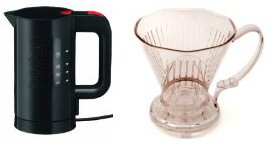
The solution to the waste issue is, indeed, to brew only the coffee you’ll drink. Rather than buying a $150 Keurig brewer, buy a Bodum 17-Ounce Electric Water Kettle for $40 which boils water in 4 minutes (getting it to the correct temperature, unlike most coffee pots or single-cup brewing machines). Then get a foolproof Clever Coffee Dripper for $22 (you can make up to three six-ounce cups in it, if you wish). A year’s supply of paper filters would set you back less than $50 and can be composted (your 2 K-Cups a day amounts to 8 pounds of crap in a landfill a year).

Is this also a huge hassle? Start to finish, brewing a K-Cup takes about 3 minutes, mostly because the water doesn’t reach a high enough temperature nor is it in contact with the coffee for enough time for proper extraction. To make one to three cups in your Clever takes about 8 minutes (four for the water, four for the brewing). For those extra few minutes, you save money and you get better coffee even if you use pre-ground coffee put in the filter the night before and accidentally let it steep for too long. For every “upgrade” you make (better quality coffee, grinding your own beans, paying attention to timing) the improvement in quality will be substantial.

K-Cup alternatives: summary and parting thoughts

Updated December 2018

I wrote my first post on an alternative for throwing away those wasteful, pesky not-really-recycled/recyclable K-Cups in 2007.  Since then, I have reviewed a number of alternatives. I’ve even reviewed another single-cup brewer. However, now that some of the patents on K-Cups have expired, we have more variations and and alternatives to Keurig brewers and single-cup pods, cartridges, and capsules than Carter has little pills.

Avoiding sending coffee-related trash to landfills (and using much more sustainably-grown coffee than is typically available in pre-packaged single-cup coffee products) is certainly within the purvey of a web site on coffee sustainability. But it’s come to the point that if I were to review, or even mention, half of the K-Cup alternatives flooding the market this site would veer away from an emphasis on the ecological effects of coffee growing.  I am going to semi-retire from discussing or reviewing these types of products, unless there is some sort of remarkable innovation or noteworthy news.

For my finale, here is a table that summarizes the popular products currently on the market which are reusable alternatives to K-Cups which allow for the use of a consumer’s own coffee that are compatible with many of the original Keurig brewers.

Reusable alternatives to K-Cups

Product
Approx. Price
Capacity in grams*
Notes
My K-Cup Reusable Filter$13, original. $23 for a universal model that fits older AND newer (2.0) Keurig brewers.15 or 17Best to have at least two so that you aren't cleaning one over and over. The best deal is a pack of 4 universal stainless steel version.

My review here.
ekobrew


$1514My review here.


2nd-most popular with C&C readers.
Solofill

See also gold versionthat has less potential to alter flavor.
$1511My review here.


Most popular with C&C readers.
The My-Cap (also known as My-Kap) was a simple and inexpensive ($7 for 3 caps plus a cleaning brush) for refilling used K-Cups. They went out of business, but a similar product is the Recycle A Cup, a product I've not tested.$12 for 29, or however much you can fit into an old K-CupUsed to refill old K-Cups.

My post of the old product here. I haven't tested the replacement.
EZ Cup by Perfect Pod which requires proprietary filters, approximately $12 for 100.


There is a newer product, the Cafe Fill Value Pack by Perfect Pod that includes two reusable filters and a special scoop with a funnel allowing for the correct amount of coffee easily placed in the pod. Very popular.
$9.90 for original, $13 for new pack.Around 9Requires proprietary filters, approximately $12 for 100. Only for older Keurig brewers.

I’m not sure, given the fact that there are so many competitors and K-Cup brands, that K-Cups themselves will ever be truly eco-friendly.  Here is what Keurig owner Green Mountain Coffee Roasters (GMCR) had to say in their 2011 CSR document:

Widespread adoption of the Keurig® single cup brewing system raises some important — and complex — environmental challenges. To better understand the impact of our products and guide our efforts to address those challenges, we conducted a life cycle analysis comparing single cup brewing systems to drip-brewing systems. We learned that the cultivation of coffee beans, operation of brewing systems, and use of materials in product packaging all represent significant impacts on the environment. The study revealed that packaging disposal represents a fraction of a product’s environmental impact across its entire life cycle.

Literally billions of K-cups ending up in a landfill may be just a “fraction” of this product’s environmental impact, but it is huge in and of itself. With the alternatives listed above, there’s no excuse for using this wasteful product.

*I’ve included the capacity as stated in promotional material, user reviews on outside web sites, and/or my own testing, if available. The volume of coffee grounds that will fit in something that goes in the original Keurig brewers is, in my opinion, the biggest limitation to coffee quality to those machines. The Specialty Coffee Association of America recommends 10 grams of coffee per 6-ounce cup; most people drink larger mugs of coffee and may also prefer a stronger cup. A regular K-Cup can hold about 9 grams of coffee. Despite “bold” selections and brewers that make various cups size, the physical capacity of the older (not the new “Vue” brewers) machines is difficult to overcome. Therefore, getting a well-crafted cup of coffee from a Keurig brewer (and many other brands I have seen or used) is hit or miss.

Review: Melitta JavaJig

Yet another player in alternatives to K-Cups market, this one by the century-old German company Melitta.  As the story goes, the company was founded by the inventor of the paper coffee filter. The Melitta Javajig is, in fact, as straightforward, reliable, and effective as one would expect from this well-respected company.

I’ve reviewed other reusable-and-use-your-own-coffee K-Cup replacements. The JavaJig is so simple, easy to use, and easy to clean that you immediately wonder why someone else didn’t immediately come up with this design.

The JavaJig has three BPA-free plastic reusable parts, plus a fluted paper filter that looks like a mini muffin tin liner. You place a filter paper over the upside-down black frame, slip the green outer sleeve over the frame, turn it over, add coffee (Melitta suggests an espresso grind), pop on the cap, and you have a pseudo-K-Cup ready to place in one of the many original style (not Vue) Keurig brewers. You do not need to remove the brewer’s filter assembly as you do with Keurig’s My K-Cup.

After brewing, the coffee and filter can be composted, the other parts rinsed, and you are ready to create another cup. Not only is this nearly foolproof, but it is dead easy to keep clean and there is no hinged lid that might snap off, as has been reported with the ekobrew or Solofill. The package includes two units, and they are inexpensive enough to have spares on hand if you feel lids may go missing.

I was able to get 12 grams of finely ground coffee in the JavaJig with a little tamping, but not packing. This is more than the insufficient 9 grams used in a standard K-Cup. There is space between the bottom of the green filter and the filter paper (thus, it does not get pierced like the bottom of a K-Cup). I tried a little manipulation of the filter to see if I could get it far away enough from the needle not to pierce the paper, but still allow for more coffee. It was too difficult to get the paper to cover the prongs, so grounds would easily leak out. Using a piece of regular coffee filter failed as it was too flimsy. By this time I realized that this amount of farting around spoiled the ease of use of the JavaJig.

Using fine grounds in some other devices causes back-up or overflow, but not in the JavaJig. The finer grounds also allow for more extraction. This is important not only because the older Keurig brewers just don’t have enough room or a long enough brew time for proper flavor development, but because the entire bottom of the JavaJig is the paper filter. Under the pressurized brewing, water goes through the grounds and filter faster than it would in a more enclosed environment, such as in some of the other K-Cup alternatives. I tried the JavaJig with 9 grams of coffee and two filters, with a 6-ounce cup; it worked, but did not slow down the brew time enough to make a difference.

Ergo, the JavaJig makes a cup of coffee comparable in strength and body to a K-Cup or similar substitute. It just suffers from the physical limitations and brewing method of the Keurig brewers themselves.

However, the resulting cup is much cleaner than the alternatives that use metal filters, since the paper filter helps eliminate sludge and small fines (for purists who can taste paper — not that they’d be likely users of this product — the assembled JavaJig and filter can be rinsed before filling with coffee).

The beauty of the JavaJig, and the reason I recommend it over all the other devices I’ve used so far, is its simplicity, cleanliness, and excellent value compared to the others. The starter outfit includes two JavaJigs and 30 filters. The filters are around $0.07 each, versus $0.16 each for the other competitor that uses filters. It can also be used with loose tea with very good results.

Alas, this will likely be my last review of any sort of K-Cup or Keurig brewer alternative. I will post an explanation, as well as a summary, in an upcoming post.

Re-purposing used K-Cups

Well-established fact: K-Cups are wasteful, and are difficult to and usually are not recycled. While there are many alternatives to them if you must use a Keurig brewer, some people will continue to use them.

I’ve provided instructions on how to refill used K-Cups; not a truly tasty option in my opinion, but no worse than the original. In that post, I even came up with an unusual use for them once you’ve decided they have no business being filled with coffee again.

I recently came across a post on “Can I Recycle This?” which had many ideas for re-purposing used K-Cups, including tiny freezer Popsicles,  bead storage, and many craft items. If nothing else, the whole site is worth a look for ideas on how to recycle or repurpose just about anything, from eyeglasses to medical tubing.

Review: Top Moka mini coffee maker

At the risk of becoming the queen of single-cup alternatives to Keurig or Nespresso brewers, here is a review of  yet another device which will produce one serving of the sustainably-grown coffee of your choice, rather than a questionably-sourced coffee in a wasteful capsule. This is a Mini Moka pot,  made by the Italian company Top Moka and provided by the Moka Pot Company.

About the pots

Moka pots are steam-based, stove-top coffee brewers, invented in the 1930s. Hot water is forced through ground coffee in a filter basket. While some steam pressure is involved, it isn’t much and even though moka pots are sometimes called “stovetop espresso makers” they do not produce true espresso, but rather a dense or richly brewed coffee.

The extremely cute Mini Moka pots come in both one and two cup models (the cup in this case being demitasse-size) and in various colors. The Moka Pot Company sells sets that come with cups, as well, not to mention a large variety of other types of moka pots. Based in the U.K, they ship to the U.S.

Typically, moka pots have two chambers. Water in the bottom chamber is forced through coffee in a filter basket, and brewed coffee collects in the upper chamber, from which it is poured. In the Mini Moka, there is only a bottom chamber for water and a filter basket. When the water is heated, it is forced up through the grounds in the filter and is dispensed directly into cups via a spout or spouts.

I received the two-cup Mini Moka version. These are made in Italy of aluminum, including the cup platform, and they are very sturdily built. There is a fair amount of debate regarding whether aluminum or stainless steel is best (see the Coffee section below) ; aluminum seems to be more common overall.

Making coffee in the mini moka

The Mini Moka brews four ounces of coffee into two small cups (although each might not contain exactly the same amount), or you can swing around one of the tubes and dispense all four ounces into a single cup (the manufacturer has informed me NOT to do this as it can cause a loss of pressure and failure of the device; both tubes should be stationary). Use care in the latter case, as a four-ounce cup can be hard to remove from under the tubes without spilling out some of the coffee; it may be easier to brew into two cups and pour it into one.

Don't do this; see text.

Making coffee seems relatively foolproof. Place water, four ounces or less, in the bottom chamber up to the release valve. Place coarsely-ground coffee in the basket. It holds about a third of an ounce (just under 9 grams). Don’t try to use instant coffee, espresso grind, or some other fine grounds. I just used drip grind. You can tap down the grounds, but don’t pack them. Screw on the top chamber and place over low heat. The Mini Moka pot can be used on any type of heat source, including gas, electric, and ceramic, but ideally a flame heat source should not be wider than the bottom of the pot. Place a little cup on the platform under each spout. It takes only about 5 minutes from the time you put the maker on the heat before it begins to dispense into the cups, and it finishes in just a couple minutes. I turn off the heat when the pot begins to make sputtering noises.

The Moka Pot Company has a very nice web site, which includes a page on how to use a moka pot, as well as how to season your mini (or regular) moka pot before you use it the first time.

Coffee from the Mini Moka

As for the coffee, it was perfectly acceptable. The filter basket has fine perforations, of course. There is also a similar screen acting as a filter between the grounds and the top chamber. Despite the fact that very fine sediment ends up in the cup, this makes an extremely smooth shot of coffee. It doesn’t have the creaminess of espresso, but depending on the coffee you use and the amount of water, it can have a similar intensity. It clearly makes a stronger cup than any K-Cup I’ve tried. If you’re satisfied with the strength of a K-Cup, you could just dilute a shot from your mini moka pot, and have fresher, better quality coffee to boot.

This isn’t the brew method you’d use to get the most out of special, high-quality beans, but the taste was certainly fine if good coffee was used. Although aluminum has been accused of imparting a metallic taste, I did not detect this. I’m sure that you could experiment a bit with water temperature, roast level, grind, and heat level, but honestly — we’re talking about a few ounces of decent coffee here. I really didn’t think I’d have a whole lot of use for a device like a Mini Moka, but I have found myself  using this for a quick pick-me-up after work, when I want to have just a little hit of coffee, but not a whole cup. This is yet another low-tech, less wasteful, simple alternative for making a small amount of coffee.

New Keurig brewers, K-Cups won’t fit

Key patents on K-Cups, the single portion packs used in Keurig brewers, are expiring this year. Rather than lose market share to the competition, Keurig is countering by coming out with new brewers. The upcoming “Vue” brewers will offer a wider range of brew sizes and beverage types as well as temperature control and other features. The list price of the Vue V700 brewer is $249.99

Importantly, the Vue brewer is not compatible with K-Cups — they will use new Vue Packs.

On the bright side, the Vue Packs are made of #5 plastic, which can be recycled once the foil lid, inner paper filter, and contents are removed by many recycling programs.

Review: Hamilton Beach Single Serve Coffee Maker

Hamilton Beach sent me their “The Scoop” single serve coffee maker [new model] to try out. Longtime readers know that I’m not keen on single-serve machines.  I completely understand wanting to make only one cup of coffee, but there are so many ways to make a truly excellent cup the manual way; my favorite ways are with an Aeropress or Clever Coffee Dripper. My complaint is primarily with machines like the Keurig brewers or Nespresso machines that sell you wildly overpriced, stale, questionably-sourced coffee in hideously wasteful little packages. Nespresso hasn’t really caught on in the U.S. as it has in Europe, but everyone and his brother here seems to have a Keurig brewer. Thus, insofar as I have talked about them at all, I have tried to encourage alternatives to K-Cups that use fresh coffee purchased by the consumer.

For those who haven’t jumped on the Keurig bandwagon yet but feel the need for some sort of single cup machine, I encourage a good look at The Scoop. It’s a better designed machine than a Keurig, dead simple to use, far cheaper up front, and you will make better coffee with it.

Design

First off, The Scoop is an attractive, sturdy, and sleek machine with a smaller footprint than the typical Keurig brewer; the two are shown side by side on my desk on the right. The Scoop retails for around $60, whereas most Keurig brewers retail for over $100.

The Scoop has a number of features that make it easier to use (and clean) than a Keurig. The water reservoir holds up to 14 ounces of water. The minimum amount of 8 ounces is held in a marked depression in the main reservoir. You just fill your mug with water and dump it in the top. It’s not only easy to see see how much water is too little or too much, but because the reservoir is shallow it’s easy to wipe clean. However, since you probably won’t store water in The Scoop like you would in the water tank of a Keurig, it is unlikely to get any filmy build up. This can occur in a Keurig, and their water tanks and lids are not dishwasher safe, so you have to find a way to thoroughly clean the inside walls of the Keurig’s water tank.

There are three parts on The Scoop that are part of the brewing process and come in contact with coffee: the filter well, the filter holder, and The Scoop brew basket. All simply lift out to rinse clean, and are dishwasher safe.

Unreachable residue in a Keurig brewer. Click to enlarge.

On a Keurig machine, the K-Cup holder can be snapped out, taken apart, and put in the dishwasher. However, the housing in which the holder sits is part of the machine and cannot be removed. I have found that it accumulates a lot of oily gunk, especially if flavored or dark roast coffees, or chocolate, cocoa, or sugary beverages are made in the machine. There is no easy way to clean the inside well of this housing, as the close-up of one of my machines shows. I have never succeeded in getting it clean despite forcing damp paper towels down from the top or up through the hole, and some of this residue ends up in every cup. Blech!

Both machines can accommodate a travel mug up to nearly 7.5 inches inches tall. The cup rest on The Scoop, however, can be flipped upside-down so that a coffee mug is elevated close to the stream of coffee (right), preventing splashes and premature coffee cooling.

The Keurig has small advantages on only two fronts. The Keurig drip tray holds 8 ounces, for those who completely forget to put a mug on the machine. The Scoop’s drip tray is really just for drips. And The Scoop’s power cord is ridiculously short at 24 inches. Okay if it’s on a kitchen counter, but impractical if you want to put it on a table and have the cord reach a standard wall outlet. At work, I have to put The Scoop on the floor under a desk. Note to Hamilton Beach: If you want to compete with Keurig for office coffee, make The Scoop with a longer cord!

Making coffee

As noted above, the reservoir accepts between 8 and 14 oz of water. Whatever you put in, comes out. This is true whether or not you use the “regular” or “bold” brew setting. The difference between the two settings is the pace of water flow, with brew time slightly slower on the bold setting.

The brewhead/showerhead has five holes that cover the whole bed of coffee, which is placed in brew basket, which can be used as a coffee scoop. The bottom of this basket is a fine stainless mesh filter. It is larger and has more surface area than Keurig’s own My K-Cup reusable coffee filter basket (shown here side by side). I found I could put up to about 16-18 grams of coffee in The Scoop’s brew basket, but only around 14-15 grams in the My K-Cup (pre-fab K-Cups themselves hold between 9 and 14 grams, depending on variety). For comparison, typical maximum amounts held in K-Cup alternatives are 10 for EZ-Cup, 14 for Ekobrew, and 11.5 for Solofill. More on coffee volume shortly.

The Scoop basket sits in a filter holder that also has a fine mesh bottom. This serves to remove even more fines, shown in the photo. Still too much for you? It turns out that the round filter papers used in Aeropress brewers fit nicely in the second filter and can act as a third filter if you desire. Use a little less coffee in this case, and/or a slightly courser grind, or it will slow the brew down enough to create overflow.

To use, pour your water, scoop your coffee, shut the brewhead and push either the regular or bold brew buttons. The Scoop does not brew under pressure — this is a quick drip method. On the regular setting, The Scoop brews 8 ounces in about 90 seconds, and 14 ounces in 2 minutes 15 seconds (plus 15 seconds to warm up from a cold start; subsequent consecutive cups are faster). The “bold” setting is only slightly slower, adding 15 seconds to an 8 ounce cup and 1 minute to a 14 ounce cup. Note that on “bold,” the brewer pauses and resumes brewing.

This machine comes with two scoops, so you can make a second cup directly after the first without having to clean out the first scoop.

Best practices for good-tasting coffee

Weak and/or stale coffee are probably the most frequent complaints about cup quality from a single-cup brewer. With The Scoop, if you use your own freshly ground coffee, staleness isn’t an issue.

The Scoop allows the use of more ground coffee, which helps overcome the weakness issue.* The 16-17 grams of coffee I use (two tablespoons is about 15 grams) is more than recommended by Hamilton Beach for a 14-ounce cup, and I make an 8-ounce cup with it. One caveat — this amount of coffee, especially if it is freshly roasted and blooms a lot, will leave grounds on the brewhead. Be sure to check the head and wipe the grounds off if needed. The rubber gasket on the head also comes right off to be rinsed and goes back on easily. Or use slightly less coffee ground a bit finer. I’ve had decent results with around 14 grams, made it too strong with 17 grams, and fit up to 19 grams. Don’t throw up your hands after a couple tries — experiment with different amounts and (if you grind your own coffee) various grind levels; these may need to be adjusted depending on the coffee variety as well.

I don’t know how inclined the typical single-cup user will be to tinker further (especially if it adds time to the process), but here are my further suggestions:

  • I’ve found, since I use a finer-than-drip grind, that the first 10-20 seconds of liquid is often clear. A little of this may be water left in the machine innards, but I think what is happening is that the water is flowing off the top of the dry grinds until they become saturated. The simple solution is to start the brewer, and as soon as the first drops come out, hit the brew button again, which stops the flow of water. Lift the brew head and wait until the water sinks into and wets the grinds (you can stir a bit if you’re in a hurry). Then re-close the head and resume brewing. This 1) improves extraction, 2) prevents dilution by eliminating plain water going into the cup, 3) helps prevent blooming coffee from depositing grinds on the brewhead, and 4) reduces the chance of overflow. It only adds 20 seconds or so to the process, unless you want to do it more than once, which would probably improve extraction even more.
  • Preheat the brewer by running a cup of plain water through the machine first. This can serve to pre-warm your mug and clean off any residue on the brewhead and filters, if you are not a meticulous housekeeper. It might even add a degree to the water temperature.
  • Use the bold setting.  An extra 15 seconds probably doesn’t make a lot of difference, but every little bit helps.

Brew time and water temperature are two other variables that factor into the strength/proper extraction of coffee. The brew time is still a little abbreviated with The Scoop. Brew time can be lengthened a bit by grind, volume, and the addition of an Aeropress filter.  Of course, it would be simple for manufacturers to make a machine that brews four minutes. However, people who buy these machines complain that two minutes is too long. What can I say? If you are that impatient, don’t complain about your coffee. You don’t expect to roast a turkey in an hour, so don’t expect great coffee in under four minutes.

Coffee should be brewed at 195 – 200 degree F, or just off a boil. Most home coffee makers fail at this. According to the Hamilton Beach blurb, The Scoop “Brews hotter than the leading competitors per SCAA standards,” which suggests it brews at 195+. I can’t vouch for the accuracy of the thermometer I used to measure the coffee in the cup, but it read 180-185 degrees F from The Scoop (1300 watts) and 170 from a Keurig (1500 watts for the B60) using a My K-Cup. I assume that pre-heating The Scoop by running a cup of water through before brewing, and then using warmer water might also bump up the temperature a few degrees.

Concluding thoughts, including cost and convenience

After a few weeks of testing, I found that coffee produced by The Scoop lacked some body and fullness, but was superior to any cup I’ve made in a Keurig with a pre-fab K-Cup or any alternative device, and comparable to many cups I have made with a standard pourover cone. It’s never going to be as good as a carefully made manual cup. But I’ve read hundreds of comments and reviews from aficionados of single-cup brewers, and price and convenience often seem to trump flavor and quality. Further, the taste profile preferred by these consumers is generally that of grocery store or Dunkin/Starbucks caliber. This is achievable and exceedable with The Scoop.

A few words about cost. Obviously, The Scoop is cheaper up front than a Keurig. Others have done elaborate price comparisons of K-Cups versus very high quality coffee, a burr grinder, etc. and found them to be equal. Frankly, I don’t see most people that are attracted to Keurig brewers making that particular leap. Thus, the typical single-cup consumer will pay less per cup using The Scoop than a Keurig with K-Cups (about $0.33/cup using $9/lb coffee, versus $0.50 to 0.65/cup for K-Cups), in addition to the savings from the original machine purchase.

As for convenience, you will have to dispose of a scoop of grounds. I’m always flabbergasted when I read comments from people who tried various K-Cup alternatives and cannot cope with the “mess” and “hassle” of two tablespoons of grounds. I wonder how they manage orange peels, candy wrappers, or dirty dishes.

The Scoop is replacing the Keurig brewer at our office.  That tells you what I think.

*Many consumers confuse roast level with “strength” of coffee, where a dark roast equals strong coffee and a light roast equals weak coffee, a misconception perpetuated by roasters that label dark roasts as “bold.” Really, weak coffee is primarily under-extracted and lacking body because it is less concentrated with fewer solubles.  I drink light roasted coffees and used them in my tests of The Scoop.

K-Cups are now recyclable! Not really.

Update: In early 2016, the New York Times reported on Keurig’s annoucement that they would finally be coming out with a K-Cup made of plastic recyclable by typical municipal facilities. But it also pointed out the continued environmentally-negative aspects of K-Cups outlined below, including high energy costs to produce and potentially low consumer cooperation. It did not address problems with the size of the cups jamming sorting machines at recycling facilities, or potential contamination if consumers don’t remove the lids. Or, oh yeah, the insane cost. See this post for alternatives.

Green Mountain Coffee Roasters’s Keurig division has announced a “recovery” program for their naughty little K-Cups (already incorrectly being referred to in the media as a recycling program). I’ve talked about the waste issue surrounding these single-serve coffee portion packs specifically, as well as posted two ways to re-use them, and three different products that allow you to use the Keurig brewers and avoid the K-Cup dilemma altogether.

In response to the environmental impact of K-Cups, Keurig has launched the Grounds to Grow On program. This sounds like a great idea, but it has some limitations.

  • It is only available in some (22) states. This program is in a testing phase with an intention to go national next year.
  • It is only available for business locations. Only about 10-11% of Keurig brewer sales are to “away-from-home” locations, based on 2006-2008 data.
  • It costs $59.75  for five small “recovery bins” which hold 175 K-Cups each, or $114.75 for larger bins which hold 450 K-Cups.  Shipping to and fro is included in the cost.
  • The K-Cups aren’t recycled. The grounds are composted, while the K-Cups themselves are burned to produce steam energy by partner Covanta Energy. This is referred to as “renewable energy” a few times. I have a hard time seeing how waste-to-energy could be considered renewable, and I’m not the only one.  The irony, of course, is that recycling is the enemy of the never-ending stream of garbage needed to feed waste-to-energy facilities. Covanta is one of the companies pushing to have waste-to-energy defined as renewable, as it would make the company eligible for subsidies. Keurig’s choice of Covanta as a partner in the Grounds to Grow On venture is unfortunate. Multiple Covanta incinerator facilities have been fined in several states for emissions violations, including Connecticut (twice), New Jersey, Pennsylvania, and Massachusetts. Further, they have a history of labor relations problems.

I certainly love the idea of all the coffee grounds being made into compost. As for the K-Cups, perhaps burning them is better than having them end up in a landfill, providing you believe waste-to-energy is clean and safe. Even if this aspect weren’t a topic of debate, the success of Grounds to Grow On depends on participation. This program was rolled out after a pilot test in 2010, but I have seen no figures on the participation rate for the pilot.

Purchasing the bins is pretty expensive, and adds 5 to 7 cents, or about 10%, to the cost of each K-Cup. Once a supply of bins has been returned, more will have to be purchased. How many businesses and consumers will make this investment?

Even in a bin is available, it is not a sure bet that everyone will drop in their K-Cups.  An EPA study (PDF) of found that participation in voluntary residential curbside recycling without incentives averaged around 68%.  With the disincentive of having to purchase the bins, I’m not sure how many K-Cups will be actually be removed from the traditional waste stream with this program.

Finally, some of the patents on K-Cup technology are due to expire next year.  This may mean others will manufacture K-Cups with different materials that cannot enter the Grounds to Grow on recovery program.

It looks like a lot of effort went into this program, and I don’t want to seem like too much of a curmudgeon. As my mom would have said, it’s better than a sharp stick in the eye, but perhaps not quite as rosy as first meets the unpoked eye. You can read more details at Grounds to Grow On.

In an upcoming post, I’ll be looking at the recycling of Nespresso coffee capsules. Due to a stunning bit of greenwashing, not nearly as many capsules are being recycled as Nespresso/NestlÁ© would have you believe.

ekobrew: another alternative to K-Cups

I have mixed feelings about writing about Keurig single-cup brewers and K-Cups. Yet single-cup brewers are wildly popular, and Keurig owns 80% of the North American market share. If I’m going to talk about consumer coffee choices and how they impact the environment, I feel I should talk about Keurig and K-Cups.

Over the years, I have written about how to minimize or eliminate the waste in the disposable K-Cups themselves:

In the past I’ve stated that I believed that K-Cups are the most environmentally-friendly product in the single-use arena because of the strong corporate responsibility and environmental record of Keurig parent Green Mountain Coffee Roasters. However, now that Folgers, Millstone, and Dunkin Donuts coffees are available in K-Cups and GMCR seems willing to license to anybody, no matter how bad or mysterious the sourcing, I no longer have this view. Ergo, it’s even more important to emphasize ways to use your own carefully chosen sustainably-grown coffee if you have a Keurig brewer.

A new contender

This brings us to the latest generation of reusable coffee filters/brew baskets to use in (most) Keurig brewers: the ekobrew Cup. I’ve not yet tried this product, as it was just released, but it is receiving very favorable reviews and has a number of benefits over competitors which are obvious to those of us who have fiddled with the various alternatives:

  • It has a larger capacity than the others. It can hold up to 14 grams of coffee (versus 9 grams of a regular K-Cup, and around 11 for Solofill). You may not want to jam the max in there, though, but take advantage of the fact that the extra room will provide for more complete infusion of the coffee and get you a stronger brew, especially for < 8-ounce cup settings. Weak coffee is a major complaint with many of the K-Cup alternatives (and K-Cups themselves).
  • It has a flat bottom, and is easy to fill. The Solofill has a big “nipple” on the bottom and won’t stand up by itself. Also, that depression can hold wet grounds and make the Solofill harder to clean than the smooth interior of the ekobrew.
  • It is BPA-free. So is the Solofill. The My-Kap is not.
  • You don’t have to remove the holster in the brewer to use the ekobrew (or Solofill) as you do with the Keurig My K-Cup.

Other reviewers have commented on the overall positive design aspects and durability of the ekobrew, including details of the brew basket, hinge, and stay-cool handles. There have been a few other products in the interim between the Solofill debut and the ekobrew, but the ekobrew seems to be the most significant recent step forward in this product arena, having improved on the few shortcomings of the well-liked Solofill.

This product could lure me into plugging in my Keurig at the office once again.

The future

I have been a fan of Green Mountain Coffee Roasters and their effort to source coffee sustainably, their support of farmer communities, and other green initiatives.  But Keurig brewers and K-Cups are now making up 88% of the company’s revenues, and most of this is from the K-Cups. Their willingness to license to big corporate coffee roasters is seemingly profit-driven; they receive $0.064 for every K-Cup sold. In my eyes, and to others I’ve talked to, this seems like a contradiction of Green Mountain’s values.

Further, when I first wrote about K-Cups in 2007, Keurig was working on sustainable (recyclable/renewable/biodegradable) packaging. There has been no meaningful progress on this front (I don’t consider the release of one flavor of one brand of tea in a paper K-Cup truly significant). Currently, three billion K-Cups head to the landfill a year.

The patent on the K-Cup runs out in 2012, ushering in the era of even more crappy, cheap coffee being available in these dreadful little cups. Will there be any incentive for other manufacturers of K-Cup clones to develop sustainable packaging? Of course not. They’ll all be competing for a slice of the market, and cheap will win out. This cheapifying of coffee has broader implications, and I can do no better than to refer you to Jim Pellegrini’s excellent blog post on the topic, Why the Keurig K-Cup is the beginning of the end for great coffee.

My final recommendation is at least use your own coffee if you already own a Keurig brewer. Use a good product in place of K-Cups, like the ekobrew. Even better — go for the dead-easy way to craft excellent single cups of coffee tweaked to your individual taste with your own beautiful, sustainably-grown beans: try a Clever Coffee Dripper. Low initial investment, low tech, great coffee.

Used K-Cup photo adapted from a Creative Commons photo by Randy Read.

Solofill Reusable coffee filter for Keurig K-Cup brewers

I’ve written about less-wasteful alternatives to the single use K-Cups used in Keurig K-Cup brewers. Each allows you to use your own coffee with the Keurig brewers. There are two routes.

One is to reuse a used K-Cup. I described step-by-step how you can refill used K-Cups, which is rather labor intensive. I also wrote a detailed review of the the My-Kap Kaps for Keurig K-Cup Brewers, a lid that fits on a used K-Cup. This does cut down on the labor of refilling a bit, but either way, you can only reuse a used K-Cup a limited number of times, and eventually it ends up in a landfill.

The other route is to use a device that takes the place of the K-Cup. Up until recently, the only option was Keurig’s own refillable filter basket, the My K-Cup reusable coffee filter. You can read my review of it here. Then along came the EZ-Cup By Perfect Pod. I have not tried this particular product, as some reviews indicated it could be a bit fiddly, and it also requires the use of proprietary paper filters, which did not appeal to me. Given that most other brands of pods are made from cheap coffee by the big corporate coffee roasters (Senseo = Sara Lee, Tassimo = Kraft), that isn’t even an option in my book.

Now we have another K-Cup replacement. The Solofill Cup, Reusable coffee filter cup. This invention appears to have resolved a number of the shortcomings of other methods.

  • The Solofill drops right into the Keurig brewer’s holder, just like a K-Cup, so there is no need to remove the filter holder assembly, as required by the My K-Cup (which is an inconvenient step).
  • The lid is attached and the stainless steel basket is integrated. With this one-piece design, no parts should go missing.
  • The whole she-bang is dishwasher safe.
  • The plastic is recyclable.  It’s made from BPA-free plastic, which the My-Kap is apparently not.
  • It’s “self-tamping” and water is dispersed through the coffee, versus just being shot through a single hole, as in most other alternatives.

The Solofill holds roughly 11 grams of coffee. This is about the same amount of coffee that is in an “extra bold” K-Cup, and so may also satisfy people who find regular K-Cups produce weak coffee. Or, to look at it another way, the Specialty Coffee Association of America, recommends 10 grams of coffee per 6 oz cup. Obviously, how the coffee turns out also depends on the brew size setting of the Keurig brewer — for the Solofill’s 11 grams the brewer should be set to brew a 7.25 oz cup, or even 5.25 oz (brewers vary in their brew size settings). For the sake of comparison, I found that the My K-Cup holds right around 14.5 to 16 grams of coffee.

The Solofill is compatible with 11 Keurig brewer models, two Brevilles, and one Mr. Coffee.  However, an enterprising user has provided a simple modification for the Solofill that allows it to be used with Keurig models that would otherwise result in leakage.

I’ve not had a chance to test the Solofill yet, but it is getting excellent reviews on the Single Serve Coffee forums.  If you have a Keurig brewer and give this product a try, please remember to fill it with sustainably-grown coffee, and feel free to leave your impressions in the comments.

Review: Reusable hemp coffee filter

Mr. Natural’s reusable hemp coffee filter

I admit that I prefer the taste of drip coffee brewed through a paper filter, but hate the waste. Although I compost both the grounds and the filter, trees still fell to produce the filter in the first place.  Every brewing method brings to the cup a slightly (sometimes greatly) different flavor profile. I’m not always enthusiastic about the results a gold filter produces with some coffees.

I decided to try a reusable cloth coffee filter, and I’ve been extremely pleased with the results.

I have read that cloth filters allow some of the coffee oils through; not as much as gold filters (or from coffee made in a French press) and not as little as some paper filters. As with paper, there is little or no sediment with a cloth filter, depending on the fineness of the weave of the cloth. In general, cloth filters are said to result in a cup that is less astringent and with better mouthfeel.

As far as types of cloth, the choice is most often cotton versus hemp. Frankly, the tightness of the weave would probably be the factor most related to the final coffee outcome, although I’m sure some people will advocate for one or the other based on some other intrinsic quality of the fiber. In my opinion, if you’re going to go green by purchasing a cloth filter , you may as go all way and get hemp. Cotton, if not grown organically, is grown with a ton of environmentally-harmful chemicals. While I have seen unbleached organic cotton coffee filters, they are not as common as hemp filters. Hemp for fiber is typically grown organically or with a minimum of chemicals, so is probably the “greener” choice.

Therefore, I went with a hemp filter by Mr. Naturals. Compared to locally available cloth filters, I found this filter to be very thick and sturdy — it doesn’t sag in the filter basket. The weave is fine enough that brew time is not accelerated. Although it’s a #4 cone for my drip machine, I’ve used it in my #2 size pour-over cone and it brews at the same pace as a paper filter, and the fit is actually perfectly adequate. I agree with others on the end product: a slightly lusher mouthfeel than paper and only a little bit of very fine sediment. At least with this filter and the coffees I have been recently drinking, I couldn’t detect a significant flavor difference due to the presence of more oils. Your mileage may vary.

In addition to being far less wasteful, the other big advantage of cloth filters is that you don’t get the “paper” taste that some people get with paper filters. I will admit that I tend not to taste paper, so this isn’t an issue for me, but I know it is for many coffee aficionados. I certainly did not taste “cloth” with the hemp filter. But one of my biggest reservations in trying a cloth filter to begin with is that it seemed to me that it would be hard to clean, and eventually you’d taste old coffee oils or just general funk.

Here’s how to clean a cloth filter:

After each use, rinse thoroughly in very hot water, give it a rub or light brushing with a toothbrush, and store in container of water in the refrigerator to prevent mold or bacterial growth between uses. If it’s used daily or more often, you can just wring it out, pop it in a Ziploc bag, and toss it in the fridge. I’m pretty lazy, so that’s what I do. I confess that I have also just wrung it out and let it dry and so far I’ve had no issues. Once a week, soak the filter in Oxyclean Free (no perfumes) and boiling water, rinse it, and store it in the fridge again. Some users boil it again in clean water after the Oxyclean treatment. Frankly, it seems easiest to have at least two filters so you aren’t left in a lurch if one is getting an Oxyclean bath.

K-Cup and other single-use pods: the waste issue, again

I’ve written several posts on the Keurig single-cup coffee brewers, or more specifically, about the K-Cup single use coffee “pods” and the waste they generate. I have explored, in detail, three ways to cope with this waste:

In each post I’ve also discussed the progress (or lack thereof) that Keurig owner Green Mountain Coffee Roasters (GMCR) has had on finding sustainable or recyclable materials for use in the K-Cups.

This week the New York Times had a worthwhile article on the continuing dilemma of the convenience of single-cup coffee versus the waste it generates. The article notes that it is expected that nearly 3 billion K-Cups will be sold this year. (We’ll get to the other brands of single-use coffee pods in a minute.)

The article mentions that GMCR are experimenting with a paper K-Cup (no foil or plastic) for use with tea this year; the issues surrounding brew temperature and freshness of coffee apparently still have them stymied. GMCR goes on to say that they have done a life-cycle analysis of the environmental impact of the K-Cup and determined that most of the impacts occur where the packaging is produced, not where the waste is disposed. But this doesn’t mean the waste stream doesn’t have a big impact, and this leaves a bitter taste in the mouths of some consumers.

The article goes on to describe the fact that some of the competitors of K-Cups can be recycled. This is a bit misleading, as these options are very limited. TerraCycle will reuse the plastic from Kraft’s Tassimo pods in Britain (and Mars’ Flavia packages). These recycling options are not available to consumers in the U.S., but offices and food services providers. NestlÁ©’s aluminum Nespresso pods can be recycled at some propietary boutiques in a few European countries. Sara Lee’s Senseo pods are made of paper and therefore compostable (how many consumers just throw them away, though?).

Even supposing these options were widely and easily available to consumers worldwide, I still believe that K-Cups are the most environmentally-friendly product in the single-use arena.

Why? GMCR sources coffee responsibly and has a strong corporate responsiblity and environmental record.* You simply cannot say the same thing about NestlÁ©, Kraft, and Sara Lee. For just a few examples, you can read my posts deconstructing the sustainability claims of NestlÁ©, Kraft, and Sara Lee; read how Kraft and NestlÁ© got caught purchasing illegally grown coffee because they don’t even know where much of their coffee comes from; and take a look at the how a major organization ranked these big coffee companies in areas like the environment, human rights, health and safety, etc. Finally, you can see how these big corporate coffee roasters exploit farmers and the environment, to the detriment of us all.

The most sustainable choice is to not use single-cup brewing systems in the first place. If they are going to be used, then consumers have to look at the big picture. With the Keurig system, there are alternatives to throwing away K-Cups, as outlined in my other posts. If disposable K-Cups are going to be used, consumers are easily able to find sustainably-sourced coffee, including Rainforest Alliance certified Caribou Coffee K-Cups. And at least using K-Cups will be better than supporting the dismal environmental  and ethical records of the big corporate coffee roasters that manufacture other brands.

*UPDATE: Now that Folgers and Dunkin Donuts coffees are available in K-Cups and GMCR seems willing to license to anybody, no matter how bad the sourcing, I am modifying this statement. Let’s just say that more responsibly-sourced coffees (including Caribou and GMCRs own coffees) are available for the Keurig brewer, and there are a lot of options for avoiding the use of wasteful K-Cups altogether by using your own coffee. Do that.

Page 1 of 2

Powered by WordPress & Theme by Anders Norén