Birds and other biodiversity

Research: Nesting birds in shade coffee

Gleffe, J.D., J. A. Collazo, M. J. Groom, and L. Miranda-Castro.  2006.  Avian reproduction and the conservation value of shaded coffee plantations.  Ornitologia Neotropical 17: 271-282.

Most of the research on birds and coffee farms focuses on migrant birds which breed in North America and winter in the tropics.  This is the first study to examine the nesting success of resident birds in shade coffee plantations compared to secondary forest.  The study took place in north-central Puerto Rico, and the shade coffee farms were in the Ciales area (map).

The majority of bird nests (72%) were found in shade coffee, and 26 species were recorded in coffee, versus 22 in secondary forest. Six species were found only in coffee, two only in forest.

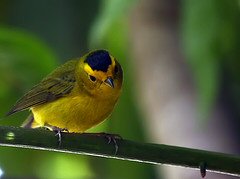
Thirty-two different plant species were used as nest sites in coffee, with the two most common plants used for nesting Inga vera and Andira inermis.  Coffee trees themselves were host to 26% of the nests, many of which were of the Bananaquit (Coereba flaveola), shown here at right. However, it was the canopy trees that were the most important and harbored most of the bird species in both the coffee and forest habitats. The stunning Puerto Rican Woodpecker (Melanerpes portoricensis), an endemic species, is one example of a bird that needs mature canopy trees for nesting. These canopy trees, of course, would not be present in sun coffee plantations, and the authors emphasize that it is the value of shade coffee plantations for preserving birds depends on the shade canopy layer, not the coffee itself.

The study also looked at reproductive success, and discovered that it was similar between coffee and forest, an important finding.  The authors suggest restoration of native shade canopy in existing and new coffee farms to conserve avian diversity in Puerto Rico.  This is especially important because Puerto Rico is experiencing both deforestation due to urban sprawl and development, and the majority of coffee grown there (59%) is sun coffee, with more being converted.  Consumers should choose their Puerto Rican coffee very carefully.  One source I found from the area where the study took place was Finca Cialitos (web site in Spanish, store in English).

Research: The value of wild coffee

Hein, L. and F. Gratweiler. 2006.  The economic value of coffee (Coffea arabica) genetic resources. Ecological Economics 60:76-185.

This fascinating paper is not about the sort of ecological research I usually summarize here, but absolutely keeps with the theme of preserving biodiversity, as well as the recent Ethiopian thread that has come up here lately.

First, the authors introduce the importance of ancestral/wild genetic resources in agricultural crops, since careful breeding can impart in existing cultivars genes that can increase yields, confer disease resistance, and improve quality.  Wild coffee, and therefore its genetic resources, are only found where the species originated, in the highland forests of Ethiopia.  The paper highlights two urgent facts:

  • These forests are disappearing at an alarming rate, a rate at which, if it continues, will eliminate the forests in fewer than ten years.
  • Unlike many other plant seeds, coffee seeds are sensitive to cold and maintain their germination potential for only a couple of months.  Therefore, wild varieties are not candidates for seed banks. They must be preserved growing in the wild.

Although the benefits of preserving genetic resources is widely acknowledged, putting a monetary figure on these resources is difficult. The authors of this paper examined the potential economic benefits of preserving the genetic resources of coffee by looking at several characteristics that are known to occur in wild Ethiopian coffees: resistance to three major coffee pests/diseases, a variety with a lower caffeine content, and a higher yield variety.

They concluded that the economic value of Ethiopian coffee genetic resources is between US$420 million up to $1.45 billion (the variation reflects uncertainty in the coffee markets over the period of time it would take to incorporate wild genes into cultivars).  This does not take into account other beneficial characteristics that might be found in wild coffees, such as heat resistance that will be needed in the face of global climate change.

Current inventories of the genetic diversity in Ethiopian forests are inadequate to determine how much forest needs to be preserved in order to maintain the coffee gene pool, conclude the authors.  Certainly, we do not need to be replacing native forest and wild coffee with large plantations of nursery-grown plants. This paper provides significant economic evidence that preserving Ethiopian forests, and their wild coffee resources, are nearly priceless.

Abstracts on presentations at the NAOC

Here are some very brief summaries of research that had to do with coffee growing that were presented at North American Ornithological Conference. I also put together a page with full abstracts, and author contacts.

  • Cerulean Warbler (Dendroica cerulea) foraging behavior in the western Andes of Colombia. This species (which I’ve written about before) was common in shade coffee plantations, and only fed in the shade canopy.
  • Population ecology of Cerulean Warblers on breeding and wintering grounds. This study concluded that shade coffee farms in the Venezuelan Andes were critical wintering habitat for this species, with density in the farms higher than in the surrounding forest.
  • Coffee certification as an economic incentive for bird conservation. Discusses the shade coffee farms of central Veracruz, Mexico, many shaded by cloud forest tree species.
  • Certification and birds: the importance of shade coffee plantations for species diversity in the Cuetzalan region, Puebla, Mexico. 182 species were recorded in this area, and while not as rich as primary forest, shade coffee still maintains a high diversity of birds.
  • Traditional coffee plantations: suitable habitat in the anthropogenic matrix for Neotropical resident and migratory birds. A study that complements the previous Puebla study, quantifying the different types of birds found in shade coffee.
  • Neotropical insectivorous birds as pest control of the coffee berry borer (Hypothenemus hampei) on Jamaican Blue Mountain coffee farms.  More on Matt Johnson’s work in Jamaica.
  • Birds, shade grown coffee, and community outreach in Ecuador. Self explanatory.
  • Sensitive bird species in shade coffee plantations. In southern Mexico, shade coffee with high levels of structural diversity (many layers of shade trees) may be good for conservation purposes; however, shade coffee may only be important for forest species which are sensitive to deforestation and disturbance when close to intact forest.

Research: American Redstarts in Jamaica

Johnson, M.D., T.W. Sherry, R. T. Holmes, and P.P. Marra.  2006.  Assessing habitat quality for a migratory songbird wintering in natural and agricultural habitats. Conservation Biology 20:1433-1444.

This study examined American Redstarts (Setophaga ruticilla) in natural and agricultural habitats in Jamaica.  Redstarts are beautiful warblers that nest in North America and winter in the tropics (see map).

Four natural habitats were compared with two agricultural habitats: citrus groves and shade coffee plantations, which were shaded primarily by Inga vera, with understories of varying densities.

Measures of habitat quality for redstarts on the coffee farms was generally intermediate between the best and worst natural habitats.  Two measures, body mass and overwinter survival, were very similar in shade coffee and the best natural habitat. Body mass is especially important.  It indicates that enough food is available, and maintaining body mass is critical for later survival, even after departure from the wintering grounds.  This study estimated that a loss of 0.1 grams (a very tiny amount!) over the winter corresponded with a 6.8% reduction in annual survival probability.

The authors provide two caveats: First, this study focuses on a single species in a single region.  And importantly, there is no similar data to compare the quality of present coffee farms with the habitat from which they were carved. Although shade coffee farms can provide habitat for some species, they do not possess the complete suite of species or ecosystem functions as the original habitat.

The paper named the three shade coffee farms/areas that were used in the study.  None were in the eastern Blue Mountain region. One was in the western growing region, in James Hill, Westmoreland Parish.  Two were in the central highlands in Manchester Parish, Coleyville Farm and Baronhall Farms.  Most coffee is pooled and single estates are hard to find, but Baronhall (formerly Broomhall Estate) is apparently an exception.  I have been able to find various roasters offering this coffee.  Here is a review of Jamaica High Mountain, Baronhall Estate at Coffee Review.

Cerulean Warblers and shade coffee

The Cerulean Warbler (Dendroica cerulea) is a bird in trouble. It breeds in the eastern U.S. and winters in South America, and populations have been on the slide in recent decades — faster than any other eastern warbler.  It is on the Audubon WatchList and is listed as vulnerable by BirdLife International.  Primary threats are loss of habitat both on the breeding grounds as well as their wintering areas in the tropics, where an estimated 64% of its habitat has vanished.  For more information on on the importance of coffee fincas to Cerulean Warblers and other migrants, read the excellent article from the National Wildlife Federation  called “The Case of the Disappearing Warbler.”

The American Bird Conservancy (ABC) is partnering with the American Birding Association to help coffee growers preserve critical wintering habitat around the new 500-acre Cerulean Warbler Bird Reserve in the Rio ChucurÁ­ basin of Santander, Colombia (click map to enlarge for range of the warbler and location of reserve).

The area, one of the last natural remnant forest fragments in the region, shelters high populations of wintering Cerulean Warblers. The reserve also contains three Critically Endangered bird species: the Gorgeted Wood-Quail, Colombian Mountain Grackle, and Chestnut-bellied Hummingbird, along with many other threatened and endemic birds. A new species of bird, a very colorful brush-finch (below) was recently discovered just outside the reserve, which emphasizes the importance of protecting the area from deforestation due to growing technified coffee.

I dug around for farms that were located in the Santander area. Beans from this region are usually marketed under the name Bucaramanga after the capital city of the department. Coffees from this area are said to be milder and fuller-bodied than other Colombians, and remind some people of Sumatran coffees.

The well-known finca Mesa de Los Santos is located here, which produces organic shade coffee certified by both SMBC and RA.  Paramito is another farm in the area, RA certified, that was the only farm from Santander to place in the 2006 Colombia Cup of Excellence competition.

Another conservation project in a coffee-growing area, the El Dorado Nature Reserve on the northwest slope of the Sierra Nevada de Santa Marta, was preserved by ABC, Conservation International, and FundaciÁ³n ProAves. This summer, two critically endangered frogs were rediscovered there.

In a country where 60% to 70% of the coffee is technified “sun” coffee, it is important to support both the conservation of areas as reserves, and to look for coffee grown in small holdings that preserve biodiversity.   I will be on the lookout for farms that will be working with these two bird organizations on the habitat preservation project.

~~

Cerulean Warbler portrait on a notecard by John Sill, available at Acorn Designs.  Brush-Finch photo from ProAves.

Research: Biodiversity in wild coffee farms in Ethiopia

Senbeta, F. and M. Denich. 2006. Effects of wild coffee management on species diversity in the Afromontane rainforests of Ethiopia. Forest Ecology and Management 232:68-74.

Traditional coffee management in Ethiopia ranges from harvesting cherries in relatively undisturbed forest, to reducing tree and shrub density in semi-forest systems. This study looked at plant species diversity in these two systems in the southeast (Bale Zone of Oromia) and southwest highlands (Bench-Maji Zone) of Ethiopia.

In the forest system, coffee plants made up less than 25% of the plant density versus greater than 88% in the same size class in the semi-forest system.  Continuous management of coffee in the semi-forest system suppresses tree regeneration, reduces tree density, and eventually leads to the disappearance of forest plant species.

This management is leading to a tall tree canopy with no intermediate layer, effecting not only diversity of plants but the structural diversity needed for other wildlife.  In some plots, not even young coffee trees were allowed to regenerate, which means coffee production will end up being affected.  Another way the production of coffee may suffer is that the lack of native forest plants species may also result in a decline of bees and other pollinators. Other studies have shown that coffee fruit set is strongly influenced by the abundance of pollinating insects.

The authors note that “Traditional wild coffee management methods are not based on systematic analysis, and hence opinions among the farmers vary on how to manage the forest.” With a higher demand and stronger market for Ethiopian coffee, farmers
in these areas tend to focus on seed production rather than
preservation of the natural regeneration of coffee trees.  The authors recommend a strategy that will strike a balance between plant diversity (and hence pollinator diversity, which contributes to coffee production, as well as other biodiversity) and coffee production.

They conclude that biodiversity conservation spots are crucial to maintain and enhance biodiversity, including acting as repositories for plant and animal diversity, and genetic resources of wild coffee populations — which are under increasing threat from deforestation — which can prove invaluable in developing new strains.

I consider this an important paper, as most of the emphasis on coffee and biodiversity has been on farming methods in the New World, while African coffees are usually considered “wild” and grown in an un-manipulated manner.  As the Ethiopian and African coffee industries gain momentum, we will have to see how management methods develop, and no longer take for granted that the coffees we purchase from these regions are always sustainable.

Note: If you are not reading this at the blog Coffee & Conversation, the content has been stolen without permission. Please report to coffeehabitat AT gmail DOT com.

World biodiversity crisis

The main thrust of Coffee & Conservation is how to choose sustainable coffees — those that help preserve biodiversity.  The more you understand the depth and urgency of the biodiversity crisis we face on Earth today, the more motivated you will be to do what you can to help (including drinking sustainable coffee).

It would be easy to devote an entire blog just to explaining, summarizing, and analyzing the biodiversity crisis, and that kind of detail is beyond the scope of C&C.  However, there is an excellent web site that pulls together many resources.  Dr. David Ulansey’s site looks a little crude, but includes many worthwhile links which are frequently updated.  I urge readers to take a look. Here are some of the links that pertain to the general biodiversity crisis or coffee growing regions in particular:

Of course it is preferable — and necessary — to preserve intact forests in coffee growing regions.  Purchasing cheap, mass-produced coffee merely encourages the exploitation of that land for high, short-term yields at the lowest price.  Buying coffee from established farms which produce coffee in the least-technified manner, and indeed paying a premium for them, 1) provides incentive for farmers to grow coffee in a sustainable manner, preserving biodiversity on their farms, 2) discourages large corporations from clearing more land and subsidizing more inputs for cheap coffee, and 3) discourages small farmers from abandoning their farms or converting them to sun coffee or other crops.

If you drink coffee, drink responsibly and sustainably. C&C is here to help.

Research: Bat diversity in different types of shade coffee

Garcia Estrada, C., A. Damon, C. Sanchez Hernandez, L. Soto Pinto, and G. Ibarra Nunez.  2006.  Bat diversity in montane rainforest and shaded coffee under different management practices in southeastern Chiapas, Mexico.  Biological Conservation 132:351-361.

Southeastern Chiapas is Mexico's primary coffee-producing region.  Very little of the original montane rainforest remains.  Originally, coffee was grown under polyshade, or trees of various species found in the original forest.  Incentives have resulted in many farms using Inga trees for shade; these are native, hardy, fast-growing, deep-rooted, and fix nitrogen (however, production is not increased with Inga, there tend to be more weeds and soil erosion, so replacing forest with Inga doesn't offer many advantages).

This study looked at the diversity of bat species in shade coffee farms that use polyshade; or monoshade (Inga or Inga and bananas) with high, low, or no chemical inputs.  While unaltered montane rainforest had the highest number of species (37), all the others had 23-27 species.  Species composition was different, though, with more fruit and nectar eating bats found in farms with high chemical inputs, which had fewer insect-eating bats.  Application of pesticides decreases insect diversity for these species, especially insect families important to rare bat species. 

Research: Shade coffee farms as habitat for monkeys

Williams-GuillÁ©n, K., C. McCann, J.C. MartÁ­nez SÁ¡nchez, and F. Koontz.  2006. Resource availability and habitat use by mantled howling monkeys in a Nicaraguan coffee plantation: can agroforests serve as core habitat for a forest mammal? Animal Conservation 9: 331-338.

The incredible contact roars of Mantled Howler Monkeys (Alouatta palliata) are a frequent wake-up call to visitors to the New World tropics.  They were studied in a Nicaraguan shade coffee plantation, which had a diverse (60+ species) canopy which insured that preferred foods were available to the monkeys year-round. The monkeys did not avoid areas of coffee plantations, but stuck to the larger trees. The authors concluded that shade coffee can serve as alternate wildlife habitat and corridors between forest fragments for howling monkeys and possibly other forest mammals.

Research: Birds and lizards as insect predators in shade coffee

Borkhataria, R. R., J. A. Collazo, and M. J. Groom.  2006.  Additive effects of vertebrate predators on insects in a Puerto Rican coffee plantation.  Ecological Applications 16:696-703.

The authors used an exclosure study to see if birds and lizards had an impact on the abundance of insects in a shade coffee plantation, in particular two that damage coffee (the coffee leafminer and flatid planthopper).  When birds or birds and lizards were excluded, the abundance of larger insects increased.  In particular, planthoppers increased greatly when birds were unable to prey upon them. The leafminers, which are serious pests of coffee and are small insects, increased if lizards were not able to prey on them.   

This study indicates that birds and lizards (which the senior author found more abundant in shade coffee than sun coffee in Puerto Rico, presented in her Masters’s thesis) may help control the numbers of some coffee pests in shade plantations. Another important finding is that neither birds nor lizards interfered with the numbers of other natural insect enemies of coffee pests, parasitoid wasps.

Research: Biodiversity, yield, and certification

Perfecto, I., J. Vandermeer, A. Mas, and L. Soto Pinto. 2005.  Biodiversity, yield, and shade coffee certification.  Ecological Economics 54:435-446.

The more complex overstory (and thus shade) in a coffee plantation, the higher the diversity.  However, the more shade, the lower the yield (although the relationship is not strictly linear), as coffee grows best in about 35-60% shade.  Therefore, farmers have to be compensated for the lower yields if they preserve shade and biodiversity.  Since a switch to organic farming typically increases yield, while a switch to more shade-dense farming decreases yield, the premiums paid to farmers for growing certified shade coffee must be higher than those for certified organic coffee.

This paper outlines the factors and decisions that have to be taken into account to determine best way to define certification criteria that will effectively preserve biodiversity while keeping yields high enough so that financial premiums paid to farmers are not so high as to discourage consumption. Of course, not all premiums have to be paid by consumers; aid and conservation organizations can absorb some of the costs.  And the authors seem to agree with others that linking shade-grown certification with Fair Trade and organic certification could be effective as long as the premiums are high enough to offset reductions in yield.

Birds and coffee plantations

Traditional, shade-grown coffee plantations harbor a diversity of many taxa — orchids, insects, and mammals, for example.  But it is the research that showed the importance of shade coffee plantations to birds that caught the attention of the public, and really kick-started the shade-grown coffee movement.

Over the last few decades, scientists noticed long-term declines in many species of Neotropical migrants — about 200 species of birds that breed in North America but winter south of the Tropic of Cancer. Researchers were prompted to examine the entire life cycle  of these species.  The ecology of the migrants on their nesting grounds here in North America was fairly well-studied, but more information was needed about the needs of these birds which spend most of their year in-transit or in the tropics. Searching for answers, researchers looked to the wintering areas of “our” breeding birds.

With so much habitat in the New World tropics being cleared for agriculture the importance of coffee plantations to wintering North American migrants (as well as resident species) soon became evident. The multi-layered vegetation of traditional or rustic shade-grown coffee plantations provides food and cover for birds which is in some cases very similar to native forest. In areas where farming has replaced natural habitat with stark pastureland and row crops, coffee farms are sometimes the only quality habitat available.

The Smithsonian Migratory Bird Center’s fact sheet, “Why Migratory Birds are Crazy for Coffee,” notes:

In the regions most heavily used by migratory birds — Mesoamerica, the Caribbean islands, and Colombia– coffee plantation “forests” cover 2.7 million hectares, or almost half of the permanent cropland.

In southern Mexico, coffee plantations cover an area over half the size of all of the major moist tropical forest reserves, providing critical woodland habitat in mid-elevation areas where virtually no large reserves are found.

Under the category “Research on coffee growing,” you can find summaries of some of the research on bird diversity on coffee plantations.  Some facts gleaned from this research include:

  • The majority of bird species in shade coffee plantations are feeding in the shaded overstory, not in the coffee.  The coffee shrubs themselves offer few resources.  This is why sun coffee monocultures do not support a diversity of birds.
  • The value of coffee farms is dependent largely upon the diversity of  their canopy: both the number of different species and the structural complexity of the canopy.
  • Invertebrates, fruit, and nectar are the most important food sources for birds in coffee plantations, so coffee farms are especially important to bird species that feed on these resources.
  • Migratory birds are more flexible in their habitat requirements, and do better in coffee plantations than many resident species, which are more sensitive to habitat changes.
  • Use of coffee plantations by migrant birds is highly seasonal.  Of course, North American migrants are only present in the tropics during spring and fall migration and in winter.  However, even during winter some migrants, in particular those that feed on nectar or fruit, tend to increase in number from early to late winter in plantations where these resources are available.  Three North American migrants are strongly associated with the flowering of Inga trees (which are commonly planted in shade coffee canopy):  Baltimore Oriole (above), Orchard Oriole, and Tennessee Warbler.

Bird diversity in rustic or heavy shade plantations sometimes rivals that of natural forests.  These plantations always have a significantly higher bird diversity (as well as a diversity of other species) than do sun coffee plantations. Shade coffee plantations offer important refuges for species in areas where natural habitats are quickly being converted to agriculture.

It is essential to understand the different degrees of shade under which coffee is grown, because some growing methods even if technically “shade grown,” are not beneficial to birds.

A summary of the eco/bird-friendly, sustainable coffee movement and its associated certifications is within the paper “In pursuit of sustainability: lessons from the coffee sector” by Robert Rice of the Smithsonian Migratory Bird Center.  Annotated PDF here.

Baltimore Oriole photo by Cindy Mead of Woodsong Nature Photography; used with permission.

Research: Shade grown coffee and orchids

Solis-Montero, L., A. Flores-Palacios, and A. Cruz-Angon.  2005.  Shade-coffee plantations as refuges for tropical wild orchids in central Veracruz, Mexico.  Conservation Biology 19:908-916.

This paper in the journal Conservation Biology reports that shade coffee plantations in Mexico provide refuge for orchids from lower montane cloud forest habitats — the most endangered forest type in the country, now comprising only 1% of Mexico’s land.

The magazine of the American Orchid Society published a similar article years ago:

Nir, M.A. 1988. The survivors: orchids on a Puerto Rican coffee finca.  American Orchid Society Bulletin 57:989-995.

Research: Ant diversity in coffee plantations

These two recent papers discuss the diversity and role of ants in coffee plantations, and how the growing method (sun versus shade) impacts these ants.  Ants are vital in ecosystems.  In tropical forests, there are entire groups of birds (known collectively as “ant birds”) that are completely dependent on swarms of army ants, which they follow in order to prey on insects flushed by the ants.  Even more birds are closely or loosely associated with army ant swarms.  Coffee growing methods that decrease ant diversity can have a profound impact on other biodiversity in tropical forests.

Armbrecht, I., L. Rivera, and I. Perfecto.  2005. Reduced diversity and complexity in the leaf-litter ant assemblage of Colombian coffee plantations. Conservation Biology 19: 897-907.

This study looked at ants along a gradient of intensification of coffee production, from organic shaded coffee with mixed types of shade cover (“polygeneric”) to unshaded sun coffee. The plantations utilizing organic shaded polygeneric methods had ant populations that most resembled natural forest.  As the method of coffee production intensified (went from complex shaded systems to simple sun systems), ant diversity decreased.

Roberts, D.L., R. J. Cooper, and L. J. Petit.  2005. Use of premontane moist forest and shade coffee agrosystems by army ants in western Panama. Conservation Biology 19: 192-199.

Two species of army ants were studied, and found in natural forest and in shade coffee plantations, including those not close to natural forest, but not in sun coffee plantations. In sun coffee plantations, there was less leaf litter for ants to forage and fewer places for the ants to set up “bivouacs” (resting places).