Jacobs Douwe Egberts/KraftHeinz

Slave labor in your cup

danwatch-logoThe British newspaper The Guardian published an article this week, “Nestlé admits slave labour risk on Brazil coffee plantations.”The subtitle sums it up: “Nestlé and Jacobs Douwe Egberts say beans from Brazilian plantations using slave labour may have ended up in their coffee.” The article is based on an extensive investigation by the Danish independent media and research center Danwatch.  Nestlé admitted it had obtained coffee from farms found to have poor labor conditions resembling slavery. Jacobs Douwe Egberts (JDE) conceded “it was possible” they did, too.

Labor practices are outside the wheelhouse of C&C coverage; you can read the entire Danwatch report here.  But I want to point out here that this is not the first time these companies have been caught buying coffee grown under illegal or unethical conditions. It’s why I advocate for not buying supermarket coffee from large corporations and why I am so skeptical of their “sustainability” claims.

The companies

Most people are familiar with the mega-giant transnational food and beverage company Nestlé. They own the coffee brands Nescafé, Nespresso, and Taster’s Choice, as well as other international brands.

The name Jacobs Douwe Egberts (JDE) is probably unfamiliar to most people outside of Europe, and the company has a rather convoluted pedigree. It was created in 2015 after a merger between Mondelez International (which had previously taken over most of the coffee brands of Kraft Foods) and European coffee giant D.E Master Blenders 1753 (which itself was spun off from the coffee business of Sara Lee Corp.). Coffee brands include Maxwell House, Gevalia, Kenco, Tassimo, and Senseo, plus many international brands.

The privately held JAB Holding Company owns the majority share in JDE.  It also has majority stakes in Peet’s Coffee and Tea, Caribou Coffee, Keurig Green Mountain, Einstein Noah, and (via Peet’s) Intelligentsia and Stumptown.

Nestlé and JDE together control approximately 18% of global coffee production, and over 40% of global retail market share.

Caught before

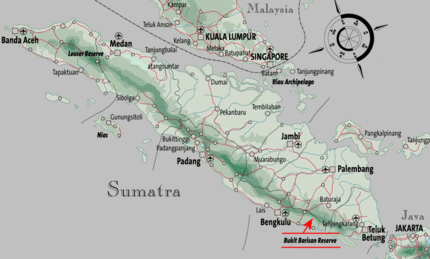
In 2007, a World Wildlife Fund report revealed that coffee illegally grown in Sumatra was being purchased by Nestlé and Kraft (most of Kraft’s coffee business is now controlled by Jacobs Douwe Egberts, see above) and other large coffee buyers. Land was being cleared in a national park to grow coffee, threatening habitat for endangered elephants, rhinos, and other wildlife.

At the time, Nestlé admitted the difficulty of determining the precise origin of their coffee. Nearly a year later, in an ABC News follow-up story, Nestlé made the cavalier comment “It might come – we have no way of  knowing – from illegal sources. Law enforcement is not our task.”

Indeed, the enormous amount of coffee purchased by Nestlé, JDE/Kraft, and Smucker’s (Folgers) follows a complex supply chain that would require effort and investment to ensure it does not originate under dubious conditions. It isn’t as if these companies can’t afford it. They make hundreds of millions (in Nestlé’s case, tens of billions) in profits annually.

You can read more about Nestlé’s various sustainability claims, and my take on them, from this page. As for JDE, the fact that the majority owner (JAB) is privately held will only reduce transparency regarding their supply chain, including that of many of their acquisitions. JAB is engaged in a quest to dominate the global coffee scene. I can’t see how this race, a competition with its main rival Nestlé, can advance the cause of coffee grown in a manner that is sustainable to farmers or the environment.

Epilogue regarding other buyers

Starbucks was also implicated in receiving illegally-grown Sumatran coffee in 2007. Prior to 2007, only about half of Starbucks’ coffee was sourced under their CAFÉ Practices guidelines, which identifies their suppliers and requires various criteria and transparency, verified by a third party. Now greater than 96% is sourced through this program. In the current Brazilian case, Starbucks told Danwatch that while they had done business with cooperatives and/or middlemen connected with the guilty farms, they knew each of their farm sources and did not obtain coffee from the farms in question.

McDonald’s and Dunkin Donuts were also mentioned in the Danwatch report because they use the Canadian distributor Mother Parkers, which in turn purchased coffee from a Brazilian firm that may have gotten coffee from one of the implicated farms. McDonald’s responded that their communication with suppliers indicated conditions described by Danwatch were not present in their supply chain. I’ll add that McDonald’s has been making considerable efforts in cleaning up their coffee supply chain. They have a goal of sourcing 100% of their coffee from verified sustainable sources by 2020, and are about a third of the way there. I’ll be writing a post about their progress in these efforts.

Dunkin Donuts response was more vague: “Dunkin Brands will continue to communicate and enforce our code of conduct standards throughout our coffee supply chain. Any material breach of this Code that does not have an immediate corrective action plan would result in termination of the supplier’s approval status.” They gave this same answer to multiple questions from Danwatch.

UPDATE: For in-depth perspective on slave labor in coffee, please see Michael Sheridan’s always deeply insightful posts:

More corporate coffee consolidation

Two of the giants in the corporate coffee world want to merge in an attempt to rival the world’s current biggest coffee buyer, Nestlé I’ve been waiting for the merger to go through to write about this deal, but it is being investigated by European anti-trust regulators, so I’ll go ahead and provide some background now.

The proposed merger is between the #2 and #3 coffee companies in the world: Mondelēz International and D.E. Master Blenders 1753.

mondelez-logoMondelēz International was the name given to the Kraft Foods division that spun off from the company’s grocery segment in 2012. Coffee brands include Gevalia, Tassimo, and Kenco. (Kraft Food Group and Kraft Foodservice control Maxwell House, Yuban, General Foods International and the Gevalia and Tassimo brands in North America. Although I’ve not read that Kraft brands are part of this deal, Maxwell House is shown as an included coffee brand in this fact sheet put out by Mondelēz.)

master-blenders-logoD.E. Master Blenders 1753 is owned by JAB Holding Company (Joh. A. Benckiser) — the private firm that recently purchased Caribou Coffee and Peet’s Coffee.  Their main coffee brand, though, is Douwe Egberts (once owned by Sara Lee Corporation). There are other coffee brands owned by D.E. Master Blenders, mainly European; the most familiar to Americans is probably Senseo.

A merger between these two companies was agreed upon in mid-2014. If approved, the new company will be called Jacobs Douwe Egberts. Mondelēz will own 49% of the new company, and JAB will have controlling interest at 51%.

Mondelēz International purchases about 500,000 tons of coffee annually. D.E. Master Blenders purchases 300,000 tons, according to Coffee Barometer 2014 (PDF). Combined, their purchases equal Nestlé’s 860,000 tons. Thus, if the merger proceeds, Nestlé and the new Jacobs Douwe Egberts will be purchasing around 20% of the entire world production of coffee.

In my table describing Corporate Coffee: How much is eco-certified, you can see how little of this coffee is falls under any of the meaningful eco-certifications (Smithsonian Bird-Friendly, Rainforest Alliance, or organic). A mere 57,000 tons — 3.3% — of the coffee purchased by Nestlé, Mondelēz International, and D.E. Master Blenders* falls under these three certifications!

I can fall back on my usual advice: avoid inexpensive, mass-produced, commodity traded, grocery store coffee. The largest coffee companies in the world control this category, and do little, if anything, to make sure the coffee they buy is produced under conditions that protect farmland, natural habitat, biodiversity, or the farmers that grow it.


*I’ve not historically included D.E. Master Blenders in my table as I have concentrated on North American brands, but I will do so if the merger goes through. D.E. Master Blenders mainly purchases UTZ Certified coffee, which does not have strong, specific, or meaningful ecological criteria; Coffee Barometer 2014 indicates the company has plans to procure more organic and Rainforest Alliance certified coffee in the future. Even adding in UTZ and Nestlé’s own self-certified, mystery Nespresso AAA Sustainable Quality program purchases, the total only amounts to 202,000 tons, or 12% of what these three companies buy each year.

Sara Lee, Kraft: more baby steps

Sara Lee and Kraft both announce increases in purchase of certified coffees: what does this mean?
Sara Lee
Sara Lee (Senseo, Java Coast, Douwe Egberts, etc.) recently announced a five-year goal of tripling the amount of Utz Certified coffee it purchases. I love how this was spun: that in the past five years, Sara Lee had purchased 110 million kilos of Utz Certified coffee. That sounds like a huge amount, but 110 million kilos is 110,000 metric tons over five years. This is a little over 20,000 tons per year of the 450,000 tons that they purchase annually — less than 5% of their purchases. Indeed, this is right in line with what we learned in my previous post Certified coffee: current market share, part 2.

The article goes on to say that Sara Lee is “committed to more than triple that amount in the next five years and purchase at least 350 million kilos across all its markets and product segments.” My emphasis added.  All product segments, as the piece goes on to say, includes tea (e.g., Pickwick and Hornimans brands in Europe). Sara Lee purchased 2000 tons of Utz Certified tea in 2010, so a tripling of that amount has to be factored in to get to their goal of 350 million kilos. If met, this goal means that in 2015, certified coffee will still only be 15 to 20% of their total coffee purchases. And Utz currently does not have significant environmental standards.

Sara Lee also just revealed that due to rising coffee prices, it will be reformulating some of its coffee blends to include more cheap robusta beans. You know — the ones typically grown as sun coffee.

Kraft
Kraft (Yuban, Maxwell House, General Foods International Coffee, Gevalia, Kenco, Maxim, Tassimo, Nabob, and Sanka) has reported that they increased the amount of Rainforest Alliance certified coffee they purchased to 110 million pounds in 2010. If we drag out the calculator again (and round up for the sake of simplicity) we see that is 50,000 metric tons…out of the 740,000 tons they purchase each year, or less than 7% of their total purchases.

Coffee image by bitzcelt under a Creative Commons license.

Illegal coffee growing threatens wildlife, Kraft major buyer

In a well-investigated and detailed report (pdf) released yesterday, the World Wildlife Fund (WWF) revealed that robusta coffee is being illegally grown in southern Sumatra, with most being purchased by large coffee producers such as Kraft and NestlÁ©.

“Illegally grown coffee is mixed with legally grown coffee beans and sold to such companies as Kraft Foods and NestlÁ© among other major companies in the U.S. and abroad.” — WWF

The coffee is being grown inside Indonesia’s Bukit Barisan Selatan National Park, which has over 300 bird species and is one of the few places where the endangered Sumatran subspecies of tigers, elephants, and rhinos coexist. This park has already lost 30% of its land to illegal agriculture, mainly coffee. WWF found 173 square miles being used for illegal coffee growing, with a yield of nearly 20,000 tons of coffee annually.  Wildlife has abandoned these cultivated areas.  WWF tracked the illegal coffee from the park through export routes to multinational coffee companies using satellite imaging, interviews with coffee farmers and traders, and trade route monitoring.

The U.S. received 17% of the coffee tainted with illegally grown beans.  Illegal beans are sold to local traders, who mix them with legally grown beans which then make their way to exporters. Major international companies purchase beans from exporters, and if they are not conscientious about their supply chain, they may not know they are buying illegal beans. The main buyers are shown in this graph from the report (click to enlarge), with Kraft being the number one buyer.

Exports of robusta beans from Lampung province, where most the park lies, have been steadily increasing, and the top six companies on the graph buy 55% of all Lampung beans. The profits spurring the encroachment into the park are financed by the purchases of these global roasters, and all Lampung beans have a very high probability of being contaminated with illegally grown beans, according to WWF. Talcoa (part of Kraft Foods), Kraft, and NestlÁ© were the top recipients in 2003-2005; Folgers (Procter & Gamble) and Starbucks received smaller amounts in 2004.

After being contacted by WWF, Kraft and Nestle were among five companies in the early stages of “engaging with WWF” on the problem. Four companies, including ED&F Man, parent company of VOLCAFE (which supplies beans to NestlÁ©  and Maxwell House), denied involvement. Eight other companies did not reply (full list in report).

Remember this is robusta coffee, so you don’t have to worry about the Sumatran arabica beans from your favorite specialty roaster. The illegal beans are those used in most supermarket blends.  Another reason to not buy these coffees!

See update #1 here and a late 2007 update here.

Hat tip to Ned Potter’s ABC News Science and Technology blog.  Map adapted from GoVacation Indonesia.

Yuban ad campaign

As I was perusing a magazine, I came across an ad for Yuban coffee with the headline “The coffee you make can make a difference.”  It showed their coffee cans, emblazoned with the Rainforest Alliance seal and a banner saying “Conserving the environment & supporting coffee farmers.  Minimum 30% Rainforest Alliance Certified Coffee.”

Let’s examine. Who are we dealing with? Yuban is a Maxwell House brand, which in turn is owned by Kraft Foods. (More on which corporations own which brands here.)

How big a deal is it that Kraft is buying RA beans? While Kraft will purchase 12,000 tons of RA coffee in 2006, this represents a tiny fraction (I’ve calculated about 1.5%) of Kraft’s coffee bean purchases.

What’s with the 30%? Rainforest Alliance (RA) allows use of their seal on products with a minimum of 30% certified beans (a fact for which they are sometimes criticized).  In order for Kraft to keep their prices so low (suggested retail for a 12-ounce can of RA-bean-containing Yuban is $3.89; a 13-ounce can of Maxwell House is $2.56), the other two-thirds of the beans in the can must be lower quality, likely technified/sun coffee.  I don’t see any other way they can do it.  The cost differential between certified beans and non-certified beans also means that I doubt Yuban will ever contain more RA certified beans than the 30% minimum required for use of the RA seal. (Update: As of January 2013, the Yuban can still indicates 30% certified beans. However, RA is requiring companies to scale up their percentages over time…read more here.)

Does this move really help farmers? While RA certification includes fair labor practices, and RA certified coffee usually commands some premium, the criteria does not set a minimum price paid to farmers. RA certification is cheaper for corporations that Fair Trade certification.  Oxfam is still pressuring Kraft to agree to buy Fair Trade coffee.

RA cannot be faulted for their efforts in promoting and making sustainable coffee available to mainstream consumers.  Nor can they really be criticized for partnering with Kraft, since RA certifies a product, not a company.

Still, it difficult for me to endorse supporting a corporation like Kraft which has a dubious ethical record (Responsible Shopper profile here). And while Kraft deserves some credit, as none of the other Big Coffee companies is making this type of effort, real environmental preservation and fair prices for farmers is far, far better served by purchasing sustainable coffees from small companies and roasters with relationships with their suppliers, especially those that provide information on the specific farms where their beans are sourced.  Plus I guarantee it will taste better!

UPDATE! The January 2007 issue of Coffee Review goes over supermarket coffees, including this coffee, which is “dominated by a cloyingly sweet nut character, the calling card of inexpensive coffees of the robusta species.”  Robusta tastes bad, and is sun coffee.  Very bad!  As for the Yuban Organic brand, that review notes it is recommended for “Those on a budget with a commitment to organic growing principles that transcends the desire to drink decent coffee.”  Please also read the accompanying article or my post about it.

More information: