Coffee and the environment

Integrated Open Canopy: a land sharing strategy for coffee

Some time ago, I wrote a detailed post about “land sharing” versus “land sparing“, two agriculture strategies. In a nutshell, land sharing is the use of cover crops, interplantings, and other measures that seek to approximate natural habitat, inviting birds and other biodiversity within the crop. Land sparing utilizes a patchwork of more intensive agriculture co-mingled with natural habitat.

Most discussions debating land sharing vs. land sparing revolve around food crops and the best way to feed a growing population without further devastation to biodiversity. A good review on the pros and cons is at the open-access paper Reframing the land-sparing/land sharing debate, as well as my previous post. This debate is somewhat different concerning coffee, because issues deal with sustainable farmer livelihoods rather than more general food security and availablility. That being said, shade coffee is an example of land sharing, while sun coffee plots in a matrix of forest would be an example of land sparing.

Over the summer, I attended (if that’s the word for a virtual meeting) the North American Ornithological Conference and listened to research on “Integrated Open Canopy” (IOC)*, a land sparing method in which intensively grown coffee plots (little or no shade) are grown at a 1:1 ratio with forested plots (primary or second growth). It reminded me it’s time to revisit this topic.

Why IOC/land sparing methods are becoming more important

The perceived advantage to farmers with IOC is that they can increase yields on the coffee plots while still preserving biodiversity on the forest plots. I add the qualifier for a few reasons. First, it’s not always true that shade coffee results in lower yields. Even when it does, shade coffee tends to be higher quality, and may be sold for higher prices (see the summary by the Specialty Coffee Association: Why Does Shade Matter?). Shaded systems provide additional benefits including increased pollination and pest control (proximity to natural habitats can also support these services). Sun or intensive coffee farming requires more inputs of fertilizer or for pest control and coffee plants need to be replaced more often, and may therefore be more costly. The decision on how to manage shade in coffee farms is therefore not simple, and it’s gotten more complicated.

A warming climate is pushing arabica coffee cultivation to higher, cooler elevations, driving deforestation. Climate change is also disrupting the distinct seasonality of tropical growing regions, expediting the spread of pests and disease. Coffee rust has become particularly devastating. The relationship between shade cover and rust is very complex; dense shade can facilitate rust, but open conditions promote spore dispersal and lack of natural vegetation disrupts ecosystem processes that bolster biological control of the fungus [1]. Small coffee farmers are giving up coffee farming for easier or more profitable crops. The importance of allowing flexibility to coffee farmers in their production methods to sustain their livelihoods while offering a way for them to preserve biodiversity at the same time is becoming more urgent.

A Slaty-backed Nightingale Thrush, Catharus fuscater, a forest-dependent species found only in primary forest and IOC farms in this study. Photo by Cephas, CC BY-SA 4.0, via Wikimedia Commons.

Does IOC/land sparing help birds?

Only a few studies have carefully looked specifically at coffee and birds in an IOC system. The most frequently cited is a paper out of Costa Rica [3], looking at small farms (<3 ha in coffee) in the Montes de Oro cooperative. Birds were surveyed in primary forest, secondary forest, IOC farms, and shade farms using mist-netting./bird banding. The authors noted most “shade” coffee in Costa Rica is commercial polyculture and thus they couldn’t compare IOC farms to shade coffee farms that might qualify for Bird Friendly certification. However, they did choose shade farms with more than 40% shade cover and 10 species of native trees.

The most important result in this study showed that IOC coffee farms had more forest-dependent bird species than shade coffee farms. In fact, forest-dependent species were least abundant on shade coffee farms. Forest-dependent species are typically found in large and/or primary forest and may be of higher conservation value due to their relative rarity in general as well as their more specialized roles — as seed dispersers, for example. Simple measures of presence/absence of species or even abundance (if those species are generalists, common, or non-native species) do not tell us much about the biodiversity value of forest.

Some further things to consider when contemplating these results:

The use of mist-netting is biased towards birds that spend most of their time in the lowest levels of the forest — from ground level to about 3 m, the height of the nets used to capture birds. Mean canopy height in their primary forest sites was 25 m, in IOC forest 18 m and in shade coffee 7 m. The mesh size they used was also small and suitable for birds only up to the size of a large jay, precluding capture of many larger species of birds. Mist netting misses many bird species, especially in plots with high canopy. If I had to guess, I would say their methods may have under-sampled forest-dependent birds, because canopy-dwelling species are often more specialized and sensitive to disturbance, and would not be sampled with standard mist nets.

On the other hand, proximity to large, intact forest greatly influences which species might occur in nearby plots, and the IOC farms were closer to the Monteverde Reserve Complex than the shade coffee farms, which may have biased the results towards more forest-dependent species. Additional survey methods are needed for clearer understanding and comparisons.

Of the 148 species they captured across all sites, only 24% were forest-dependent. Further, a third of those 148 species were only captured once or twice; not much can be concluded from such infrequent captures. These species may just be transients, and little can be surmised about their use of any of the habitats. Considering just the 36 species captured 20 or more times, only 8 were forest dependent. The capture rates for 5 of these was highest in primary forest, 2 in IOC, and 1 in shade coffee. All species were found in primary forest and on IOC farms, and all but one in secondary forest. Only half were found in shade coffee farms.

An additional limitation to this study was that it took place over several years in the months of November-March. This is the dry season, and resident birds (comprising 34 of the 36 forest-dependent species) nest later, in the rainy season. An important metric of the conservation value of land is whether it can support reproductive success, which was not possible in this study.

Nonetheless, there are encouraging trends in this study; similar results were presented for Honduras at the meeting I described, although this research has not yet been published. The results indicate that in regions where there are still intact forested plots combined with a tradition or need for more intensive forms of coffee farming, land sparing may be a good way to preserve birds and biodiversity. In addition to better bird sampling methods, examining the ecological and functional roles played by various birds (and ultimately other taxa), their reproductive success, and evaluating their usage of IOC forest plots, will need to be incorporated into further studies.

That being said, the benefits of land sparing to birds and wildlife are highly dependent on geography, climate, and plot configuration at farm, local, and landscape levels. In addition to scale, many other variables will factor into the value of land sparing for birds or other taxa, some of which I mention below.

How can certification play a role?

There really isn’t a mechanism for certifying IOC-type farms right now. Bird Friendly (which is currently the only true biodiversity-friendly/shade coffee certification) requires organic certification and canopy cover of at least 40 percent, as well as other vegetation parameters. It represents the classic land sharing concept. Building a framework for certification of land sparing IOC-type farms will require ecologically sound, scientifically-based criteria.

Some things to consider:

  • There should be some minimum size to the forest plots themselves, as well as requirements on their shape. This is because very small plots or plots with a lot of edge rather than core area are less valuable to forest-dependent species of birds (as well as other taxa).
  • The configuration of coffee plots and forest plots could play critical roles in habitat connectivity throughout the landscape (important to wildlife) or acting as buffers or windbreaks (important to coffee). These factors should be examined and taken into account.
  • While regenerating or second-growth forests should by all means be permitted under any certification scheme, forest age should also be taken into consideration, with older usually being more valuable. Fortunately, tropical forests mature quickly, and farmers should also be able to take advantage of tree biomass and receive credit for carbon sequestration. While this should be obvious, there should also be some way to define and evaluate whether a forest patch is actually a forest patch, and prohibit inappropriate plots such as gardens, etc. that are permitted in some certification schemes.
  • Clearing of new intensive farming plots, even if adequate offsetting natural forest is present, should not be allowed.
  • Forest composition (diversity of plant species, emphasizing natives) and structure (density and layers of vegetation, presence of vines and epiphytes) are important components. Many of these details are already incorporated into the Bird Friendly standard, but could probably use some tweaking depending on the region which may have birds or other taxa with specialized habitat needs, or where growing conditions are varied or unique.
  • The issue of chemical use in plots embedded or directly adjacent to forest plots also requires some thought. While organic practices are ideal, they will be more challenging for farmers in these situations because intensive coffee cultivation often requires supplemental fertilization, if not pest control.

When I visited coffee farms in Panama years ago, the patchwork of coffee and other land uses clearly demonstrated to me the difficulties in assessing these farms for certification. Several farms I went to in both Panama and Nicaragua would not qualify for Bird Friendly certification but had hectares of high-quality forest preserved on their farms. They were deserving of a certification that would recognize their efforts and afford them access to market incentives and increased income.

There are a number of slippery slopes on this road, but it is one that should be traveled. Coffee growing is becoming more difficult, and biodiversity loss in the tropical areas where coffee is grown is accelerating.

——

*Integrated Open Canopy is a term trademarked by the Mesoamerican Development Institute, an NGO working primarily in Honduras. They couple IOC farming with solar or biofuel drying methods for post-harvest processing — important to reduce deforestation for firewood typically used to fuel drying; read more here, as well as their goals and commitments at the Sustainable Coffee Challenge website.

[1] Vandermeer, J., D. Jackson, I.Perfecto. 2014. Qualitative dynamics of the coffee rust epidemic: Educating intuition with theoretical ecology. BioScience 64: 210—218. doi.org/10.1093/biosci/bit034

[2] Arce, V.J.C., Raudales, R., Trubey, R., King, D.I., Chandler, R.B., Chandler, D.C., 2009. Measuring and managing the environmental cost of coffee production in Latin America. Conservation and Society 7: 141-144.

[3] Chandler, R.B., King, D.I., Raudales, R., Trubey, R., Arce, V.J., 2013. A small-scale land-sparing approach to conserving biological diversity in tropical agricultural landscapes. Conservation Biology 27: 785-795.

A rusty nail in the coffin of organic-certified coffee?

Coffee leaf rust (Hemileia vastatrix) is a highly contagious fungal disease that is devastating coffee production in Latin America, with losses estimated at 15 to 70%, depending on the region. One essential component to combating this disease is the use of fungicides. Copper-based fungicides are relatively inexpensive and are permitted under organic certification. However, they must be reapplied frequently (around every three weeks, or more often if it rains and gets washed off) and are not without ecological risk. If used frequently or in excessive amounts, copper can build up in soils and can also be harmful to aquatic organisms. Some types of synthetic fungicides*, not allowable under organic certification,  can be more effective — and in some circumstances may actually be safer for the environment.

Some of the best reporting on the coffee rust crisis is from Michael Sheridan writing at CRS Coffeelands. As I was contemplating writing this post on the connection between coffee leaf rust and organic certification, Michael hit on the topic himself.  He notes that farm management [use of shade, planting density, pruning, proper timing of fungicide applications] has as much or more to do with crop losses from rust as does whether the farmer uses organic or conventional production; this was echoed in survey results gathered by Green Mountain Coffee Roasters. The severity of this disease is also very dependent on climate and weather factors such as wind, moisture, and temperature. Still, Michael notes that the “official response to coffee rust in Central America so far seems to have been heavily skewed toward agrochemical-intensive approaches”.

For example, at a recent coffee rust summit, a representative from PROMECAFE, a Central American coordinator for coffee-related technical training, suggested that in the short term, organic farmers might consider leaving organic for conventional production.

nailCRS Coffeelands quotes Miguel Medina of the Guatamalan national coffee organization Anacafé as saying, ”I don’t know how organic coffee can have a future.  There is nothing that works to control rust in the field and I am not seeing anyone in the market offering more to create additional incentives for organic farmers.”

Despite a strong commitment by farmers in many Latin American countries to preserve their environment and even a suspicion by a few that chemical companies may be behind the rust epidemic, many farmers may feel compelled to give up their organic certification to fight the rust. With the severity of this threat to their livelihoods — and even survival — the choice between trying to salvage their coffee trees with artificial fungicides or stick with organic certification is straightforward. Many will do what they can to keep afloat and give up organic certification. This not only allows them to use more potent artificial fungicides to try to control the coffee leaf rust, but it also frees them to use pesticides and artificial fertilizers that may be considered necessary to protect or help vulnerable or ailing coffee trees.

Over the past few years, some farmers have already abandoned organic certification because the extra money they receive for it simply does not compensate them for the added expense of producing coffee this way. The rust crisis adds to this dilemma. Eventually, coffee fields are likely to be replanted with rust-resistant varieties, but even those in the ground today will take three to five years to produce a crop. Meanwhile, we as consumers need to brace ourselves for higher coffee prices as crop yields decline, and be that much more willing to pay extra for organic coffee.

More reading on the topic:

*Some media mention “Triazaline” as the synthetic fungicide used for coffee leaf rust control. From what I can tell, there is no fungicide named triazaline. However, there is a group of synthetic fungicides called triazoles that are used. Triazaline may be a brand name in this family, or a misinterpretation/misspelling of triazole.

Rusty nail photo by Scott Robinson under a Creative Commons license.

Is coffee really at risk of extinction?

Recently, a paper was published in the peer-reviewed, open-access journal, PLoS ONE: “The impact of climate change on indigenous arabica coffee (Coffea arabica): predicting future trends and identifying priorities.”

It specifically looked at wild, endemic populations of Coffea arabica in Ethiopia (and a few points in nearby areas). In a nutshell, the authors created computer models using known localities, environmental conditions, and various climate change scenarios to predict current and future distribution of these populations. The models determined a reduction (ranging from very worrisome to nearly complete) in suitable locations in this region by 2080. This is no surprise. I’m not sure I’ve seen any models that do not show some impact on the ranges (whether expansions, contractions, or shifts) of plants and animals under any accepted climate change scenarios. And we all know coffee is a very climate-sensitive species, especially arabica coffee.

It is a big leap to go from what this paper actually examined and concluded to the shrill, frantic headlines and stories pumped out by mainstream  media. For instance, under the headline So Long, Joe? World Coffee Supply Could Be Threatened By Climate Change, US News and World Reports declared “Nearly 100 percent of the world’s Arabica coffee growing regions could become unsuitable for the plant by 2080.” This is way off base, given the study was only looking at wild arabica in the vicinity of southwest Ethiopia. The article also stated that “If Arabica becomes impossible to raise in its native areas, it could wreak havoc on the economies of the mainly third-world countries in which it grows,” which is ridiculous considering that coffee is already grown on millions of acres in dozens of countries around the world where it is not native. Likewise, Salon.com made the even more extreme statement, “By the end of this century, climate change could wipe out nearly all the world’s coffee” in their piece, Coffee beans at risk of extinction.

I could cite more hand-wringing examples of failure by news outlets to make an honest effort at reporting what this paper really said, but you get the gist. As a scientist, journalist, editor, and world citizen, this lack of accuracy disgusts me. First, there is no excuse for it; the paper is open-access and anyone can read it for themselves! Apparently, this dismal reporting stems from incomprehension, laziness, and/or incompetance on the part of writers and their editors, as well as a disregard for actually informing the public in favor of profit for the news outlet via sensationalism.

If you’ve read this far and want a more nuanced analysis of the paper, I’ll give a few of my thoughts.

I thought the  paper was thorough and well-conceived. The bioclimatic modelling used is pretty standard for looking at the distribution of species under future climate change situations. Computer models, of course, are as robust as the data one feeds into them.  In this paper, the bulk of the data used to model current distribution was based on unpublished field work done by one of the authors; the rest was from herbarium specimens or literature reports, some dating back to 1941.  Ergo, it is technically not possible to evaluate the quality of this data. The climate data emphasizes factors like temperature, rainfall, and seasonality. These are all critical for coffee growing, but the models did not integrate other important environmental influences on coffee production such as soil types, microhabitats, and ecological processes, and the authors acknowledge those shortcomings.

The results and discussion provided didn’t stray far beyond these limitations and delivered on the authors intended goals: to identify conservation, monitoring, and research needs for wild, native Coffea arabica. It established baseline data to help assess future impacts of climate change on these populations, having identified suitable localities for them.

Two paragraphs in the discussion are devoted to the implications of the findings for cultivated arabica coffee, and they are also presumed to be negative. Does this mean the news headlines, while not the subject of the actual paper, are true? Not exactly. The authors note that optimum cultivation requirements for arabica coffee will likely become harder to achieve in the face of climate change, productivity will probably be reduced, and more intense management (especially irrigation) will be needed.

Is the potential loss of genetic resources in these populations something to worry about? In their article Climate change threatens sweet smell of morning coffee, Reuters took a stab at trying to interpret what the paper had to say by writing, “Although commercial coffee growers would still be able to cultivate crops in plantations designed with the right conditions, experts say the loss of wild arabica, which has greater genetic diversity, would make it harder for plantations to survive long-term and beat threats like pests and disease.”  Indeed, a reason the authors focused on wild populations of arabica in their native range was that their genes may be valuable for breeding disease and pest resistance and climate resilience into commercially grown coffee. While this is logical, and maybe even likely, the paper did not provide detail on the genetic diversity, number of unique arabica strains, or other features of the coffee being mapped and modelled. In fact, the authors noted that genetic variation in wild arabica still needed to be assessed. Further, other more tolerant species of coffee (primarily Coffea canephora, robusta, and its hybrids) are being used in breeding programs today and probably hold the best hope for resilience in commercial coffee. (This is not to discount the importance of preserving these populations; I’m a strong believer that genetic biodiversity should be preserved regardless of it’s commercial value.)

One point was made in the paper that I thought was not given enough emphasis. The biggest driver of the loss of wild coffee populations has been and is deforestation and land conversion, which themselves exacerbate climate change. We can sit on our hands and watch one of the models in this paper play itself out, with what the authors term as “profoundly negative influence” on coffee. Or we can encourage the production (and consumption) of coffee grown in an ecologically-sustainable manner, using carbon-capturing shade trees and sensible agroforesty techniques — and reward farmers for their troubles by paying more for eco-friendly coffee. The press  could make a real contribution by informing the public on the issues surrounding the sustainability of one of the world’s most popular beverages, rather than thoughtlessly spew out faulty proclamations with little basis in fact and no call to action.

More of my posts on coffee and climate change here.

Davis AP, Gole TW, Baena S, & Moat J (2012). The Impact of Climate Change on Indigenous Arabica Coffee (Coffea arabica): Predicting Future Trends and Identifying Priorities. PloS one, 7 (11) PMID: 23144840

More pollinator research for Pollinator Week

My last post summarized research on current and historical pollinators and their role in robusta coffee fruit set in India, and I noted it was in recognition that this is Pollinator Week — an international celebration of the valuable ecosystem services provided by bees, birds, butterflies, bats and beetles.

I’ve summarized a couple of other papers on pollinators and coffee:

These are by no means the only research done on pollination, pollinators, and coffee! Below I have listed many peer-reviewed papers specifically dealing with bees and coffee pollination, and often the role of preserving shade in and near the coffee farm to preserve the habitat of pollinators and improve the fruit set of the coffee and other crops on the farm. If you are especially interested in one of the papers and do not have academic access, please let me know and I can try to provide you with a copy.

Meanwhile, I also encourage everybody to head over the the website of the Pollinator Partnership, which sponsors Pollinator Week. They have every resource you can think of regarding pollination and pollinators — not just bees, but all the other insects and animals that perform this incredible service — and their conservation and status. New this year is a free app (iPhone or Android) called BeeSmart, a database of hundreds of North American native plants for attracting pollinators.

(more…)

First Rainforest Alliance climate-friendly coffee farm(s)

(Updated) Finca Platanillo in San Marcos, western Guatemala is the first coffee farm to be verified by Rainforest Alliance (RA) for compliance with the Climate Module of the Sustainable Agriculture Network (SAN, the standards-setting organization for RA). Less than a week later, it was announced that the well-known Daterra Estate in Minas Gerias, Brazil became the second farm to earn the verification.

I first reported on RA’s plan to develop this module in 2008. It isn’t a certification, but a voluntary add-on to RA certifcation. The module isn’t intended to indicate that a farm is carbon-neutral, or participates in carbon offsets, and doesn’t measure carbon stocks on farms.* The module’s goal is to encourage farmers to assess their climate risks, analyze their greenhouse gas emissions, maintain or increase carbon stocks on their lands (via habitat preservation or restoration), and identify best management practices to help them adapt to future climate change.

Verification occurs if farms comply with 80% of the 15 voluntary criteria of the module. Failure doesn’t effect the compliance score of regular RA certification. Farms can have the Climate Module audit done at the same time as their regular audit for RA certification; thus, it incurs no additional costs.
Finca Platanillo is 350 ha, of which nearly 40 are set aside as a protected area (although the ANACAFE site lists the area as 303 ha, of which 296 are cultivated). The finca grows bourbon, caturra, and catuai varieties at about 1150 to 1450 m; their maragogype is currently being offered by a number of roasters in Europe. In 2007, Finca Platanillo was one of the top-scoring farms in RA’s Cupping for Quality competition.

We reviewed several of Daterra’s coffees and provided background in this post. Daterra was also the first Rainforest Alliance-certified estate in Brazil (it consists of more than one farm). You can read more about the broad range of their long-standing sustainability efforts on their web site.

*RA and its partners have also worked on developing a guide for farmers on how to measure and verify carbon stored on coffee farms to enable producers to receive payments for carbon credits. See this post for details and a link to the guide.

Climate change threatens east African coffee via borers

Some like it hot: The influence and implications of climate change on coffee berry borer (Hypothenemus hampei) and coffee production in east Africa. Jaramillo et al. 2011. PLoS One.

An important new paper published this week outlines the threat posed by the expansion of coffee berry borers in east Africa due to climate change.

This paper follows up research by the authors that was published in 2009. That paper looked at life history characteristics of the coffee berry borer (CBB), one of the worst pests of coffee, and how they might react to various climate change scenarios. This paper built on that data, looked at current distribution of CBB in east Africa, and modeled the change in distribution by 2050 based on two climate change scenarios.

The models indicated that CBB infestation will be worse in the arabica coffee producing regions of Ethiopia; the Ugandan part of the Lake Victoria and Mt. Elgon regions; Mt. Kenya, particularly in the coffee-producing areas of Embu and Meru, and the western part of Kenya, around Kitale and the Kenyan aide of Mt. Elgon; and most of Rwanda and Burundi. Further, it appears that increasing temperatures will likely double the number of generations of CBB per year in all current arabica-producing areas. Both models (using slightly different projections of climate change) are very similar, one figure is reproduced below.

Suitability of climate for CBB, year 2050. EI values indicate suitability, where 0 is unsuitable, and 100 is perfect. Click to enlarge. From Jaramillo et al. 2011.

Lest you view climate modeling (or climate change) with skepticism, the authors note that as recently as ten years ago, CBB were not reported above 1500 m. Now, due to increasing temperatures in coffee growing regions around the world, CBB can be found at higher altitudes, where arabica coffee is typically grown. CBB have been documented 300 m higher in Tanzania than they were ten years ago. The authors note that some of the changes predicted in their earlier paper, such as increased number of generations and broader distribution, seem to already be occurring.

The damage an increase in CBB to now-untouched coffee growing areas is serious and sobering. These impacts do not even incorporate other changes that are likely to take place with increasing temperatures: a change in the distribution of biological enemies of CBB, and the impact of changes in rainfall patterns, disrupted seasonality, and thermal stress to coffee plants.

The authors state,

We suggest that the best way to adapt to a rise of temperatures in coffee plantations could be via the introduction of shade trees in sun grown plantations.

They note adding shade trees can lead to a decrease in the temperature around coffee berries by up to 4°C, which in turn may reduce the rate of increase in CBB by 34%.  They go on to say shade coffee agroecosystems can serve as a refuge for beneficial arthropods, leading to higher levels of biological control of CBB, and they create a diversified and therefore more resilient system that will perform better under climate change. They conclude that while it is only one of many adaptation strategies, the use of shade trees is “… rational, affordable, and relatively easy for coffee farmers and other stakeholders to implement.”

The paper is open access, and you can read it the whole thing and view all the maps here. A link to an abstract in Spanish is available near the end.

Jaramillo, J., Muchugu, E., Vega, F., Davis, A., Borgemeister, C., & Chabi-Olaye, A. (2011). Some Like It Hot: The Influence and Implications of Climate Change on Coffee Berry Borer (Hypothenemus hampei) and Coffee Production in East Africa PLoS ONE, 6 (9) DOI: 10.1371/journal.pone.0024528

Two degrees up

The International Center for Tropical Agriculture (CIAT) produced a series of short films on what a changing climate could mean for farming communities in East and West Africa, and South America. The segment below is the impact on coffee producers in Colombia — not only what changing climate could mean, but what it does mean already.


This film is also available in Spanish. The other films in the series chronicle land conflict and rural displacement in Ghana and water scarcity in Kenya.

Mitigating climate change with coffee

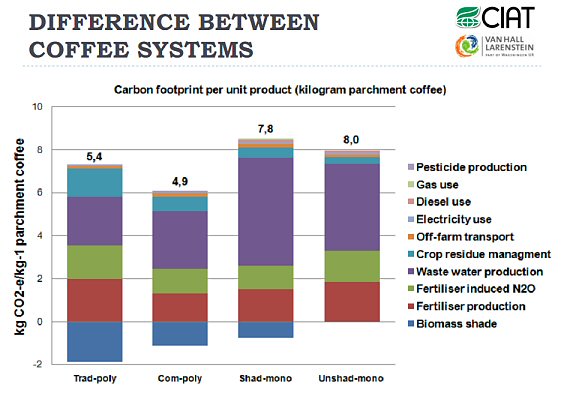
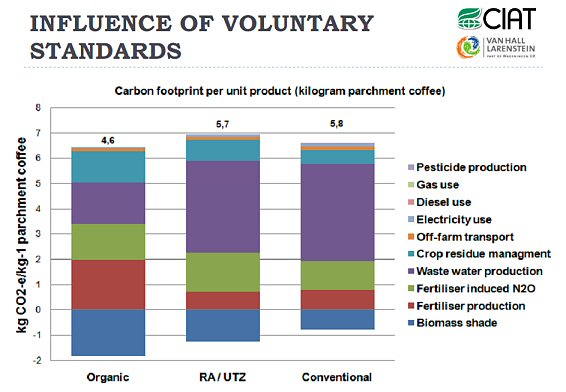
The Decision and Policy Analysis (DAPA) Program of the International Center for Tropical Agriculture (CIAT) recently released results from a research project on mitigating climate change in Mesoamerican coffee production. You can download a PDF of the report, The Potential of Mesoamerican Coffee Production Systems to Mitigate Climate Change. This document is actually the thesis project of a Dutch student. The paper is a straightforward look at the how different shade coffee systems store carbon and their levels of greenhouse gas emissions, as well as how a few certifications (organic, Rainforest Alliance, UTZ Certified) influence those metrics.

Here are two slides from a presentation to whet your appetite (click to enlarge).

Traditional rustic shade has a larger carbon footprint than commercial polyculture because yields are lower per unit area, and all the contributing factors are allocated to less product. Note that biomass (below 0 on x-axis) denotes “credit” subtracted from factors that add to the carbon footprint.

Certifications other than organic don’t do much to reduce carbon footprint over conventional farming, suggesting that standards need to be modified to encourage footprint-lowering practices. Note that biomass (below 0 on x-axis) denotes “credit” subtracted from factors that add to the carbon footprint.

For an explanation of these interesting graphs take a look at the full report.  While it is over 100 pages, it is not a difficult read and I especially encourage people to take a look at page 68, which outlines coffee production practices that result in lowered greenhouse gas emissions, and page 70, which gives overall conclusions.

Climate change impacts on coffee nations

The Center for Global Development recently released data on the vulnerability of countries around the world to climate change. I’ve taken slices of two maps that show the latitudes where coffee is grown. Both maps rank agricultural productivity loss, with countries having the most impact in darker reds, less impact in oranges and yellows.

The top map shows risks due to physical climate change only. Coffee-growing nations (including those growing primarily robusta coffee) ranked at highest risk (top 15) for agricultural productivity loss due to the physical effects of climate change are Central African Republic and Democratic Republic of the Congo, Bolivia, Burundi, Rwanda, the Dominican Republic, and Haiti.

The second map takes into account vulnerability and adjusts these risks based on a given countries’ ability to cope with climate risks. All of the African countries remain in the top 15, with Burundi moving well up the chart (indicating that there are not policies and infrastructure in place to help farmers cope with climate change). Rwanda just leaves the top 15, but Ethiopia now makes the list. The Latin American countries — Bolivia, the Dominican Republic, and Haiti — all move well down the list, but Cuba comes in at 15.

Share it or spare it?

Intensifying production while conserving biodiversity

Food security and the ability of agricultural lands to feed over 9 billion people by 2050 is an increasingly-discussed topic. Part of this issue is how to conserve biodiversity while boosting agricultural capacity, either by increasing the productivity of land currently in production through some sort of intensification, or expanding the farmed area itself. Two methods of production are frequently mentioned in the overall debate: “land sparing” and “wildlife-friendly farming.” If this sounds familiar, it’s because these concepts have helped frame the sustainable/shade coffee certification movement.

Increasing yield is not the only way for coffee farmers to increase their income, of course. Increasing quality can also lead to handsome profits for farmers. However, most coffee grown around the world — in tropical biodiversity hotspots — is destined for the commodity market. A look at how the agricultural models attempt to balance productivity and biodiversity can reveal some of the complexities of coffee production, and the challenges for coffee certifications.

Land sparing. This approach promotes the intensification of agriculture on existing farmed land in order to increase yield so that more land does not have to be converted. This allows for adjacent land to be permanently preserved. Biodiversity within the crop space itself is limited, but the protected natural habitats are meant to harbor species native to the region.

The catch-all term for this type of coffee agriculture (minus the set-aside component) is “sun coffee,” as coffee is grown in a monoculture under full sun, rather than under a canopy of trees.  Growing coffee in the sun generally requires generous use of pesticides, herbicides, and artificial fertilizers.

Wildlife-friendly farming. As the name implies, this approach seeks to preserve biodiversity within the agricultural landscape via modifications of the production area (addition of different crops, incorporation of natural habitat) and/or more eco-friendly growing practices (reduction in agrochemical use, organic mulching).  A variety of fauna can utilize the farmed land, but this type of production method usually means lower crop yield per unit area.

In the case of coffee, wildlife-friendly farming means the use of a multi-layered canopy of diverse shade tree species, limited pruning of the shade trees and their epiphytes, preservation of leaf litter, and minimal (or no) use of chemicals — all hallmarks of what we call “shade coffee.”

Coffee certifications favor wildlife-friendly farming

When we talk about coffee production, birds, and conserving biodiversity, intensification is the boogeyman — the state to be avoided. Sun coffee has been considered the antithesis of shade coffee and all that is good in sustainable coffee growing. Thus, aspects of wildlife-friendly farming have become the building blocks of many coffee certifications. Some, like Smithsonian Bird-Friendly, deal exclusively with wildlife-friendly farming techniques while others, such as Rainforest Alliance, incorporate wildlife-friendly criteria along with other types of requirements for certification.

Wildlife-friendly coffee farming (from here on out, we’ll just call it shade coffee) is therefore the intuitive choice in the spare-or-share debate. But there are rarely one-size-fits-all solutions in ecology.  While the benefits of shade coffee to birds and other biodiversity are great, even high quality shade coffee does not hold the same levels of biodiversity as intact natural habitat. This is especially true for forest specialists that do not thrive in small forest remnants or agroforestry areas. Many of these important species are unlikely to reproduce and maintain their populations in shade coffee alone if there is not gene flow from nearby natural habitats. Some sort of land sparing (protection of native habitat on the farm) is likely needed to conserve species of high conservation concern in at least some areas, even if shade coffee techniques are used.

There are many variations of “shade.” There is rustic shade similar to forest, all the way to shade limited to a few pruned, non-native tree species. The closer we approach the latter, the less value a shade coffee farm has for biodiversity. Shade coffee may not be suitable if it creates expanses of marginal habitat for species that need high quality land, or if the production areas prevent the movement of some species between patches of prime habitat. Incorporating specific criteria into certification standards provides assurance that the amount and type of shade fosters biodiversity. Unfortunately, becoming certified is beyond the means of many farmers.

Another issue is that in some coffee-growing regions, growing coffee under shade is not practical. At high elevations, for instance, light and humidity levels limit growing coffee under multiple layers of shade because of increased fungal diseases and decreased yield. In these instances, where coffee is grown in sun, biodiversity need not be forsaken if some form of land sparing is utilized.

Should we revisit intensification of coffee production?

There is some evidence that the concept of land sparing can help prevent deforestation, which in turn helps preserve biodiversity. In Latin America during the 1980s, countries with a higher crop yields had lower deforestation rates, and countries that increased the crop yields per unit area had lower rates of cropland increase. Similarly, between 1970 and 1995, a period of intensification of coffee farming in Latin America, there was a 44% increase in production, largely due to intensification, while the area planted with coffee increased 27%. Colombia is a country that embraced intensification as a way to combat the arrival of coffee rust; between 1970-1997, more than 70% of the coffee area in Colombia intensified coffee growing practices. During this period, the area planted in coffee decreased 18.5% and forest and secondary growth increased 12.1%.

This suggests that with very careful planning, intensification of coffee production with planned land sparing could take place without disastrous results for the environment. Among other things, a land sparing scheme won’t work for biodiversity preservation unless the set-aside lands are actively protected and probably managed in some way so that they do not become degraded.

And while the production area itself can be farmed more intensively, it can’t be farmed in an “anything goes” manner. If intensification results in negative impacts beyond the farm (e.g., in the protected area, such as pesticide run-off), then the value of the protected area is likely to be diminished.

Finally, there needs to be some incentive for farmers to protect their spared land. Adjacent forest patches can provide benefits to coffee production even if the farmed area is sun coffee. This includes a source of pollinators as well as birds and insects which prey upon coffee pests. However, further financial benefits will likely need to be built into this scheme. If all economic gain is seen in the  high-yielding production areas of their property, farmers may be inclined to expand those areas at the expense of protecting habitat.

How do we integrate agriculture and biodiversity?

When ethical consumers consider a coffee purchase, they are often presented with a dichotomous view of coffee production. The reality is more nuanced. Full-blown “wildlife-friendly” farming may not be the only or best choice (or even an option for some farmers). And “land sparing” may not be its polar opposite. Coffee can be and is grown in a myriad of blended models. Consider patches of sun coffee, supplemented by some artificial fertilizers, using no pesticides, interplanted with natural habitat and fruit and timber trees, with protected forest nearby. In some instances, this could be preferable to an extensive landscape of shade coffee (especially low quality shade).

Right now, the obstacles to establishing criteria to certify blended models are daunting. For example, how do you set a threshold on how much land must be set aside? Is 60% better than 55%, and how can it be measured?  The amount and quality of land to be set aside would need to be determined on a regional basis, and be dependent on local land use, conservation issues, coffee farming traditions and conditions, and farmer needs.

This post is already long-winded, so it represent a simplification of a very complex issue. It’s not meant to endorse sun coffee or intensifying coffee production, or to disparage coffee certifications. It’s just an exercise to illustration the complexities of sustainable coffee production, and provide some food for thought.


This post drew from the following sources:

  • Fischer, J., Brosi, B., Daily, G., Ehrlich, P., Goldman, R., Goldstein, J., Lindenmayer, D., Manning, A., Mooney, H., Pejchar, L., Ranganathan, J., & Tallis, H. 2008. Should agricultural policies encourage land sparing or wildlife-friendly farming? Frontiers in Ecology and the Environment 6:380-385.

  • Green, R., Cornell, S.J., Schalemann, J.P.W., Balmford, A. 2005. Farming and the Fate of Wild Nature Science 307:550-555.

  • Guhl, A. 2008. Coffee production intensification and landscape change in Colombia, 1970-2002. Pp. 93-115 in Land Change Science in the Tropics: Changing Agricultural Landscapes, A. C. Millington and W. Jepson, eds. Springer: New York.

  • Phalan, B., Balmford, A., Green, R.E., & Scharlemann, J.P.W. 2011. Minimising the harm to biodiversity of producing more food globally. Food Policy, DOI: 10.1016/j.foodpol.2010.11.008

  • Rice, R. 1999. A Place Unbecoming: The Coffee Farm of Northern Latin America Geographical Review, 89 (4) DOI: 10.2307/216102

Short video on shade coffee and birds

The Colombian bird conservation organization FundaciÁ³n ProAves is now presenting a short video, “Shade-grown coffee and saving migratory birds of North and Latin America.”  A lot of the tropical footage was shot in their Cerulean Warbler Bird Reserve and the community of San Vicente de Chucuri in Santander Department. It also touches on the issues in the U.S. Appalachian region, where mountain-top removal coal mining is also destroying habitat.

The video is also available in Spanish.

Several partners funded and produced the film. I don’t like to nitpick, but I’d be remiss if I didn’t mention that there is a link at the end of the video that goes one of their sites where they are marketing a certified organic, Fair Trade, shade grown coffee.

There is no origin or shade certification indicated for this coffee.  Given that a major theme of the film is “Where does your coffee come from?” this seems ironic. After digging around a bit, I found a page that says the coffee is from Nicaragua; the roaster offers a Nicaraguan  — I presume that’s probably what they are using — but it’s not from the Smithsonian Bird-Friendly certified farm in that country. The cooperative the roaster sources from is 2300 members, and most grow under at least some shade. Still, it would have been appropriate to use Bird-Friendly certified coffee.

Coffee and climate change updates

It’s been about six months since I gathered together recent resources on coffee-growing and climate change (you can read past material in the new climate change category). Here are some new resources.

Peer-reviewed research related to coffee and/or agroforestry, and climate change:

Uganda’s wild coffee

The Agricultural Biodiversity Weblog beat me to summarizing a recent peer-reviewed paper, Kibale Forest Wild Coffee: Challenges to market-based conservation in Africa (abstract). The paper outlined the (unsuccessful) attempt at creating a market for products based on wild robusta coffee growing in western Uganda’s Kibale National Park.

This nearly 800-sq-km park in the Rift Valley on the border with Congo protects lowland and mid-elevation evergreen and semi-deciduous rainforest. Areas surrounding the park have high human populations, many who rely on subsistence agriculture of mostly plantain, sweet potatoes, and sugar cane. The regional deforestation, save for the park, is evident in the satellite image.

Kibale is very biodiverse, with 11 species of primates, 325 species of birds, and at least 140 species of butterflies. This forested area was highly exploited in the 1970s. Agricultural encroachment destroyed roughly 17% of the area. When Kibale National Park was officially created in 1993, use of the park’s resources by local people were restricted, causing conflicts.

Two species of coffee grow wild in many parts of the park. Coffea eugenioides and C. canephora [1]. The former is widespread but not abundant, while the latter (known as robusta coffee and used commercially in many inexpensive grocery store coffee blends) is less ubiquitous but very abundant where it grows, covering 7800 ha in the park.

The goal of the project was to manage sustainable harvesting of the coffee and provide income for local communities. Ultimately, the harvested robusta would be blended with Ugandan certified organic arabica coffee and, through private sector partnerships, be marketed as Uganda or Kibale Wild Forest Coffee. Appealing enough. The proposed ratio was 10% Kibale robusta to 90% Ugandan organic arabica. This seems a bit low, in my opinion, to really capture the “authenticity” of the product, but was the best deemed feasible.

Things fell apart when the quality of the arabica was not up to snuff, and the harvest yield of the Kibale beans would have resulted in a blend that contained less than 2% wild robusta. That seemed less viable, so other coffee-derived products were considered, but funding ran out and without sales revenue to keep it going, the project withered. You can read more about other factors in the failure in the summary at the Agricultural Biodiversity Weblog.

The idea was a good one, and the concept of providing local communities with opportunities for sustainable use of the land, including agriculture, in the buffer zones of protected areas is not novel. It’s a typical management strategy in the biosphere reserves of Mexico. An example is the organic, shade-grown coffee produced in the buffer zone of the El Triunfo Biosphere Reserve in Chiapas, which by and large been a great success. While it was not without problems or detractors, a lot of this success can be attributed to the commitment in the region by Starbucks, which uses the coffee for its organic shade-grown Mexico variety. I wrote about the project and coffee in this post.

Thus, big buy-in from major players might be needed to truly get a project like this off the ground, and I think the investment is worth it for local people and the environment.

[1] Kasenene, J. 2002. Forest association and phenology of wild coffee in Kibale National Park, Uganda. African Jrl. Ecology 36:241-250.


Coffee and climate change: updated resources

Here are additional resources related to coffee and climate change, including how climate change may impact coffee production, how growing coffee under shade can buffer against climate change, and how shade coffee and habitat preservation on coffee farms can contribute to carbon sequestration.


Research: Shade coffee conserves bee diversity

Impacts of coffee agroforestry management on tropical bee communities. 2010. Jha, S. and J. H. Vandermeer. Biological Conservation 143:1423-1431.

Most people are aware of the importance of bees and other pollinators to functioning ecosystems and agriculture. This study took place in Sococusco, Chiapas, Mexico, and looked at what habitat variables were most important to the abundance and diversity of insect pollinators (bees, in this case). It looked at a number of variables — number of tree species, how many were in flower, canopy cover, etc. — and how important they were at different scales (100 m, 500 m, and 1 km). The study took place in small forest fragments and many small shade coffee farms (13 to 70% shade).

Researchers trapped 46 different bee species in these sites, including both social and solitary bees, and cavity-, wood-, and ground-nesting species. They found that habitat management on farms was more predictive of bee abundance than the forest cover in the surrounding landscape at all the three scales. On these farms, tree diversity — the number of tree species — was the best predictor of bee abundance and diversity. The number of tree species flowering and canopy cover were next.

These results are different than many other similar studies. Often, biodiversity in agricultural areas is dependent on the quality and extent of the surrounding landscape, which acts as a source and provides resources for fauna found on farms. Two factors could be influencing the results of the current study. First, this shade coffee region has farms with high structural diversity, and
low regional forest cover, so resources may be more available on farms
than in forests. Second, bee communities in the study area are small-bodied and thus have shorter foraging ranges. They may react more strongly to local resources.

This study indicates that coffee farmers in Chiapas — and in similar landscapes — can attract pollinators and bolster biodiversity by using diverse shade tree species, allowing trees to mature, creating
light gaps, and creating patches of flowering herbaceous plants. Farmers will also benefit from the ecosystem services provided by the bees which will pollinate supplementary crops on the farm in addition to promoting cross-pollination of their coffee (which improves yield).

The authors conclude that coffee farmers don’t need to rely just on the presence of landscape-level forests to provide pollinator resources. They note, “…most coffee cultivators can only implement land-use changes within their own farms… Our study indicates that local habitat factors, managed within agroforestry systems, can have strong impacts on local bee abundance and diversity.”

Augochlora bee, one of the common genera found in this study, by graftedno1 under a Creative Commons license.

Jha, S., & Vandermeer, J. (2010). Impacts of coffee agroforestry management on tropical bee communities Biological Conservation, 143 (6), 1423-1431 DOI: 10.1016/j.biocon.2010.03.017