Rainforest Alliance impacts report, Part 2
How insightful are impacts attributable to a soon-to-be-modified standard? Has Rainforest Alliance certified most “pre-qualified” farms?
Rainforest Alliance (RA) certified coffee conforms to standards and criteria established by the Sustainable Agriculture Network (SAN). SAN/RA recently released an impacts report. It summarizes the effects of RA certification on farms, farmers, and the environment worldwide for over 100 agricultural crops, and goes into more depth for several important crops, including coffee. I’ll focus, as usual, on issues surrounding biodiversity and habitat on coffee farms.
The report largely presents impacts evaluated through 1) compliance of a sampling of farms to all criteria at the first and most recent audits, and 2) results of studies comparing certified versus non-certified farms. Part 1 examined compliance for coffee farms. Here, I will discuss the studies.
Field studies: based on criteria to be changed this year
Much of the impacts report is based on studies comparing RA certified farms with non-certified farms. For coffee, the report highlighted three studies from Latin America that included 81 RA certified farms. Later in the report, it also cited at least four more studies that included at least 15 more RA certified farms (some only used evaluations of regional vegetation or non-farm-specific metrics). There are 194,356 RA certified coffee farms worldwide.
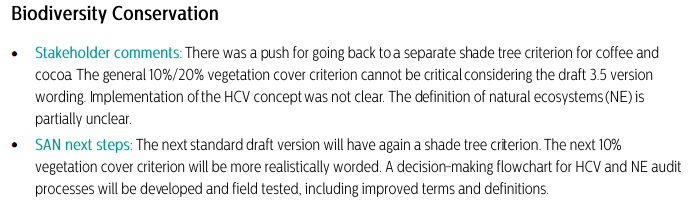
The studies themselves are interesting. However, they may be largely irrelevant to our understanding of the effectiveness and impact of RA certification for biodiversity measures going forward. That’s because the farms were certified under the current standard, and the new standard that is to be published in July is likely to be weaker when it comes to tree and shade requirements. You can read about the relaxing of these criteria over the years at this post, and the even more lax criteria that were proposed for the new standard here.
So we must take the reports of positive impacts of the stricter current standards with a grain of salt, in light of the changes ahead. This is even more important considering that many of the impacts (on biodiversity-related issues) were modest.
For example, the report noted that one study1 found certified farms had higher tree species diversity than the non-certified farms. The difference was a median of nine species versus six species. These are very low numbers. The standard calls for at least 12 native tree species per hectare for certified farms, so there are either certified farms in this sample that are not meeting that criteria, or there is error in the farmer reporting. Further, another study2 mentioned in the impacts report recommended the criteria should be changed to require at least 10 more native tree species per hectare than the local baseline of highly disturbed areas, since even technified “sun” coffee farms had 35 tree species.
Two other factors dilute the usefulness of using the studies to evalute impacts. First are small sample sizes — both the number of studies and the number of farms within the studies. Second, the time periods covered by the studies are too short to adequately track significant ecological change. The authors of one study3 explictly point out both shortcomings, even though they looked at a period of 9 years.
There are other examples, but given those caveats, I won’t discuss them further. What I will point out is that these studies may hint at the real reason why RA/SAN proposed weakening some of their criteria.
Low hanging fruit
RA has been certifying coffee farms for over 10 years now. The first adopters of certification schemes are usually the farms that already meet all or most of the requirements for certification.
Studies provided in the impact reports verify this. One1 used used farmer surveys and interviews, and noted that more certified farmers protected streambanks with vegetation than farmers that were not certified. However, 70% of the former already did so before certification; this scenario was described for other issues. In another study3, the authors stated ”the first cycle of certified farms consisted of those that already had a commitment to environmental and social issues.”
In these cases, it is difficult to attribute positive results on certified farms with the actual certification requirements, as the conditions may have been pre-existing (this is known as self-selection bias). Remaining uncertified farms may not have the resources to invest in the changes that need to occur before they can qualify for certification4. If RA has now certified a large proportion of farms that already met or found it easy to meet their standard, the way to continue the growth of the program may be to lower the requirements.
Parting thoughts
RA has stressed that they believe it is important to bring more producers under the tent of sustainability. I would like to see RA work toward helping their producers reach 100% compliance of all their criteria, rather than having many more farms meet weaker criteria. There are already certifications that fill that role: 4C compliance, followed by UTZ certification. They are the foundations for ethically-acceptable and sustainable coffee production. In other words, the dilution of RA criteria brings them closer to other coffee certification programs with broader and/or weaker standards. Rainforest Alliance should be the next, higher rung in that ladder (which for biodiversity, Smithsonian Bird-Friendly is the top). I don’t see how this homegenization of standards and “race to the bottom” offers any incentive for serious improvements to exceptional ecological sustainability. Nor do multiple certifications with very similar requirements provide sufficient differentiation in the market to merit higher interest (or prices) from buyers.
More on impact assessments
In these two posts, I have only touched on a couple of the most relevant highlights. I encourage a critical read of the impacts report. It contains a wealth of data and does outline many positive impacts of RA certification, as well as areas that need improvement. I’ll be referring to it in the future, especially when the new version of the SAN/RA standard is published.
As both an ecologist and long-time freelance science writer, I know how difficult it can be to interpret and summarize scientific analyses for public use, and the Rainforest Alliance impacts report is a fine effort. The last decade has seen a proliferation of certification schemes of all types, and there has been a growing effort to develop accurate, efficient, standardized means of assessing their impacts. If you are interested in learning more, here are some resources:
- Certification and Biodiversity: Exploring improvements in the effectiveness of certification schemes on biodiversity. KPMG, 2012.
- Assessing the Ecological Impacts of Agricultural Eco-Certification and Standards, a Global Review of the Science and Practice. EcoAgricultural Partners, 2012.
- The COSA Measuring Sustainability Report, Coffee and Cocoa in 12 Countries. Committee on Sustainability Assessment, 2013.
- ISEAL Alliance Impacts Code of Good Practice for Assessing the Impacts of Social and Environmental Standards Systems, 2014.
————————
1Rueda X, Lambin EF. 2013. Responding to globalization: impacts of certification on Colombian small-scale coffee growers. Ecology and Society 18(3):21.
2Komar O. 2012. Are Rainforest Alliance Certified coffee plantations bird-friendly? Final technical report for UNDP/RA/GEF Biodiversity Conservation in Coffee Project. Available from http://www.rainforest-alliance.org/publications/komar-bird-study.
3Hardt E, Borgomeo E, dos Santos RF, Pinto LF, Metzger JP, Sparovek G. 2015. Does certification improve biodiversity conservation in Brazilian coffee farms? Forest Ecology and Management 357: 181—194.
4TechnoServe. 2014. Colombia: A business case for sustainable coffee production (PDF). A report for the Sustainable Coffee Program. 18 pp.