Know Your Coffee Birds: Red Siskin

Male Red Siskin. Photo by Linda De Volder under a Creative Commons license.
Here’s a entry in the occasional Know Your Coffee Bird series, which profiles birds that utilize shade coffee farms. This post is about a species people might not immediately connect with coffee. It is a finch, related to more familiar goldfinches (both American and European), and like them primarily eats seeds and favors a variety of open or semi-open habitats. This is in contrast to the insect- and fruit-eating birds inhabiting tropical forests that we tend to associate with coffee farms. Let’s talk about the endangered Red Siskin (Spinus [formerly Carduelis] cucullatus).
The Red Siskin never had a large range, being primarily found along the northern coast of Venezuela, just edging into Colombia. Once common, populations are now critically fragmented across this area and it is estimated that somewhere between 1500 to 7000 birds (at best) remain in the wild; this includes a relatively recent location found in Guyana. Red Siskins are considered so iconic in Venezuela that they are depicted on the country’s currency. Streets, a park, and even the country’s Little League team is named for them (“cardenalito” in Spanish).
Habitat loss has played a role in the decline of the Red Siskin, but unsustainable trapping for the cage bird trade is a major reason for the near-disappearance of this species. Males are prized for their bright coloration (females are duller) and their ability to mate with the common canary, introducing their red coloration to future generations of canaries. Because Red Siskins can be harder to raise in captivity, wild birds are continually captured to maintain the red genes in canaries — which is actually unnecessary from a genetic standpoint. Although trapping in Venezuela has been illegal for decades, the increasing rarity of these birds, the poverty-inducing economic crisis and political upheaval in Venezuela combine to make illegal trade in the birds lucrative for both greedy poachers and desperate citizens.
 In 2015, the Red Siskin Initiative was established among many partner organizations to address the precipitous declines. Strategies include research, captive colonies with the aim to breed siskins for reintroduction, reducing overexploitation, and public education. An important component of this initiative is habitat preservation and income security through coffee farming.
Venezuela once had a thriving coffee industry which was eclipsed by the oil economy and grew out of favor due to government price controls that make coffee farming unprofitable and unsustainable. However, Bird-Friendly coffee certification (which requires organic certification) qualifies the coffee as gourmet, exempt from the price controls, and allows it to be sold at a premium. In addition to organic farming methods, Bird-Friendly certification has requirements regarding shade cover and composition, native tree diversity, and other criteria that provide habitat for birds, including Red Siskins. Partners also provide technical assistance and help producers with capacity-building.
In 2019, nearly 40 farms occupying 165 ha, members of the AsociaciÁ³n Civil de Productores Agroforestales—Piedra de Cachimbo y Florida (ACAFLO), obtained organic certification, with 13 also gaining Bird-Friendly certification. The goal is to expand the certified production area to 400 ha by the end of 2021. Venezuela exports little or no coffee these days, and the situation is dire there. I really hope for the success of this project, and look forward to being able to purchase this coffee to support this great conservation initiative. The establishment of Bird-Friendly certified coffee farms will provide a sustainable livelihood for farmers and preserve habitat for Red Siskins and many other bird and wildlife species.

Pair of Red Siskins. From a plate in Bird Notes, scanned by the Biodiversity Heritage Library.
More reading:
- Saving Red Gold: The International Effort to Rescue Red Siskins (American Bird Conservancy)
- Coffee and Chocolate Could Help Preserve Endangered Birds in Venezuela (Smithsonian Magazine)
- The Red Canary (Tim Birkhead)
- Venezuela: Coffee Annual (2020, USDA)
- From Red Siskin Science, New Paths and Opportunities in Guyana (Smithsonian)


 A new species of orchid, Teagueia puroana, was discovered in central Ecuador in the eastern Andes, and named for the Puro Coffee company.
 More on the coffee
 The Organic blend was everybody’s favorite. Two adjectives were mentioned by nearly all reviewers: “smooth” and “milk chocolate.” Soft and creamy also came up. Personally, I usually don’t like Peruvian coffees too much, because the
  We approached the Noble with some trepidation due to its robusta content. We were all surprised we could not detect any hint of rubbery, chemical flavor familiar to us from other robusta offerings we’ve tried, and least when the coffee was fresh and hot. The flavor deteriorated a little bit as it cooled. Overall, we found it very similar to the Organic blend, just not as bright. This lack of some liveliness and the flavor change when cool dipped the score to 3 motmots.
 Upping the robusta content to 50% was clearly the tipping point for us, as nobody was really enthusiastic about the Fuerte blend. I’m really not sure exactly what was going on here, as some of the flavors our more experienced tasters were finding seemed beyond the usual bold, rubbery type of flavor that is a more normal characteristic of robustas. In a French press in particular, it seemed dirty and oddly astringent, with a most peculiar flavor/aroma that reminded me of rubbing alcohol. Not sure what might have caused this. Medicinal flavors can come from over-fermented beans; perhaps this batch may have had some bad beans in it, as it seemed at odds with what must be a really well-processed robusta from the CDI Bwanmanda group in Congo. Some grocery-store-coffee drinkers we dragged into this panel didn’t really detect these flavors; perhaps it might also be more suitable for an espresso prep than a drip. This blend ended up with 2 motmots.
 I have yet to meet someone who has seen an American Redstart (Setophaga ruticilla) who was not charmed by this bright, energetic little bird. Redstarts are warblers, but like many New World birds bear the name of similar-appearing (though unrelated) Old World birds. In this case, the original redstarts are flycatchers that often have patterns in black and red. Likewise, male American Redstarts that are at least two years old are jet black and vivid orange. Younger males and female American Redstarts are gray and salmon or yellow, but no less beautiful.
 In winter, redstarts can be found in a variety of forested habitats. They are particularly well-studied in the West Indies, where they are
  The Ovenbird (Seiurus aurocapillus) is often heard before it is seen, a loud ringing “tea-cher, TEA-cher, TEA-CHER!” broadcast from close to the forest floor through much of the
  On their North American breeding grounds, Ovenbirds need large forests to breed in, and habitat loss and fragmentation has taken its toll. Even in large forests in northern regions, declines in reproductive success are tied to, believe it or not, earthworms.

 Many birders have a “spark bird,” a species that captured their attention and inspired lifelong interest in birds. For me, it was the

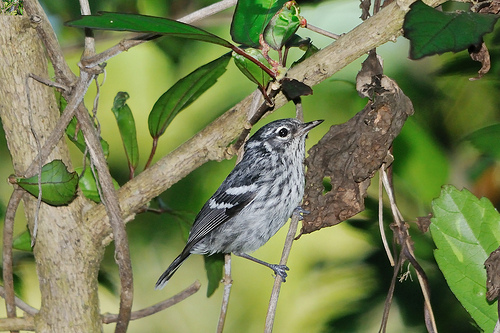
 This study looked at the most important bird species preying on the borers, the Black-throated Blue Warbler. This species
  Finca La Bella is a group of 24 independently owned small farms that grow coffee under a high diversity of shade (


 The tiny, bright yellow bird that
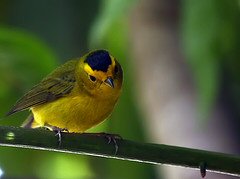 While many bird species tend to be somewhat set in their behavior at certain times of the year, wintering Wilson’s Warblers may be solitary, either roaming through a locality or forming a territory, or found in mixed flocks of other birds. In addition to insects and some fruit, nectar is also consumed in winter. This flexibility in habitat requirements, behavior, and food resources has no doubt contributed to the success of Wilson’s Warblers, which remain one of our most common warblers. Yet recent population trends indicate numbers have declined 2% a year in the U.S., and over 4% a year in the eastern U.S. in recent decades. This is a well-studied species, but we need to know more to understand how to best conserve them. Unfortunately, we often neglect to take action with common species until serious problems are evident.