October 2006

Roast Magazine Roaster of the Year 2006

Roast Magazine has just announced the winners of their 3rd annual Roaster of the Year Award.

Macro Category
Winner: Intelligentsia (Chicago).  It’s hard to say too many good things about Intelly’s commitment to great coffee, from the farm to the cup.  Read this super article about green coffee buyer Geoff Watts, and this note from Geoff regarding Fair Trade and Direct Trade.
Runners-Up: Coffee Bean International and Portand Roasting (both Portland, OR)

Micro Category

Winner: Metropolis Coffee (Chicago)
Runners-Up: Cinnamon Bay Coffee (Clearwater, FL), Sacred Grounds (Aracta, CA)

All these roasters offer at least some environmentally-friendly coffees, a great testament that sustainability does not sacrifice quality. Congrats to these roasters.

Coffee growing and climate change

Coffee (Coffea sp.) requires quite specific growing conditions.  It grows in subtropical regions that have distinct wet and dry seasons.  Although plants can live and produce fruit for decades, drought or heat in summer can diminish production and quality.  And while coffee requires a dry period in the spring, heavy rains in this season can disrupt flowering.

This sensitivity to climatic variables means that global climate change is likely to have profound impacts on coffee growing and production.  An upcoming article in the journal Climatic Change (1) modeled what could happen to coffee production in Veracruz, Mexico if observed trends in climate change continue and coffee prices remain steady.  The report concludes that coffee production will not be economically viable in Veracruz by 2020 due to lowered yields and many current areas becoming unsuitable for coffee growing.

Although there is some work being done on breeding coffee varieties that are more heat-resistant, it will do little to prevent losses due to the climatic instability brought on by global warming (droughts and floods, unusual cold spells) or the pests whose ranges will also change as temperatures rise.

Farmers will be left with few choices.  Areas at higher latitudes (which although too cool now to grow coffee will become warmer) could be used. However, most small holders do not have the money or credit to buy property, even if it is available to purchase; most land is already under ownership that is passed down in families.  If land upslope is turned into coffee farms, it means some conversion and clearing of existing forest, and the old coffee farms will be converted to other crops, none of which is likely to be as environmentally friendly as shade coffee.  This means a loss of biodiversity, and the deforestation of new and old coffee farms will exacerbate and accelerate warming trends, since trees help sequester carbon and buffer temperature changes.

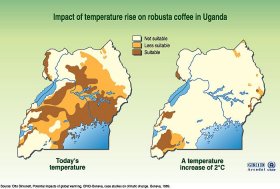
We all have a great deal at stake as the planet warms. Unfortunately, the poor in developing countries, such as coffee growing nations, often bear a large burden.  Even growers of more heat-tolerant lowland robusta coffee, where it is indigenous, stand to lose their livelihoods, as this graphic illustrates.

The authors of the Veracruz report recommend supporting farmers to move into specialty coffee to help to provide some financial security. Purchasing shade coffee and providing incentive for farmers to plant trees rather than cut them down will also help.  As the Fresh Cup article notes,

In the past several decades, roughly half of the world’s coffee plantations have cut down their trees, or cut down forest to plant unshaded coffee. This decreases the ability of vegetation to counteract global warming by absorbing carbon dioxide, and it also raises local temperature.

All the more reason to stay away from corporate technified sun coffee, and enjoy the superior taste of environmentally-friendly coffee.  I’ll be following the research on climate change and coffee, and report further news and suggestions.

(1) Gay, C., F. Estrada, C. Conde, H. Eakin, and l. Villers. 2006. Potential impacts of climate change on agriculture: case study of coffee production in Veracruz, Mexico.  Climate Change 79:259-288.

Starbucks Ethiopia Gemadro Estate: Corporate greenwashing?

The new Black Apron edition coffee from Starbucks, Ethiopia Gemadro Estate, showed up in our local stores within the last few weeks. Despite our generally low opinion of the taste of many Starbucks coffees, C&C is happy to review them if they can be determined to be sustainable and environmentally friendly.  From the description on the web site, the Gemadro Estate selection seemed like a good candidate.  But as always, we research each source carefully, and in this case we found that the reality of this coffee is not exactly what Starbucks has indicated.

From the Starbucks description:

“In this nation of more than more than 300,000 small, family-run coffee farms, the expansive Gemadro Estate stands as an exception. With its pure water supply, near pristine growing environment and dedication to conservation-based farming methods, this 2,300-hectare farm on the banks of the Gemadro River is setting new standards for progressive, sustainable coffee farming.

At the Gemadro estate, high altitude coffee plants flourish in the protective shade of towering 50-foot ferns. With just 1,100 hectares under cultivation, the remaining estate is devoted to a natural, primary forest that supports the local ecosystem.”

According to my research, this is not exactly the case.

  • The plantation was started in 1998, and the Estate web site confirms the Starbucks information: “Between 1998-2001, a total of 1010 ha of the 2295 ha of its holding was planted with coffee. The remaining land is left for preserving the existing natural vegetation.”  Information indicates the site was written in late 2001 or early 2002. Last month an article in the Ethiopian Herald reported a spokesman said the Gemadro project “had developed coffee on 1,000 hectares of land, adding, the project has began activities to develop additional coffee on 1,500 hectares of land.” (Emphasis added.)
  • This results in damage to the ecosystem. A report on coffee growing in the region of the Gemadro farm (1) described how the expansion of coffee and tea plantations requires opening up of forests, thinning of large trees, and clearing of the understory vegetation.  This in turn exacerbates soil erosion and reduces habitat for wildlife. There is an Important Bird Area in this zone, the Bonga Forest, and the central Ethiopian Highlands are considered a biodiversity hotspot.Additionally, these forests are genetic repositories of wild strains of coffee. Another report (2) states that wild coffee strains are being endangered because montane forests are being cleared or thinned for coffee farms (with the Gemadro Estate parent company being specifically mentioned) and this type of intensively managed “forest” coffee replaces wild coffee with nursery-raised plantsNursery-raised coffee is what is planted at Gemadro.
  • Gemadro Estate is owned by the Ethio-Coffee and Tea Plantation and Marketing, PLC, a division of MIDROC Ethiopia, a MIDROC International Group company. MIDROC is a conglomerate that owns gold mines, hotels, construction and real estate companies, multiple oil companies, cement factories, and other interests that are not generally recognized as being environmentally friendly.
  • MIDROC is owned by Ethiopian-born Saudi Sheik Mohammed Hussien Al-Amoudi. I’ve seen some unflattering profiles of him, but even if he’s the cleanest-living guy in the world, his net worth of $6.9 billion doesn’t inspire me to line his pockets with his latest venture.

Gemadro Estate employs 250 regular and 650 seasonal workers, according to an article in African Business. Al-Amoudi’s companies are Ethiopia’s largest employers, and he is well known for his philanthropy.  Aside from the fact that good deeds don’t always come from wholesome organizations, you can benefit more Ethiopian small-holders and the environment by purchasing coffees that are organic, forest grown, and Fair Trade.

Consider the well-known and widely available Oromia Co-op, with over 23,000 members.  A number of other co-ops are listed at the  Sidama Coffee Farmers Cooperative Union site, which indicates which are organic and Fair Trade.  Novo Coffee has a great selection of Ethiopian coffees, including wild Kaffa forest coffee, and we will be reviewing some of their great alternatives soon.

I don’t hate Starbucks.  They have introduced the public to something akin to specialty coffee, and raised awareness to regular consumers that there is something beyond grocery store slop.  But whereas they have offered some Fair Trade or organic products, this Black Apron selection sounds like a corporate conglomerate sell-out, and calling it sustainable, or saying that it is preserving habitat, is misleading.

UPDATE: See this post for a follow up investigative report.

1. Vlek, P.L.G., ed. 2005. Forest conversion – soil degradation – farmers’ perception nexus: Implications for sustainable land use in the southwest of Ethiopia. Ecology and Development Series No. 26, Cuvillier Verlag GÁttingen, 169 pp.

2. Richerzhagen, C. and D. Virchow.  2002. Sustainable Utilization of Crop Genetic Diversity through Property Rights Mechanisms? The Case of Coffee Genetic Resources in Ethiopia. BioEcon Workshop, 24 pp. (PDF)

Coffee review: Panama Finca Hartmann

Plainspoken Coffee. A Coffee Review for Ordinary People by Ordinary People, #8.

I have been interested in trying coffees from Finca Hartmann since I traveled to Panama a couple of years ago.  Finca Hartmann is in the Chiriqui highlands in the Boquete region, and most of the land is in shade coffee.  It is a popular birding destination, and researchers are welcome (they offer a field station for use) — many associated with the Smithsonian Tropical Research Institute have published papers on research conducted there, some with Hartmann family members as co-authors. Over 280 bird species have been recorded at the finca, and Christmas Bird Counts typically yield around 200 species.  It is an example of a finca with a great deal of concern for preservation of biodiversity that has not been certified shade or organic.  We tried several Finca Hartmann coffees from different roasters.

Paradise Roasters Palo Verde.  This coffee placed sixth in the 2006 Best of Panama competition — the same competition in which the Hacienda la Esmeralda won first prize. There are two “sections” to Finca Hartmann, and Palo Verde is the smaller, southernmost one on the property. This was a medium roast, with no oil on the beans.  I detected some sort of very sweet, fruity aroma in the beans that I found really nice.

As is typical, we tried this in the French press, Aeropress, and as a brew. Something had to have gone awry in the press, because it was pretty bad.  It fared better as an Americano from the Aeropress, and as a brew, where it was a nice, smooth, sweet, classic coffee, with a hint of chocolate.  In general, nobody was overwhelmed by it.  It was variously described as “unspectacular,” “not a lot of depth,” and one taster said, “I’m not moved by it.” I think I’m beginning to foster snobs.  2 motmots. Also available green, for which there is a review at Coffee Cuppers.

Mayorga Coffee Roasters Hartmann Estate.  This coffee was billed as a medium roast, but was leaning much darker than the Paradise Roaster selection, with all beans showing quite a bit of oil.  The coffee beans were quite fragrant, and the coffee itself fresh from the French press had a slightly fruity fragrance — a couple tasters suggested cherries.  This was a very well-balanced, smooth cup, without any distinctive characteristics, a classic cup.  “It’s just a good cup of coffee,” Nighthawk suggested.  I think a lighter roast might have coaxed some more interesting aspects out of the bean. 2.5 motmots.

Cafe Pronto Panama Boquete SHB, Hartmann Estate. This coffee was received a mere two days after ordering (truly pronto!), but had been roasted five days prior to ordering.  Thus it was 8 days old when we tried, within it’s fresh period, but perhaps “middle-aged.” Nonetheless, when the water hit it in the French Press, it produced a moderate amount of bloom, and was the hands-down winner of the three.

It was also a medium roast, with some beans showing a bit of oil.  The beans, both whole and ground, were very fragrant, sort of spicy, one of the most appealing aromas we’ve had from a Central American bean so far.  Very hot, the coffee delivered a juicy, almost mouth-watering first few sips.  It stayed just as good as it cooled, medium-bodied, with a very soft mouthfeel.  I wasn’t sure what to think when I saw this descriptor from the roaster, but it is certainly an apt adjective. Brewed, it was also tasty, but lacked some of the pleasant subtleties found when prepared in a press pot.

We could call this coffee well-balanced, but “harmonious” might be a better description.  As in many “classic” coffees, there were not a lot of flavors that jumped out.  Yet it stood out from the other Finca Hartmann’s.  Let’s call this a Classic ++ rated at 3.75  (nearly 4) motmots.
Yuban ad campaign

As I was perusing a magazine, I came across an ad for Yuban coffee with the headline “The coffee you make can make a difference.”  It showed their coffee cans, emblazoned with the Rainforest Alliance seal and a banner saying “Conserving the environment & supporting coffee farmers.  Minimum 30% Rainforest Alliance Certified Coffee.”

Let’s examine. Who are we dealing with? Yuban is a Maxwell House brand, which in turn is owned by Kraft Foods. (More on which corporations own which brands here.)

How big a deal is it that Kraft is buying RA beans? While Kraft will purchase 12,000 tons of RA coffee in 2006, this represents a tiny fraction (I’ve calculated about 1.5%) of Kraft’s coffee bean purchases.

What’s with the 30%? Rainforest Alliance (RA) allows use of their seal on products with a minimum of 30% certified beans (a fact for which they are sometimes criticized).  In order for Kraft to keep their prices so low (suggested retail for a 12-ounce can of RA-bean-containing Yuban is $3.89; a 13-ounce can of Maxwell House is $2.56), the other two-thirds of the beans in the can must be lower quality, likely technified/sun coffee.  I don’t see any other way they can do it.  The cost differential between certified beans and non-certified beans also means that I doubt Yuban will ever contain more RA certified beans than the 30% minimum required for use of the RA seal. (Update: As of January 2013, the Yuban can still indicates 30% certified beans. However, RA is requiring companies to scale up their percentages over time…read more here.)

Does this move really help farmers? While RA certification includes fair labor practices, and RA certified coffee usually commands some premium, the criteria does not set a minimum price paid to farmers. RA certification is cheaper for corporations that Fair Trade certification.  Oxfam is still pressuring Kraft to agree to buy Fair Trade coffee.

RA cannot be faulted for their efforts in promoting and making sustainable coffee available to mainstream consumers.  Nor can they really be criticized for partnering with Kraft, since RA certifies a product, not a company.

Still, it difficult for me to endorse supporting a corporation like Kraft which has a dubious ethical record (Responsible Shopper profile here). And while Kraft deserves some credit, as none of the other Big Coffee companies is making this type of effort, real environmental preservation and fair prices for farmers is far, far better served by purchasing sustainable coffees from small companies and roasters with relationships with their suppliers, especially those that provide information on the specific farms where their beans are sourced.  Plus I guarantee it will taste better!

UPDATE! The January 2007 issue of Coffee Review goes over supermarket coffees, including this coffee, which is “dominated by a cloyingly sweet nut character, the calling card of inexpensive coffees of the robusta species.”  Robusta tastes bad, and is sun coffee.  Very bad!  As for the Yuban Organic brand, that review notes it is recommended for “Those on a budget with a commitment to organic growing principles that transcends the desire to drink decent coffee.”  Please also read the accompanying article or my post about it.

More information: