October 2006

Abstracts on presentations at the NAOC

Here are some very brief summaries of research that had to do with coffee growing that were presented at North American Ornithological Conference. I also put together a page with full abstracts, and author contacts.

  • Cerulean Warbler (Dendroica cerulea) foraging behavior in the western Andes of Colombia. This species (which I’ve written about before) was common in shade coffee plantations, and only fed in the shade canopy.
  • Population ecology of Cerulean Warblers on breeding and wintering grounds. This study concluded that shade coffee farms in the Venezuelan Andes were critical wintering habitat for this species, with density in the farms higher than in the surrounding forest.
  • Coffee certification as an economic incentive for bird conservation. Discusses the shade coffee farms of central Veracruz, Mexico, many shaded by cloud forest tree species.
  • Certification and birds: the importance of shade coffee plantations for species diversity in the Cuetzalan region, Puebla, Mexico. 182 species were recorded in this area, and while not as rich as primary forest, shade coffee still maintains a high diversity of birds.
  • Traditional coffee plantations: suitable habitat in the anthropogenic matrix for Neotropical resident and migratory birds. A study that complements the previous Puebla study, quantifying the different types of birds found in shade coffee.
  • Neotropical insectivorous birds as pest control of the coffee berry borer (Hypothenemus hampei) on Jamaican Blue Mountain coffee farms.  More on Matt Johnson’s work in Jamaica.
  • Birds, shade grown coffee, and community outreach in Ecuador. Self explanatory.
  • Sensitive bird species in shade coffee plantations. In southern Mexico, shade coffee with high levels of structural diversity (many layers of shade trees) may be good for conservation purposes; however, shade coffee may only be important for forest species which are sensitive to deforestation and disturbance when close to intact forest.

Veracruz, Mexico

I am attending the North American Ornithological Conference in Veracruz, Mexico.  Coffee breaks are catered by Consejo Regulador del Cafe Veracruz, the organization that regulates and certifies “Cafe Veracruz” labeled coffee, guaranteeing origin and quality.

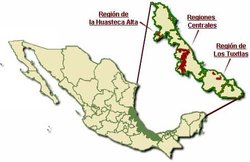
Veracruz state is on the Caribbean coast of Mexico, and is divided into three growing regions, as shown in this map (click to enlarge).

One of the farm requirements is for coffee (arabica only: typical, bourbon, or Mundo Novo) to be shade grown (how much I don’t know).  There are several vendors selling these coffees as well, but so far I’ve only seen ground coffee, and would rather not bring that home for a review.  The coffee we’ve had on breaks has been quite good.  If I do find whole beans, I’ll snap some up for a report.

I’ve seen several posters on coffee and birds, and talked to several people very involved in both research and the certification process.  I will have much more information in the weeks to come as I synthesize what I learn.  More later.

Rainforest Alliance to certify 10% of coffee exports

Rainforest Alliance (RA) received a seven-year, $12 million grant to increase the number of certified farms in six Latin American countries: El Salvador, Guatemala, Honduras, Colombia, Peru, and Brazil. By the project’s end, RA will have certified 10% of the world’s coffee (they currently certify less than 1%).  The grant comes from the Global Environmental Facility, an independent financial organization established in 1990 by the World Bank, the United Nations Environment Program, and the United Nations Development Program. These entities manage projects that benefit the global environment and promote sustainable livelihoods in local communities.

Grant funds will go towards increasing production and demand of RA coffees. On the production side, RA indicates it will “provide farmers with the information and tools necessary to improve their management practices and make them more responsible with regards to the environment, workers and communities.”  Plans for increasing demand include encouraging companies to buy and promote RA certified coffee, and arranging media tours of RA certified farms so that consumers realize “their potential roles in fostering the conservation of habitats and quality of life for millions of third-world workers.”

The press release (PDF) as well as a separate project summary put the emphasis on the marketing side.  Elsewhere, there was mention of a research or monitoring component, noting that the “project also plans to monitor and document the impact of coffee plantations on biodiversity.”

Obviously there is no incentive for farmers to produce coffee which is sustainable (under any certification scheme) without sufficient demand. I think it will be very important for third parties to make sure that consumers are clearly educated about what they are supporting when they purchase RA certified coffee — especially versus other certification programs.