 I have yet to meet someone who has seen an American Redstart (Setophaga ruticilla) who was not charmed by this bright, energetic little bird. Redstarts are warblers, but like many New World birds bear the name of similar-appearing (though unrelated) Old World birds. In this case, the original redstarts are flycatchers that often have patterns in black and red. Likewise, male American Redstarts that are at least two years old are jet black and vivid orange. Younger males and female American Redstarts are gray and salmon or yellow, but no less beautiful.
American Redstarts breed across much of eastern North America and western Canada, and winter in the West Indies, southern Mexico, Central America, and northern South America. Like other warblers, they feed primarily on insects, and may flush them from foliage by spreading and flashing their tails. This has earned them several other names, particularly in the tropics, including candelita (“little candle” or “little flame”) or mariposas (the same word used for butterflies).
In winter, redstarts can be found in a variety of forested habitats. They are particularly well-studied in the West Indies, where they are most often found in mangroves, coastal scrub, and shade coffee. In Jamaica, redstarts have been found to greatly benefit coffee farmers by providing pest control, especially against the hard-to-control coffee berry borer, one of coffee’s most dreaded pests. To reap these benefits, however, farmers needed to provide habitat for the birds, either via shade trees or adjacent forest patches. Another vote for shade-grown coffee!
In the Dominican Republic, redstarts returned annually and stayed put overwinter on shade coffee farms at rates similar to natural forest [1]. Other studies have specifically documented shade coffee use by redstarts in Mexico, Venezuela, and Guatemala; and I have recorded them myself in coffeelands in Panama and Honduras.
A recently published paper [2] presented data on a very rigorous study of wintering migrant birds in Puerto Rico that began in 1973, in which American Redstarts are among the three most common species (the other two are also “coffee birds”: Ovenbird and Black-and-white Warbler). All three species have shown population declines, even though overwinter survivorship has remained the same for the birds that do winter there. The most dramatic declines have occurred over the last decade, but the authors cannot pinpoint an explanation. They concluded with words seldom found in academic publications:
“Given the patterns shown by our data, we now join with those who earlier proclaimed that ‘the sky is falling’ for Neotropical migratory birds, even though we lack a ready explanation for these declines.”
Please see this as a call to action. This is one of many studies that have documented the loss of migratory bird species. These “birds of two worlds” have very complex life cycles, and many things impact their survival. Some of these factors are within our control, and they include habitat loss due to agriculture — such as coffee. You can help by choosing your coffee carefully and being willing to pay more for organic and eco-certified coffee that encourages the preservation of habitat and enhancement of coffee farms with shade trees. Seldom is so simple an individual action apt to lead to such positive results for redstarts, other warblers, and the biodiversity and health of our planet.
See more in the ”Know your coffee birds” series.
Photo of male redstart by Laura Gooch under a Creative Commons license; female redstart banded at the Rouge River Bird Observatory by Julie Craves, all rights reserved.
[1] Wunderle, J and SC Latta. 2000. Winter site fidelity of Nearctic migrants in shade coffee plantations of different sizes in the Dominican Republic. Auk 117:596-614.
[2] Faaborg J, WJ Arendt, J D Toms, KM Dugger, WA Cox and MC Mora. 2013. Long-term decline of a winter-resident bird community in Puerto Rico. Biodiversity and Conservation 22:63-75.
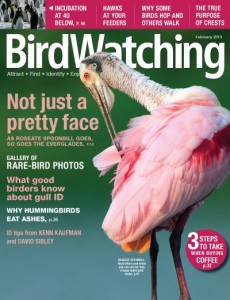 Welcome to BirdWatching Magazine readers who are exploring Coffee & Conservation for the first time after reading my article “The True Cost of Coffee” in the February 2013 issue. There are many ways to find more information on the connection between coffee, birds, and biodiversity here.

 I have yet to meet someone who has seen an American Redstart (Setophaga ruticilla) who was not charmed by this bright, energetic little bird. Redstarts are warblers, but like many New World birds bear the name of similar-appearing (though unrelated) Old World birds. In this case, the original redstarts are flycatchers that often have patterns in black and red. Likewise, male American Redstarts that are at least two years old are jet black and vivid orange. Younger males and female American Redstarts are gray and salmon or yellow, but no less beautiful.
 In winter, redstarts can be found in a variety of forested habitats. They are particularly well-studied in the West Indies, where they are