Starbucks CAFE Practices at Daily Coffee News
 I have written a post at Daily Coffee News providing an overview and fresh update on the coffee sourcing standards of Starbucks, known as the CAFE Practices program. Check it out here.
I have written a post at Daily Coffee News providing an overview and fresh update on the coffee sourcing standards of Starbucks, known as the CAFE Practices program. Check it out here.
It’s no wonder why news about Starbucks prompts such strong reactions in people. Some weeks  there will be an announcement about a really worthwhile initiative, and only a little while later, something sort of repulsive.
The final publication by the recently disbanded Tropical Commodity Coalition was the Coffee Barometer 2012. I have used TCC data to put together summaries (most recent here, just updated with the receipt of the latest report) on how much eco-certified or verified coffee is purchased by the world’s major coffee buyers. While my summary table focuses on buyers of particular importance to U.S. markets, the Coffee Barometer includes all top ten buyers.
Here is what TCC had to say about them. You can refer to my post for information on Nestlé, Kraft, Sara Lee, Smucker, Starbucks, Green Mountain, and Caribou (the last two are U.S. companies I chose to include that are not in the TCC report).
So, of the top ten buyers, seven (Nestlé, Smucker, Sara Lee, Strauss, Lavazza, Aldi, and Segafredo) are essentially ignoring environmental sustainability in their coffee supply chains and buying little, if any, coffee that is produced under meaningful environmental standards. This represents over 1.9 million tons (24% of world production).
Two (Kraft and Tchibo) are making nominal efforts, with 7% and 5% of their coffee supply, respectively, being eco-certified. Their certified purchases combined are less than 60,000 tons (or less than 1% of world production).
Only one of the top 10 buyers, Starbucks, is sourcing a large portion of its coffee under worthwhile eco-standards. In 2010, this was 84% of the 122,000 tons it purchased, with a goal of 100% in the near future. Kudos to the Mermaid.
 Starbucks, through its partner Conservation International, has been assessing the impacts of its CAFE Practices coffee sourcing program. This has included a close look at participating farms and their compliance with the CAFE Practices criteria and their impacts on coffee-growing best practices. The publicly available reports provide an unusually-transparent opportunity to understand a major coffee company’s efforts in ethically and environmentally responsible coffee sourcing.
Starbucks CAFE (Coffee and Farm Equity) Practices is the company’s green coffee sourcing program, started in 2004. The standards were developed in partnership with Conservation International and an independent third-party company, SCS Global Services (SCS). Points are awarded in four categories — product quality, economic accountability, social responsibility, and environmental leadership — to producers that supply Starbucks coffee. Certain criteria are mandatory for all suppliers. Reaching a certain point level confers preferred supplier status, a higher level is awarded strategic supplier status. These suppliers get enhanced pricing and contract terms.
Although CAFE Practices is a proprietary set of sourcing guidelines and not a certification per se, their criteria are available to the public, much like those of various coffee certifications.
Not only do the environmental criteria stack up favorably to some other actual coffee certifications, but Starbucks is on track to source all of its coffee under CAFE Practices by 2015; the 2010 amount was 84% of its coffee, or 103,000 tons.
Criteria met, now what?
Once certification/verification is awarded to a producer under any program, the data available to the public about the scheme is often along the lines of how many farms/hectares are certified, how much certified coffee is sold, and other general information. More in-depth results — most often on the economic benefits to farmers and communities — are typically restricted to academic studies that are often behind pay-walls and thus not readily available to the public. We rarely have an idea of which particular criteria are being met by all/most/some farms, or if the certification is changing the way producers grow coffee. No doubt this is largely due to the sheer logistics of making this information available. Tens of thousands of farms are inspected and evaluated throughout the year by dozens of approved contractors. Analyzing the audit reports, comparing them from year to year, making sense of the results…this task would be monumental and probably require a team of specialists, perhaps adding to the cost of certification. Starbucks is attempting to gather this material, and has been publishing reports on the results.
CAFE Practices assessment reports
Starbucks and Conservation International (CI) have been releasing reports assessing the CAFE Practices program to see how it is impacting best-practices at the producer level and how the program could be improved. The first report, “Assessment of the Coffee and Farmer Equity (C.A.F.E.) Practices Program for FY08 is 143 pages and was released in March 2011. It covered 2008, the first year farm-level data could be sufficiently collected and analyzed. Two 30+ page reports focused on producers in Guatemala and Colombia.
 Research, analysis, and reporting were performed by CI and, in the case of the regional reports, local partners. The reports follow a format similar to what is found in peer-reviewed scientific literature. Methods included analyzing farm verification reports submitted by approved third-party auditors (the “scorecards”), and (for the latter two reports) surveying both participating and non-participating farmers. The reports summarized information on participating farms, how farms (and mills) complied with various key social and environmental criteria, and made recommendations on how CAFE Practices might be improved. Results were broken down in various ways, including farm size and geographic area.
I saw a clear progression in the refinement of methodology and results reporting as these reports were produced. I was very impressed with the level of detail and consideration that went into developing the methods. The introductory material, and identification and description of local Important Bird Areas and priority flora and fauna in the two regional reports was accurate and demonstrated a level of understanding of biodiversity beyond the general concepts often bandied about by certification schemes. The quality of the most recent (Colombia) report was better than a lot of consulting, academic, and scientific reports I’ve read over the years.
What has Starbucks accomplished through CAFE Practices?
The sheer volume and detail of data in these reports is too much to go into here. Each report handled analysis a little differently, so it is hard to make general statements on many of the results. Here, I’d like to pull out some noteworthy facts, with an emphasis on environmental data. Overall data is for FY 2008 (the subject of the first report). Survey data from Guatemala is from 2009, Colombia from 2011. Note that CAFE Practices has slightly different criteria for small (<12 ha) farms than for medium (12-49 ha) and large (>50 ha) farms.
The assessment concluded that lower compliance in some areas meant that some criteria were not well understood, that farmers did not have the resources to improve their methods, and/or that the CAFE Practices criteria were insufficient to encourage or even evaluate some practices. Some recommendations included:
It was also determined that certain questions needed to be added or clarified when surveying farmers to better assess particular conditions and resources. Based on the evolution of the reports, I expect those in the future will be more standardized and clearer, and I hope there will be some sort of easily digestible summary one day.
Conclusions
The compliance numbers for most eco-criteria seemed fairly strong to me, especially given the very high numbers and variety of participating farms. In general, most Starbucks suppliers seem to grow coffee in a fairly responsible manner compared to nearby non-participants in the sampled countries. The reports indicate a trend toward improved farm management among participants, in part because of their participation.
Most coffee certification criteria don’t span quite the diversity or record the level of data that are covered in CAFE Practices, nor have I seen similar analyses performed for other sets of standards. Thus, we don’t have anything to compare to these results. The fact that CI, a partner in development of the criteria, identified weaknesses and areas that needed improvement struck me as very positive. While this component obviously should be included in this kind of assessment, it’s not something the public sees very often. Of course, it’s an invitation to for us to see how Starbucks acts on the recommendations, and I know I will be keeping my eyes open.
Starbucks’ goal with CAFE Practices is to drive long-term sustainability of their coffee supply through improvements in environmental conditions and socio-economic status of producers. This is a business decision on the part of Starbucks. While good stewardship of the earth may be part of it, the company doesn’t pretend it launched this initiative out of altruism. While other big coffee companies trumpet their empty sustainability claims, Starbucks releases these reports with a minimum of flag-waving and, from what I’ve seen, no attempt at greenwashing.
I think what Starbucks is doing with CAFE Practices is enormously important. They’ve shown that sustainability can be a good business decision and that ethical sourcing need not be achieved at the expense of profits. Rather than taking what may have been an easy road of obtaining coffee certified under less stringent conditions, they have made a serious effort to develop measurable standards to meet their needs, and committed to sourcing all their coffee under these guidelines. They implemented tools to examine their effectiveness and impact, and have been surprisingly transparent in presenting the results to the public. Whether you like their coffee or not, Starbucks deserves a great deal of credit for their approach to coffee sourcing.
Starbucks cups courtesy of Starbucks Coffee; coffee cherry photo by Neil Palmer/CIAT under a Creative Commons license.
Late last month, Starbucks announced they will be offering four “Blonde” roast coffees beginning in January 2012. This comes after many years of complaints from consumers that the company roasted all their beans too dark, hence the often-heard “Charbucks” moniker. The lighter roasts will be two new regular coffees, Starbucks Veranda Blend (using Latin American beans) and Starbucks Willow Blend (Latin America and East Africa), a decaf (Decaf Starbucks Willow Blend), and an instant (Starbucks VIA Ready Brew Veranda Blend).
 Rumor has it that four of their current offerings will be replaced by the new coffees. They are the Fair Trade certified Café Estima Blend, the decaf Café Verona, the decaf House Blend, and the Organic Shade Grown Mexico. In response to my specific inquiry, I have confirmation from Starbucks that the latter will indeed be discontinued.
We reviewed the Organic Shade Grown Mexico here awhile back, and provided a lot of background information. In a nutshell, this coffee was sourced from farmers in Chiapas in the buffer zone of the El Triunfo Biosphere Reserve. The sourcing of coffee from this area was done in partnership with Conservation International, and lead to the development of Starbucks’ green coffee sourcing standards program, known as CAFE [Coffee and Farm Equity] Practices. The Starbucks/Conservation International partnership began in 1998, continued for years with substantial reinvestments by Starbucks, being known as the Conservation Coffee program.
Starbucks just recently renewed the partnership for two years and $3 million, with a focus on climate change. The renewal will mark the beginning of work in Brazil, and expand on programs in Sumatra and Chiapas. However, I was unable to get a direct answer from Starbucks on whether or not they will still be providing an organic, shade-grown Mexico coffee as a seasonal offering, whether it will be used in one of the new Blonde blends, or in some other blend.
With the advent of the Conservation International partnership and the development of their CAFE Practices, Starbucks imposed quality standards on the Chiapas cooperatives supplying this coffee. While it supplied significant benefits to the co-ops initially, many objected to the requirements and quit selling some or all of their coffee to Starbucks once their own capacity and abilities improved. These included CESMACH (Ecological Farmers of the Sierra Madres of Chiapas), Organizacion de Productores Cafetaleros de Ángel Albino Corzo (OPCAAC), Finca Triunfo Verde Sociedad Civil, and Organizacion Regional de Productores Agroecologicos (ORPAE). At least one source [1] indicates that many of the suppliers to Starbucks in this area of Chiapas are small producers that do not belong to cooperatives. Perhaps there is not enough volume to support a quasi-single-origin coffee from this region any longer.
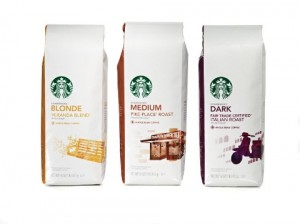 In any event, the Blonde roast roll out will coincide with an overhaul of coffee packaging/branding at Starbucks to emphasize the three roast levels (with the lightest being Blonde, which is still roasted to second crack) rather than origin, and that may also play a role in the discontinuation of this coffee.
I have generally recommended the Organic Shade Grown Mexico to friends who are Starbucks customers looking for their most eco-friendly offering. While I generally believe that the Starbucks CAFE Practices environmental standards, which apply to nearly all their coffees, are quite strong and relevant, I’ll have to reassess to come up with a specific recommendation once the Mexico disappears from shelves.
Renard, M.-C. 2010. In the name of conservation: CAFE Practices and Fair Trade in Mexico. Journal of Business Ethics 92:287-299.
 Some recent news from/about the Mermaid.
I have provided information on the five major certifications applied to coffee: organic, Fair Trade, Smithsonian Bird-Friendly, Rainforest Alliance, and Utz Certified.
Starbucks does sell certified organic and Fair Trade coffees. You can see how much coffee they (and other major companies) purchase and how much is eco-certified in this data table, which is kept updated.

Starbucks also has its own green coffee sourcing standard, known as CAFE (Coffee and Farm Equity) Practices. It was developed in partnership with the non-profit environmental group Conservation International and SCS Global Services. (SCS), an independent evaluation and verification company. The CAFE Practices program covers four categories. Two, product quality and economic accountability, are criteria that are required by all Starbucks suppliers. The other two categories are social responsibility and environmental leadership. I’ll focus on the environmental criteria.
How it works
Like some other certifications, CAFE Practices operates on a point system. The social responsibility and environmental leadership categories are divided into sections. A least 60% of possible points are needed for preferred supplier status, and 80% for strategic supplier status. These suppliers get enhanced pricing and contract terms. [Update: the average score was 80%, and 60% of supplies were preferred or strategic; these data were for all new and renewing farms in the year 2012.]
A point is awarded for compliance with individual “indicators.” In the current version, there are 185 total indicators for large suppliers (greater than 12 ha) and 124 for smallholders, including those who are part of a cooperative.
In the section “Coffee Growing — Environmental Leadership” 45 points are possible (42 for smallholders). Many of the individual indicators are actually multiple variations on the same criteria; only one of them can be counted for a point. For instance, the indicators dealing with organic mulch award a point for either 25% of the production area being covered by organic matter, 50%, or 100% — three indicators but only one point possible.

What kinds of environmental criteria are included?
The “Coffee Growing — Environmental Leadership” section covers water body protection, including criteria for width and type of vegetated buffer zones along permanent and seasonal water bodies, and use of chemicals or waste storage near water bodies; protection of soil resources, including measures to control and prevent erosion and use of organic mulches and cover crops; conserving biodiversity, including maintaining a shade canopy, protecting wildlife, and establishment of conservation areas; and environmental management, including pest and disease control.
There is an additional section that deals with environmental issues having to do with coffee processing, specific to either wet processing or dry processing, which includes indicators on water conservation, waste management, and energy use.
A closer look at Conserving Biodiversity
This particular subsection has three indicators that are mandatory: 1) native trees are only removed if they are a hazard to people or “significantly” compete with coffee plants, 2) hunting or commercial collecting of flora or fauna is prohibited, and 3) no conversion of natural forest to agricultural production.
Indicators specific to maintaining shade cover include percent cover, canopy tree diversity and native species benchmarks, and preservation of epiphytes and vines.
How does this stack up?
The Starbucks CAFE Practices environmental criteria address many more relevant ecological issues than either Fair Trade certification standards or UTZ Certified Good Inside standards. Although there is some lack of specificity (e.g., what constitutes native trees being in “significant” competition with coffee plants?), they are far less generic and more comprehensive than Fair Trade or UTZ standards. While the large number of indicators from which to garner points seems to make it easy for suppliers to attain favored status, I think that their division into sections and subsections covering a wide range of ecological issues is more valuable and should result in more eco-friendly farms than fewer, weaker, or more vague “requirements.”
To compare Starbucks CAFE Practices environmental criteria with those of Rainforest Alliance would probably take sitting down and mock-scoring some imaginary farms. I suspect that a farm meeting Rainforest Alliance’s minimum environmental standards would turn out to be using more sustainable growing methods than the typical Starbucks preferred supplier — although a lack of standardization among the standards might make that assessment difficult (Rainforest Alliance uses 99 criteria in 10 principals, with percentage thresholds for certification). It also wouldn’t surprise me that a Starbucks strategic supplier that scored highly in the Environmental Leadership sections could beat out a Rainforest Alliance-certified farm.
Because the Smithsonian Bird-Friendly biodiversity criteria are so well-developed and targeted, and since their certification also requires organic certification, their environmental standards are the strongest.
Overall, I’m generally impressed with the scope and level of detail of Starbucks CAFE Practices environmental standards, and find them superior to those of some highly-regarded certifications.
Criticisms and more resources
There have been accusations that the reality on the ground with some Starbucks suppliers is inconsistent with CAFE Practices standards. In some cases at least, that is true, but it is also true with other certifications; Starbucks tends to receive a lot of scrutiny. Third party verification systems are subject to the same corruption and deceit whether they are certifying organic products or Starbucks coffee. There are plenty of places where compliance can break down, and that’s the topic of a separate investigation.
To examine all of the Starbucks CAFE Practices criteria yourself, download the standards documents which are available online at the SCS web site. You can also download current and past Global Responsibility reports at the Starbucks website.
Updates:
Starbucks coffee cup by Rudolf Schuba under a Creative Commons license.
Some recent sustainability-related news regarding Starbucks:
 Starbucks has a new Conservation International-branded loyalty card. Every time a customer uses a CI Starbucks card from now through the end of 2010, five cents will go to Conservation International for forest preservation. Starbucks cards are re-loadable cards used for purchases at their stores; registered cards earn rewards. These cards are only available in U.S. stores, but I presume that, like other cards, can be used at any store worldwide.Conservation International has been partnered with Starbucks for over a decade. They worked together to develop Starbucks’ Coffee and Farmer Equity (C.A.F.E.) Practices coffee sourcing guidelines and created a funding mechanism to address climate change in coffee growing regions. You can read more about their project that led to Starbucks Organic Shade Grown Mexico coffee variety here. CI’s Charity Navigator profile here.
 A Starbucks store in France won a sustainable retail design award. This store was the first international store that went for LEED-certification, indicating building sustainability. The company plans to have all its new stores LEED-certified. It also has a LEED-certified roasting facility, and the Starbucks headquarters in Seattle is the oldest and largest building to get LEED certification.
Starbucks cup photo by Josh Semans under a Creative Commons License.
Last year, Counter Culture Coffee launched its Direct Trade program. They also started rolling out their current line of packaging: brown kraft-like valve bags with a sleeve that has nice origin-appropriate art, a map on one side panel showing the source, tasting notes on the other side, and a good description of the farm or co-op on the back. I believe they won an award at a coffee trade show for this labeling.

This year, Starbucks debuted “seasonal coffees.” These coffees are only available for a limited time, and are “harvested in-season when they are at their peak of flavor.” I’m not sure what Starbucks is really trying to say, since all coffee is harvested “in season.” Coffee is at its peak flavor when it is fresh — when the green beans have not been sitting around for ages, and when it is freshly roasted. Maybe these seasonal coffees are not as stale as the Starbucks coffee often found on store shelves. But I digress.
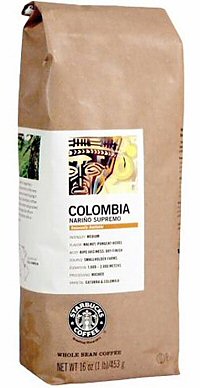
What I really wanted to point out was that the packaging for the new Starbucks seasonal coffee line looks very familiar. A brown (non-valve) bag, with a printed wrap-around-look label with art on the front and tasting notes and a map on the side… You get the picture. If not, here you go:
Plainspoken Coffee. A Coffee Review for Ordinary People by Ordinary People, #41.
Starbucks Organic Shade Grown Mexicois produced by around 900 small farmers on 3200 ha of land in the southern Mexican state of Chiapas [1]. Many of the farms are near or adjacent to the El Triunfo Biosphere Reserve, which contains the northernmost cloud forests in the world and is considered as one of the greatest biodiversity sites of North America. El Triunfo totals 119,000 ha, of which 93,458 ha corresponds to a buffer zone and the rest to the core areas. Core areas are primary forest owned by the government. The buffer zone consists of privately owned lands, about 60% of which are forested. The remainder is agricultural, with shade coffee being the dominant crop; up to 70% is rustic shade.
Originally this coffee was to be a temporary offering, but proved so popular that it is on the permanent Starbucks menu.
 Background
This coffee-sourcing is part of a partnership with Conservation International (CI) which began in 1998. Originally, this was to be a three-year program with CI providing technical assistance to producers encouraging them to continue eco-friendly growing practices, and Starbucks as a dependable buyer. This partnership has continued with some new wrinkles, including the development of Starbucks C.A.F.E. practices.
This project has not been without controversy. One main gripe has been that the contracts with Starbucks paid above-market prices, but the beans went through the large exporter and processor Agroindustrias de Mexico (AMSA), which took a cut of the price. This doesn’t seem like an unusual arrangement and perhaps the only practical one with between a large buyer and dozens of cooperatives. At some point Starbucks did try to deal directly with producers, but the cooperatives were unable to arrange shipment.
Some of the co-ops withdrew from participation. Various reasons have been given. According to CI’s report to USAID [1], when the world price of coffee rose above the price already agreed to in the contracts, producers reneged and sold to other buyers (a not too-uncommon occurrence). Some felt that, after a long struggle for autonomy, that they were once again beholden to middlemen [2]. CI apparently negotiated many of the initial contracts, and some producers later regretted signing when they found out Starbucks was the end buyer (was that not in the contracts?). There were also objections to quality demands being imposed on them.
Nonetheless, the arrangement with Starbucks did and has increased income for many of the farmers. One co-op mentioned as a participant in a New York Times article was identified by a Fair Trade advocate as being organizationally weak, not well suited to judging the quality of their own beans, and unable to seek out other buyers. If that’s the case, this co-op may not be qualified for Fair Trade certification, and therefore Starbucks might be the best option for them, at least at this time.
While there is a lack of publicly available objective information on the outcomes of the Chiapas coffee project, from what I have read it has had an overall positive net impact. Encouraging and promoting organic and shade-grown coffee is a major goal of El Triunfo conservation efforts. At least for some period of time, cooperatives that withdrew from the CI/Starbucks program had a hard time finding buyers, especially those that would pay high prices and invest in their communities. If Starbucks is purchasing an average of 1.7 million pounds of coffee from this area every year, this is likely a good thing, especially if these producers do not have other options for selling their beans.
Finally, we need to bear in mind that this is a certified organic coffee, but it does not have shade certification by Smithsonian or Rainforest Alliance. As mentioned above, however, the coffee grown in this area, especially in the El Triunfo buffer zone, is traditionally grown in the shade, often diverse shade.
Let’s move on to the coffee
Starbucks Organic Shade Grown Mexico is billed as a medium roast. For a company known to over-do the roasting, I was surprised to see that “medium” was actually “medium.” I think good Mexican coffees are delicate and sweet and should be roasted light, but I suppose medium was a good compromise to cater to the tastes of Starbucks customers. I was also surprised to see that in a French press, this coffee was fresh enough to have a decent bloom.
This coffee was what we expected from a Mexican coffee: pleasant, approachable, smooth, and well-balanced. It was fairly sweet with hints of chocolate; a couple people thought that rather than milk chocolate it was a more bittersweet dark chocolate, perhaps due to the roast. One person tasted cinnamon. Overall, comments were quite positive. A few people with known  anti-Starbucks sentiments were grudgingly impressed. This is a decent coffee that most people should find more than acceptable. When the votes were tallied, it came away with a solid 3 motmots.
Because of its size, Starbucks falls victim to its own success. Providing a consistent product at such large volumes inevitably means lower quality, buying through exporters (and thus lower prices for producers) and an inability to truly police the growing methods of thousands of farmers. Still, I can think of few other offerings by any of the big roasters that are as positive for the environment as the Starbucks Organic Shade Grown Mexico. It sure beats Kraft’s 30% Rainforest Alliance certified (and 70% mystery-sourced) Yuban, and tastes better to boot.
[1] Conservation International and Starbucks Coffee Company. 2007. The Conservation Coffee Alliance. USAID Contract # 596-A-00-04-00039-00, Annual and Final Report 2004-2007.
[2] Gonzalez, A. A. and R. Nigh. 2004. Smallholder participation and certification of organic farm products in Mexico. Journal of Rural Studies 21:449-460.
 I’ve just finished Starbucked: A Double Tall Tale of Caffeine, Commerce, and Culture by Taylor Clark, just released by Little Brown. It’s an entertaining, well-written and researched “biography” of the genesis and rise of Starbucks, and the concurrent/coincident specialty coffee scene in the U.S. Anyone interested in Starbucks (love, hate, or neutral) or the genius of retail marketing will really get into this book. Those intrigued with American culture will also find ponderable material here, and it will be valuable for readers who want to understand the post-1970s history of coffee in the U.S. (for the most thorough overall history of coffee, you can do no better than Mark Pendergrast’s Uncommon Grounds).
Clark leaves few stones unturned, especially when discussing the evolution of the Starbucks marketing strategy. The one thing that was barely discussed was sustainability. The closest is an entire chapter on Fair Trade which correctly points out that low-quality robusta coffee is the enemy of struggling coffee farmers, whose
“…fortunes rise and fall on the world’s demand for good coffee beans, and no one has done more to generate an insatiable global thirst for high-quality coffee than Starbucks.”
We can quibble about the quality of Starbucks beans, but the distinction here is between the quality of the big grocery store brands versus Starbucks. While exploding the myth that Starbucks harms independent coffee houses, Clark makes a point I have made here several times: that Starbucks has drawn out people who never strayed from Folgers, and these converts go on to explore other coffee venues. And with any sort of luck, these converts don’t turn back to grocery store brands. Clark also echoes one of my mantras:
Helping lift farmers from poverty, then, isn’t so much a matter of hectoring companies like Starbucks (even if the company isn’t the human rights champion it claims to be) as it is of making sure people never drink the cheap and exploitive coffee offered by conglomerates like the Big Four.
Not only lifting farmers from poverty, but also preserving biodiversity.
Starbucked will help readers understand why we owe Starbucks quite a bit of credit for transforming coffee culture and triggering a chain of events that is helping consumers realize their own transformative power via the choices they make for their daily cup.
Plainspoken Coffee. A Coffee Review for Ordinary People by Ordinary People, #29.
 Starbucks Black Apron Exclusive: Organic Lomas Al Rio (Costa Rica).
This review is a tad out of the ordinary for two reasons. First, I don’t buy coffee from Costa Rica. For the most part, they have gone in for sun coffee and chemicals and the Costa Rican marketing model makes it very difficult to identify where and how a particular bean was grown. You can read all the details in my post on coffee growing in Costa Rica. Second, I don’t buy coffee from Starbucks. Not because I dislike the company, but I just find most of their coffee overroasted, not very fresh, and in the case of the Black Apron line, outrageously overpriced ($14/half pound). Nonetheless, the back stories of the Black Apron coffees have been so interesting (e.g., Gemadro, Terranova) that I always see what’s new and what I can find out about it.
The latest Black Apron Exclusive is Organic Lomas Al Rio. Lomas Al Rio is not an estate, farm, or co-op, but a coffee mill in the Central Valley. This area is known for its sun coffee. To its credit, Starbucks makes no claim that this is shade coffee, and clearly states Lomas Al Rio is a mill. This source is not new to Starbucks, which has been purchasing Lomas Al Rio coffee since 1998; it is an intregal part of its Cafe Estima blend.
The Lomas Al Rio mill receives coffee from well over a hundred small and medium farms. It doesn’t process exclusively organic coffee, in no small part because so little organic coffee is produced in Costa Rica (less than 1% of the crop). Many farms in Costa Rica that were once organic have given up on it and gone back to using chemicals (non-organic nitrogen fertilizers in particular). The reason often given is that quality can’t be sustained organically. This is inaccurate in general, but in the case of large areas of sun coffee, it may be true. Sun coffee monocultures strip the soil of nutrients, and pests are more prevalent without the predators (birds, lizards, other insects) found in more forested coffee farms. The long route to high quality organic coffee in Costa Rica would probably involve re-planting a lot of native shade trees. Obviously, it’s easier to just start using non-organic means instead.
Around 2002, Lomas Al Rio was Costa Rica’s first Smithsonian Bird-Friendly certified coffee. Alas, it is no more, having let certification lapse.
No doubt this coffee is Catuai and/or Caturra, as these sun-tolerant varieties are very dominant in Costa Rica. If the “use by” date on the packaging is 6 months out from roasting, we sampled this coffee at two months old, rather long in the tooth. It produced a weak bloom, so I’d guess the we’re pretty close on the age. As I mentioned, most Starbucks coffees are roasted too dark for my taste. This wasn’t too bad, a medium-brown with a sheen, but no spots of oil. But I was dismayed at the pieces and shards in the bag, and the tell-tale missing divots on many beans, a sign that the coffee was roasted too fast. This is a sign of carelessness, but may only affect a given batch. At $14 a box, I was not about to buy another to see how common this error might be. So my expectations were not high. I was very happily surprised.
This coffee had great balance, with a medium body, a pleasant, soft mouthfeel, and a nice finish. It was wonderfully sweet when hot, and it had a distinct flavor than none of us (amateurs) could identify. Marzipan popped into my head — some sort of carmelized sugary almond flavor. Another taster also felt strongly about an almond note. This intriguing mystery flavor meant we tried it repeatedly with different people. Just about everybody liked it, and nobody came any closer to  really nailing the sweet taste. Once the coffee really got cool, it took on a sort of odd flavor. But, what do you know, it got a solid 3.25 motmots.
Coffee Review tasted Lomas Al Rio from two different roasters in 1998 and 2002.
The Sacramento Bee has published an in-depth report by Pulitzer Prize-winning journalist Tom Knudson exploring Starbucks and its Ethiopian relationships.
 Of particular interest to C&C readers will be the information on Ethiopia’s Gemadro Estate, the source of one of their Black Apron exclusive coffees. I reported on the Gemadro Black Apron when it was being offered (Starbucks Ethiopia Gemadro Estate: Corporate greenwashing?). One thing I discussed was the extent of the land clearing on the estate and its implications for the environment.
 Knudson goes over this point (and many others) in greater detail. He interviewed Tadesse Gole, an Ethiopian ecologist who did his PhD work on the preservation of wild coffee and the author of a study on the environmental and cultural impacts of coffee and tea plantations in Ethiopia, including Gemadro. He found an annual deforestation rate of 12.2% in the Gemadro area, the highest in the Sheka Zone. A spokesman at Ethio-Agri CEFT, which manages the estate, says that much of the land was cleared before Gemadro obtained it, and that conservation practices include reducing erosion by planting grasses and reeds, establishing shade trees over the coffee, and leaving 3,200 acres untouched for wildlife.
Gole countered this by pointing out that many of the plants and trees are not native to Ethiopia, which changes forest composition. Knudson points out confirmation on Gemadro’s web site (which says crops planted there include some from South America, Mexico and India).
Finally, Knudson uncovered the fact that the estate was certified under Starbucks’ own CAFE Practices but that nobody from Starbucks or their certification auditor (Scientific Certification Systems, SCS) had actually visited the estate. The inspector at another firm employed by SCS was fired for poor performance, and SCS would not release the inspection report to the Sacramento Bee. This demonstrates a weakness in certification schemes in general, which often rely on third parties for inspections.
While the article comes down hard on Starbucks, it does offer some pros along with the cons, and admits,
“No coffee company claims to do more for the environment and Third World farmers…In places, Starbucks delivers on those promises, certainly more so than other multinational coffee companies.”
I will add that Starbucks has also been the forerunner in waking up Americans to “specialty” coffee, or at least that there is an alternative to Folgers and Maxwell House. Frankly, every former grocery store/big four coffee drinker that converts to Starbucks is a step in the right direction towards sustainability. And no other company has spawned more converts than Starbucks.
The article is Investigative Report: Promises and poverty. Check out the sidebar: a large aerial photo showing the estate and surrounding area, highlighting areas of forest and development. The article has also been reprinted in its entirety at the web site of the Organic Consumers Association.
Last month, I posted about the latest Starbucks Black Apron selection, from Zambia’s Terranova Estate, owned by the Street family. Warren Street was kind enough to leave a long comment on the post, giving more detail on things I found difficult to research, such as the water management at the farm, the fact they have a 400-acre natural reserve, an update on the school, and that the $15,000 from Starbucks Black Apron program will go to fund a clinic. Please give the comment a read — it’s a worthwhile addition to the post!
 (Update: As of 2013, the family that owned Terranova made the difficult economic decision to cease farming coffee. More here.)
I have commented on two previous Starbucks Black Apron selections (Sulawesi Kopi Kampung and Ethiopia Gemadro Estate), so I may as well keep going. The latest Black Apron coffee is Terranova Estate from Zambia.
Recall that the Black Apron Exclusives are limited offerings that are described by Starbucks as being rare, exotic, distinctive, or unique in some way. Farmers receive a cash award of $15,000 for community projects.
As far as I can recall, this is the only coffee I’ve seen from Zambia. This country lags behind the big players on the African coffee scene, such as Kenya, Ethiopia, Rwanda, and Tanzania. Zambia is a land-locked country, and at times its coffee has suffered from transportation problems getting to and sitting at port. Coffee is not a traditional crop in Zambia, which first began exporting only about 15 years ago in an effort to diversify the economy. The majority (greater than 95%) of Zambian coffee comes from the 30 to 50 large commercial coffee farms. About 40% of Zambian coffee is grown in the northeastern part of the country, the southern Mazabuka region accounts for about just under 50%.
 So, what about the Terranova Estate? Terranova is one of the large estates, at 1000 hectares, of which about 20% is in coffee. It supports a small village of 300 people year-round, and employs 2,500 people during peak harvest time. Terranova is located in the upper Kaleya Valley near the town of Mazabuka. The altitude is around 1000-1200 meters, at the low end of the arabica growing range.
During the European colonial era, when Zambia was known as Northern Rhodesia, large farms run by whites produced food for local consumption. Many European plantation owners left the country when it gained independence in 1964. The Street family had been farming in the area for decades when they acquired Terranova in the mid-1980s. In addition to other crops, including cut flowers for export, they began farming coffee with the help of financing from a number of sources, including the World Bank, the European Investment Bank, and the EU’s Export Development Programme.
The eco-friendliness of the estate is a bit hard to assess. Because coffee farming is relatively “new” in Zambia, the more modern techniques of pulp composting, water conservation, and natural pest control are often practiced. Southern Zambia has a very prolonged dry season, so coffee requires irrigation. In the case of Terranova, water is provided by at least one dam on the Kaleya River that was built by the Street family, as well as other advanced irrigation systems. However, there was nothing on the Terranova web site regarding their farming practices or sustainability measures. The site does say that the “Estate contributes heavily to the wildlife management of the Lower Zambezi National Park.”
The export revenue as well as seasonal jobs provided by coffee is important to Zambia. Zambia is one of the poorest nations in the entire world. Although I’m uncertain about biodiversity preservation measures at Terranova, there is a connection between poverty and environmental exploitation — and fighting poverty can preserve ecosystems. Terranova provides many jobs, and has constructed a school on the estate that has over 200 students. It may very well be that this enterprise is a worthy cause to support.
 As far as the coffee itself, Coffee Review pretty much flunked coffee from Terranova in 1999, calling it flat and woody. But according to Sweet Maria’s, 1999 was not a good year for Zambian coffee. Things have apparently improved. Although not a fan of dark roasts, the Star[bucks]ling said that the Starbucks Terranova was incredibly complex, and fruity flavors emerging in stages as it cooled: blueberry, orange, apricot, and plum, with blueberry dominating. He said it was “very African, like a fine, rich, wine,” and quite impressive.