Retail and specialty roasters

Coffee Review: Starbucks Black Apron: Sulawesi Kopi Kampung

Plainspoken Coffee. A Coffee Review for Ordinary People by Ordinary People, #1.

The new C&C tasting panel decided to cut our teeth (so to speak) on Starbucks’ newest Black Apron offering: Sulawesi Kopi Kampung. We chose this for our first test run mainly because The Star[bucks]ling got some on employee comp.

The coffee: Sourced from northern Toraja, in central Sulawesi, an area of lush forest where coffee (often typica) is usually grown under shade.  It is a semi-washed bean.

The beans: It looked like a full city roast, perhaps a bit beyond, as nearly all beans showed some oils.  Sweet Maria’s suggests this may be too dark a roast for a Sulawesi, not surprising from Starbucks.  We opened the bag and took a sniff.  We all agreed it had a distinctive smell. BirdBarista thought they smelled spicy or earthy.  ConLeche immediately said smoky, “like burning leaves.”  Nighthawk also detected a smoky smell, but none of us thought it unpleasant.

In a french press: First, we tried a french press.  The consensus was that this was a very distinctive coffee, with a lot of character.  It had good body, and we thought it was “intriguing,” as we tried to come up with good descriptors.  The flavors of coffees frequently develop as it cools, and it only took a few minutes before our generally favorable impressions began to change.  Star[bucks]ling and BirdBarista began to detect rubber notes.  Really.  The mouthfeel went from lingering and smooth to lingering and “hairy.”  BirdBarista: ”I definitely taste tires.”  Sweet Maria’s described semi-washed beans from Toraja as ”deep and brooding.”  This seemed apt.

Brewed: We may have steeped it too long or made it too strong in the french press, because we really didn’t care for it at all prepared that way. This is a mistake any average joe could make making a cup of joe, so we consider this part of the review valid.  However, the next two days we tried the Kopi Kampung as ordinary drip coffee in the office coffeemaker through an unbleached paper filter.

The results were much better.  It was much “friendlier,” while still retaining a unique character.  The Risky Kingbird liked it.  Nighthawk was quite enthusiastic.  He described it as “pungent and vigorous,” and said it really ”jumps at your palate.”  ConLeche found it hearty, but he said milk neutralized the character.  Once again, as it cooled, we found bitter notes emerging, but overall in the pot it was a much more approachable coffee.  Both Star[bucks]ling and another Starbucks barista, CoalTit (Charbucks, coal, get it?) found it quickly became flat on the palate, the spicy and smoky notes becoming more pronounced.

The verdict was that this was an okay and very distinctive coffee, but perhaps not an every day coffee (good thing, at $13 for a half-pound).  Star[bucks]ling said, ”I wouldn’t want to wake to it.”  It just develops a weird taste after a short period of time.  Surprisingly, we let it sit in the pot for 30 minutes, and it didn’t taste any more bitter after cooking all that time.

When to drink this coffee (field oriented): Mid-afternoon, during a long stakeout watching bird behavior at the nest, when you need to be jarred alert and distracted from your cramped thighs and mosquito bites.

And we’re rating this 2.5 motmots. UPDATE: Coffee Review has posted their comments.
Starbucks responsible coffees

Under the Starbucks category, you can read more about the company’s struggles with committing to Fair Trade and environmentally-responsible coffees.  In particular, Green LA Girl has two posts (here and here) regarding the Starbucks point-based CAFE Practices as they compare to Fair Trade. (Update: an in-depth overview of the latest version of CAFE Practices and their environmental standards here.)

Many people go to Starbucks and want to know — or should know — about which coffees are their most responsible. Here is a run-down on their current offerings.

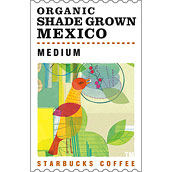
  • Organic Shade Grown Mexico.  Medium roast, origin Chiapas, Mexico.  Grown near the El Triunfo Biosphere Reserve, a park threatened in part by coffee plantations. This is one of the coffees produced in partnership with Conservation International, their “Conservation Coffee.”  Although the description on the Starbucks web page says “traditional shade-growing,” as noted in the post about the partnership, it does not appear that these coffees are grown with any specific or enforced rules regarding degree of shade management or level of organic practices.  Therefore, it does not seem that this coffee is comparable to coffees that are certified organic or bird-friendly. (Update: review and background of this coffee here.)
  • Shade grown Mexican decaf. Medium roast, origin Chiapas, Mexico. Description makes it sound like the same coffee as above, yet it is not labeled organic.
  • Serena Organic. Medium roast, origin Latin America and east Africa. No indication what organization, if any, certifies this as organic.  Coffee Review review.
  • Cafe Estima. Bold roast, origin not specified.  Their featured “Good Coffee, Doing Good” blend.

Starbucks has a line of Black Apron limited edition coffees. They give $15,000 to the farmers of each Black Apron coffee for community projects.  These beans are pricey, and $3 of each half pound must go into producing the fancy laser-cut box.  I just tried the Rwanda Blue Bourbon Black Apron, which is just about at the end of its run, and liked it quite a bit.  But then, I’m a fan of Rwandan coffees.

On the one hand, I give Starbucks some credit for attempting to buy and market responsible coffees; the fact they do it is what counts for me, I don’t care whether they are dragged into it kicking and screaming.  On the other hand, I personally am not a Starbucks fan and think a lot of their coffee is over-roasted.  Click on the Starbucks category for more on the company’s coffees and policies.

Caribou Coffee and Rainforest Alliance

Caribou Coffee, based in Minneapolis with stores in 15 states, announced last July that it was partnering with Rainforest Alliance (RA) to provide certification for much of their coffee.  They expected 20% of their coffee to be certified by the end of 2006, with a goal of half of all the green beans purchased to be RA certified by 2008.  The phase-in is necessary because Caribou wants to preserve existing relationships.  This has an upside in that new producers will be adhering to certification standards.  Considering that a number of Caribou offerings are from Africa and Asia, which are not eligible for shade certification and which often are grown under shade as a matter of course, this means that well over half of Caribou’s coffees will represent shade coffees, in one shape or form.

(Update: 100% of all Caribou coffees will be 100% Rainforest Alliance certified by 2011. More on this here.)

As the second largest U.S. specialty coffee company, selling over 4 million pounds of coffee annually, the purchase of half their beans from certified sustainable sources is nothing to sneer at, and it makes Caribou one of the only big coffee houses where this kind of sustainable coffee will be readily available.

Caribou has a commitment to responsible coffee sourcing, social responsibility (including work in coffee growing areas) and frequently donates to local communities and charities.

Where to get certified shade-grown sustainable coffee

Version 4. My list of responsible roasters currently resides in the footer of the site. The list rotates when the page refreshes. This post outlines my criteria for inclusion in the list.

There are a lot of great roasters out there, and many carry sustainable coffees, but my list will not include them all. The intention is to provide links to places where consumers can find the best variety of good, sustainable coffee. Note that not all coffees from each place will be sustainable. I’ll continue to provide reviews of additional providers and specific coffees from many further roasters. For a list of roasters that regularly carry Bird-Friendly certified coffee, see this post.

Overall criteria
I would love to make it simple, and provide a list of retailers that sell only certified shade-grown coffee. You can look for suppliers of Smithsonian Bird-Friendly certified coffee here. Rainforest Alliance does not provide a list of roasters or retailers, only producers; a list can be downloaded from this page.

There are many sustainably-grown coffees out there that are not certified. This will probably continue to be the case for some time due to high costs to producers for certification and other factors. In addition, some coffees from shade certified farms are not sold with the “seal” if the retailer decides not to market it as such. On the other hand, there are also coffees marketed as “shade grown” that may not be grown under any sort of measurable criteria.

Finally, there are places in the world where coffee is grown in areas that weren’t forested to being with (and thus where “shade” is not valid), at high altitudes where shade is provided by clouds and not trees, or where the ecology is (and therefore biodiversity preserving requirements) are far different from those for which shade criteria were developed. Current shade certification standards are not a good fit for these places.

Finding sustainable coffee, then, requires some due diligence on the part of the consumer (my list of the top 5 indicators of sustainable coffee can serve as a guide) . I have compiled a list of roasters in the footer that offer sustainable coffee, using these criteria:

  • I look for providers that mention shade, sustainability, or biodiversity specifically, and include details, and which source from farms that I’m able to determine, to the best of my ability, are biodiversity and environmentally friendly.
  • If they say their coffee is “Bird-Friendly,” it better have the SMBC seal and be listed as a certifed farm on the SMBC web site. If they say their coffee is “shade grown” and the coffee isn’t certified by SMBC, I’d like to see an explanation of how they determined it really is grown in shade. Sometimes a very specific description of origin is sufficient (see below).
  • They must have clear descriptions of origins on most of their offerings — not just the country, but if possible region and estate.  Big bonuses if they also provide links to the farms or cooperatives. Added details such as the botanical variety are also great. Including these facts provide important details which help consumers make wise choices in sustainable coffee.
  • I look for roasters who have direct relationships with farmers and are committed to helping their producers use sustainable growing practices.
  • An obvious dedication to offering quality coffee. Occasionally I come across a retailer who is more concerned with a “cause” than with the coffee. I want consumers who try coffee to love it and become converts to great-tasting sustainable coffee. I look for details on roast level and flavor, outside reviews, and in many cases whether the C&C tasting panel liked the coffee (note that not all coffees we taste get a published review).
  • Although not a requirement, it’s terrific if the retailer also describes their own sustainable business practices.
  • They must have online retail shopping.
  • I’ve stuck to North America, mostly roasters in the U.S.

Solar Roast

Solar Roast is Fair Trade and/or organic coffee roasted in what must be the world’s only commerical solar roaster. According to the web site,

“…this roaster uses a 10ft solar array to focus the rays of sunshine onto a drum roaster. This roaster is capable of reaching temperatures upwards of 550 degrees F. The roaster swivels and tilts allowing it to track the sun throughout the day from sunrise to sunset.”

Based in Oregon, they have had issues in the past with being able to roast sufficient quantities to be able to keep up a steady supply.  The web site invites wholesale inquiries. It wasn’t clear if retail is available at times, but I did find it available for purchase at The Solar Store; the roaster currently resides in the front yard of this establishment.  There are five blends available at $8.00 per 8 oz. bag.

Starbucks and Conservation International

Starbucks entered into a partnership with Conservation International in 1998, an alliance also supported by USAID (unfortunately known to finance many projects promoting sun coffee).  Here is a short history of some of the results of that partnership:

In late 1999, Starbucks introduced a shade-grown coffee grown in Chiapas, Mexico that was part of their partnership with Conservation International (CI), which “promotes practices such as water and soil conservation, crop diversification, and chemical fertilizer and pesticide reduction.”  In addition to buying the beans, Starbucks also “provides financial support to the project and offers technical advice to farmers to raise the quality of their coffee.”

In 2001, Starbucks announced new purchasing guidelines it had developed with CI, which award points to suppliers based on sustainability categories. Suppliers with higher points receive a preference from Starbucks.  Starbucks will also pay a premium of up to  ten cents a pound to suppliers who meet sustainability guidelines.  At the time, Starbucks was reportedly paying an average of $1.20 a pound for coffee, which is still below the typical $1.26 per pound Fair Trade minimum.

It is worth mentioning that these sustainability categories are not strictly environmental, but are also based on quality, social conditions, and economic benefits to the communities.  They do mention shade and chemical reduction, but do not impose any enforceable guidelines for shade management or organic farming methods.

In 2003, Starbucks launched a Colombian coffee that was the result of their partnership with CI and the Colombian Coffee Federation, with stated goal “to promote coffee production methods that protect biodiversity and, at the same time, allow coffee farmers to improve their livelihood.” Starbucks also provides substantial financial support to other CI coffee field projects.

The measures Starbucks is taking on environmentally-friendly coffee are not comprehensive.  The CI guidelines are a start, but lack the strong certification for organic or shade-grown farming practices that are needed to truly protect biodiversity. Their efforts are appreciated, and if customers demand it, perhaps they will continue to improve their commitment both to Fair Trade and the environment.