
Research on coffee growing

Research: Andean shade coffee quality habitat for birds

Bakermans, M. H., A. C. Vitz, A. D. Rodewald, and C. G. Rengifo. 2009. Migratory songbird use of shade coffee in the Venezuelan Andes with implications for the conservation of the cerulean warbler. Biological Conservation 142:2476-2483. doi:10.1016/j.biocon.2009.05.018

Most studies of birds in shade coffee have concentrated on numbers, species composition, and foraging dynamics, but none has looked at whether birds using shade coffee improve in body condition during the winter months. Body condition is strongly correlated with annual survival, and thus a crucial metric.

This study took place in Venezuela’s northern Andes near La Azulita in the state of Merida. This region is not very well represented in the literature (either coffee-growing or bird ecology research), yet it is an important wintering site for many North American bird species. These include various flycatchers and thrushes (Contopus and Catharus sp.), and a number of warblers including Cerulean Warbler (Dendroica cerulea). This species, which I have written about before, has declined an estimated 83% in the last four decades. The shade coffee farms examined ranged from 3 to 5 ha with 38 to 63% canopy cover. Nearby primary forest was also included in the study.

The four most common North American migrant species found, all warblers, were American Redstart, Blackburnian Warbler, Cerulean Warbler, and Tennessee Warbler. These species were three to fourteen times more common in shade coffee than in primary forest, even when detectability was factored in (because coffee farms are more open, birds can often be easier to detect, which would introduce bias if not accounted for).

Body condition was measured using various parameters in the five most common species of birds captured for banding in the shade coffee farms. Body condition improved over the winter for three species, including Cerulean Warblers, and was maintained in the other species. Nearly 30% of the individuals of the 15 species of migrants banded were recaptured, meaning they stayed in the coffee farms for prolonged periods of time throughout the season. These are all indications that the shade coffee provided quality habitat for these species.

In addition, 65% of Cerulean Warblers banded the first winter were recaptured or resighted the next winter, a remarkable return rate. Faithfulness to wintering sites is advantageous in that birds are familiar with resources such as food and cover, which can improve survivorship. However, it is also quite risky for birds wintering in areas experiencing high rates of habitat loss. Venezuela has seen nearly 40% of its shade coffee converted other types of agriculture — the authors state that they witnessed several shade coffee farms turned into cattle pasture during the two year duration of this study.

Just noting the sheer numbers, or even diversity of birds, in a particular habitat doesn’t tell the whole story. They may be present, sometimes only briefly, depending on the availability of resources in the larger landscape. This study not only showed that migrant birds were very common in shade coffee even in a region with primary forest, but also demonstrated site fidelity and improvement in body condition — adding  a critical component to the story of the value of shade coffee.

Cerulean Warbler photo by Petroglyph under a Creative Commons license.

Bakermans, M., Vitz, A., Rodewald, A., & Rengifo, C. 2009. Migratory songbird use of shade coffee in the Venezuelan Andes with implications for conservation of cerulean warbler Biological Conservation DOI: 10.1016/j.biocon.2009.05.018
Research: Coffee as an invasive plant in India

Brewing trouble: coffee invasion in relation to edges and forest structure in tropical rainforest fragments of the Western Ghats, India. A. A. Joshi, D. Mudappa, and T. R. Shankar Raman. 2009. Biological Invasions 11:2387-2400.

While invasive plant species receive a lot of attention, the focus is often on weed species that compete with crops — not the potential invasiveness of the crops themselves. Coffee is native to Africa, but of course is widely planted in tropical regions worldwide. Both varieties of coffee, Coffea arabica and C. canephora (commonly called robusta) are grown in India.  In the Western Ghats of India, a biodiversity hotspot, coffee is often planted adjacent to fragmented forest reserves. This study looked at the spread of coffee into forest fragments at four sites that adjoined coffee farms, but varied in degree of disturbance.

Both coffee species were found in all the forest fragments, with whatever species that was cultivated in the adjacent farms being the most abundant. Stem density generally decreased as the distance from the the plantation edge increased for the coffee species planted in the adjacent farms. Stem density of arabica increased with disturbance level of the fragment. Robusta did not show such a pattern, and stem density was many times higher than arabica in fragments adjoining robusta farms, including the least disturbed, protected forest fragment. Further, there was a negative relationship between robusta invasion and native shrub density.

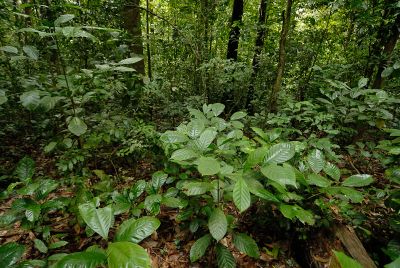
Robusta coffee growing in the forest, Anamalais, Tamil Nadu, India. Kalyan Varma, used with permission.

The main consumers and dispersers of coffee in India are the Asian Elephant, Lion-tailed Macaque (Macaca silenus), Sloth Bear (Melursus ursinus), and Brown Palm Civet (Paradoxurus jerdoni). Yet in this study the pattern of dispersal in one fragment, which was separated from the farm by a stream, and the sharp decline of coffee densities beyond 100 meters hints that small mammals might be important agents for dispersal in these systems. Larger mammals have bigger ranges, and the stream would not have acted as a barrier for them.

The authors concluded robusta may have a greater impact as an invasive species than arabica in this region. Whether this has to do with robusta being more adaptable, or just more fecund (robusta coffee plants can produce four times more fruits than arabica plants) needs further study.

I’ve not seen any similar research on the spread of coffee into forest fragments in Latin America. This may be because of a more limited number of potential animal dispersers, and, at least in many parts of Central America, less cultivation of robusta coffee.

You can find a summary of the paper at the Nature Conservation Foundation web site.

Thanks to Kalyan Varma for use of his photo of robusta

Joshi, A., Mudappa, D., and Raman, T. 2009. Brewing trouble: coffee invasion in relation to edges and forest structure in tropical rainforest fragments of the Western Ghats, India Biological Invasions DOI: 10.1007/s10530-009-9423-6

Research: Coffee and sacred groves in India

Comparing tree diversity and composition in coffee farms and sacred forests in the Western Ghats of India. 2009. S. Ambinakudige and B. N. Sathish. Biodiversity and Conservation 18:987-1000.

The Western Ghats of India is a global biodiversity hotspot with high endemism. And like many other tropical montane regions, a lot of coffee is grown there. This study took place in the Kodagu (a.k.a. Coorg) district of Karnataka state, where both arabica (Coffea arabica) and robusta (C. canephora) coffee are grown. It’s one of the most densely forested areas remaining in India.

There are several types of land tenure and timber rights in the coffee lands of India. On unredeemed land, the coffee farmer owns the land, but the government owns the rights to the trees; tree rights belong to the farm owner on redeemed lands; and sacred groves are forest patches with little human impact used for communal activities that are the most pristine forests left in the region. The study was straightforward: comparing the diversity and abundance of trees in each category of land ownership.

The results regarding tree diversity were unsurprising, with sacred groves containing the more species (62) and more unique species (51) than either of the land tenures planted in coffee. The most common species in the sacred groves was Dimocarpus longan, a native fruit tree.

Redeemed and unredeemed lands had nearly the same number of species (38 and 39), but examination of dominant species showed the influence of government regulations on timber rights. On unredeemed coffee lands, where the government owned the tree rights, rosewood (Dalbergia latifolia), was most common. A high-value native timber tree, it can only be harvested under special license. On redeemed coffee lands, the most common tree was Grevillea robusta. This Australian tree is commonly used as a shade tree in Indian coffee farms. It grows quickly, straight and tall, so it is used as a living trellis for a common companion crop (pepper vines) before it is harvested for timber.

Species composition in these plots is not static, and highlights the ironic destructive nature of laws designed to protect native tree species in this region. In interviews with coffee farmers that were part of this study, it was found that growers were concerned about coffee prices and wanted to plant timber trees to hedge against low prices. Grevillea was not only planted in redeemed lands for this reason, but farmers were also planting it in unredeemed lands because it is easier to get permission to harvest non-native trees (Grevillea is apparently totally unregulated). This is encouraging the planting of Grevillea, where it is supplementing or (more often) replacing native species.

Not only does this diminish tree biodiversity, but diversity of other species as well. Birds, for instance, that depend on insects to eat find fewer insects adapted to feed on non-native vegetation. In another study, an increase in Grevillea from 33% to 55% was associated with 91% reduction in the abundance of one restricted-range, endemic species, the Malabar (Crimson-fronted) Barbet (Megalaima malabarica), shown above.

This has implications for any type of shade certification scheme that might be used in India, as encouragement of “shade” without adjustment to regulations regarding harvesting native species will only further serve to promote planting of more non-native trees, especially Grevillea.

Photo of barbet, taken in Karnataka, by Shiva Shankar. Used by permission.

Coffee-related deforestation in Sumatra

Three decades of deforestation in southwest Sumatra: effects of coffee prices, law enforcement and rural poverty. 2009. D. L. A. Gaveau, M. Linkie, Suyadi, P. Levang, and N. Leader-Williams. Biological Conservation 142:597-605 .

I’ve written in the past about Sumatra’s problems with illegal coffee growing, particularly in Bukit Barisan Selatan National Park. A 2007 World Wildlife Fund investigation revealed that the robusta coffee grown illegally in the park was threatening the integrity of tiger, elephant, and rhino habitat and was purchased by such large companies as Kraft and Nestlé. A year later, I posted an update that noted Nestlé was still buying coffee originating in the park.

This study revisited this on-going situation, examining how deforestation can be curbed by law enforcement efforts, and how deforestation rates are driven by coffee prices.

Over the last 34 years, the main driver of deforestation in and around the park has been production of low-grade robusta coffee, the kind used in cheap grocery store blends and instant brands. In 2005, more than 85% of the forested areas in the park that had been converted to agriculture was planted with coffee, and the yield was a remarkable 4% of Indonesia’s entire annual robusta production.

The was a complex interplay of changing laws, local coffee prices tied to currency valuation, and low wages in the coffee-growing regions that drove the coffee-related deforestation, nicely analyzed by the authors. Active law enforcement did curtail the encroachment in the park in the 1980s. It has rebounded since the late 1990s; the departure of President Suharto has seen a decline in the emphasis on law enforcement, and a change in the governing philosophy towards conservation and rural workers, explain the authors.

The authors did not give a lot of cause for optimism that the coffee-related deforestation can be easily addressed. For example, eco-certification has been suggested to help provide premiums to farmers that grow coffee outside of the park under sustainable guidelines. But according to the authors, buyers and roasters are unwilling to manage the costs of certification. I doubt that the premiums wouldn’t be sufficient to discourage farming inside park boundaries (consumers would be unwilling to absorb additional costs for low-quality robusta).

Ultimately the authors suggested that prohibiting local use of the park would have to be reconsidered, including, perhaps, some type of sustainable-use policy and community conservation projects.

Photo of a Sumatran Tiger by g-na under a Creative Commons license.