Research on coffee growing

Research: Coffee certification and bird conservation in Ethiopia

Ethiopian coffee cultivation — Implications for bird conservation and environmental certification. 2008. A. D. Gove, K. Hylander, S. Nemomisa, and A. Shimelis. Conservation Letters 1:208-216.

Common Fiscal (Lanius collaris), a shrike relative that favors shrubland found almost exclusively in the farm plots.

This is probably the first peer-reviewed paper specifically about coffee growing/shade coffee and birds in Ethiopia. It reveals that the relationship between coffee management and bird diversity is different in Ethiopia than it is in Latin America, where shade coffee criteria were developed, and these differences need to be taken into account in certification criteria.

The study took place in southwestern Ethiopia near Bonga, where coffee is harvested from within existing forests, and also grown in mixed systems with other crops under isolated shade trees. The study area is a mosiac of forest and agriculture, and authors compared birds present in 19 forest sites with 19 farm sites — all representing a range of tree and coffee densities.

Many of the 106 bird species recorded were found in both the forest and farm plots, but forest bird assemblages were distinct from those found on farms.

The Red-chested Cuckoo (Cuculus solitarius) is a woodland species that was found in both farm and forest plots, but more often in forest.

Tree density on farms had a positive influence on the number of forest and woodland bird species. In this way, coffee cultivation, with its associated shade trees, improves habitat for birds by increasing
habitat complexity in these largely open degraded lands. The
coffee plots with their isolated tree patches would not qualify as “shade coffee” under most current criteria. But since coffee is native to Ethiopia, even these little plots could be considered rehabilitation of cleared land. Further, although isolated, the shade trees in coffee farm plots acted as “stepping stones” through inhospitable habitat, and, if plots were abandoned, as valuable sources of seeds that could regenerate forests. The authors concluded coffee cultivation on these small farms was a plus for bird habitat.

On the other hand, most of the forest plots would qualify as shade coffee under current criteria, which emphasize canopy structure. However, it is not uncommon for forest plots to be manipulated for increased coffee density; these plots had complex canopy but simplified understories. This change in forest structure decreased the number of bird species. Encouraging this type of “shade” coffee farming would actually have an overall negative impact on birds and bird habitat. These situations need to be taken into account in future certification schemes in Ethiopia, and perhaps elsewhere in Africa.

A forest specialist, the African Hill Babbler (Pseudoalcippe abyssinica) was found nearly exclusively in forest plots.

Finally, the authors emphasized that “Ensuring that coffee farmers receive a reasonable price for the commodity is perhaps most important.” Under low prices, farmers anticipate clearing forest for cereal, corn, or khat crops, or large government-sponsored sun coffee farms, threatening habitats of all types.

Top: Common Fiscal photo by Lip Kee. Middle:  Red-chested Cuckoo photo by Johann du Preez. Bottom: African Hill Babbler photo by Veli Pohjonen, East Usambara Conservation Area Management Programme, Bugwood.org.

A. D. Gove, K. Hylander, S. Nemomisa, A. Shimelis (2008). Ethiopian coffee cultivation — Implications for bird conservation and environmental certification. Conservation Letters, 1, 208-216.
Research: Ethiopian garden coffee preserves epiphyte biodiversity

Home garden coffee as a repository of epiphyte biodiversity in Ethiopia. 2008. K. Hylander and S. Nemomissa. Frontiers in Ecology and the Environment. 6:524-528.

Nearly all the work that’s been done examining the relationship between shade coffee and biodiversity has taken place in Latin America, so it’s good to see studies like this coming out of Africa.

This study looked at the diversity of epiphytes and bryophytes (mosses, liverworts) in home coffee gardens and forest patches in southwestern Ethiopia near Bonga. People often grow coffee under shade trees in their gardens, and this study not only compared the gardens versus the forest, but also the epiphytes growing on the coffee shrubs and shade trees.

Six to 27 species of epiphytes were found growing on coffee shrubs in home gardens, and only liverworts were more diverse on forest coffee shrubs. Eleven to 33 species were found on shade trees in home gardens. Overall, epiphyte/bryophyte diversity was higher on forest shade trees, but there was a lot of overlap and many garden shade trees had richer diversity than those in the forest. It was also noted that heavily pruned coffee in more intensively managed farms did not host many epiphytes.

The authors concluded that coffee shrubs and shade trees in home gardens are important hosts of epiphytes and bryophytes, helping to preserve the biodiversity of these plants. They also felt that epiphytes and bryophytes likely provide nest material, nest sites, and food sources for birds as has been proven in Latin America. Shaded home coffee gardens also had the added benefit of providing resources such as honey and firewood, and environmental services such as erosion control.

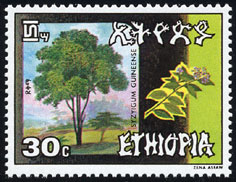
The tree depicted on the stamp, Bicoloured waterberry, Syzygium guineense, is a common canopy tree in the region of Ethiopia examined in this study.

K. Hylander, S. Nemomissa. (2008). Home garden coffee as a repository of epiphyte biodiversity in Ethiopia. Frontiers in Ecology and the Environment, 6 (10), 524-528 DOI: 10.1890/080001

Research: Shade coffee promotes genetic diversity of native trees

Shade coffee farms promote genetic diversity of native trees. 2008. Jha, S. and C. W. Dick. Current Biology 18:R1126-1128.

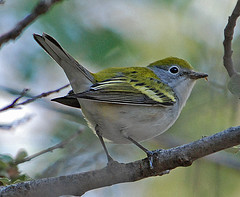
Chestnut-sided Warbler in winter plumage.

This study looked at genetic differences and gene flow in an understory shrub, Miconia affinis, in a 1200  ha matrix of forest and shade coffee farms in Nueva Alemania, Chiapas, Mexico. Birds are extremely important as agents of seed dispersal in tropical ecosystems. The authors wanted to explore how shade coffee farms — with their attendant suite of vertebrate seed dispersers such as birds, bats, and mammals — might act as corridors or reservoirs promoting healthy gene flow in trees. Other studies have indicated that limited seed dispersal in fragmented landscapes results in inbreeding and demographic declines in tree populations.

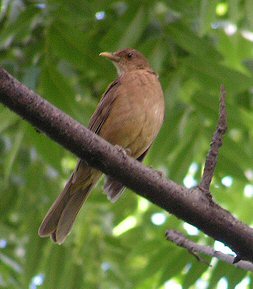
Clay-colored Thrush.

Genetic analyses showed that the Miconia in the coffee farms were genetically diverse, and came from multiple source populations. Clusters of Miconia in the forest were actually more closely related to each other than the clusters on coffee farms. The authors speculated that this may be due to the short foraging ranges of birds that specialize in forest habitats, versus the birds found in shade coffee, which are often wide-ranging generalists. [Note that the interpretation of this aspect in the Science Daily article is somewhat misleading. The paper stated that Miconia seeds are spread by birds such as the resident Clay-colored Robin (Turdus grayi) and the migrant Chestnut-sided Warbler (Dendroica pensylvanica), a North American breeder than winters in the tropics. The SD article said that the warbler is a short-ranging forest specialist responsible for limited seed dispersal in forests; this was not stated in the paper.]

The authors conclude that “[S]hade coffee farms support extensive dispersal processes crucial for the connectivity of remnant forest and agricultural habitats…[and they play a role] as potential foci of native forest regeneration.”

Chestnut-sided Warbler by Jerry Oldenettel. Clay-colored Robin by Arthur Chapman.

S. Jha, C. Dick. (2008). Shade coffee farms promote genetic diversity of native trees. Current Biology, 18 (24) DOI: 10.1016/j.cub.2008.11.017

Research: Shade coffee provides additional income besides the coffee crop

Agricultural intensification within agroforestry: the case of coffee and wood products. 2008. Rice, R. A. Agriculture, Ecosystems, and Environment 128:212-218. doi:10.1016/j.agee.2008.06.007

Robert Rice, of the Smithsonian Migratory Bird Center, surveyed 338 owners of coffee farmers in Peru and Guatemala to determine what portion of total income from shaded coffee farms was attributable to non-coffee products derived from the farm. These were smallholders (under 3 ha of coffee; average total farm area was 10 ha in Peru and 6.2 ha in Guatemala). The value of the non-coffee products was based on local market prices, and included the value of products both used/consumed by the farmers, and exchanged or sold.

A fifth to a third of the total value came from non-coffee products. Fruit and fuelwood were the two biggest non-coffee income producers in both countries; lumber for construction materials was also important. Because yields and prices are higher for coffee in Guatemala, the percentage of income derived from non-coffee products was lower there, just under 19%. In Peru, it was 28%.

This is one of the first studies to quantify the “shadow economy” in shade coffee agrosystems that exists alongside of the economics of the coffee production itself. Diversification is particularly important for farmers producing a crop such as coffee, which is so sensitive to global price flucuations. Hopefully, we are also working toward proper appraisal of the value of carbon sequestration and biodiversity preservation in shade coffee systems. When mechanisms are in place to compensate farmers for these less-tangible assets, it should provide further motivation for farmers to foster diverse shade in their coffee holdings.

Forest photo by Alexander Gonzelez.