Research on coffee growing

New coffee species from Madagascar

Earlier this year, the news of the “discovery” of a caffeine-free species of coffee from the Cameroon created a bit of a stir. This species was actually first collected in 1983, but remained unstudied and not described to science until 2008 [1], at which point it made headlines when it made a 2009 top ten list of new species. I wrote about it here.

Similiarly, the Royal Botanical Gardens at Kew just announced some recent achievements, among which was the “discovery” of new species in the genus Coffea from Madagascar. Again, these species were not necessarily just discovered but were described in a paper published in 2008[2].  Coffea ambongenis, for example, was first collected in 1841 but not described, was rediscovered in 1999, and is now published as a new species.

There are 103 described species of Coffea in the world, and the Madagascar species are part of the Coffea subgenus Baracoffea, which now stands at 9 species. In addition to species in this subgenus being deciduous rather than evergreen like all other coffee species, some have unusual morphological characteristics. Here is a very brief run-down.

  • C. ambongensis and C. boinensi: Very large fruit, in C. ambongensis often larger than 2.5 cm long. C. boinensi was first collected in 1994.
  • C. bissetiae: Underside of leaves and fruit hairy.
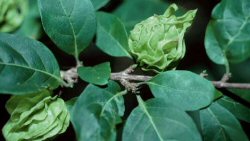
  • C. labatii and C. pterocarpa: Unusual winged fruit. C. labatii, first collected in 1992, has 12 to 18 “wings” per fruit. C. pterocarpa (first collected in 1954) has 16 to 20 wings, and is pictured at right in a photo by Aaron Davis from Kew; an informative accompanying article is here. One theory as to the function of the wings is that it helps the fruit float, and these species occur in regularly-flooded karst limestone habitats.
  • C. namorokensis: First collected in 2000, but not identified as a new species. Also has hairy fruit and leaves.
None of the new species have been tried as a beverage, and it is unlikely they will ever be commercialized.  All are rare: near-threatened to critically endangered, and Madagascar forests are among the most exploited and threatened in the world today.

[1] Stoffelen, P., M. Noirot, E. Couturon & F. Anthony. 2008. A new caffeine-free coffee from Cameroon. Botanical Journal of the Linnean Society 158: 67-72.

[2] Davis, A. P, & F. Rakotonasolo. 2008. A taxonomic revision of the baracoffea alliance: nine remarkable Coffea species from western Madagascar.
Botanical Journal of the Linnean Society, 158 (3), 355-390 DOI: 10.1111/j.1095-8339.2008.00936.x
The water footprint of coffee

The water footprint of coffee and tea consumption in the Netherlands. 2007. Chapagain, A.K., and A. Y. Hoekstra. Ecological Economics 64:109-118.

This is not a newly published paper, but I found it well worth summarizing here.

“Footprint” evaluations — ecological, carbon, or water — determine the amount of a resource needed to produce a unit of a good. This paper calculated the water footprints per ton and per cup of tea and coffee, as well as “virtual” water imports into the Netherlands for each beverage. I’ll only summarize the water footprint of coffee here, but the paper can be downloaded from the publications list at the Water Footprint Network.

The authors measured coffee crop water requirements in different parts of the world. Some regions must irrigate (e.g., Brazil) while others rely on rainfall. Water used in processing, which also varies by region, was then factored in. Much of the world’s coffee (especially arabica) is wet processed, requiring a water source such as a river or groundwater to ferment and wash the coffee prior to drying the beans.

The calculations also took into account the shrinking weight of the product throughout processing — e.g., fresh cherries to pulped cherries to hulled beans, etc.– in order to keep the metric (cubic meters of water per ton of coffee) consistent.

Because of all the variability, from annual crop water requirements (they used FAO estimates) to the number of grams of ground or instant coffee used to make a weak or strong cup, this whole operation is somewhat of an inexact science. However, the authors appeared meticulous in their choices and inclusiveness, and the results seem to at least give us a relative picture between regions and methods, if not numbers that are actually well in the ballpark.

As it turns out, there was little difference whether coffee was wet or dry processed. The water used in wet processing made up only 0.34% of water used to grow the coffee. The summary tables provided figures for wet processing only.

The main results summarized the cubic meters of water used per ton of coffee (for each step from fresh cherry to roasted) for 25 countries.  The two countries with the highest totals were both robusta-producing nations: Togo (49341 m3/ton) and Ghana (47554). In fact, six of the top ten countries grew robusta either exclusively or in addition to arabica. The highest arabica-only country was Panama at 37660 m3/ton.

The average (weighted for world production) “virtual water content” was calculated at 20987 m3/ton. Lowest countries were Vietnam at 6054 and the U.S. (Hawaii and Puerto Rico, 9061). Other countries that grow primarily arabica which were ranked below-average were Ethiopia, Guatemala, Costa Rica, El Salvador, Bolivia, and Colombia.

Finally, the authors calculated that the “average” cup of coffee required around 140 liters of water; several variations were provided. The authors also estimated that if the price of coffee included the economic value of rainwater, it would increase about 20 cents per kilo. This cost increase does not include surface or groundwater used for processing or irrigation water, nor any environmental costs due to erosion or water pollution.

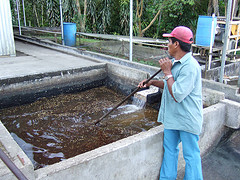
Coffee flotation in Chiriqui, Panama; photo by Darrin O’Brien, used with permission.

Chapagain, A., & Hoekstra, A. (2007). The water footprint of coffee and tea consumption in the Netherlands Ecological Economics, 64 (1), 109-118 DOI: 10.1016/j.ecolecon.2007.02.022

Shade coffee farmers attitudes towards wildlife

Attitudes and knowledge of shade-coffee farmers towards vertebrates and their ecological functions [PDF]. 2009. P. Lopez-del-Toro, E. Andresen, L. Barraza and A. Estrada. Tropical Conservation Science 2:299-318.

The authors of this study interviewed 36 Mexican shade coffee farmers regarding their knowledge and resultant perception and attitudes of the wildlife on their farms. Farmers were members of a cooperative, and some of them had also attended environmental workshops, which included wildlife-related topics, sponsored by the cooperative. In general, this study found that:

  • All farmers liked having birds on their farms, and they were viewed positively.
  • Farmers thought most snakes were poisonous, and only a third knew they ate rodents and/or could be beneficial in pest control.
  • Most farmers had a very utilitarian view of non-flying mammals (everything from squirrels to ocelots), being largely indifferent except towards those used for food.
  • Bats were the least understood, with most farmers not knowing what bats feed on or what ecological role they fulfilled.
  • Most farmers knew that seed dispersal was an important ecological function, and identified birds as seed dispersers. Few knew mammals could also disperse seeds.
  • Few farmers perceived pollination as being important, or understood the process well.
  • Farmers that had attended educational workshops gave an
    “environmentally friendly” answer to questions for the majority of the
    questions, compared to the farmers who had not. The authors acknowledge this could either be due to what the farmers learned in the workshops, or inherent interest or knowledge by the farmers attending, since the sessions were voluntary.

These results are not particularly surprising, but serve to illustrate a point. I think most First World coffee drinkers, if they think about coffee farmers at all, envision a Juan Valdez-like farmer. There is some romantic notion of the peasant who lives close to the land, full of indigenous knowledge and in tune with nature. This study presents something much closer to reality: for the average small coffee farmer, the land is there to support a family. The flora and fauna have to aid in that goal. There are no field guides or textbooks (or, in many cases, the level of literacy to comprehend them). No binoculars or microscopes.

These are the people we expect to conserve and protect tropical biodiversity for us. We think they should grow their coffee a certain way, without cutting down trees, using chemicals, or harming animals. Further, we would like them to pay someone to prove this to us, by way of some type of certification. And we’d like them to do this with little or no compensation.

There is no such thing as “cheap coffee.”

Coffee farmer by Neil Palmer (International Center for Tropical Agriculture, CIAT).

Lopez-del-Toro P., Andresen, E., Barraza, L., & Estrada, A. (2009). Attitudes and knowledge of shade coffee farmers towards vertebrates and their ecological functions. Tropical Conservation Science, 3 (2), 299-318.


Climate change and coffee pests

Jaramillo, J., A. Chabi-Olaye, C. Kamonjo, A. Jaramillo, F. E. Vega, H.-M. Poehling, and C. Borgemeister 2009. Thermal tolerance of the coffee berry borer Hypothenemus hampei: Predictions of climate change impact on a tropical insect pest. PLoS ONE 4(8): e6487. doi:10.1371/journal.pone.0006487.

A paper just published in the journal PLoS ONE explores the impact of climate change on the life history and distribution of the world’s worst coffee pest, a minute beetle called the coffee berry borer (CBB), Hypothenemus hampei.

The study modeled potential changes in mortality, number of generations per year, and developmental rate, among other traits, under eight different temperature regimes. The model indicated that CBB successfully develop at 20-30°C, and the intrinsic rate of increase (rate at which a CBB population increases in size) is highest, and the population doubling time lowest, at about 25-26°C (around 77°F).

As mean seasonal temperatures in coffee-growing countries move toward the optimum development temperatures for CBB, these areas become more vulnerable to increasing pest pressure from CBB. This could be especially problematic in Colombia, where multiple flowering of coffee plants means nearly year-round availability of coffee cherries.

The predicted optimal temperature for CBB increase is higher than that which is best for arabica coffee, which prefers a temperature range of 18-21°C (above which yields are reduced), while robusta coffee thrives at temperatures several degrees higher. Climate change is already predicted to reduce area suitable for coffee production. This is probably an even more pressing threat to coffee than changing pest dynamics.

As far as mitigation of the effects of higher temperatures on CBB and coffee production in general, the authors state:

A proven strategy to alleviate the potentially negative effects of climate, especially warmer temperatures, on coffee production is the introduction of shade trees in coffee plantations.

They point out that shade trees can lower temperatures around coffee by up to 4°C at low altitudes (<700 m) and 2°C higher up (>1100 m), that shaded farms harbor more CBB enemies which can provide bio-control of these pests, and that coffee cherry weight and quality is higher when grown under shade, thus offsetting lower yields.

A number of the authors are associated with the International Center of Insect Physiology and Ecology.

Update, March 2011: James Hoffman did an overview of the CBB with some links to climate change research.
Update, September 2011: Further follow-up research by the authors is summarized here.

Photo of a female CBB entering an unripe coffee cherry, part of Figure 1 from the PLoS paper, photo by Gonzalo Hoyos of CENICAFE. Don’t discount small enemies.

Jaramillo, J., Chabi-Olaye, A., Kamonjo, C., Jaramillo, A., Vega, F., Poehling, H., & Borgemeister, C. (2009). Thermal Tolerance of the Coffee Berry Borer Hypothenemus hampei: Predictions of Climate Change Impact on a Tropical Insect Pest PLoS ONE, 4 (8) DOI: 10.1371/journal.pone.0006487