Indo-Pacific

Review: Caffe Vita YUS (PNG)

When you think of endangered species, I’ll bet you don’t think about Matschie’s Tree Kangaroos. Tree kangaroos and coffee also make an unlikely pairing. But I’m here to tell you that Seattle-based Caffe Vita has brought them together. We’ll start with the ‘roo.

A kangaroo…

Matschie’s Tree Kangaroo (Dendrolagus matschiei) is one of about 10 species of tree kangaroo, most of which are found in Papua New Guinea. The Matschie’s Tree Kangaroo is only found on PNG’s Huon Peninsula, located in Morobe Province in the northeastern part of the island. Matschie’s Tree Kangaroos live in cloud forests, and look nothing like the upright, savannah-bounding Australian animals with which they share a name. These arboreal animals more resemble red pandas, although like more conventional kangaroos they do raise young in pouches and have impressive leaping abilities. They weigh about 10 kg and eat mostly leaves.

A conservation area…

In 1996, Seattle’s Woodland Park Zoo started a tree kangaroo conservation program focusing on the Matschie’s Tree Kangaroo. From the start, they took a community-based approach to the preservation of the tree kangaroo habitat. A major accomplishment was the establishment of the 76,000 ha YUS Conservation Area — named for the three primary rivers in the Huon Peninsula: the Yopno, Uruwa and Som. In addition to Matschie’s Tree Kangaroos, this area, of course, preserves many other species including several incredible endemic birds-of-paradise: the Huon Astrapia (Astrapia rothschildi), Wahnes’s Parotia (Parotia wahnesi), and the Emperor Bird-of-paradise (Paradisaea guilielmi) — some of the most truly spectacular birds in the entire world.

In an arrangement similar to that of biosphere reserves, the  conservation area has a core protected area and buffer zones that allow for mixed, environmentally-friendly uses. One of these sustainable management strategies for local communities (there are nearly three dozen villages in the area) was coffee growing. Only about 6% of PNG’s coffee comes from Morobe Province. The YUS area is remote and very rugged, with no road access, and getting coffee to market is an enormous challenge. And it’s not like these farmers are in a place where the some equivalent of a local county extension agent can drop by and give some agricultural assistance. Thus, in 2010, the Zoo’s conservation program worked to provide technical training for over 300 YUS coffee farmers.

A coffee roaster…

Zoo program personnel knew a direct relationship with a stateside roaster would be a strong step in the right direction, so they approached Caffe Vita, a roaster with six locations in the Seattle area. In early 2011, Caffe Vita introduced a Zoo Special Reserve coffee to support the Woodland Park Zoo. Although currently sourced from Guatemala, it is organic and Rainforest Alliance certified, and $1 a bag goes to Zoo conservation efforts.

Green coffee samples from YUS farmers were brought to Caffe Vita to roast and evaluate. Green coffee buyer Daniel Shewmaker could tell there was potential. In the summer of 2011, encouraged by improvements to new samples he tasted, Shewmaker visited YUS. Abandoned coffee plots have been renewed and tended. He worked with farmers on improving drying methods and separating lots by elevation. He agreed to buy 22 bags. The coffee arrived in the U.S. in December, 2011, and in February, the coffee was made available to the public.

And the coffee

The YUS farmers are growing bourbon, typica, Mundo Novo, and Arusha varietals at 1200 to 1500 m.  While not certified organic, no chemicals are used; as you might imagine, if coffee is so difficult to get out of the area, any synthetic or commercially-produced inputs are just as hard to get in. The photo taken during a Caffe Vita visit shows the shade trees over the coffee shrubs.

Caffe Vita describes this coffee as “mellow and honey-like, with flavors of toasted hazelnut, orange zest, guava, and sugarcane.” We found the coffee to start out with a very slightly wild flavor, reminiscent of a Sumatran; one person described it as a spicy note. Brown sugar and caramel was mentioned several times from our panel, and nutty also came up more than once. One taster remarked upon enjoying a savory undertone as the coffee cooled. Nearly unanimous was the opinion that the YUS was very clean and smooth.  The panel gave it an average of 3.5 motmots, with many giving it 3.75.

PNG is one of my favorite origins, in part because I never know exactly what to expect. Those of us that drink PNG coffees fairly regularly were very impressed with this coffee, especially given its history. We didn’t find it extremely unique or mind-blowing, but it absolutely was as good as any other specialty PNG we had tasted in the past, and better than a hell of a lot of them. These farmers, in the short time they have had to work with Caffe Vita on upgrading and improving their growing and processing methods, came up with a perfectly clean coffee. We detected no baggy notes, a concern Shewmaker had given elevated moisture levels in earlier samples. A coffee this good so early in the game has no place to go but up, and I’m really looking forward to future crops. It’s available at Caffe Vita locations and online.

This coffee and conservation story is remarkable in many ways. In my line of work I see plenty of preservation efforts and cross-disciplinary partnerships. Many aren’t very long-lived or successful, and few are as encouraging, inclusive, and transparent as the work undertaken by the Woodland Park Zoo. Please take a look at the conservation program’s web site; in particular I encourage you to download some of their excellent, informative annual reports. Caffe Vita’s commitment to helping these efforts in so many meaningful ways is a model for what other coffee roasters can achieve by taking sustainability to heart. The only thing missing is you.

More info:

  • Short video about the coffee and project from the Woodland Park Zoo – 2.5 minutes and very cool.
  • Journey to a Papuan Paradise – great article from National Wildlife magazine about the Huon Peninsula, the tree kangaroo projects, and stunning photos of birds-of-paradise.
  • Capacity Building, Coffee, & Conservation Through the Woodland Park Zoo – National Geographic News Watch.

Matschie’s Tree Kangaroo photo by Tim Laman and map from the Woodland Park Zoo Tree Kangaroo Conservation Program media kit. Shade coffee photo by Caffe Vita on Flickr under a Creative Commons license.

Review: Coffees from India

Plainspoken Coffee. A Coffee Review for Ordinary People by Ordinary People, #47.

In the overview of coffee growing in India, I promised some reviews. The crew here at C&C has, in fact, been busy drinking multiple offerings from India. We hope to do at least two posts, each with several short reviews.

We start off here with reviews of several non-traditional coffees. We purchased these from Muddy Dog Coffee Roasting in Morrisville, NC.

Sethuraman Estates Liberica

This is certainly one of the most unusual mainstream coffees (versus novelty coffee such as Kopi Luwak) currently available. Two species of coffee make up nearly all coffee on the market today: arabica (Coffea arabica) and robusta (C. canephora). Coffea liberica is a species native to west and central Africa, and accounts for only about 1% of world trade. It is a large tree with big, leathery leaves often grown on roadsides or as a windbreak.

Sethuraman Estates is in the Chikmagalur region of Karnataka state, near the town of Magundi and the Bhadra Wildlife Sanctuary. By all accounts, including this excellent one by Muddy Dog owner Jim Pelligrini, there is ample shade and lots of wildlife on the farm. Much of the coffee at Sethuraman is grown organically, and part of the estate is in the process of being certified. Coffee is fertilized with estate-produced worm compost, and other environmentally-friendly practices have been initiated, including the installation of new water-conserving processing equipment.

This coffee is grown at about 900 m, and prepared as a pulped natural. The aroma of the ground coffee as well as the first taste is very fruity — there is the strong suggestion of blueberries, as in a dry process Ethiopian, but there are components of other dark fruit (plum was mentioned by one taster) as well as cherry. A fruit brandy or liqueur flavor was agreed on by multiple tasters, leading a couple of people to say it would be good as an after-dinner coffee.

As the coffee cooled, several drinkers who tended to favor milder coffees were put off by the sour notes that emerged. It wasn’t harsh or sharply sour — in fact, overall the coffee was remarkably smooth. On the other hand, the finish reminded one German taster of sauerbraten — in a good way. “I did not expect to have this kind of experience from coffee!!!” was his remark. I have seen this coffee described elsewhere as “meaty.” This may represent savory or umami aspects of the profile. We (gratefully) did not come up with “animal-like flavors of jackfruit…and mint.”

The first few sips are indeed powerful, and perhaps could be considered challenging to many. We found it was more approachable in a French press than as a drip.

I was a little surprised that such an assertive coffee was liked by so many people. Nobody dismissed it, and most people agreed that while they wouldn’t want to drink it every day, they’d try it again. A few were very enthusiastic. When scores from the larger-than-usual panel were averaged, the final score was 3.25 motmots, very respectable for such an unusual coffee. Please give it a try!

By the way, liberica has a higher caffeine content than arabica (beans at about 1.4% caffeine versus around 1%), but less than robusta (1.7%)[1], although nobody thought it produced any more buzz than usual.

Monsooned Malabar

I think for Americans, Monsooned Malabar is the coffee most associated with India. The name is a legal Geographical Indication, indicating that the coffee comes from a particular region. In this case, Monsooned Malabars are processed coffee beans (usually, maybe always, dry processed) exposed to the annual monsoon winds in warehouses along the Malabar coast of India. This unusual treatment is deemed necessary to replicate the unique taste and character of Indian coffees that were once transported to Europe on sailing vessels and subjected to months of humidity on the journey. As the beans absorb moisture, they swell and turn pale. Again, Jim of Muddy Dog has a great blog post on how the process proceeds in modern times: How Stuff is Made: Monsooned Malabar Coffee.

There are a number of adjectives that invariably pop up in descriptions of Monsooned Malabars: earthy, woody, pungent, wild, funky, low-acid, and heavy or syrupy-bodied. Unadventurous coffee drinkers might balk at a coffee described this way. Usually roasters don’t recommend Monsooned Malabars to people who like sweet, bright coffees. I consider myself solidly in that group, yet I really enjoyed this coffee.

The tasting panel did find some of those flavors in this coffee, but they were nowhere near as odd, unpleasant, or unappealing as this coffee’s reputation had lead us to expect. We found this coffee well-rounded, with pleasing tones of earthiness, leather, and smoke. There was a very agreeable rustic, musty nuance that added character to the overall mellowness of the coffee. Really no hint of fruit, despite the dry processing.

Nobody gave this coffee less than 3 motmots, and the average score was between 3.25 and 3.5 — so we’ll go with 3.5 to encourage people to give it a try. Whereas many Indian coffees are hard to come by, Monsooned Malabars are not terribly hard to find. Some roasters even offer single-estate origin Monsooned Malabars. On the other hand some also have monsooned robustas, and many roasters are just not sourcing very high quality monsooned coffees, or have the skill to roast them correctly. I assume that’s why so many Monsooned Malabars are described as extreme or intense. Choose a roaster carefully. I know our positive experience with this coffee was due in large part to Muddy Dog’s honoring the bean’s interesting profile.

Kaapi Royale Cherry Robusta

This robusta selection is also from Sethuraman Estates, grown lower than the liberica, at 750 m. “Cherry” in regards to Indian coffee means a natural or dry process. Much of the world’s bad supermarket coffee is made up of cheap robusta. However, there are some carefully grown and processed robustas used in espresso blends. Typically, people don’t drink robusta straight, with the exception of the occasional single-origin espresso shot. Since we have so far not branched out into espresso prep reviews, we bravely prepared this sample as a drip and in a French press.

Robusta beans have a distinctive rubber flavor, and a bitterness that comes from the high caffeine content. When prepared in my Technivorm drip coffee maker, these characteristics were a bit more emphatic than they were when prepared as a French press. Because a sourness also developed as the coffee cooled, making this coffee in any typical consumer drip coffee maker would surely accentuate the most formidable aspects, while drowning out the intriguing properties. Thus, we proceeded with several trials in the press.

Although a dry processed coffee, fruit was not the dominant feature. There was no mistaking it was a robusta — the “rubber” was there — but it was tempered by semi-sweet chocolate, wood, and earth. It was not bitter, but very, very smooth. Nobody found this offensive. While everyone agreed this wasn’t something they’d go out and buy a bag of, they liked the idea of a cup now and then, and very much appreciated an opportunity to taste a high quality robusta, rather than the crap in supermarket coffees. It ended up with a respectable 2.75 motmots.

A future review will cover some more traditional, single-estate arabicas from India.

We’d like to thank Jim Pelligrini for putting together a great package of Indian coffees for us to buy and try out. Nor can we neglect to also thank Allen Leibowitz of Zingerman’s Coffee Company for inspiring us to embark on exploring Indian coffees.

[1] Ashihara, H. and A. Crozier. 2001. Caffeine: a well known but little mentioned compound in plant science. Trends in Plant Science 6:407-413.

Review: Doi Chaang Civet coffee, revisited

Plainspoken Coffee. A Coffee Review for Ordinary People by Ordinary People, #46.

I’ve written about Doi Chaang Coffee, a unique Thai/Canadian partnership, before.  This is certified organic, certified Fair Trade (although the partnership goes well beyond), single-origin coffee grown in northern Thailand. There is plenty of background information on the company and the coffee in the review of their medium roast that we did in 2008. I won’t rehash everything here, but just provide the basics:

Doi Chaang coffee is grown on over 2400 ha in the vicinity of the village of Doi Chang (20.325, 99.839) in Chiang Rai province at around 1200 meters. It is 50% Caturra, 35% Catimor, and 15% Catuai. The coffee is grown under the shade of various fruit and nut trees, including macadamia, plum, pear, and peach. Reforestation efforts in the area strive for a 50/50 mix of native tree species and cash crop species (both marketable and consumable crops are necessary to replace the income formerly generated by poppy growing).

In 2009, we reviewed Doi Chaang’s civet-processed coffee. Unlike most other civet coffees (often known as “kopi luwak“), Doi Chaang does not farm or raise civets in captivity (see the third photo here for the tiny cages in which these animals are typically held). All beans are gathered from what is left behind by wild civets in the Doi Chaang coffee-growing areas. Two species of civets are found in the area, the Masked Palm Civet (Paguma larvata) and the Asian Palm Civet (Paradoxurus hermaphroditus). The related Binturong (Arctictis binturong) also occurs there and is known to eat coffee fruit as well.

Generally, civet coffees are made from beans that have passed through the digestive tracts of these animals: they eat the ripe coffee cherries, but do not digest the seeds, which are passed in the waste. For more on this, er, process, read our review of typical kopi luwak coffee, and the review of Doi Chaang’s wild civet coffee. As I mentioned in the latter post, Doi Chaang actually offers two types of wild civet coffee: passed and spat. It’s not unusual for animals to regurgitate large seeds from fruit they have just eaten rather than have all the bulk pass through their systems. Modest chemical changes in the coffee beans apparently do occur when they pass through the entire digestive systems of civets. I’m not sure they’d be exposed to digestive enzymes long enough to make a profound difference if they are just held in the mouth and then spit out. However, it’s conceivable that mammals may first swallow the fruit and shortly thereafter regurgitate the seeds, in which case they will have been exposed, at least for a short time, to some of the digestive processes that apparently give “passed” civet coffee its character.

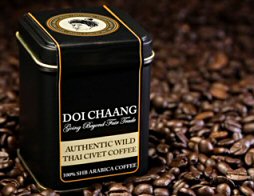
Doi Chaang provided us with a tin of the “spat” wild civet coffee for us to try. Because these are wild civets, the coffee is very limited. This year it is available in 50-gram tins, so we were unable to have a lot of people taste the coffee, so we won’t provide a motmot rating as we usually do.  We prepared the civet coffee as a simple pour-over, side by side with their medium roast single estate variety. Later, we also made the medium roast peaberry variety as a drip, and compared notes with another round of the civet as a pourover. We were going to use the peaberry for the side-by-side comparison, but the standard bean version seemed closer in roast level to the civet variety. The latter was, visually, perhaps just a tad lighter.

Now we don’t consider ourselves as having an extremely sensitive palates — we are ordinary people, after all — and I was frankly skeptical that a “spat” coffee could have gone through any flavor-enhancing changes. So we didn’t expect to be able to tell the difference between the two. We were wrong. The civet coffee was markedly smoother, with an understated milk chocolate sweetness. In our previous review (the “passed” civet coffee), we didn’t detect the Sumatran-like profile of earth and leather that we did in the regular and peaberry varieties (which were muted in that crop year, but much sharper this year). This time, we did get a more Sumatran vibe from the wild civet coffee, although it was restrained and very mellow, especially as the cup cooled. Hands down, we liked this better than either the peaberry or the standard single origin.  Was it due to the extra care and sorting that might go into the preparation of the civet beans? More careful roasting of the precious beans? Can a civet discern some particular property in ripe coffee cherries, thus making these beans share some special characteristic? Or does even brief consumption by the mammal impart a distinct profile? I can’t say. But I will admit, it was markedly different, and clearly more enjoyable.

Here is a recent review of the Doi Chaang wild civet “spat” coffee by CoffeeReview.

Since we first started reviewing Doi Chaang’s coffees, they have become much more widely available in both retail outlets and online.

One of my absolute favorite things about Doi Chaang is a coffee is the nearly overwhelming amount of information the company freely provides about its history, growing, processing, and people. If people could have this kind of background on all the coffee they buy, nobody would be drinking mystery corporate coffee anymore. Here are a couple resources:

  • The Doi Chaang blog.
  • A 30-minute documentary produced by Global TV is available in segments on YouTube. Part 3 is a quickie, and deals with the civet coffee as well as other products being produced by Doi Chaang, including macadamia nuts, honey, and soap. I love hearing brother Wicha talk about poop!

The Doi Chaang story is really remarkable. I especially recommend the documentary. The success of Doi Chaang in North America is nothing compared to how successful its been in changing the lives of the hill tribe that produces it. If you feel an urge to drop some cash on an animal-processed coffee, go for the Doi Chaang version. Not only does it avoid exploiting animals, it generates income for a company doing truly good work.

Coffee review: Doi Chaang Wild Civet Coffee

Plainspoken Coffee. A Coffee Review for Ordinary (or in this case, wealthy) People by Ordinary People, #42.

Introduction to animal-processed coffee
Our previous experience with kopi luwak — coffee beans processed through the digestive system of  civets — was not a pleasant one. You can read the ins and outs of kopi luwak in the original post, but basically the beans are gathered from the poop of a mongoose relative known as a civet cat, usually the Asian Palm Civet (Paradoxurus hermaphroditus). Due to the relative scarcity of civet-processed beans, the labor theoretically involved in gathering the poop, and the substantial novelty factor, kopi luwak demands very high prices and is often billed as the most expensive coffee in the world. Civets are native to southeast Asia, and low quality robusta beans are often a major component of kopi luwak coffee.

In my review, I surmised that it was impossible to determine if kopi luwak coffee was sustainably grown because in order to maintain volume, beans could have been gathered from any type of coffee farm, including sun coffee, especially because so much of it is cheap robusta. I’ve also come to learn another way volume is maintained is to keep civets in captivity and feed them coffee cherries. You can view videos that show civets in cages, then people supposedly harvesting civet dung off the forest floor. Likewise, this web site indicates the civets are raised on a farm. This practice is nothing new, as civets are raised for fur, musk, and food in many areas; these animals are usually caged. I have also heard that civets may be penned in a particular area where they can forage for coffee. So not only do you not know where the beans come from, there may also be animal welfare issues, as farm conditions cannot be verified.

Thai wild civet coffee
Enter Doi Chaang Coffee Company. We have reviewed Thailand’s Doi Chaang coffee before, and in that post I outlined the story behind this innovative partnership (more detail here by Canadian partner John Darch). The driving force behind the success of the Thai coffee venture is Wicha Promyong (left), a former entrepreneur from southern Thailand who “adopted ” the Akha hill tribe families in the Chiang Rai region and helped them organize and improve and market their coffee. Do not be fooled by this humble-looking man in traditional garb — he is no country bumpkin!

Recently, Wicha read about kopi luwak: the outrageous prices, the questionable quality. He asked the Doi Chaang farmers if they had observed civets in their coffee farms and seen their bean-laden scat. Sure enough — civets were present (Asian Palm Civet and Masked Palm Civet, Paguma larvata), and leaving their potentially-precious nuggets on the ground. Wicha recognized two important aspects of this situation: the civets were wild, and they were consuming all-organic, all-arabica coffee (caturra, catimor, and catuai varieties). He approached the Canadian partners, who were initially reluctant to roast the coffee and get on the bandwagon. However, they went ahead and invited various VIPs to taste the coffee — and the comments were very positive. And so here we are, another country heard from in the animal-processed coffee arena.

Akha woman harvesting coffee, in the more conventional manner.

Perhaps one of the most interesting aspects of the Doi Chaang Wild Civet coffee is that it will be sorted into two types: digested and regurgitated. It’s not unusual for animals or birds to immediately regurgitate large seeds from fruit they have just eaten rather than have all the bulk pass through their systems before they can continue to feed.

It is the digestive process of the civet that supposedly creates the unique flavor profile of kopi luwak and similar coffees. Since the regurgitated beans will not have gone through the digestive process or been exposed to digestive enzymes for any appreciable amount of time, it’s hard to imagine that the regurgitated type will have any detectable flavor difference than normally (by humans) harvested and processed beans. Of note, however, is that the “spit” coffee has traditionally been tossed in with the defecated type by kopi luwak purveyors, functionally acting as filler.

Doi Chaang will not mix the two types. This was originally described to me by Doi Chaang as “separated between the spit and swallow.” And I have decided to include those terms here as it will undoubtedly bring all sorts of new readers to Coffee & Conservation. But I digress.

The Review
Now to the $64,000 $500/pound question: how does it taste?

First, the beans were beautiful, of uniform size and shape, without pieces or defects, unlike the hodge-podge we saw in our sampling of kopi luwak. Doi Chaang’s roaster Shawn McDonald used a light hand with these beans and the fragrance was similar to the Doi Chaang peaberry, which we tried beforehand for comparison.

Our group — nearly all of whom suffered through the kopi luwak tasting — were unanimous: we really liked this coffee. It was sweet with a light chocolate or caramel flavor. Nearly every person commented on the civet coffee’s medium body, which was very rich, smooth, even creamy, a sensation that increased as the cup cooled. “Smooth chocolate” and “honey syrup” were also mentioned. The coffee was well-balanced, and just really pleasant.

Whereas the peaberry and the standard medium roast we reviewed previously did have the distinctive, though muted, Sumatran-like profile of earth and leather, the civet coffee did not. In fact, I would have been hard pressed to guess the
origin of this coffee, and I surely would not have thought it came from the same dark place as kopi luwak.

In the past, I have tried beans from a single farm that were processed in different ways (washed, semi-washed, natural). I found the degree of difference in flavor between washed and semi-washed from that experience to have been greater than the difference between the washed Doi Chaang peaberry and their civet-processed beans. Clearly, there was some difference in the civet coffee, but it was subtle, maybe more in line with the difference in flavors between microlots grown on the same farm.

Everyone who tried both Doi Chaang coffees liked the civet coffee better, hands down, and overwhelmingly agreed the civet coffee was better than the kopi luwak. Since that’s not saying much, note that the final rating of 3.75 motmots (several people gave it 4 motmots) is at the upper range of our usual coffee ratings. Is it worth $500 a pound? It was very good coffee, and I wouldn’t complain if I had paid $25 or so a pound for it. But personally, I don’t expect to ever have a coffee, beverage, or any food item that is worth that price based on flavor alone. But I will say without reservation: for those who feel compelled or interested in having an animal-processed coffee and are willing to pay for the rarity and novelty, this is it.

The Wild Civet coffee will be marketed starting in June at Urban Fare markets in Vancouver, BC, in Pusateri’s in Toronto, and on the Doi Chaang web site. I wasn’t fooling about the approximate price. The annual gathering of the Doi Chaang Wild Civet coffee is not expected to exceed 100 kilos, with only 40 being available this year. Since the only way to increase production without farming the civets is to increase natural habitat, Doi Chaang plans to step up reforestation efforts in the region of the farms. A final, nice, sustainable touch.

Update: Ken Davids at Coffee Review has just written about this coffee.

Coffee review: Doi Chaang Coffee

Plainspoken Coffee. A Coffee Review for Ordinary People by Ordinary People, #33.

The vast majority of the coffee grown in Thailand is robusta, grown in the southern part of the country and commonly doused with chemicals. In the late 1970s, planting of arabica coffee (and other crops) in the northern highlands was encouraged in order to replace the cultivation of opium poppies, as well as to counter deforestation from shifting agriculture practiced by many of the local ethnic groups, known as “hill tribes.”

The hill tribes of the northern Thailand have faced extreme challenges in the past several decades. When cultivation of opium poppies was outlawed in 1958, it forced these people to use more land to generate income and sustenance, a situation exacerbated by their increasing numbers, which have quadrupled the last 30 years; the growth rate is double that of the national average. The poverty of the hill tribes is further compounded by their cultural isolation, difficulty in attaining citizenship and land ownership, and lack of good access to education and other employment opportunities.

Until recently, much of the coffee grown in Thailand was typically used in the domestic market. The better arabica beans were mixed in with inferior beans, so some farmers were not receiving the prices their beans merited. Now some of the hill tribes in northern Thailand are working with partners to market their beans for export.

The Akha tribe of Chiang Rai province in the Golden Triangle is one. Their Canadian partners are Vancouver investment banker John Darch, trade and shipping executive Wayne Fallis, and Alberta roaster Shawn McDonald. McDonald’s coffee ventures include Planet Coffee Roasters and import/export company Mayan Winds. They’ve teamed up to form the Doi Chaang Coffee Company. The tribe’s coffee farmers, consisting of over 800 families, retains a 50% ownership in this company, and entirely owns their Thai-based company.

Doi Chaang coffee is grown on over 2400 ha in the vicinity of the village of Doi Chang (20.325, 99.839) in Chiang Rai province (highlighted on map above) at around 1200 meters. It is 50% Caturra, 35% Catimor, and 15% Catuai. The coffee is grown
under the shade of various fruit and nut trees, including macadamia, plum, pear, and peach. Reforestation efforts in the area strive for a 50/50 mix of native tree species and cash crop species (both marketable and consumable crops are necessary to replace the income formerly generated by poppy growing). The photo below shows some of the coffee and shade cover in Doi Chaang: there appears to be liberal use of shade trees and nice variety.

No chemicals are used on the coffee, and it is certified organic. The coffee is wet processed and sun dried.

Doi Chaang offers eight varieties/roasts including aged and peaberry offerings. Green beans are also available. We reviewed the medium roast. Our expectation was that it might be slightly on the darker side of “medium,” since many south Asian/Indonesian coffees are roasted dark. But it was a typical medium roast with just a few pinpricks of oil. The aroma was interesting, and did lean towards an Indonesian bean. It was described by our panel as spicy (several people), woodsy, dry, tobacco/smoke, and (in the spirit of not dismissing anybody’s opinion) soy sauce, and meatloaf with gravy.

Those of us with more coffee tasting experience were anticipating a taste like a Sumatran or Timor. We were very surprised by the Doi Chaang coffee — it started out with more acidity than we expected, a juicy, tart beginning that was more reminiscent of a Central American. It was also much sweeter than we thought it would be, also like a Central, with a little hint of chocolate. As it cooled, it betrayed its heritage, with cedar and especially leather notes coming through, and it had a characteristically Indonesian heavy body. Overall, however, the Sumatran-like profile was muted and subtle, and mingled with classic Central American attributes. It was a really interesting and pleasing combination. Darker roasts, of course, might weigh in more on the Indonesian-like side.

We confess that brewed in a drip machine, it lost much of this intriguing nature. It was still pleasant, but both the bright sweetness and the sturdy leather spicyness were rather lost. It would not be a disappointment, but if you try the Doi Chaang, prepare it at least once in a French press to appreciate the subtle and satisfying interplay of flavors. The final tally was 3.25 motmots. Coffee Review tasted the peaberry and the dark roast varieties last year. UPDATE: We review the Doi Chaang Wild Civet coffee here.

The Doi Chaang project represents part of an effort towards sustainable agriculture and development in northern Thailand to provide economic stability for the hill tribes. Thailand has been losing forests at a higher rate than most other southeast Asian countries. Although mixed agriculture that includes coffee and other crops and native trees is not “reforestation” in a pure sense, it is certainly preferable to illegal logging and unsustainable farming practices. Some ventures to aid the hill tribes have met with criticism and failure, and one of the early problems was an inability to efficiently move and market cash crops. The energetic marketing efforts of Doi Chaang Coffee Company of a quality product, as well as the retention of ownership by the Akha, indicate this project is better concieved and executed, and much more of a success.

More general info:

  • Reclaiming the Golden Triangle — Ecos Magazine (link to PDF)
  • Thailand environmental profile — Mongabay
  • Fragmentation and wildlife in montane evergreen forests, northern Thailand. Pattanavibool, A. and P. Dearden. 2002. Biol. Cons. 107:155-164.
  • Secondary forest succession after the cessation of swidden cultivation in the montane forest area in Northern Thailand. 2008. Forest Ecol. Manage. doi:10.1016/j.foreco.2007.12.022

Coffee review: Papua New Guinea coffees

Recently, I posted a backgrounder on Papua New Guinea coffee. One of my favorite coffees is Allegro Coffee Roaster’s PNG Sigri Estate, which is not reviewed here because the crop ran out and it was unavailable at my local Whole Foods Market. In fact, it’s my understanding that PNG coffees are best when the beans come from the peak of harvest. So these reviews should perhaps be taken with a grain of salt, as this time of year last year’s crop (2006) would be a bit long in the tooth anyway.

First up is The Roasterie’s Kimel Estate, from the Eastern Highlands. This coffee was closest to a Sumatran of the three we tried. It was fairly heavy, sort of tannic and earthy, but not quite as in-your-face as a Sumatran. Very hot, it had sharp notes, but as it cooled the dull leathery tones emerged; I describe these woody/earthy flavors as wet cardboard, which sounds a little more unpleasant than it is.  We found this wasn’t a subtle, sweet coffee, and would be more of a hit with people who like more aggressive tastes. We gave it 2.5 motmots, but our take on this was at complete odds with the description at Coffee Review. Take two reviews and call us in the morning.

Ecco Caffe’s Purosa Estate is an organic coffee that is not technically from a single estate, but from small holders in Western Highlands. This coffee was very bright with a surprising citrus zing when hot.  It was full-bodied, and as it cooled it got a bit syrupy, rustic, and earthy. We found this generally very interesting, with many little flavors hitting the tongue throughout. 3.25 motmots.

Last up was Counter Culture’s Red Mountain, from the Waghi Valley in the Western Highlands. (Caveat: I know this was the last batch from the crop.) The most curious thing about this coffee was that the taste gave us no hint of origin. It was closest to a classic Central American, pleasant and subtle, but with few other distinguishing characteristics. All of us got a fleeting zesty sparkle on the first hot sip; like a shooting star it quickly faded into the dark night. Like the other PNGs, it was medium-bodied, but a bit lighter than the others, further obscuring a sense of source. 2.75 motmots.

These coffees were all over the page. It’s actually one of the things a couple of us really like about PNG coffees — they are a bit mysterious and hard to pin down, you just don’t know what you might get in the cup.  But given the age of the coffees in these reviews, we’re going to revisit PNG coffees when roasters start getting their 2007 crop because none of these lived up to what we have enjoyed in PNGs in the past. Stay tuned.

Kopi luwak

What is kopi luwak?
In a recent post I mentioned kopi luwak, the coffee that is “processed” in the digestive tract of a civet cat (usually Paradoxurus hermaphroditus).  These animals (found in southeast Asia and related to mongooses, although they look and behave a bit like raccoons) eat ripe coffee berries.  Stomach enzymes have a subtle but apparently genuine chemical impact on the coffee beans, which are gathered as soon as possible after being passed by the civet, e.g., in the scat.

I mentioned Animal Coffee in my post, a company which specializes in kopi luwak.  I soon received a 4-oz sample of luwak beans, as well as a hunk of civet crap in lucite (left), and a brochure, all enclosed in a very attractive gift box, a really nice presentation.

Is this sustainable coffee?
I’ll get to a review of the coffee itself, but first let’s try to determine if this is sustainable coffee.

Civets eat mostly ripe fruit and seeds, but also small vertebrates and insects.  Since the civets do not eat coffee berries exclusively, luwak-processed beans are not common.  They also must be harvested from fresh scat, before rain breaks up the clustered beans/poop.  This is because 1) the elements might further change the taste of the beans, 2) the beans would be very hard to find on the forest floor individually, and 3) Animal Coffee, at least, requires the beans to come to them in scat form to be assured they are genuinely luwak-passed. So, the availability of luwak beans is limited; I’ve read that annual production is between 200 to 500 pounds (100 to 250 kilos).

Asian palm civets have a wide range throughout southeast Asia (see map). Because civets do not produce enough volume from any single location, the beans are from a variety of places — even (and probably) different countries.  Some beans will be robusta, some arabica, some lots mixed.  Distributors like Animal Coffee and Indonesian Grocery must be able to narrow down bean type at least some of the time, because both are types are available for order.  There is no way, however, to determine if the beans came from a rustic small plot, or a large sun coffee plantation dosed with chemicals. (Note that due to animal cruelty issues, most coffee certifications disqualify luwak produced coffee.)

Civets are arboreal animals, living in trees and raising young in tree cavities. This might indicate that they would require forested areas near the coffee farms where they forage. However, any bunch of trees will generally do, as these animals are quite adapatable to human activities and will live towns and villages.

What’s it taste like?
The sample I received was labeled  robusta from Sumatra.  The beans were all shapes and sizes, from the size of a BB to more typically-sized, along with shards and beans misshapen by, perhaps, their arduous intestinal journey. Their variety, a sample shown below, is also a testament to their unrelated origins. The roast was fairly dark, with most beans showing some oil.

The smell was unpleasant and discomforting, a burnt rubber/plastic smell.  It was vaguely reminiscent of the distinct aroma of other Indonesian coffees, but far more strong and offensive.  Musky I might have expected, but this smell was not animal-like it any way. It was just as pronounced and weird when the beans were ground.  It brought back memories of opening the door to the garage of my childhood home, where my dad and brother had disassembled a car and had greasy parts all over.  Yes, that’s it!  This coffee smells like used auto parts.

It tasted no better than it smelled, I’m afraid. We made it in a French press, as is our habit when first tasting a new coffee. Super hot, you were hit by the strong — ghastly — aroma, which battled with the taste.  It mattered not who won.  It was flat, monodimensional, and just nasty. It became rapidly and progressively worse as it cooled. It was not “crappy” tasting, it just had an overwhelmingly assertive flavor of dirty, burnt  rubber gasket.  We tasted it next to a fairly generic organic Sumatran, which was like ambrosia in comparison.

On the small chance this was an anomaly, we made it again, this time in the Eva Cafe Solo, and served it to more people, including some that were regular diner/pedestrian coffee drinkers. The kopi luwak was consistent, just as aggressively malodorous and grimace-producing as before. One of our most mild-mannered friends announced it was worse than vending machine coffee and declined a second sip.  Another was also repulsed by it, and later wrote to me: “After three light sips, I was lost and confused.  Was this from a cat’s rectum or a cat’s litterbox? I soon realized, it didn’t matter….”  Star[bucks]ling agreed it reminded him of a Jiffy Lube, and found it undrinkable as it cooled.

It’s possible, I suppose, that some batches can be good, some bad, since there isn’t enough of it to be sourced from one place. And having been shipped directly from Indonesia, which takes 7 to 10 days to the U.S., it was also not that fresh.  You can order green beans, and perhaps they’d be better.

Still, it is really hard to understand how even the freshest luwak coffee could overcome the shortcomings we experienced.  It might drinkable, but it has way too far to go to become outstanding or worthy of the price it commands. The chemical changes that take place in the digestive system of the civet are subtle — primarily, proteins are leached out. Proteins in coffee cause bitterness, but bitterness wasn’t really this coffee’s problem, so that can’t account for big improvements. Add that to the hodge-podge of beans — grown in various southeast Asian countries/regions on many different farms under different conditions — it’s just a literal crap shoot that you are going to get a great batch of coffee beans. I just can’t imagine that this coffee can in any way compare with a halfway decent bean grown and roasted with care.

The (ahem) bottom line
Ten people tried this coffee, more than our usual reviews. Some were not told ahead of time what it was, to prevent bias. I don’t think any of us had high expectations, and peculiar or unextraordinary we could have accepted.  This was wicked. None of us got past an ounce or two, which classified it as basically undrinkable.  It killed the motmot.

Nor can we recommend it on the basis of sustainability.  There is no way to guarantee the beans were sustainably grown. On a positive note, you won’t find another fecal product as attractively gift-boxed as kopi luwak from Animal Coffee.

Here are some other reviews.  There are many fans of kopi luwak, but I have to wonder if those who pay top dollar for it have to convince themselves they love it. At any rate, you will note others are also impressed with the service and packaging from Animal Coffee.

More information, including updated links:

Coffee review: Coffees from East Timor

Plainspoken Coffee. A Coffee Review for Ordinary People by Ordinary People, #7.

In a previous post, I discussed the political situation in East Timor, and the role of coffee in the economy. I promised short reviews of several Timor coffees, and here they are.  These are all Fair Trade, organic, and grown in shade.

Counter Culture — Maubesse.  City roast, very little oil.  The beans had a spicy, smoky aroma.  Freshly brewed, it had an amazing woodsy, cedar odor.  Both Star[bucks]ling and Nighthawk immediately exclaimed that it evoked the cedar bogs of the Upper Peninsula of Michigan. Soon we found out that it tasted very different than it smelled.

The first few sips of hot coffee had a momentary sparkle.  After, there was a very subtle butterscotch element that lingered slightly.  But overall, we were very surprised at the simplicity of this coffee.  East Timor’s nearest coffee-producing neighbor is Sulawesi, and it, like other Indonesian coffees, seems to have a lot of character (in fact, we really didn’t like the pungent Starbucks Sulawesi we reviewed). Yet this was much friendlier coffee, without a lot of easily distinguished flavors, to our palates.  We rate this 2.75 motmots.

Sweetwater Organic Coffee Company — Maubesse.  This was the first time we tried the same source, different roaster (unfortunately, not at the same time). Billed as a full city roast, it was medium brown, with only the faintest hints of oil on the bean.

Brewed, it did not have the initial citrusy sparkle as the Counter Culture, but overall it was more distinctive.  It had the woodsy, cedary taste and especially aroma, that we are learning is characteristic of Indonesian coffees.

We decided to really bring out the character and tried it in a press.  Doing so evoked strong reactions from all tasters. Those who like Indonesian coffees liked the cedar/woodsy flavors that popped out with this preparation.  Those that don’t really care for those tones thought it tasted like bark. There were distinct leather flavors as well, apparently typical of this source but not everybody’s cup of tea (so to speak).

I don’t very often drink milk in my coffee, but since Con Leche was not available, both Kingfisher and I tried it this way, his with soy milk.  We both liked it better with milk, but it gave it a kind of chalky mouthfeel.

I’m not a huge fan of Indonesian coffees, but kept trying this every other day or so. I was amazed that it seemed each time I tried it, some other taste combination cropped up, variations on a theme, depending on how I prepared it, or even with what I considered pretty minor differences in the strength.  Some cups I thought I liked more than others, one batch was just alarming — it took Kingfisher by surprise and he exclaimed that it was terrible on the first sip.  By the time it cooled, he ended up thinking it wasn’t too bad. All in all, a testimony to the complexity of this bean.

It seemed that Sweetwater was able to bring out a little more of the terroir of this bean, which would have been an asset if there were more Indonesian fans in this tasting round. It ended up with 2.25 motmots. Also available as decaf.

Sweetwater Organic Coffee Company — Carpe Diem blend. Side-by-side with their Maubesse, we tried Sweetwater’s blend of Timor, Sumatra, and Bolivian beans.  It was also labeled a medium roast, although it looked just a tiny bit darker.  Both as a brew and in a press and Cafe Solo, this coffee had the characteristics of the Timor, mellowed just a bit by the South American bean.

It was nicer as a drip, rich and interesting. In the press, the Sulawesi, perhaps, contributed to an earthier tone than the single-source. This earthiness intensified as the coffee cooled; some of us detected a nearly musty flavor. The woodsy flavors were also pronounced, and it was a bit spicier and smokier as well. There was a cocoa/carmelly lingering aftertaste. I consistently tasted a rubber note in both of these coffees…but I liked the blend better than the single source.  We gave the Carpe Diem 2.5 motmots.

These were tough reviews for us…their complexity often left us at a loss for words, and for the most part none of us were huge fans of the distinctive flavors of the coffees of this region. If you are fond of Indonesian coffees, though, absolutely give these a try.  The timid can drink them brewed to be teased by the character, or prepare them in a Chemex, press, etc. for much more intense flavors.  We would not recommend a Timor in a dark roast…we did try a darker roast Timor from Heine Brothers prior to getting into these formal reviews, and none of us liked it.

To get a load of what the experts think, go read the Coffee Review reviews of Timor coffees (sounds like I have a stutter).

Coffee Review: Starbucks Black Apron: Sulawesi Kopi Kampung

Plainspoken Coffee. A Coffee Review for Ordinary People by Ordinary People, #1.

The new C&C tasting panel decided to cut our teeth (so to speak) on Starbucks’ newest Black Apron offering: Sulawesi Kopi Kampung. We chose this for our first test run mainly because The Star[bucks]ling got some on employee comp.

The coffee: Sourced from northern Toraja, in central Sulawesi, an area of lush forest where coffee (often typica) is usually grown under shade.  It is a semi-washed bean.

The beans: It looked like a full city roast, perhaps a bit beyond, as nearly all beans showed some oils.  Sweet Maria’s suggests this may be too dark a roast for a Sulawesi, not surprising from Starbucks.  We opened the bag and took a sniff.  We all agreed it had a distinctive smell. BirdBarista thought they smelled spicy or earthy.  ConLeche immediately said smoky, “like burning leaves.”  Nighthawk also detected a smoky smell, but none of us thought it unpleasant.

In a french press: First, we tried a french press.  The consensus was that this was a very distinctive coffee, with a lot of character.  It had good body, and we thought it was “intriguing,” as we tried to come up with good descriptors.  The flavors of coffees frequently develop as it cools, and it only took a few minutes before our generally favorable impressions began to change.  Star[bucks]ling and BirdBarista began to detect rubber notes.  Really.  The mouthfeel went from lingering and smooth to lingering and “hairy.”  BirdBarista: ”I definitely taste tires.”  Sweet Maria’s described semi-washed beans from Toraja as ”deep and brooding.”  This seemed apt.

Brewed: We may have steeped it too long or made it too strong in the french press, because we really didn’t care for it at all prepared that way. This is a mistake any average joe could make making a cup of joe, so we consider this part of the review valid.  However, the next two days we tried the Kopi Kampung as ordinary drip coffee in the office coffeemaker through an unbleached paper filter.

The results were much better.  It was much “friendlier,” while still retaining a unique character.  The Risky Kingbird liked it.  Nighthawk was quite enthusiastic.  He described it as “pungent and vigorous,” and said it really ”jumps at your palate.”  ConLeche found it hearty, but he said milk neutralized the character.  Once again, as it cooled, we found bitter notes emerging, but overall in the pot it was a much more approachable coffee.  Both Star[bucks]ling and another Starbucks barista, CoalTit (Charbucks, coal, get it?) found it quickly became flat on the palate, the spicy and smoky notes becoming more pronounced.

The verdict was that this was an okay and very distinctive coffee, but perhaps not an every day coffee (good thing, at $13 for a half-pound).  Star[bucks]ling said, ”I wouldn’t want to wake to it.”  It just develops a weird taste after a short period of time.  Surprisingly, we let it sit in the pot for 30 minutes, and it didn’t taste any more bitter after cooking all that time.

When to drink this coffee (field oriented): Mid-afternoon, during a long stakeout watching bird behavior at the nest, when you need to be jarred alert and distracted from your cramped thighs and mosquito bites.

And we’re rating this 2.5 motmots. UPDATE: Coffee Review has posted their comments.