
Growing coffee at home
People are always interested in the coffee I have grown from seed at 189 meters in southeast Michigan without a greenhouse. Since I’ve just reached a milestone with my oldest plants — flower buds! — I thought I’d show everybody the family album, and provide some tips, for what they’re worth.
I started out by collecting fallen ripe cherries in Panama in January 2008. Some were from Finca Hartmann near Santa Clara in Chiriqui, some from a Starbucks supplier (Finca La Florentina) in Volcan, Chiriqui. I probably had three dozen beans, which I attempted to germinate the way I sprouted lima beans as a kid — in damp paper towels against the side of a clear plastic cup. I’ve refined this a bit to layering them flat between damp paper towels in a covered seed starting tray. I’ve found that perhaps 20% will sprout, but it takes 3 or 4 months. Other folks have had good luck with soaking the beans in water 24 hours, then doing the paper-towel thing.

After a 4-month wait, some coffee sprouted. It seems to take another month or so before the first leaves can finally shed the bean!
Once there was several millimeters of both root and stem, I transplanted them into sterile potting soil mix in peat pots. For future “crops” I have tried to use more compost (coffee has pretty high nitrogen requirements).

The first leaves are round.
The peat pots were prone to falling apart. I placed the peat pots into another tall, deep, clear plastic cup with potting soil cut with a fair amount of coarse sand. I placed marbles in the bottom of the cup, and sliced a bunch of drain holes in the cup. I was worried about drainage, and wanted to keep track of root growth.

Five seedlings went outside against a west-facing wall under shade.
In fall, I brought them in the house, and put them under a grow-light set up. Still, by March they looked really crappy. I think it was both some lack of nutrients, nitrogen, perhaps and not enough light. I had been fertilizing with a weak solution of orchid fertilizer, but apparently that wasn’t doing the job.

This coffee needs some TLC, or maybe N-P-K.
Repotted and back outside, they seemed to recover by mid-summer.

Summer vacation against an east-facing wall, no overhead shade.
Meanwhile, I picked up some more cherries at Finca Esperanza Verde in San Ramon, Nicaragua in March 2009. This time I looked for over-ripe, but not dessicated, fruit. About 30% of the beans sprouted in roughly three months. All the plants came indoors again in the winter. I don’t have a lot of windowsill room, but the Panama plants and some of the Nicaragua seedlings got moved around to various sills, and some of the Nicaragua plants went under lights. They all made it through the winter, not as anemic as the winter before, but without having grown much at all

Smaller Nicaraguan plants had been on a windowsill, the one on the right under the lights.

The Panama plants wintered in front of a west-facing window.
Once again, lots of growth in the summer. In fact, I had a hard time finding pots deep enough for the roots that weren’t equally as wide. I finally ordered these “tree pots” from a nursery supply company. Cheap, lightweight, available in many sizes, they were perfect. When I repotted, I used organic potting soil with NO additives (so many come with time-release fertilizer) and at least 30% sand.

All the coffee, plus an orchid, on summer vacation.
Late last fall, I decided that the plants were doing too well to let them decline over the winter. I purchased a good lighting set up: One four-foot Sun Blaze T5 fluorescent fixture with four 6500K (blue) bulbs. It was ready to hang, and allows for expansion (daisy-chaining additional fixtures). I also purchased two four-foot T5 fluorescent 3000K (red) bulbs, which I figured I’d use next winter to induce blooming. I put the fixture on a timer for 12 hours of daylight a day. At the same time, I started using Earth Juice “Grow” fertilizer/micro-nutrient nearly every time I watered. Prior to this, I usually only fertilized with organic fertilizer or worm/compost “tea” in the summer when the plants were outside, or orchid fertilizer or house plant fertilizer inside.
The results were amazing, and I attribute it to both the light intensity and hitting on the right fertilizer. Lots of lush growth — I had to prune several of them. We have a whole-house humidifier, but I still worry about humidity under these lights, which do get pretty warm. I try to spray-mist them every day.

We don’t even need to close the bedroom curtains in the winter! The farm now has a name, in honor of Sophie and Juniper, the feline caretakers.
Last week when I was rotating their positions, I noticed several of the Panama plants were starting to bud!
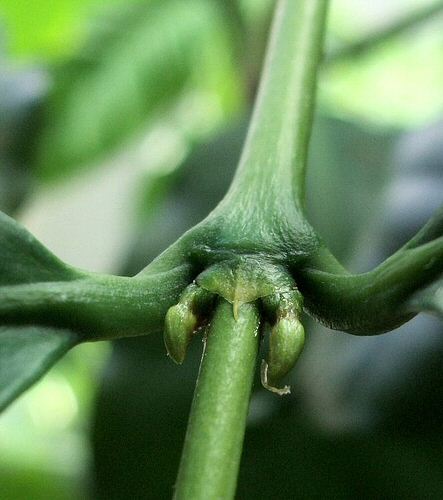
Buds! Present on three of the five Panama plants so far. Conceivably, these could be leaf buds, but I’ve never had leaves emerge from the axils before.

Uno gato (Juniper) for scale. She has munched her share of coffee leaves, and I have to take care to keep her off the finca. Naughty girl.
I’m pretty sure these are all caturra, except one tall, rangy plant that may be typica or even geisha. It was from an area where all three varieties were being grown. However, this plant is growing in a heavier garden soil (I ran out of potting soil when I was transplanting) and also spent one winter on the windowsill versus under lights. Not sure that would account for the different growth style or not. Opinions welcome!

Typica rather than caturra? I had already pruned off about 8 inches from the top and some of the side branches prior to this photo.
Last month, I picked up more cherry in Nicaragua. Since I’m running out of room here at Finca Dos Gatos, I decided to only try starting some yellow cataui from El Jaguar. I also picked up only a couple of cherries I found from coffee growing wild in the forested part of Selva Negra, right next to the spot where I saw my first Resplendent Quetzals. I thought a coffee plant from that location would be a great memento.
Tom Owen at Sweet Maria’s has a nifty guide to coffee growing at home.
UPDATE: I’ve given a photo update in late October 2011.
 The last word on Keurig single-cup brewers
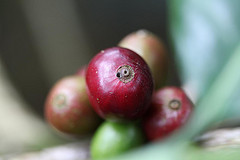 The featured insect of the week at the North Carolina State University Insect Museum blog is the coffee berry borer (Hypothenemus hampei, a.k.a. “la broca”), the extremely tiny insect with the enormous impact on coffee worldwide. The post outlines the life cycle of the CBB, which is frankly fascinating, from an evolutionary and entomological perspective.
 We have just returned from a 10-day trip to Nicaragua, where we did insect and bird surveys, and bird banding, at two great coffee farms, Finca El Jaguar in Jinotega, and