Coffee news and miscellany

Sips: Season of giving

In the past, I have provided some suggestions for holiday gifts — great coffee- or bird-related charities as well as more conventional gifts for sustainable-coffee lovers. Here are my 2010 suggestions, which focus on helping people in coffee-growing communities.

  • Sustainable Harvest International works in Belize, Honduras, Nicaragua and Panama. Through projects with organic vegetable gardens, wood-conserving stoves, and biogas digesters, SHI works in rural communities to preserve tropical forests while overcoming poverty.  You can support their work by contributing through AlternativeGifts.org to SHI’s sustainable farming project, which funds the planting of shade agroforestry crops such as coffee and cacao. You can also donate directly through their web site to that project, or others including funding women’s loans and wood-conserving stoves.
  • Speaking of stoves, David Pohl of Equator Coffees recently wrote a great piece at Huffington Post outlining the huge problem in coffee-growing (and other rural) communities with primitive cooking methods that endanger health and the environment. This is a serious and widespread problem with straightforward solutions. One way to help is to donate to the Global Alliance for Clean Cookstoves.
  • Support organic farming — including coffee — in Chiapas, Mexico. This project is coordinated by International Development Exchange (IDEX), a grant-making non-profit that works with local organizations. You can donate via the Global Giving website.
  • Grounds for Health provides cervical cancer screening in coffee-growing communities, and Coffee Kids [now under a larger foundation] has a wealth of programs in coffee communities in Latin America supporting education, health awareness, microcredit and food security.

Peace this holiday season.

Sips: Starbucks news

Some recent news from/about the Mermaid.

  • Starbucks plans to develop its own coffee farm in Yunnan, China. A move I think is (relatively speaking) good news for the environment there. In my post on coffee growing in China, I noted deforestation and high chemical use are problems with coffee growing in China, which is dominated by Nestlé for instant coffee. I also mentioned that Starbucks used Yunnan-grown arabica in one of their local coffees; the quality was not up to snuff for a single-origin offering and it had to be used in a blend (“South of the Clouds”).  Starbucks wants to increase quality, and will be training farmers and will establish a farmers’ support center, (its third globally, others are in Costa Rica and Rwanda). The growing operation will no doubt have meet the standards of the rest of their suppliers, which include very good environmental criteria. This has to be an improvement over what I believe is the norm for coffee growing in China.
  • First, Starbucks announced it was terminating its partnership with Kraft, which has distributed The Mermaid’s coffee to grocery stores since 1998. Kraft was unhappy. This sparked speculation that Starbucks might want to expand in the single-cup market (currently the closest it comes is with its Via instant coffee). Green Mountain Coffee Roasters was the presumed partner, since the main alternative is Kraft’s Tassimo brand. Then Starbucks announced it would launch its own single-brewer. Stay tuned.
  • GreenBiz.com had a nice article on Starbucks’ green buildings initiative, featuring LEED-certified buildings, including a roasting facility and all new retail stores. More at the Starbucks web site.

Sips: Coffee "CSA", la broca, farmer education, co-ops and cash

I always come across items that might be of interest to readers that deserve more than just a Tweet (@birdbarista) but not quite a whole post. Hence the debut of the "Sips" feature.

  • San Rafael Sustainable Coffee Initiative: Interesting riff on direct trade/CSA model. Provide micro-loans to three farms near San Rafael, Costa Rica, get coffee when the crop is harvested. Coffee isn't certified organic, but no pesticides or herbicides are used. Farm photos and videos on the site look shadier than most in Costa Rica.
  • La broca (coffee berry borer) found in Hawaii: Bad news. It's also turned up in Puerto Rico. More on la broca control here.
  • Project First Taste: Many coffee farmers have never tasted their own coffee, and they can't make quality improvements or business decisions because of it.
  • What do high market prices mean for cooperatives? Understanding how the cooperative system works and is impacted by the C market.


Birds on coffee

I talk about birds in coffee a lot on this site– how birds use and need the resources provided in shade coffee farms is the inspiration for the site. How about birds on coffee…labels and logos?

First up, coffee roasting companies named after birds.

Caffe Ibis – White Ibis

Black Stilt Coffee Lounge

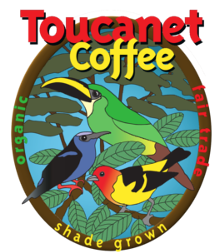
Toucanet Coffee – Three birds: an Emerald Toucanet, Red-legged Honeycreeper, (both tropical species) and Western Tanager (breeds in North America, winters in the tropics).

And here’s a sampling of birds on coffee packaging.

Thanksgiving Coffee Company – Songbird Coffee series in partnership with the American Birding Association. Top = Wilson’s Warbler, Black-throated Green Warbler, and Indigo Bunting; Bottom = Ovenbird, American Redstart, and Baltimore Oriole. All North American breeding birds that winter in the tropics.

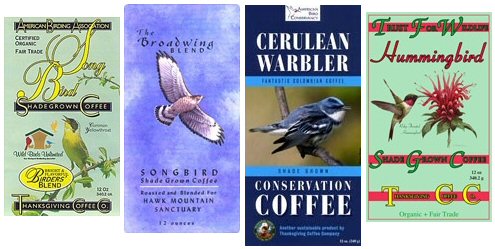
Thanksgiving Coffee Company – More partnership coffees. Common Yellowthroat on Birder’s Blend (Wild Birds Unlimited); Broad-winged Hawk on Broadwing Blend (Hawk Mountain Sanctuary); Cerulean Warbler on Conservation Coffee (American Bird Conservancy); and Ruby-throated Hummingbird on Trust for Wildlife. All North American breeding birds that winter in the tropics.


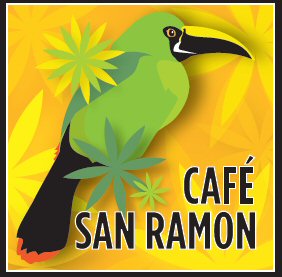
Counter Culture Coffee,Café San Ramon — Emerald Toucanet, a tropical species. I have to say, this is my personal favorite because Counter Culture asked me to help them identify an appropriate species for this product and this was one of the first choices. Plus, I’ve actually seen this species on the very farm that is the main source of this coffee.


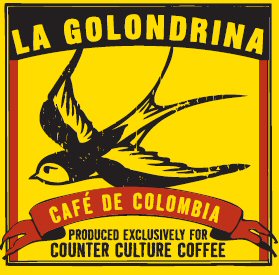
Counter Culture Coffee, La Golondrina – a swallow. There are many swallow species, both resident and migrants to the tropics. According to Counter Culture, a swallow was chosen as in Latin American culture, the swallow is a symbol of communication between people separated by distance and borders.


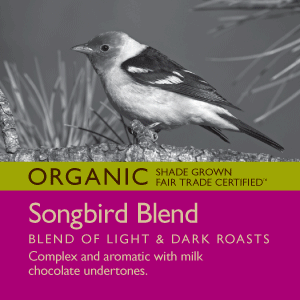
Tony’s Coffee and Teas, Songbird Blend. Another Western Tanager.


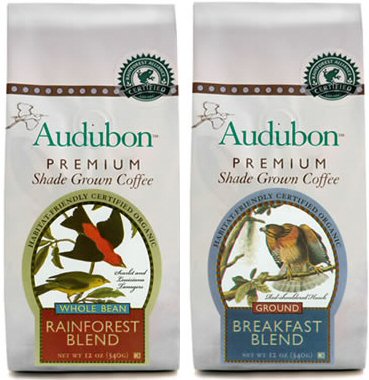
Audubon Coffee, Rainforest Blend and Breakfast Blend. Scarlet Tanager and Broad-winged Hawk. Both North American breeders that winter in the tropics. These are both portions of paintings by John James Audubon.


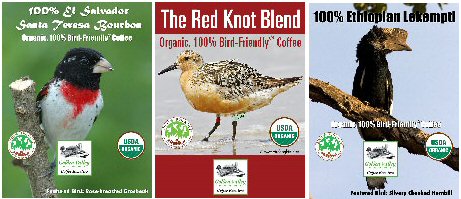
Golden Valley Farms has nearly a dozen Smithsonian Bird-Friendly certified coffees featuring birds on the packaging. Here are just three. The El Salvador Santa Teresa Bourbon has a Rose-breasted Grosbeak, which breeds in North America, winters in the tropics. The Red Knot blend shows a shorebird of the same name, which makes one of the longest migrations of any bird, from the Arctic to Tierra del Fuego. This coffee raises funds for this species, which has experienced dramatic population declines. Finally, their Ethiopian Lekempti has a hornbill on the package, probably a Silvery-cheeked Hornbill. These striking large birds nest in cavities, and they restrict the entrance to their nest holes with mud, droppings, and fruit pulp. The female becomes sealed inside while incubating eggs and tending to young, with the male passing food through a small hole. The female breaks out when the nest hole gets too crowded.

Know some other roasters or coffees with a cool bird as a logo? Let me know in the comments!

Transparency via smartphone apps

One of the great dilemmas in educating consumers about sustainable coffee is how to fit a lot of sometimes complex information on a bag of coffee. The point of purchase is where the rubber hits the road — it’s probably the first and/or last place to inform a potential consumer where the coffee came from and how it was grown, purchased, and processed.

Certification schemes are designed, in part, to help consumers in this regard by assuring them that their coffee (or other product) was produced under some particular condition: all the consumer would need to do is recognize the “seal” of the certifier. Unfortunately, the proliferation of different certifications has led to consumer confusion and “label fatigue.”

Now a new option is coming along, an extension of our electronic age that takes advantage of the near-ubiquity of smart phones in the First World: two dimensional (or 2-D) codes, especially QR codes. QR (for Quick Response) codes are 2-D codes that can store more information than a 10-digit bar code. A QR code on a coffee package or shelf display can be photographed by any phone with a camera. A free app rapidly processes the image and on an Internet-enabled phone transmits data back to the user. Usually, this means opening a web site where all kinds of information about the coffee can be relayed to the consumer: certifications, photos of the farm, roasting date, cupping reviews…and the list goes on.

Anyone can create QR codes pointing to web sites, contact information, or simple text for free. The code in this post is the URL to a mobile version of Coffee & Conservation’s RSS feed. If you have a smart phone, install a reader app, take a photo of the code, and give it a try. (And don’t forget to bookmark C&C on your mobile browser!)

On my Blackberry I use the reader from ScanLife, the company that will be working with Utz Certified to bring information about Utz coffees at a very large retailer in North America in the near future. Despite the enormous popularity of QR codes in Japan and some other countries, I think this will be the first major application of this technology in the U.S. — certainly it is for coffee.

Starbucks has been testing 2D codes for payment (essentially simulating a Starbucks card) in some markets. Canada’s Ethical Bean Coffee went with a 2D code that also requires an iPhone and free iPhone app to read. It allows access to farmer, harvest and country of origin information, as well as certification documents, roast details, cupping notes, video and photo logs of all Ethical Bean coffee offerings, so it is more in line with the vision of transparency and consumer information outlined above.

This mobile technology obviously has huge potential for consumer education. I hope more specialty coffee roasters experiment with using QR codes — that work on apps available on multiple platforms for maximum universality — on package labels to provide sustainability information.

Counter Culture Coffee transparency report

Counter Culture Coffee has just released its first annual Transparency Report, covering 2009. Simple, straightforward, five pages describing each of CCC’s Direct Trade coffees, including the date of the last farm visit by a CCC employee and how much they paid for each coffee in 2009. This, IMHO, is the future of coffee: roasters providing all the information a consumer could want or need to choose their coffee wisely and with a clear conscience.

Scenes from SCAA

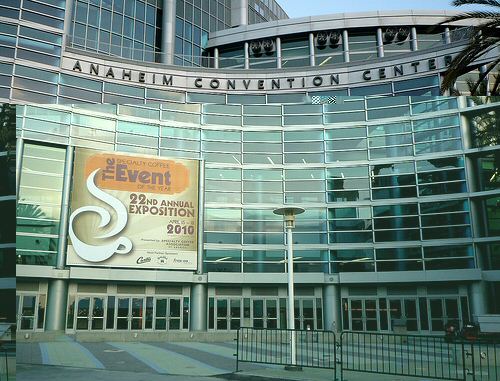
Every so often there needs to be a break from the serious and educational for something a little more fun and personal. Here are some photos from the recent Specialty Coffee Association of America (SCAA) event.

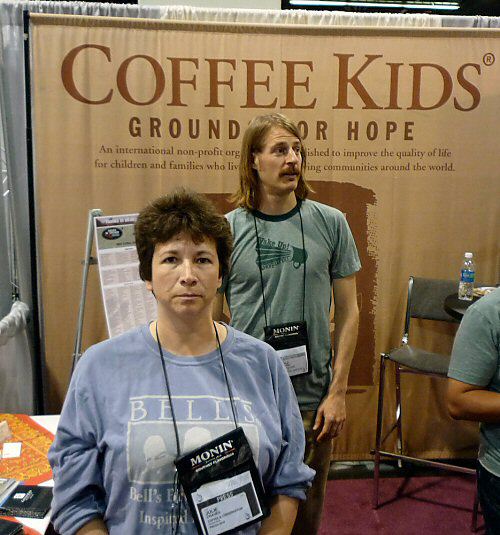
First off, we had to stop and visit our friend Kyle, at the Coffee Kids booth. This is an awesome charity, and Kyle is awesome as well. In fact, this photo has a backstory. Check it out.

Andy Sprenger is the roaster at Caffe Pronto in Annapolis, MD. Andy is a birder and former field biologist, and we’ve been in touch for years now. Yet, we’d never met. He tracked us down when he recognized the slogan on my husband’s Rouge River Bird Observatory t-shirt! Julie: “A light-roast Central is best before a spring bird walk.” Andy: “No way. A blend with some Peru boosts your flycatcher ID skills.” [Stand off.]

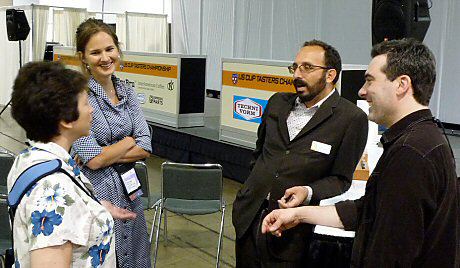
Andy competed in the U.S. Cup Tasters Championship, where he came in third place (second last year). This is a fast, fun competition where people have to pick the odd coffee out of eight flights of three cups. We found it more enjoyable to watch than the U.S. Barista Championship, which is much slower and more serious.

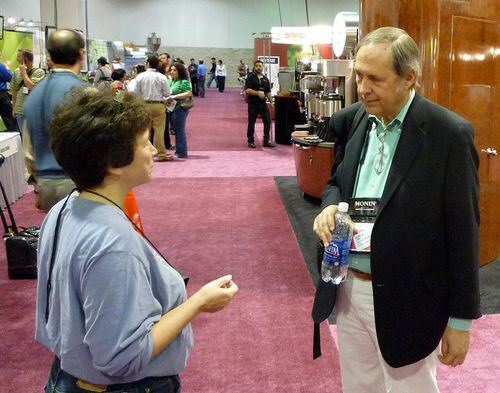
I’m in the odd position of not being in the coffee industry, but counting among my coffee friends some of the VIPs of coffee. I can’t tell you how much I’ve learned from Counter Culture Coffee’s sustainability and producer relations manager Kim Elena Bullock, Counter Culture director of coffee and co-owner Peter Giuliano and Intelligentsia’s VP of coffee and green coffee buyer Geoff Watts. They’ve been incredibly generous with their knowledge, and I’m very grateful!

If only George Howell of Terroir Coffee had been in the previous photo. Another VIP of specialty coffee who has been thoroughly patient and kind in answering my questions. I always enjoy catching up with him at these events.

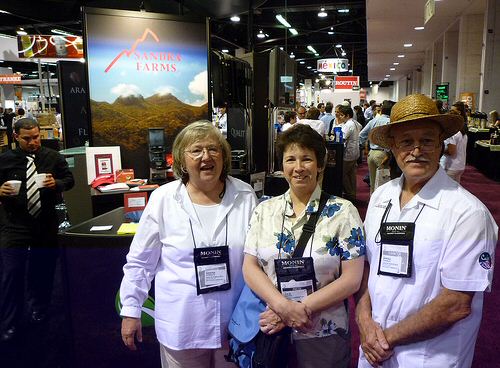
Meeting producers is a highlight of SCAA events. This is Sandra and Israel Gonzalez of Sandra Farms in Puerto Rico. They are the in-laws of one of my University colleagues and a supplier to Michigan roaster Rowster Coffee, so I have long wanted to meet them. What an incredibly charming couple! You’ll be hearing more about them and Sandra Farms in the future, because I know we will visit the farm when we go to Puerto Rico within the next couple of years.

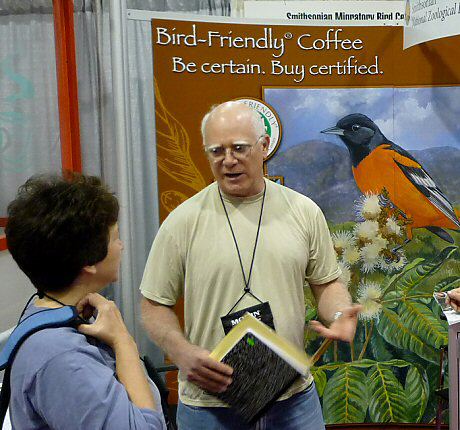
Of course, we have to stop by the Smithsonian Migratory Bird Center booth and say hi to our friend Dr./Mr. Robert/Bob Rice (inside joke), who runs the Bird-Friendly certification program. Aside from Andy Sprenger, there aren’t too many people at these events with whom we can talk coffee AND birds.

We were invited to a cupping of some Utz Certified Latin American coffees…

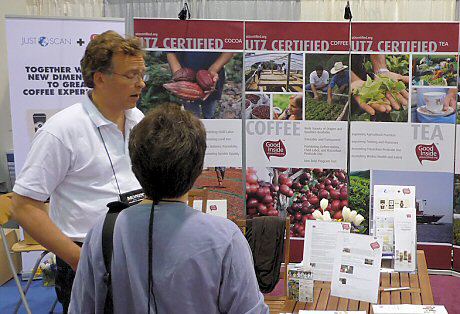
…and we got to spend more time talking with folks from Utz (Graham Mitchell here) about their certification. They have modified their standards since I last wrote about them, and I now have a better understanding of their goals and achievements. I’ll be writing more about them in future posts.

And we also spent time with the good folks from Rainforest Alliance, like Petra Tanos, who has been great about getting me information. RA rolled out an excellent implementation guide for Latin American coffee farmers, which I’ll be writing about, and told me about a couple of other upcoming initiatives that I am excited about — in spite of what the expression on my face might suggest. Believe it or not, there is a worse photo of me from this conversation!

We spent some time with folks from S&D Coffee. S&D supplies some McDonald’s and other restaurants and retailers, in addition to have several of their own coffee lines. I was impressed with their concern with sustainably-grown coffee, as evidenced by my conversation with two representatives from the importer Sustainable Harvest, who were at the S&D booth making deals. I am learning more about the import/export side of specialty coffee, as well as about the larger roasters and suppliers. Expect more on these topics as I incorporate this knowledge into my posts.

The foot soldiers of the specialty coffee industry are the roasters. Here I am talking trash (at the garbage bin next to the Barista Guild brew bar) with Chattanooga’s finest roaster, Bryan Dyer. Bryan is one of the funniest and sweetest coffee guys we know. We’ve met and befriended so many excellent people at SCAA events that we no longer wander around like aimless outsiders, but now have a full social schedule!

Aside from hob-nobbing, we attended several lectures every day on sustainable coffee issues, tasted a lot of great coffee, watched talented baristas do their thing, pondered many coffee-related products, and generally had a good time. I was invited to be on a panel on eco-certifications next year in Houston, and I hope we will be able to work it into our schedules. There’s this little conflict with spring bird migration and my day job…

Another endangered coffee relative

The genus Coffea has over 100 species other than the two commonly cultivated ones, Coffea arabica and Coffea canephora (robusta). New species are still being described, and over 70% of the species in this genus are threatened with extinction. There are other close relatives to Coffea, some of which are also extremely rare.

In honor of 2010 being the International Year of Biodiversity, the International Union for the Conservation of Nature (IUCN) is featuring a different endangered species every day. This week one of the species was a coffee relative.

Café marron (Ramosmania rodriguesii) exists in the wild as a single plant on the island of Rodrigues, part of the Mauritius islands in the southwest Indian Ocean east of Madagascar. It is surrounded by four fences. Cuttings are being propagated for a re-introduction program on to a nature reserve — the only hope in an island nation which has been nearly completely deforested. Success is not guaranteed, however. Not only is the in-vitro propagation process difficult, it sounds like the species faces problems even if it were to be re-established. The species account at the web site of the Royal Botanical Gardens at Kew (UK), which is leading the conservation effort, notes,

“As with much of Rodrigues’ native vegetation, it was probably a combination of introduced herbivores, invasive alien plants and habitat loss that devastated the Café marron population. Indeed, goats had reduced the remaining wild specimen to a small, half-eaten shrub when it was first discovered. Owing to the unprecedented level of scientific interest that surrounded the little plant in the aftermath of its re-discovery [in 1980], local people became convinced of the plant’s medicinal properties. Consequently, there was a period before the erection of multiple fences and even the installation of a guard, when people were intent on removing branches, twigs and leaves from the hapless plant.”

There is only one other species in the genus Ramosmania and it is also critically endangered.

Virtual hat tip to the Agricultural Biodiversity Weblog.

Sustainable instant coffee

I’ve been asked more than once about a source of sustainably-grown instant coffee. My usual reply is that there isn’t one. Understanding how instant coffee is manufactured will illustrate why the majority of the coffee beans that are used to make it are low-quality commodity coffee, and thus not a good option for consumers looking for coffee grown in an environmentally-friendly manner.

How instant coffee is made
Green coffee is brought to large manufacturing plants, often in the country of origin. Colombia, Brazil, and Mexico are the largest producers of instant coffee. At the factory, the coffee is roasted in large batches and ground. It then goes through multiple extractions using hot water under pressure. The resulting liquid is filtered and concentrated. Finally, the concentrated extract is dehydrated by either spray drying or freeze drying. Spray drying, in which the extract is spewed into an enormous tower and blasted by hot air, produces a fine powder. This powder must be “agglomerated” (other materials added to create familiar-looking granules that flow and dissolve more freely). Freeze drying creates clumps that resemble ground coffee, but the process is more expensive.

These production processes rob the coffee of most of the aroma. This is reintroduced by various combinations of natural or synthetic compounds, typically mixed with some type of oil, which are put back on the coffee particles prior to packaging in a process known as “replating.”

Why low-quality beans are used
The final goal of a specialty coffee roaster is great taste in the cup. To that end, they want carefully grown beans, processed properly at the mill, expertly roasted to bring out the best nuances of that particular bean.

The final goal of instant coffee is convenience. All the technology is aimed at leaching out all the water-soluble compounds to produce a product that looks and feels like coffee, but is quick and convenient to prepare.

This is the primary reason that low-quality beans are used for instant coffee: higher-quality beans with good flavor profiles would be used for the roast-and-ground market. Another way low-quality beans end up in instant coffee is because most countries don’t allow their lowest quality beans to be exported. Since instant coffee is often produced in the country of origin, it can be the final resting place of non-exportable beans.

Finally, instant coffees from the big corporate roasters such Nescafè’s Taster’s Choice (Nestlè), Maxwell House (Kraft), and Folgers (Smuckers) all contain robusta beans. Robusta is the lower-growing species of coffee (Coffea canephora) that is grown in large full-sun plantations. In some markets, some of these brands are 100% robusta (spray-dried instants are more likely to be all-robusta). In addition to the negative environmental impact of robusta plantations, these beans are considered inferior quality. To make robusta palatable, it generally must be steamed or treated in some way.

The big roasters not only use robusta, they will use very low-quality robusta. This article from Nestlè (a downloaded copy, since removed from their site)– incredibly boasting about quality — notes that they buy “coffee beans having eight percent to 16 percent triage.” Triage coffee, for the unsuspecting, is all the moldy beans, broken beans, sticks, stones, insect-damaged or rotten beans…all the stuff that is rejected or sorted out at the mill! [1].

The world’s largest producer of robusta is Vietnam, where it has been noted, “Wherever coffee was grown, forests have disappeared.” Brazil also grows a lot of robusta, but the variety grown there, called Conillon, is higher-priced than African- or Asian-sourced robusta. Côte d’Ivoire (Ivory Coast) is another major exporter. Côte d’Ivoire is the most biodiverse nation in west Africa, but has suffered severe deforestation and fragmentation, in part due to mass plantings of coffee and cacao in the late 1980s. Because of the time lag between environmental destruction and biodiversity loss (known as “extinction debt”), it has been projected that Côte d’Ivoire may still lose a third of its primate species.

In addition to being cheap, an additional motivation for manufacturers to use robusta is that it has a higher extraction rate than arabica. The rule of thumb is that it takes 2.6 kg of green beans to produce 1 kg of instant coffee. Manufacturers get a higher proportion of soluble materials out of robusta.

The authors of The Coffee Book: Anatomy of an Industry from Crop to the Last Drop put instant coffee in historical context:

“If in retrospect the coffee industry appeared to be out of its collective mind in pursuing the race for low quality, it is worth remembering that this blind love affair with consistency and technology was part of a larger cultural embrace of a mass-market modernism … Instant coffee was created by the same technophila that later produced technified cultivation systems.”

My mantra is generally that when it comes to the environment or farmers’ livelihoods, there is no such thing as “cheap” coffee. In the case of instant coffee, the cost of convenience and low consumer prices nearly always includes habitat loss and crappy proceeds to farmers.

One exception may be the new Starbucks VIA Ready Brew.  The majority of Starbucks beans are sourced under their C.A.F.E. Practices supplier guidelines (with a 100% goal by 2015), which use 24 criteria based on over 200 social and environmental indicators. I’ve received no confirmation so far that the beans used in VIA are part of this program.

[1] For a couple of discussions on how the use of this extremely poor quality coffee drags down the entire coffee industry, see this statement to Congress by the former SCAA director (scroll down halfway) and the post and comments on this blog post by Sweet Maria’s Tom Owen.

Photo from iStockphoto.
My year in beans: 2009

Last year I kept track how much I paid for coffee over the course of 2008. This year, I kept even more precise numbers. Here are my 2009 stats:

  • 81 bags of coffee totaling 63 pounds; I probably gave away or shared 5 to 8 pounds.
  • Total retail price = $1031. I purchased very few bags locally, so I also spent $129 on shipping, for a grand total of $1160 for the year.
  • This still works out to only $0.45 per six-ounce cup.

This isn’t even a good example of how little you have to spend to drink great, sustainably-grown coffee, because I’m pretty self-indulgent. I drink a lot of fine coffees, with 13 in 2009 retailing over $20/lb. The most expensive was a Bolivian Flor de Mayo from Terroir Coffee, which was the equivalent of $55.90/lb. All but 6 of the coffees were single-origin, and they came from 19 countries and 20 roasters. I know I’m not a typical coffee drinker.

Let’s say you order from Birds & Beans, which only sells organic, SMBC Bird-Friendly certified coffees, and donates a portion of profits to bird research and conservation. Their coffees retail for $19.95 for 2 pounds. If you drink (and gift) as much coffee as I do, that’s $618 a year in coffee. They charge a flat rate of $8 for shipping, so even if you order twice a month (they have a handy subscription service so no matter what you want or how often you want it, you don’t even have to think about it), that’s
another $192, for a total of $810 a year, or $0.31 per six-ounce cup. Amber at Birder’s Lounge decided to keep track of her shade-grown coffee consumption last year, too, and only spent $0.40 a cup.

For most people, it’s a myth that environmentally-friendly, sustainably-grown coffee is too expensive. And given the number of great roasters providing subscription services similar to the one described above, it’s also a myth that environmentally-friendly, sustainably-grown coffee is too hard or inconvenient to get.

I’ll conclude my New Year’s crusade against cheap coffee with the words of Geoff Watts, which appeared in a comment in a post at Hungry Magazine (which may now be defunct). Geoff is Vice President of Coffee and the green coffee buyer for Intelligentsia Coffee, spending the bulk of his year on coffee farms with producers. My emphasis added.

“The mainstream first-world consumer has held stubbornly to the idea that coffee is a cheap luxury, that  the $1.00 bottomless mug is somehow a right or a deserved privilege. It is this very attitude that will continue to ensure that the modern smallholder coffee farmer has little hope of escaping a life of extreme poverty. Cheap coffee (and by ”cheap” I mean low cost, which typically equates to low quality) is one of the many forces shackling the developing world and suppressing opportunity for advancement for a huge chunk of the planet’s population who depend on coffee to make a living.

And while of course it makes sense to be thrifty in difficult economic times, we still need to realize that the decisions we make will have an impact further down the line. For a consumer the choice to purchase cheaper coffee has ramifications that extend far beyond the personal sacrifice of taste in favor of lower cost. It impacts the way coffee is produced, the way it will be produced in the future, and the ability of those who produce it to earn a living wage from their efforts.”

How can you not afford to drink environmentally-friendly, sustainably-grown coffee? Make this your resolution for 2010.

Very special promo on Counter Culture Holiday Blend 2009

My holiday fundraiser for the Smithsonian Migratory Bird Center

One of my favorite coffees is Counter Culture’s Finca Nueva Armenia from Guatemala’s Huehuetenango region. We reviewed it in November 2008. Here are some quick facts about this coffee:

  • Although it is not marketed as such by Counter Culture, this is a certified Bird-Friendly farm, meeting the highest shade and biodiversity standards available for coffee. You can verify this status at the Smithsonian Migratory Bird Center (SMBC) web site; just click on “Guatemala.”
  • It’s certified organic (this is also a requirement for Bird-Friendly certification).
  • As a family-owned farm, Finca Nueva Armenia doesn’t qualify for Fair Trade certification, which only covers small farmers that are part of a cooperative. However, this coffee is Counter Culture Direct Trade Certified, in which Counter Culture pays a minimum price that is well above the Fair Trade floor price, plus quality incentives. Price and other aspects of the program are certified by a third party.

Finca Nueva Armenia has remained consistently delicious the last several crop years. So I was thrilled to find out that Counter Culture has decided to use this coffee as their 2009 Holiday Blend. As they have done in the past, Counter Culture’s “blend” is not composed of coffees from different origins, but a single origin roasted using a European technique called Vienna MÁ©lange, in which different roasts are mixed and blended. You can read more about this technique here.

This year, for each bag of Holiday Blend sold, Counter Culture will be donating $1 to a native tree-planting project. Acting on a suggestion by the SMBC, the Recinos, owners of Finca Nueva Armenia, want to incorporate more fruit-bearing and canopy trees in the coffee production areas. These funds will help cover costs of collecting seeds from native trees, raising them in their nursery, and planting and tending them. So far, they have 7500 seedlings.

I want you to support this tree-planting effort; support the Recinos family’s commitment to growing organic, shade-grown, Bird-Friendly coffee; and I want you to try this fine sustainably-grown and sourced coffee.

For every bag of the Finca Nueva Armenia Holiday Blend purchased by a Coffee & Conservation reader from now through December 21, 2009,  I will donate $1 to the Smithsonian Migratory Bird Center*.

The Holiday Blend is $11.75 for a 12-ounce bag. That’s $0.65 for a cup of great coffee. Counter Culture is now offering a $3 flat rate shipping for all orders — so even if you only order a single bag, it is still only $0.82 a cup (calculate it here yourself).

Order it here, and put your money — and mine, and Counter Culture’s — where our hearts are: in support of a great future for great coffee and the birds and biodiversity that depend on it.

UPDATE: I rounded up and contributed $50 to SMBC…I wish more people had cooperated, and am up for ideas on how to run a similar promotion next year.

*The Fine Print. Send me a copy of your order via email (coffeehabitat AT gmail.com). I’ll just note how many bags of the Holiday Blend you purchased so I can keep track, then I’ll delete it. It does not contain your credit card information (but feel free to strip out the payment section if you like) and I won’t save any of your personal information. I am a modestly-compensated ecologist, so I’ll have to cap this at $250, but feel free to make me fork over every penny. Does anybody care to join me in this effort with a match in part or whole? Send me an email!  This promotion was entirely my idea, and I am not receiving any compensation for this promotion from Counter Culture.

Coffee: The World in Your Cup is hitting the road

Coffee: The World in Your Cup is an exhibit providing a broad overview of the powerful influence of coffee on environments, human cultures, and economies worldwide. For nine months this year it was at the organizing institution, the Burke Museum of Natural History and Culture, in Seattle. Now it is going on the road.

The exhibit, done in collaboration with the University of Washington, the Smithsonian Migratory Bird Center, Seattle University, Seattle Audubon, and the Specialty Coffee Industry, includes videos, photographs, and coffee tastings from local roasters. The web site describes some of what visitors learn:

Coffee explores the environmental and social impacts of the coffee industry and recommends ways for consumers to make socially and environmentally responsible coffee purchases at the grocery store or in a coffee shop. Concerned about how coffee affects human health? Learn about the impacts of caffeine, the world’s most commonly-used drug, on your body. Curious about how coffee became so popular? Discover its early controversial reputation as a “revolutionary drink,” and consider the culture that surrounds coffee in the twenty-first century.

Here is the current schedule:

This exhibit was so popular at Burke that it was extended three months beyond the initial run. If you have attended or do attend, drop a note in the comments regarding your impressions.

Shade coffee at HowStuffWorks

There’s an article up on the popular Discovery web site HowStuffWorks on shade coffee. The author contacted me a couple of months ago; Coffee & Conservation is cited frequently as a resource (under the common alias “Coffee Habitat”) and my photos of Finca Esperanza Verde from this post are used in the sections “Growing coffee in the shade” and “How shady is shade coffee?”

Speaking of Finca Esperanza Verde, the new crop is now available from Counter Culture Coffee as Cafe San Ramon. I can personally vouch for the shade, birds, and biodiversity present on this farm. I’ve just started drinking my first bag, and it’s excellent as always.

Shade-grown coffees at Coffee Review

For August 2009, Ken Davids’ Coffee Review takes a look at shade grown coffee. First he describes the definition of the term “shade grown” and goes on to provide reviews of 12 coffees that scored 89 or over. Three were Smithsonian Bird-Friendly certified coffees, others were not certified, but grown under various levels of shade.

There were four coffees earning the highest mark of 92 points:

  • Counter Culture’s Finca Nueva Armenia (Guatemala). Certified organic and Bird-Friendly, this is one of my all-time favorite coffees. I reviewed last year’s crop, and this year it tastes even better. Ken describes a “slight hint of fruit ferment” that I find gives this year’s crop an extremely interesting, deep-toned, subtle wine-like complexity — it’s fantastic! I can be accused of giving a lot of love to Counter Culture, but I can assure you I recommend them and their coffees simply because they just do a bang-up job. Go buy this coffee!
  • Arbor Day Specialty Coffee Mexico ISMAM Co-op. Certified organic and Fair Trade. Coffee is traditionally grown under mixed shade in this region, and one or more of the many farms in this co-op (but not all) is or has been Bird-Friendly certified. I reviewed the Arbor Day Blend, which is sourced either from this co-op, or Nubes de Oro (which scored 91 points in this issue of Coffee Review). I wasn’t as enthused about either of these coffees as Ken, but suspect it was due to the crop I sampled being a little long in the tooth. I don’t see any way on their web site to order either of these Mexican coffees as a single origin, but you can go to the Arbor Day coffee web site and browse around.
  • Ecco Cafe Brazil Santa Terezinha. Organic. Santa Terezinha is indeed one of the only Brazilian farms that makes much use of shade; you can read more about the farming techniques at the blog of the importer, Sustainable Harvest. All the coffees I’ve had from Ecco Cafe have been excellent. I’ll be grabbing a bag of the Santa Terezinha with my next coffee order.
  • Flying Goat, Siberia, El Salvador. Certified organic, typically grown under shade in this region.  A classic, sweet Central from one of my favorite origin coffees.

There are other very nice sustainably-grown coffees in the list, many of which I’ve had and enjoyed. Go take a look at the reviews, the article, and while you’re there, the rest of Ken’s informative and authoritative site.