Coffee awards and competitions

Caribou Coffee wins Roaster’s Choice award

In a previous post, I mentioned that one of my favorite aspects of the recent SCAA conference was tasting the ten finalists in the Roasters Guild 2008 Roasters Choice Tasting Competition. The theme was Single Origin coffees, and 36 members of the Roasters Guild participated in the event by submitting roasted coffee. Voting was open to all conference attendees (nearly 8000!).

The winner: Caribou Coffee’s Roastmaster’s Reserve: Ethiopia Yirgacheffe. When I tasted this coffee (blind) I knew it was an Ethiopian, and I enjoyed the understated berry notes. And although I like Ethiopian coffees, I wouldn’t opt to drink one daily, which I considered a requirement for my vote. With so many great artisan roasters participating, many with very special microlots, I couldn’t help but be surprised that Caribou took top honors. I think this says a lot about this company. I’m not the only person who thinks Caribou does a fine job and is underappreciated for it. Check out these posts from the Coffeed forum, from both late last year and after the competition. Congrats, Caribou!

The full list of the winners is below.

I mentioned that #103 was my favorite, my second pick was #111. I knew 103, a Colombian microlot, was a classic from Latin America, but I thought that 111 was also. For a Rwandan, 111 was quite sweet and chocolately. I also love Kenyan coffees, but have to admit that 109, the third place Kenyan from The Roasterie, was one of the most difficult to categorize coffees I’ve tasted lately, and we tried it over three days. I thought it might be Sumatran, because for me it had some sort of vaguely sour earthy flavor. I wrote on my sheet “What is this?!”  Kingfisher’s top pick was #104, the Tanzania (I pegged that origin blind, too!).

  1. RC102 — Caribou Coffee — Ethiopian Organic Yirgacheffe
  2. RC106 — Sweet Maria’s — Rwanda Gkongoro Nyarusiza
  3. RC109 — The Roasterie — Kenya Jambo Estate
  4. RC104 — Berres Brothers Coffee Roasters — Tanzania Peaberry — Songea
  5. RC105 — Dolce Gourmet Gelateria & Café — Panama — City Roast
  6. RC103 — Tony’s Coffees and Teas — Colombia — Tolima Microlot — Gaitania Cyerposo
  7. RC108 — Lexington Coffee Roasting Company — Rwanda Bufcafe
  8. RC107 — Bear Creek Coffee — Papua New Guinea
  9. RC110 — Vermont Artisan Coffee & Tea — Ethiopian Sidamo — Organic Fairtrade
  10. RC111 — Cuvee Coffee Roasting Company — Rwanda – Bucafe

Meanwhile, in an adjacent room, judges were cupping the entries in the 2008 Roasters Guild Coffee of the Year Competition.

The winner list is after the jump. A Colombian entry won first place, bumping Hacienda La Esmeralda to second place after winning the competition the last three years. I was pleased to see a Domincan Republic coffee in the top ranks. I would provide more links and information about the winners, but the list is so generic that I am unable to get more specifics.

1. C.I. Racafe & CIA S.C.A., Colombia (placed 11th last year)
2. Hacienda La Esmeralda, Panama
3. Volcafe Specialty Coffee, Ethiopia
4. Sidama Coffee Farmers, Co-Op Union, Ethiopia
5. San Rafael Pacun/ Cafetalera El Tunel S.A., Guatemala
6. Agropecuaria Salfar S.A./ San Sebastian, Guatemala
7. Agoga Plantation Limited, Papua New Guinea
8. Finca La Ilusion-Café de El Salvador, El Salvador (2008 Cup of Excellence winner)
9. Federacion Nacional de Cafeteros de Colombia, Colombia
10. San Jose Ocana, Guatemala
11. Big Island Fine Coffee, Hawaii
12. Kona Coffee Plantation, Hawaii
13. Consejo Dominicano Del Café (Natura Bella), Dominican Republic.
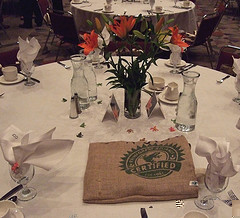
SCAA Sustainability Awards

The Specialty Coffee Association of the Americas (SCAA) presented its annual awards last night. One is the Sustainability Award, which honors individuals, businesses or organizations in the coffee industry that have created innovative projects to expand and promote sustainability.

And the winners are…

Essent Energy Trading and Solidaridad (The Netherlands) — for their partnership to use coffee husks (compressed into pellets) as biofuel. I wrote about this initiative late last year. At the time I wondered about the energy efficiency of shipping the pellets from Brazil to the Netherlands, where the biofuel is used. At the awards ceremony, it was explained how innovate this idea was to begin with, so the best source for this Dutch company (which originated the idea) was large producers in Brazil. It has been so successful that they did, in fact, state that in the future they hope to be using coffee husk biofuel to produce electricity in Brazil and other places in Latin America.

Another clarification: in the previous post I surmised that by “coffee husk” they meant just the parchment. From the short infomerical shown and the acceptance comments, it appears they mean the whole coffee skin and pulp. They mentioned how piles of coffee residue produces high pH leachate that can contaminate water and soil, and that the rotting piles produce methane, a greenhouse gas. Those facts, in addition to the fact that coffee pulp is not an animal feedstock or human feed source, makes it a really “green” biofuel with a lot of potential. Congrats to Essent and Solidaridad.

Alianza para la Sostenibilidad (APS) / Sogimex SA / Ecom Agroindustrial Corp Ltd. (Honduras) — for their efforts to increase sustainability efforts among specialty coffee producers in Honduras. The goals was to achieve overall sustainability throughout the coffee chain in Honduras, obtain critical certifications, and offer technical assistance to impact producers in the region. It’s been a huge success.

Honorable mentions went to Finca Selva Negra in Nicaragua for their waste water program, and Brazil’s Fazenda Ambiental Fortaleza for their overall focus on sustainability.

Past winners:

2007 — Poabs Organic/Biodynamic Estates, India; Selva Negra Coffee Estate, Nicaragua; International Paper Company and Green Mountain Coffee Roasters; SOPPEXCCA, Jinotega, Nicaragua.

2006 — Sustainable Harvest Coffee Importers; Timothy’s World Coffee & Embera-Chami Coffee Community.

2005 — Las Nubes Coffee; Portland Roasting Company; Starbucks.

2004 — Thanksgiving Coffee Company; Dean’s Beans; ForesTrade;
PPKGO.

Rainforest Alliance Cupping for Quality winners

My husband and I attended the Rainforest Alliance Sustainable Coffee Breakfast this morning, at which the winners of the fifth annual “Cupping for Quality” event were announced. These awards recognizes Rainforest Alliance (RA) certified coffee farmers dedicated to growing top quality beans, while protecting the environment and the rights of workers.

The first year of the competition, eight countries participated submitted 40 coffees to be judged. This year, 90 RA certified farms in 11 countries participated; judging was held last month in New York and Long Beach, CA. Coffee from 94 percent of the participating farms received scores of 80 or above.

The top scoring farms that received scores of 85 or above are listed below. I’ve provided links or additional information if available.

  • Hacienda La Esmeralda (Panama) — 89.93. This is not the famous geisha Jaramillo Especial coffee which I wrote about here, but I did discuss their sustainability initiatives. Although the sustainability section of their web site has not been substantially updated recently, I have read more about the work of the Peterson’s (owners of
    Hacienda La Esmeralda) and think they are doing a good job.
  • COMISAJUL (Cooperativa Mixta San Juancito Limitada) La Montana (Honduras) — 87.22
  • Daterra — Boa Vista (Brazil) — 86.58.  I wrote about Daterra here.
  • Grupo Yariguies (Colombia) — 86.32. I believe these producers are in Santander province, in the region where the Cerulean Warbler preserve is located. Terrific!
  • Aguadas (Caldas, Colombia) — 86.08
  • Victoria (El Salvador) –– 85.98
  • Carmen Estate (Panama) — 85.55. I wrote about Carmen Estate in a review here. This is one of only five farms that have participated in this competition every year so far.
  • Coagro Brisas (Colombia) — 85.50
  • Finca Arroyo Negro (Chipas, Mexico) — 85.46. More info here.
  • La Merced (Colombia) — 85.25
  • Finca San Luis (Colombia) –– 85.13
  • Santa Rita (Jinotega, Nicaragua) — 85.00. I think this is the same producer that is also Utz Certified.

Below, I’ve listed the top three scorers (fewer means there were fewer than three farms competing) from each country.

Panama: Hacienda Esmeralda (89.93), Carmen Estate (85.55), La Fortuna (81.00)
Guatemala: La Retiro (84.93), San Diego Buena Vista (84.64), La Pampa (84.63)
Peru: Pronatur — Monterrico (84.81)
Costa Rica: Coopronaranjo R.L. (84.82), Cooperativa de Caficultores de Dota R.L. (83.31)
El Salvador: Lictoria (85.98), La Mecca (84.48), Santa Isabel (84.42)
Honduras: Comisajul La Montana (87.22), Cohorsil (83.67), Café Tierra (80.72)
Colombia (39 farms participating!): Grupo Yariguies (86.32), Aguadas (86.08), Coagro Brisas (85.50)
Tanzania: Uru Estate (83.48), Machare Estate (83.12)
Nicaragua: Santa Rita (85.00), La Bastilla (83.27), Momimboo (83.13)
Brazil: Daterra — Boa Vista (86.58), Fazenda Lambari (84.75), Fazenda Sete Cachoeiras Estate Coffee (84.35)
Mexico: Finca Arroyo Negro (85.46), Finca Santa Elena (81.35), Espana (80.25)

Roast Magazine’s 2007 Roasters of the Year

The November/December issue of Roast Magazine includes their picks for roaster of the year. (You can check out my posts on previous winners here and here.)

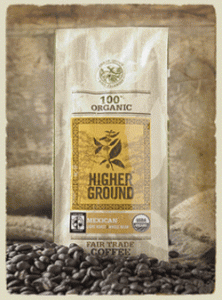
In the micro-roaster category (annual output less than 100,000 pounds) is Higher Ground Roasters.

Last May, C&C reviewed three of their selections and I discussed how impressed I was with their wide-ranging and thoughtful sustainability efforts. Roast was also impressed, especially taking into account the considerable challenges faced by Higher Ground on their home turf in Alabama, where specialty coffee is still a bit of a novelty.

The Roast article notes that because the company doesn’t have a retail location,

“Perhaps the biggest challenge Higher Ground faces is getting the coffee into people’s hands for the first time.”

Let me give them a hand and tell you that this is a great small company that deserves this honor, and you should certainly give them a try.


Roast awarded their macro-roaster award to Zoka Coffee Roaster and Tea Co. We have not reviewed any of Zoka’s coffees yet here at C&C, although I have tried a couple of them. Whereas all Higher Ground coffee is certified organic and Fair Trade, and shade-grown, Zoka does not restrict itself to certified coffees. But Zoka does carry a number of certified organic coffees (7 right now), strives for full traceability, and the Roast article goes on to say,

“…the buyers do make a conscious effort to visit farms and verify firsthand that the producers: 1) maintain a diverse and multi-level shade canopy (when appropriate) on their farms; 2) use natural, worm-generated compost made from cherry pulp at a micro-mill; 3) when necessary, use only parabolic dryers fueled by renewable sources rather than timber from surrounding forests; and 4) safely neutralize all the wastewater from wet mills.”

Congratulations to both of these worthy roasters!