Coffee awards and competitions

Roast Magazine Roaster of the Year

Roast Magazine has announced their Roaster of the Year winners. One of the major criteria for the award is showing a commitment to sustainability. As in past years, I’ll give a recap of the winners, focusing on their sustainability initiatives.

In the large (macro) roaster category, Equator Estate Coffees and Teas of San Rafael, California came out on top among 40 competitors. Founded in 1995 by Helen Russell and Brooke McDonnell, Equator has a focus on sustainability, with over half of their coffees being certified Organic, Fair Trade, Rainforest Alliance, or some combination of all three. On their excellent web site, you can read more about their eco-philosophy and social responsibility initiatives. Among them are these accomplishments that helped Equator win this honor:

  • Use of biofuel and hybrid vehicles for all deliveries.
  • Composting all of its coffee chaff and burlap bags.
  • Providing micro-loans to coffee partners around the world.
  • Purchasing its own farm in Panama, where they are in the process of growing
    sustainable coffee alongside a team of Panamanians.

Kickapoo Coffee took the award in the micro-roaster category (roasting less than 100,000 lbs of coffee per year) out of a field of thirty. Located in Viroqua, Wisconsin (in western Wisconsin, southeast of La Crosse), and founded only four years ago, Kickapoo buys about 80% of its coffee through direct relationships with small producers, aided in these efforts through its membership in Cooperative Coffees, a green coffee buying cooperative.

Kickapoo is one of the few roasters that uses distinctive reusable and recyclable cans, made from 80% post-consumer recycled steel. They also use sustainable materials in their larger coffee packaging, and have eliminated most plastic from their operations. Their roastery is located in an historic train depot, and was restored and is operated using sustainable practices — the roaster even has handmade belts supplied by local Amish craftsmen.

Oh, and Kickapoo roasts some kick-ass coffee.

SCAA coffee awards

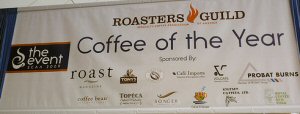
Two coffee competitions took place at the Specialty Coffee Association of America expo in association with The Roasters Guild: the Roaster’s Choice Tasting Award and the Coffee of the Year.

The ten Roaster’s Choice coffees were available for tasting during the expo and everybody was able to cast a vote for their favorite. We had a lot of fun with this last year. The competition was held in a more convenient location then, so we were able to go back more frequently to taste the coffees. Still, it was worthwhile to taste so many flavors in an array of coffees.

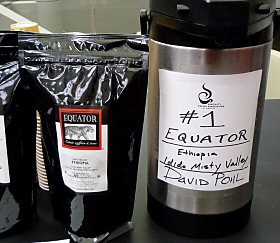
The results were interesting: half the winners Ethiopian, including the top three — two of which were from the same cooperative. Last year the number one coffee was an Ethiopian. The winners are below; I have more info on the top three because they were displayed at the expo. The rest are from a release from the SCAA that only lists the roaster and country of origin (see my comments at the end of the post). Update: I’ve added additional information received in the comments.

1. Equator Estate Coffee & Teas — Ethiopia Idido Misty Valley — roasted by David Pohl.
2. Caffe Pronto — Ethiopia Wondo Worka, Yirgacheffe — roasted by Andy Sprenger (Andy also came in 2nd out of 22 in the first U.S. Cup Tasters Competition, where folks compete to identify coffees in the shortest time in triangulation rounds). This coffee also received a 92 from Coffee Review. Talk about potently floral — wow.
3. Berres Brothers Coffee — Ethiopia Wondo Worka, Yirgacheffe — roasted by John Johnson. This was the only one of the top three that also made my top three. Also distinctly floral, but I like my Ethiopian’s a little more subtle.
4. Flying Goat Coffee — Costa Rica, Cafetin de San Martin micro mill, Terrazu, 2009 crop.
5. Barefoot Coffee Roasters — Ethiopi, Oromiya, Yirgacheffe, Dominion Trading Co. Certified organic. Reviewed at Coffee Review.
6. Tony’s Coffee and Teas — Sulawesi Toraja Peaberry Toarco.
7. Intelligentsia — Ethiopia Yirgacheffe, I presume their Direct Trade Kurimi.
8. Kaldi’s Coffee Roasting — Burundi Kinyovu.
9. Coffeesnobs.com.au — Bolivia Flor de Cafe San Ignacio.
10. Aroma Trading Co. — R&A Javar farms, milled by Pavaraga, Hawaii — roasted by Dan Tang. Exclusive rights on U.S. mainland to Kean Coffee.

Single origin coffees in the Coffee of the Year competition were evaluated by industry cupping professionals in several rounds over the weekend. There were 135 coffees entered. Here are the top ten, with the silly misspellings from the official SCAA press release corrected:

1. Colombia — C.I. Virmax Colombia S.A, Los Naranjos, San Agustin, Huila (88.66).
2. Panama — Hacienda La Esmeralda, Boquete (87.69). After winning first place in 2005-2007, this also came in second to a Colombian last year.
3. Ethiopia — Ninety Plus Coffee, Aricha Micro Selection 14, Yirgacheffe (87.03)
4. Colombia — C.I. Racafe & CIA S.C.A., Santa Maria, Huila (85.78). Racafe came in first place last year.
5. Kenya — Royal Coffee, NY, Gethumbwini Estate, Aberdare Ranges (85.72)
6. Guatemala — El Injerto, S.A., La Libertad, Huehuetenango (85.59). Rainforest Alliance certified; shade is rather low on native diversity, but there is forest reserve on the property as well.
7. Hawaii — Kailiawa Coffee Farm (sponsored by Ka’u Farm and Ranch Company LLC, milled by Pavaraga), District of Ka’u on the Big Island if Hawaii (85.05)
8. Colombia — C.I. Virmax Colombia S.A., La Piramide (Inza, Cauca) (85.00)
9. El Salvador — Exportadora El Volcan S.A. de C.V., Finca Shangrila, Apaneca/Ilamatepec Mountain Range (84.89)
10. Guatemala — San Diego Buena Vista, Acatenango (84.86). Rainforest Alliance certified, came in third out of the Guatemalan coffees in the Rainforest Alliance Cupping for Quality awards, where it scored 83.75.

Sorry, but I’m disappointed in the Roasters Guild and SCAA for the way they publicized the results of these competitions. It took a week for me to dig up the list of winners for the Roasters Choice awards; they didn’t even send a press released to registered media. As I noted, just a list of the roaster and country of origin. There were no other details on the coffee, nor did they give the numbers they were assigned in the blind tasting, so I can’t even tell you which one I liked the best. The press release for the Coffee of the Year was more prompt, but had several misspellings, which I corrected above. Really, it’s embarrassing for the SCAA not to correctly spell “Yirgacheffe.”
SCAA Sustainability Award 2009

The Specialty Coffee Association of America (SCAA) presented its annual awards last night. One is the Sustainability Award, which honors individuals, businesses, or organizations in the coffee industry that have created projects which expand and promote sustainability. Criteria include projects that are innovative and have social, economic and environmental aspects, that can be replicated at different scales, and are inspirational. This year’s award winning project certainly fits the bill.

The 2009 award goes to the ZERI Foundation’s coffee-pulp-to-mushrooms project.  Every coffee farm produces tons of coffee pulp — the final consumable portion of a coffee cherry is less than one percent, so most of the fruit is waste. Something has to be done with it, because it has the potential to pollute waterways if left to ferment and leach into streams. Usually, it is composted and then used as mulch and low-quality fertilizer.

ZERI’s project promotes the use of the pulp to grow mushrooms, which provide a protein-rich food for the community and generate income and jobs when marketed to grocery stores. After the mushrooms are harvested, the used pulp substrate can then be fed to goats, chickens, pigs, or other livestock, which in turn provide additional food as well as manure (to enhance compost).

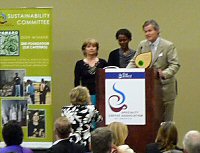
The ZERI Foundation (Zero Emissions Research & Initiatives) is a “global network of creative minds seeking solutions to world challenges.” The mushroom project was has a rather long an interesting history, which ZERI director Gunter Pauli outlined, along with two women instrumental in working on the project: Carmenza Jaramillo of Colombia and Chido Govero of Zimbabwe. Give it a read, because it is quite exceptional and demonstrates the potential of this project to greatly improve the quality of life in coffee communities — and beyond.

I have a summary of the 2008 winners here, which includes a list of past recipients.

Rainforest Alliance Cupping for Quality 2009

As we did last year, Coffee & Conservation attended the Rainforest Alliance Sustainable Coffee Breakfast at the SCAA annual show. The breakfast took place this morning. The winners of the sixth annual “Cupping for Quality” event were announced. These awards recognize Rainforest Alliance (RA) certified coffee farmers dedicated to growing top quality beans, while protecting the environment and the rights of workers.

This year, 80 RA certified farms in 11 countries (Brazil, Colombia, Costa Rica, El Salvador, Ethiopia, Guatemala, Honduras, Indonesia, Mexico, Nicaragua, and Panama) participated. Coffee from 94% of the participating farms received scores of 80 or above, although none scored over 89. The average score for the top 10 farms was 85.08; last year it was 86.39.

Here are the top 10 farms. I’ve provided links and information where available. After the country-based summary, I’ve concluded with some comments.

  1. Hacienda La Esmeralda — Panama (88.99). No surprise here, the Peterson’s farm nearly always grabs the top slot in any contest. Last year it also came in first in this competition, when it scored 89.93.
  2. Santa Elisa Pachup — Guatemala (85.74). In 2007, this farm came in 5th place in the Guatemala Cup of Excellence. From the photo on that site, it looks like the shade is rather sparse — shade monoculture or polyculture. However, 113 ha of the 493 ha total is forest, natural or in the process of being reforested.
  3. La Pampa — Guatemala (84.96). This farm didn’t make the top ten last year, with a score of 84.63.
  4. Finca Santa Anita — Costa Rica (84.92).
  5. Grupo Asociativo San Isidro — Colombia (84.58). A 93-member Fair Trade co-op from Huila. In 2004, researchers found the uncommon endemic Dusky-headed Brush-finch (Atlapetes fuscoolivaceus) in forested land owned by the cooperative.
  6. Sumatra Mandheling Rainforest — Indonesia (84.56).
  7. Fazenda Capoeirinha – Ipanema Coffees — Brazil (84.44). Fazenda Capoeirinha is one of three farms operated under the Ipanema name. This coffee is/was a component in Intelligentsia’s popular Black Cat espresso blend, and Ipanema Coffees are also used by Starbucks. From what I’ve been able to determine, this is not shade coffee but grown in sun like much of Brazil’s coffee.  Brazilian law requires habitat preservation, and the Ipanema web site at one point discussed a reforestation goal of 350 ha by 2014 which will create 68 “micro-reserves.” Although corridors are also mentioned, habitat fragments are not as functional as large parcels of intact forest. Perhaps more promising are the 790 ha of wetlands set aside for biodiversity conservation.
  8. Fazenda Lambari — Brazil (84.31). Another large sun coffee farm, and also undertaking a reforestation project as part of their Rainforest Alliance certification.
  9. Gemadro Coffee Plantation — Ethiopia (84.18).  In 2006, I wrote all about this very large farm, owned by a company belonging to a wealthy Saudi sheik. At the time they weren’t Rainforest Alliance certified and it doesn’t look the web site has been updated, so I don’t know what environmental changes have taken place.
  10. Monte Sion (I think this is the correct name, not Siona) — El Salvador (84.17). A small farm (around 35 ha) in the Apaneca mountains.

Here are how each of the participating countries scored:

  • Guatemala (with six farms participating) 83.83; top 3 –  Santa Elisa Pachup (85.74),  La Pampa (84.96), San Diego Buena Vista (83.75)
  • El Salvador (with six farms participating) 83.30; top 3 – Monte Sion (84.17), Las Mercedes (84.13), San Jose (83.39)
  • Costa Rica (with 10 farms participating) 82.58; top 3 – Finca Santa Anita (84.92), Rincon Socola (83.56), Espiritu Santo Estate Coffee (83.18)
  • Brazil (with 10 farms participating)  82.42; top 3 – Capoeirinha — Ipanema Coffees (84.44), Fazenda Lambari (84.31), Pinheiros — Sete Cachoeiras State Coffee (83.33)
  • Colombia (with 24 farms participating) 82.30; top 3 -Grupo Asociativo San Isidro (84.58), Grupo Aguadas (83.94), Grupo Anserma (83.90)
  • Nicaragua (with six farms participating) 82.13; top 3 –Selva Negra (83.49), Los Placeres (82.97), Finca Organica y Reserva El Jaguar (82.13)
  • Honduras (with 7 farms participating) 80.57; top 3 -El Derrumbo (81.65), La Guama (80.96), El Cascajal (80.83)
  • Mexico (with eight farms participating) 80.25; top 3 – Finca Arroyo Negro (82.87 — they showed a photo of a jaguar taken in the coffee production area at the breakfast — very impressive!), Finca Kassandra (82.64), Oaxacafe (82.61)
  • Panama, Indonesia & Ethiopia each had only one farm participating.

There are some nice farms here, but what is striking is the variety of sizes and levels of shade management represented in these RA certified farms. While RA certification is not wholly concerned with shade or biodiversity, the variation in these farms highlight the differences in RA ecological criteria and that of Smithsonian Bird-Friendly certification. I’ve spoken to a lot of consumers, and their overall impression is that RA certification is an ecological one and they generally believe that it indicates that the coffee is shade grown. This is not always the case (or even the intent). I will echo a sentiment I’ve heard several times from coffee professionals: I wish RA could come out with some sort of tiered or categorical certification scheme that would clarify things for consumers.

That being said, what I love about RA’s Cupping for Quality awards is that they provide extra incentive for producers to move toward sustainable practices. This includes those that preserve biodiversity, even if they are not as rigorous as Smithsonian’s Bird-Friendly requirements. This annual recognition and emphasis on quality (especially with RA’s partnership with the Coffee Quality Institute), is likely to stimulate more price premiums than can be generated by the certification itself. Ultimately, increased profit can be the best motivator for producers to pursue sustainability and certification.

Roast Magazine’s 2008 Roaster of the Year

I’m in the habit of mentioning Roast Magazine‘s annual Roaster of the Year awards, and I’m a bit tardy in posting the 2008 results.

This year, the macro Roaster of the Year goes to Topeka’s PT’s Coffee Company. Over 95% of the 225,000 pounds PT’s roasted last year came from small lots. Thus PT’s is a great source of very special single origin coffees, many of them sourced under their direct trade model, which includes healthy environmental practices.

It’s been awhile since I have had any of PT’s coffees, so in honor of their honor, I placed an order. I was especially keen to try their Finca Kilimanjaro, from one of Aida Batlle’s El Salvador farms. I’m a big fan of her coffee; you can read our reviews of several of her coffees from Counter Culture here. Aida received organic certification on all three of her farms earlier this year (Mauritania, Kilimanjaro, Los Alpes). The Finca Kilimanjaro is grown at 1650 m on the slopes of the Santa Ana volcano under diverse shade. There are 30 ha in coffee.

This coffee recently scored 95 from Coffee Review. PT’s has already sold out of this coffee, so I won’t do a full review. Let me just say this coffee deserved that 95, and is another stellar example of Aida’s commitment to exceptional sustainable coffee. She grows the Kenyan SL28 variety at Finca Kilimanjaro, and it’s wine-like acidity shines through. This coffee is juicy, very floral — it reminded me a lot of the famous Hacienda La Esmeralda — with a truly room-filling aroma. It was easily one of best coffees I’ve had all year, and had we been doing a review, I would have given it 4.25 motmots.

Moving on, Roast’s micro Roaster of the Year is Coffee Klatch of California, whose coffees are frequently high scorers at Coffee Review. Even roasting less than 100,000 pounds a year and with only four employees, owner Mike Perry still makes several trips to origin a year. He also pursues a direct trade model, and in fact often travels and buys lots with PT’s Jeff Taylor. About a third of Coffee Klatch’s coffees are direct trade, but they also carry Fair Trade selections, as well as a variety of organic coffees. They note that a few of their organics such as the Peru and Mexico are “also shade grown and therefore considered ‘Bird Friendly.'” However, there is no mention of the Smithsonian Migratory Bird Center (the certifier that trademarks “Bird Friendly” coffee) and not enough information in the item descriptions for me to figure out if these are SMBC-certified farms.

Here are my posts on the 2005, 2006, and 2007 winners.

Caribou Coffee wins Roaster’s Choice award

In a previous post, I mentioned that one of my favorite aspects of the recent SCAA conference was tasting the ten finalists in the Roasters Guild 2008 Roasters Choice Tasting Competition. The theme was Single Origin coffees, and 36 members of the Roasters Guild participated in the event by submitting roasted coffee. Voting was open to all conference attendees (nearly 8000!).

The winner: Caribou Coffee’s Roastmaster’s Reserve: Ethiopia Yirgacheffe. When I tasted this coffee (blind) I knew it was an Ethiopian, and I enjoyed the understated berry notes. And although I like Ethiopian coffees, I wouldn’t opt to drink one daily, which I considered a requirement for my vote. With so many great artisan roasters participating, many with very special microlots, I couldn’t help but be surprised that Caribou took top honors. I think this says a lot about this company. I’m not the only person who thinks Caribou does a fine job and is underappreciated for it. Check out these posts from the Coffeed forum, from both late last year and after the competition. Congrats, Caribou!

The full list of the winners is below.

I mentioned that #103 was my favorite, my second pick was #111. I knew 103, a Colombian microlot, was a classic from Latin America, but I thought that 111 was also. For a Rwandan, 111 was quite sweet and chocolately. I also love Kenyan coffees, but have to admit that 109, the third place Kenyan from The Roasterie, was one of the most difficult to categorize coffees I’ve tasted lately, and we tried it over three days. I thought it might be Sumatran, because for me it had some sort of vaguely sour earthy flavor. I wrote on my sheet “What is this?!”  Kingfisher’s top pick was #104, the Tanzania (I pegged that origin blind, too!).

  1. RC102 — Caribou Coffee — Ethiopian Organic Yirgacheffe
  2. RC106 — Sweet Maria’s — Rwanda Gkongoro Nyarusiza
  3. RC109 — The Roasterie — Kenya Jambo Estate
  4. RC104 — Berres Brothers Coffee Roasters — Tanzania Peaberry — Songea
  5. RC105 — Dolce Gourmet Gelateria & Café — Panama — City Roast
  6. RC103 — Tony’s Coffees and Teas — Colombia — Tolima Microlot — Gaitania Cyerposo
  7. RC108 — Lexington Coffee Roasting Company — Rwanda Bufcafe
  8. RC107 — Bear Creek Coffee — Papua New Guinea
  9. RC110 — Vermont Artisan Coffee & Tea — Ethiopian Sidamo — Organic Fairtrade
  10. RC111 — Cuvee Coffee Roasting Company — Rwanda – Bucafe

Meanwhile, in an adjacent room, judges were cupping the entries in the 2008 Roasters Guild Coffee of the Year Competition.

The winner list is after the jump. A Colombian entry won first place, bumping Hacienda La Esmeralda to second place after winning the competition the last three years. I was pleased to see a Domincan Republic coffee in the top ranks. I would provide more links and information about the winners, but the list is so generic that I am unable to get more specifics.

1. C.I. Racafe & CIA S.C.A., Colombia (placed 11th last year)
2. Hacienda La Esmeralda, Panama
3. Volcafe Specialty Coffee, Ethiopia
4. Sidama Coffee Farmers, Co-Op Union, Ethiopia
5. San Rafael Pacun/ Cafetalera El Tunel S.A., Guatemala
6. Agropecuaria Salfar S.A./ San Sebastian, Guatemala
7. Agoga Plantation Limited, Papua New Guinea
8. Finca La Ilusion-Café de El Salvador, El Salvador (2008 Cup of Excellence winner)
9. Federacion Nacional de Cafeteros de Colombia, Colombia
10. San Jose Ocana, Guatemala
11. Big Island Fine Coffee, Hawaii
12. Kona Coffee Plantation, Hawaii
13. Consejo Dominicano Del Café (Natura Bella), Dominican Republic.

SCAA Sustainability Awards

The Specialty Coffee Association of the Americas (SCAA) presented its annual awards last night. One is the Sustainability Award, which honors individuals, businesses or organizations in the coffee industry that have created innovative projects to expand and promote sustainability.

And the winners are…

Essent Energy Trading and Solidaridad (The Netherlands) — for their partnership to use coffee husks (compressed into pellets) as biofuel. I wrote about this initiative late last year. At the time I wondered about the energy efficiency of shipping the pellets from Brazil to the Netherlands, where the biofuel is used. At the awards ceremony, it was explained how innovate this idea was to begin with, so the best source for this Dutch company (which originated the idea) was large producers in Brazil. It has been so successful that they did, in fact, state that in the future they hope to be using coffee husk biofuel to produce electricity in Brazil and other places in Latin America.

Another clarification: in the previous post I surmised that by “coffee husk” they meant just the parchment. From the short infomerical shown and the acceptance comments, it appears they mean the whole coffee skin and pulp. They mentioned how piles of coffee residue produces high pH leachate that can contaminate water and soil, and that the rotting piles produce methane, a greenhouse gas. Those facts, in addition to the fact that coffee pulp is not an animal feedstock or human feed source, makes it a really “green” biofuel with a lot of potential. Congrats to Essent and Solidaridad.

Alianza para la Sostenibilidad (APS) / Sogimex SA / Ecom Agroindustrial Corp Ltd. (Honduras) — for their efforts to increase sustainability efforts among specialty coffee producers in Honduras. The goals was to achieve overall sustainability throughout the coffee chain in Honduras, obtain critical certifications, and offer technical assistance to impact producers in the region. It’s been a huge success.

Honorable mentions went to Finca Selva Negra in Nicaragua for their waste water program, and Brazil’s Fazenda Ambiental Fortaleza for their overall focus on sustainability.

Past winners:

2007 — Poabs Organic/Biodynamic Estates, India; Selva Negra Coffee Estate, Nicaragua; International Paper Company and Green Mountain Coffee Roasters; SOPPEXCCA, Jinotega, Nicaragua.

2006 — Sustainable Harvest Coffee Importers; Timothy’s World Coffee & Embera-Chami Coffee Community.

2005 — Las Nubes Coffee; Portland Roasting Company; Starbucks.

2004 — Thanksgiving Coffee Company; Dean’s Beans; ForesTrade;
PPKGO.

Rainforest Alliance Cupping for Quality winners

My husband and I attended the Rainforest Alliance Sustainable Coffee Breakfast this morning, at which the winners of the fifth annual “Cupping for Quality” event were announced. These awards recognizes Rainforest Alliance (RA) certified coffee farmers dedicated to growing top quality beans, while protecting the environment and the rights of workers.

The first year of the competition, eight countries participated submitted 40 coffees to be judged. This year, 90 RA certified farms in 11 countries participated; judging was held last month in New York and Long Beach, CA. Coffee from 94 percent of the participating farms received scores of 80 or above.

The top scoring farms that received scores of 85 or above are listed below. I’ve provided links or additional information if available.

  • Hacienda La Esmeralda (Panama) — 89.93. This is not the famous geisha Jaramillo Especial coffee which I wrote about here, but I did discuss their sustainability initiatives. Although the sustainability section of their web site has not been substantially updated recently, I have read more about the work of the Peterson’s (owners of
    Hacienda La Esmeralda) and think they are doing a good job.
  • COMISAJUL (Cooperativa Mixta San Juancito Limitada) La Montana (Honduras) — 87.22
  • Daterra — Boa Vista (Brazil) — 86.58.  I wrote about Daterra here.
  • Grupo Yariguies (Colombia) — 86.32. I believe these producers are in Santander province, in the region where the Cerulean Warbler preserve is located. Terrific!
  • Aguadas (Caldas, Colombia) — 86.08
  • Victoria (El Salvador) –85.98
  • Carmen Estate (Panama) — 85.55. I wrote about Carmen Estate in a review here. This is one of only five farms that have participated in this competition every year so far.
  • Coagro Brisas (Colombia) — 85.50
  • Finca Arroyo Negro (Chipas, Mexico) — 85.46. More info here.
  • La Merced (Colombia) — 85.25
  • Finca San Luis (Colombia) – 85.13
  • Santa Rita (Jinotega, Nicaragua) — 85.00. I think this is the same producer that is also Utz Certified.

Below, I’ve listed the top three scorers (fewer means there were fewer than three farms competing) from each country.

Panama: Hacienda Esmeralda (89.93), Carmen Estate (85.55), La Fortuna (81.00)
Guatemala: La Retiro (84.93), San Diego Buena Vista (84.64), La Pampa (84.63)
Peru: Pronatur — Monterrico (84.81)
Costa Rica: Coopronaranjo R.L. (84.82), Cooperativa de Caficultores de Dota R.L. (83.31)
El Salvador: Lictoria (85.98), La Mecca (84.48), Santa Isabel (84.42)
Honduras: Comisajul La Montana (87.22), Cohorsil (83.67), Café Tierra (80.72)
Colombia (39 farms participating!): Grupo Yariguies (86.32), Aguadas (86.08), Coagro Brisas (85.50)
Tanzania: Uru Estate (83.48), Machare Estate (83.12)
Nicaragua: Santa Rita (85.00), La Bastilla (83.27), Momimboo (83.13)
Brazil: Daterra — Boa Vista (86.58), Fazenda Lambari (84.75), Fazenda Sete Cachoeiras Estate Coffee (84.35)
Mexico: Finca Arroyo Negro (85.46), Finca Santa Elena (81.35), Espana (80.25)

Roast Magazine’s 2007 Roasters of the Year

The November/December issue of Roast Magazine includes their picks for roaster of the year. (You can check out my posts on previous winners here and here.)

In the micro-roaster category (annual output less than 100,000 pounds) is Higher Ground Roasters.

Last May, C&C reviewed three of their selections and I discussed how impressed I was with their wide-ranging and thoughtful sustainability efforts. Roast was also impressed, especially taking into account the considerable challenges faced by Higher Ground on their home turf in Alabama, where specialty coffee is still a bit of a novelty.

The Roast article notes that because the company doesn’t have a retail location,

“Perhaps the biggest challenge Higher Ground faces is getting the coffee into people’s hands for the first time.”

Let me give them a hand and tell you that this is a great small company that deserves this honor, and you should certainly give them a try.


Roast awarded their macro-roaster award to Zoka Coffee Roaster and Tea Co. We have not reviewed any of Zoka’s coffees yet here at C&C, although I have tried a couple of them. Whereas all Higher Ground coffee is certified organic and Fair Trade, and shade-grown, Zoka does not restrict itself to certified coffees. But Zoka does carry a number of certified organic coffees (7 right now), strives for full traceability, and the Roast article goes on to say,

“…the buyers do make a conscious effort to visit farms and verify firsthand that the producers: 1) maintain a diverse and multi-level shade canopy (when appropriate) on their farms; 2) use natural, worm-generated compost made from cherry pulp at a micro-mill; 3) when necessary, use only parabolic dryers fueled by renewable sources rather than timber from surrounding forests; and 4) safely neutralize all the wastewater from wet mills.”

Congratulations to both of these worthy roasters!

Quality, price, and sustainability

I made this comment on my post about Counter Culture’s “Source” initiative:

Fair Trade is such a darling of the green set, but it’s certification is restricted to cooperatives, and does little to address quality.

It’s come to my attention that there is a more profound disconnect between price, quality and sustainability by the public than I first suspected. Although I’ve tried to address these issues here at C&C, perhaps I should be more explicit.

First, the connection between price and quality should be self-evident: you get what you pay for. Cheap (= grocery store, mass-marketed) coffee is never going to be great coffee. Coffee is a living crop; it responds to many environmental variables, not the least of which are altitude (generally, the higher it’s grown, the harder and better the bean) and shade (older varieties will only grow well under shade, and shade coffee matures more slowly, which is believed to intensify flavors in the cup). Coffee is also not a direct plant-to-table crop, and the best coffees are hand-picked and initially processed in a labor-intensive manner. Hence, there is no way to efficiently mass-produce coffee in a mountainous terrain with lots of various shade trees “in the way” by using machinery.

Second, high quality coffee promotes environmental sustainability. No farmer receiving premium prices for his coffee — nor any roaster — wants to see the land depleted and crop quality decline. Coffee grown under sun requires high inputs of fertilizers, herbicides, and pesticides, and land is subject to erosion and soil loss. Coffee grown in the shade gets nutrients from fallen canopy leaves, has fewer weeds, attracts birds and other wildlife that reduce pests, and maintains soil integrity. Obviously, it also maintains biodiversity. Coffee farmers who care about their land invariably grow coffee in ways that echo natural ecosystems.

Coffee farmers who receive a higher price for their quality coffee are also less likely to exploit their land for other purposes — whether it is turning to less environmentally-friendly but higher paying crops (including drugs), logging, or pasture.

Finally, there is little incentive to producers to grow high quality coffee except price. Let’s see how our buying practices influence prices, and therefore quality, and ultimately sustainability.

  • If you are buying coffee at a grocery store at around US$6/lb., it was purchased as green beans from producers at between US$0.80 to $1.12/lb [1] on the commodity market. These prices are often lower than the cost of production, a sure path to poverty for farmers. Also, it tastes like crap.
  • If you buy Fair Trade coffee, the producers (which are cooperatives, NOT single farmers or estates, which do not qualify for Fair Trade certification) receive US$1.26/lb. The cooperative decides how the money is distributed to member farmers (or if; it may be reinvested in the capital of the co-op, or community projects). Quality and taste will vary. This price is not a hell of a lot higher than the current commodity price [2], and no matter how brilliant the quality, there is no mechanism built into the Fair Trade model that rewards a farmer for it. Great quality Fair Trade coffee is great not because of Fair Trade, but in spite of it.
  • If you are buying a Cup of Excellence or another award winning coffee, farmers are typically getting over US$5.00/lb. Examples of average prices for the top ten coffees received per pound by farmers or cooperatives from recent CoE auctions are $7.40 for the top El Salvadors, and $9.64 for the top Guatemalans. You’ll pay about $15.00/lb for these carefully-grown, artisan-roasted beans — that’s still less than $0.70 per 6 ounce cup! You can often find beans from the same winning farms that were not part of the CoE auction lot which are usually just as good and cost far less.

The connections between price, quality, and sustainability are much more deep and complex than this (or at 200+ posts I wouldn’t still be at the “scratch the surface” level of this blog). But if you are buying Fair Trade coffee because you believe it is the best mechanism to insure that farmers are paid a fair price or even a living wage, you may want to consider a broader picture, do some research, and try buying the best quality coffee you can afford.

[1] Cost pass-through in the U.S. coffee industry/ERR 38. Economic Research Service, USDA. (PDF).

[2] The day I wrote this in early July 2007, the composite indicator price on the New York Board of Exchange for green commodity coffee was US$1.06.

Recent sustainability awards

Rainforest Alliance Cupping for Quality. This event was started in 2004 as a competition for Rainforest Alliance certified coffees. The most recent cuppings took place last December and in April, with over 100 samples submitted. There are many top-flight sustainable coffees available; I was disappointed to see that most of these coffees scored under 90 points (specialty coffee = 80 or greater).

Here are the top farms:

  1. La Esmeralda, Panama, 90.04. Arguably, the most famous and pricey specialty coffee in the world.  We offered background here and a review here. It also won first place in the SCAA 2007 Roasters Guild Cupping Pavilion Competition earlier this month (for the third year in a row), and the Best of Panama, once again, last month. We have a jar on my desk to save up to try this one again. It just sold at auction for $130/pound, $80 more per pound than last year, it is just not worth it.  It was very distinctive and interesting, but this pricing reflects novelty/celebrity status.
  2. Carmen Estate Coffee S.A., Panama, 88.96.
  3. Santa Teresa, El Salvador, 88.25. (All bourbon coffee from four farms, from western El Salvador in Ahuachapan, is milled at the Santa Teresa Estate.)
  4. Finca Medina, S.A., Guatemala, 87.46 (Antigua;10% of the farm is regenerated native forest.)
  5. Grupo Aguadas de Caldas, Colombia, 87.04.

SCAA Sustainability Awards.  Established in 2004, this award recognizes specialty coffee companies that have created innovative projects to expand sustainability within the coffee world while inspiring others to initiate similar endeavors. These are the winners for 2007 announced earlier this month.

  • Poabs Organic/Biodynamic Estates, India. In the Nelliyampathy hills in the Western Ghats (Palakkad district, Kerala), pioneers of organic farming not only of coffee, but also tea and other crops.
  • Selva Negra Coffee Estate, Nicaragua. Sustainable coffee producer — read about their shade production, which incorporates Smithsonian Bird-Friendly criteria.
  • International Paper Company and Green Mountain Coffee Roasters. For producing the first hot beverage cup made from fully renewable resources (ecotainer), a compostable corn-based material produced in a greenhouse-gas neutral manufacturing process.
  • SOPPEXCCA, Jinotega, Nicaragua. Cooperative alliance of coffee producers with many community initiatives, as well as a move from conventional to organic production.

Rainforest Alliance Green Globe Awards. RA honored companies which significantly advanced the goals set forth by the Rainforest Alliance and have integrated environmental and social sustainability into their work at their 20th anniversary gala last month. Honored were:

    • Caribou Coffee. Caribou has made a larger commitment than any other big coffee house to buying RA-certified beans, and they are up-front about exactly how much they use. By 2008, Caribou Coffee has pledged that 50 percent of its coffees will come from Rainforest Alliance-certified farms. Caribou Coffee’s lines that currently bear the seal, and the percentage certified in each blend include:    — Daybreak – 50 percent
      — Colombia – 100 percent
      — Guatemala El Socorro – 100 percent
      — Caribou Blend – 75 percent
      — Fireside Blend – 30 percent
      — Espresso Blend – 75 percent
      — French Roast Blend – 75 percent
      — Reindeer Blend – 30 percent
      — Perennial Blend – 30 percent
      — Amy’s Blend – 50 percent
  • Nestlé Nespresso SA. Okay, this is why I take a somewhat dim view of some of RA’s work. This recognition is for their AAA Sustainability Program. I’ve read through their whole web site, and the emphasis here is more on quality than environmental practices, and seems to lack stringent environmental criteria. Although this is a partnership with RA, it is not indicated that RA certification criteria are even required.  Some of the individual projects seem quite worthwhile. But even if we could agree that this particular program is completely righteous, it supplies 30% of Nespresso’s beans (50% by 2010).  Nespresso is a subsidiary of Nestlé and represents only a small amount of the total  beans purchased by this huge company which has a poor track record on many environmental issues, including pollution, water rights, and recycling (read more at Responsible Shopper).  I just can’t get behind rewarding a company like this unless they make an across-the-board effort to clean up their act.
  • Another award went to “innocent”, a UK smoothie brand.

Bolivian Cup of Fair Trade

The C&C tasting panel’s favorite coffee, among tough competition, is still Paradise Roasters’ Calama Marka Bolivia Cup of Excellence, which is now, sadly, sold out. In that review, I discussed the cancellation of the 2006 Bolivian Cup of Excellence, due to political foolishness. Gary Howe of Traverse City, MI was kind enough to leave a comment on a follow-up post, pointing me to his blog, where he talks about his recent trip to Bolivia to attend the Cup of Fair Trade event.  He includes a slide-show clip describing the event, featuring his really outstanding photography (wow!).

Gary went to Bolivia with Chris Treter, of Higher Grounds Trading Co., a northern Michigan roaster.  Their web site looks completely unfamiliar to me, yet I know their name well. I swear the last I checked their site, they did not offer online ordering, so they did not end up in my righteous roaster list.  Whether I’m right and things have been updated, or if I just completely missed the boat, they have now been added to the sidebar and interactive roaster map, and are on my “to try” list.

Thanks to Gary for bringing both Higher Grounds and the Cup of Fair Trade event to my attention.  I really would love a report on the winning farms!

Roast Magazine Roaster of the Year 2006

Roast Magazine has just announced the winners of their 3rd annual Roaster of the Year Award.

Macro Category
Winner: Intelligentsia (Chicago).  It’s hard to say too many good things about Intelly’s commitment to great coffee, from the farm to the cup.  Read this super article about green coffee buyer Geoff Watts, and this note from Geoff regarding Fair Trade and Direct Trade.
Runners-Up: Coffee Bean International and Portand Roasting (both Portland, OR)

Micro Category

Winner: Metropolis Coffee (Chicago)
Runners-Up: Cinnamon Bay Coffee (Clearwater, FL), Sacred Grounds (Aracta, CA)

All these roasters offer at least some environmentally-friendly coffees, a great testament that sustainability does not sacrifice quality. Congrats to these roasters.

Roast Magazine Roaster of the Year 2005/06

The July/August 2006 issue of Roast Magazine announced it’s winner of Roaster of the Year: Oren’s Daily Roast.  Members of the Roaster’s Guild submitted coffees for tasting by their executive council, who picked their top 10.  These were voted on by attendees of the Specialty Coffee Association of America show in April.  Congrats to the winners. Here are the top ten with the coffee submitted, and notes on sustainable offerings.

  1. Oren’s Daily Roast (NY), Ethiopian.
  2. Vermont Artisan Coffee & Tea (VT), Kenyan. Carries FT and organic coffees.
  3. Gridge’s Coffee & Roasting (TN), Ethiopian Yirgacheffe. No online retail.
  4. (tie) Batdorf & Bronson (WA), Colombian. Carries FT, organic, and relationship coffees.
  5. (tie) Lexington Coffee Roasting (VA), Ethiopian Yirgacheffe. Carries FT, organic, and certified shade coffees.
  6. Ecco Caffe (CA), Ethiopian Yirgacheffe. Carries FT and organic coffees.
  7. Cafe Imports (MN), Tanzania Songea. Wholesale.
  8. Cuvee Coffee Roasting (TX), Kenya AA Top. Carries FT, organic, and certified shade coffees.
  9. Caffe Pronto (MD), Ethiopian Yirgacheffe. Carries organic, and certified shade coffees.

Look at all those African coffees!  I’ll have to roll out a review of an Ethiopian Yirgacheffe later today!