Coffee and the environment

Habitat still destroyed for cheap corporate coffee

Nearly a year ago, I wrote a post discussing a World Wildlife Fund report revealing that robusta coffee was being illegally grown in southern Sumatra, with most being purchased by large coffee producers such as Kraft and Nestlè (press release here, full PDF here). That report focused on coffee being grown inside Indonesia’s Bukit Barisan Selatan National Park in Lampung province.

Earlier this week, ABC News carried a report on the plight of wild elephants in Sumatra. The story updated the situation at Bukit Barisan, and reported that only 4 elephants out of 60 still survive there. ABC said:

The national park is a protected forest, but a lot of it has been burned and cleared to grow Robusta coffee beans. These beans are commonly used in Europe and North America to make instant coffee.

Nestlè, which makes Nescafe, buys coffee from the region — 40 percent of it from local traders.

A Nestlè spokesman told ABC News, “It might come — we have no way of  knowing — from illegal sources. Law enforcement is not our task.”

In a follow-up post, I provided and update, in which Nestlè admitted the “difficulty of determining the precise origin” of its coffee. The company promised a year ago to increase the scrutiny of its Indonesian sources to make sure it didn’t buy illegally grown beans and launch an effort to clean up its supply chain.

If Nestlè hasn’t bothered to clean up its act, there’s a good reason: consumers are not penalizing them for their poor behavior. For the first nine months of 2007, since the first reports about the illegal coffee came to light, the Nestlè division that includes Nescafe and other coffees grew 10%, with sales — just in this division — of over US$11 billion.  It’s not just Nestlè, Kraft’s North American beverage division also posted a 5.3% gain in net revenues in the third quarter of 2007.

As long as people buy these coffees, they will continue to be produced, no matter how much habitat and wildlife gets destroyed, or how many growers become impoverished. The large multinational corporations that bring us our dirt cheap coffee are motivated by profits. Do you buy this coffee? What motivates you?

Photo of robusta coffee growing in the sun in southern Sumatra, from Smithsonian Migratory Bird Center.

Tim Hortons coffee and the environment

If you are Canadian or live in a U.S. border state, you know Tim Hortons. This coffee and donut/fast food shop completely dominates the carry-out coffee market in Canada, with over 2,700 locations serving around 3 million cups of coffee a day, leaving Starbucks a distant second. Tim Hortons is such a Canadian cultural icon that there is even a store in Kandahar, Afghanistan, serving Canadian troops. There are also 345 stores in the U.S. with a goal of 500 by the end of 2008. Tim Hortons was acquired by Wendy’s International in 1995, but divested and spun it off late in 2006, so Tim Hortons is once again an independent company.

Is Tim Hortons coffee sustainable?

The coffee
The one-sentence summary is this: Tim Hortons does not sell organic coffee, does not sell Fair Trade coffee, and does not disclose the source of its green beans.

On their web site, the company explains, “we decided against buying fair trade coffee” and instead developed a program that works directly with the growers. This program, initiated in 2005, is called the Sustainable Coffee Partnership, and is implemented and managed by the outside organization EDE Consulting, of the Neumann Kaffee Gruppe, Hamburg, Germany. The Partnership will focus on three-year projects. These will provide technical assistance and investment in infrastructure to improve productivity and quality, aid in crop diversification (such as bananas), address the needs of families, and emphasize  “the need to respect and
protect the environment.”

The 2006 Tim Hortons annual report notes that part of the purpose of the Sustainable Coffee Partnership is to “fight against poverty among the people who provide one of the Company’s most important products, and to play a meaningful role in providing for the future supply of quality green coffee.” Therefore, the sites of the projects presumably give an indication of where Tim Hortons sources some its coffee. The first project was in Guatemala, with 750 producers in the communities of Zacapa, Chiquimula and Jutiapa near the Honduran border. Other projects are with 200 producers in Colombia in northern Huila, and in Brazil.

Colombia and Brazil are two of the biggest producers of technified “sun” coffee in the world, but there is no information on how much coffee they source from which countries or how it is grown. Their annual report merely says they have “many suppliers and alternate suppliers for coffee.”


Waste

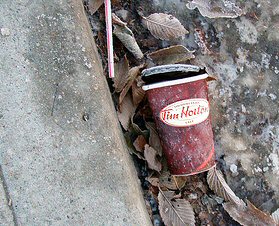
I found that one couldn’t research Tim Hortons without coming across a lot of material on the ubiquity of disposable Tim Hortons coffee cups. They evidently paper Canada. An article in Macleans quoted a Sierra Club representative who said, “The Tim Hortons cup is easily the No. 1 recognizable item of litter in the country.” One often-cited statistic is that 22% of the litter in the province of Nova Scotia was from Tim Hortons.

Of course, it’s not really the company’s fault if people don’t properly dispose of their, and the company has started some anti-litter campaigns. Nonetheless, Tim Hortons cups contain no recycled material and are not recyclable. The company objected to a proposed tax on non-recyclable cups in Toronto, saying “We’re not a waste-management company. Our product is very price-sensitive.” They have recycling at some of their locations, but I’m unclear on whether it includes the cups. Tim Hortons apparently also offers a discount for bringing your own mug, but this customer (scroll to the bottom) discovered that the employee used a paper cup to fill the customer’s mug. I have had this happen myself on more than one occasion at different establishments, although not Tim Hortons.

Updated addition: Tim Hortons also objects to having its drive-through lanes be subjected to an anti-idling ordinance in Ontario.

Frankly, I’m not impressed with the sustainability efforts of Tim Hortons, or their products.

Photo of store by Thiesen.
Photo of cup in gutter by Kevin Steele.

Coffee growing in Brazil’s Cerrado region

Coffee growing in Brazil, in brief:
Coffee was first planted in Brazil in the early 1700s. By the mid-1800s, Brazil was already the world’s #1 producer of coffee, a distinction it still holds today. However, it produces a great deal of low quality arabica, as well as quite a bit of robusta. With so much invested in the coffee market, Brazil was in trouble during the coffee crisis of the 1990s. It turned to increased technification (high-density sun coffee, chemicals, and mechanization) to increase productivity. About 70% of Brazil’s coffee is technified coffee, much to the detriment of the environment in many places.

There are three main growing regions in Brazil. Mogiana is along the border of Sao Paulo and Minas Gerais states. Sul de Minas is a more hilly/mountainous region in southern Minas Gerais state.  Here, we will discuss coffee growing in the Brazil’s cerrado region, mainly in Minas Gerais, as it is a primary area where Brazil’s specialty coffees are grown.

The Brazilian Cerrado: A biodiversity hotspot
The cerrado, consisting of grassy savannah, scrub lands, and gallery forest, is found on the high, flat, central plateau of Brazil. It covers over 2 million square kilometers — three times the size of Texas. Portions extend into Bolivia and Paraguay, making it the largest woodland-savannah in South America, and the richest savannah in terms of biodiversity in the entire world.

The World Wildlife Fund states it plainly: “The biodiversity of cerrado is extraordinary.” Nearly 45% of the 10,000 plants species found in this region are found nowhere else on earth. Almost 20 of the 800 bird species are endemic, such as the critically endangered Blue-eyed Ground-Dove (Columbina cyanopis). There are numerous unique mammals, reptiles, and amphibians as well. The Maned Wolf (Chrysocyon brachyurus), South America’s largest canid, is an iconic mammal of the cerrado.

Since the 1960s, vast areas of the cerrado have been destroyed. Over 40% of the original cerrado area has already been converted to agriculture (especially soy and sugar) and livestock (40 million cattle), with 67% of the land having been modified in some major way. The world demand for biofuels is now increasing agricultural conversion in the cerrado. Less than 2% of its region protected in national parks and conservation areas.

A recent article in the New York Times (Scientists are making Brazil’s savannah bloom), notes that the cerrado “has been transformed in less than a generation into Brazil’s grain belt, thanks to the discovery that soils could be made fertile by dousing them with phosphorus and lime.” Coffee has only been grown here for around 40 years, but the cerrado now supports around 3000 farms, mostly in small holdings.

Coffee growing in the cerrado
As indicated above, soil in the cerrado is quite lean, and requires fertilization. While organic fertilizer is used, non-organic nutrients are almost always necessary, and it is said that the soil in the cerrado must be “engineered” to grow coffee. Coffee production in this region is the most highly mechanized in the world, with little hand picking. The flat terrain lends itself to machine harvesting, as do the sharply defined wet and dry seasons, which result in most coffee trees ripening simultaneously. This synchronized ripening is further choreographed by targeted irrigation. Given the pronounced dry season, most farms in the cerrado are at least partially irrigated. Drip irrigation is very expensive, so pivot-arm irrigators (which are more wasteful) are frequently used.

Because the natural habitats of the cerrado have few trees, the whole concept of “shade coffee” is not applicable here — coffee is grown in the sun. Preserving biodiversity in the cerrado relies on setting aside areas of natural habitat.

Consumers will often read that Brazilian coffee farms have preserved natural areas on their property. For the most part, this doesn’t mean they have a commitment to the environment. The Brazilian Forest Code is a law that states that in certain areas, a proportion of the land must be permanently preserved for conservation of natural resources and wildlife. In the cerrado, the percentage is 35%.

A close friend of mine lives in Minas Gerais, Brazil, and is active in the bird conservation community, serving on the boards of several national bird organizations. Responding to my recent inquiry regarding the Forest Code, he wrote to me,

“[T]here is intense lobby to change the law to reduce these numbers and/or to allow other forms of compensation (such as: I destroy a virgin forest and buy some useless land *in another biome* and set aside to compensate for it). Also, farmers include everything in their reserve: useless land, land that is already set aside for permanent protection (such as water course margins and hilly slopes).

Unhappily, corruption is, let me make it clear, ***WIDESPREAD*** in Brazil, by far our biggest problem and the source of many others. Many people and companies do not obey the laws and [bribe] the inspectors.”

This lack of compliance is well documented. This is truly disturbing, for the amount of acreage set aside is critical. Unlike growing coffee in a rustic forest setting, which is similar enough to native habitat to support many insects, birds, and other animals, little if any of the fauna of the cerrado utilizes the densely planted fields of coffee. Coffee replaces the native vegetation of the cerrado, and does not in any way resemble the natural ecosystem, unlike shade grown forest coffee systems.

Currently covering around 160,000 hectares, coffee farms represent only a fraction of the agricultural landscape of the cerrado. Nonetheless, coffee growing is agent of habitat conversion in this unique ecosystem, offering fewer opportunities to preserve biodiversity than coffee growing in other regions.

Update (January 2026): This review paper in the journal Nature Conservation updates the dire situation of the destruction of the cerrado. It goes into excellent detail on the biodiversity of the area, which unique species are at risk, the extent and source of threats, impediments to conservation, etc.

Maned Wolf photo = World Wildlife Fund, UK.

5 top actions coffee drinkers can take to help the environment

Today is Blog Action Day: thousands of bloggers are uniting to put a single important issue on everyone’s mind. This year, it’s the environment.

Coffee & Conservation is all about the impact of coffee growing on the environment. Because coffee consumption is so ubiquitous, coffee drinkers have tremendous influence on habitat preservation and the conservation of biodiversity. The small actions of many people have enormous power — your actions can make a difference!

Here are the top 5 actions you can do as a coffee drinker to help the environment.

  1. Stop buying coffee from “the big four”: Nestlé, Kraft, Procter and Gamble, and Sara Lee/Doewe Egberts. Here is a list of their brands. These multinational companies, aside from having other dubious business practices outside of coffee, are motivated entirely by profit and market share. The only way they can offer cheap coffee at their huge volumes is to increase production and decrease production costs. Coffee is grown as a monoculture in the sun on large plantations with high chemical inputs and farmers are not paid a living wage. Read more about how sun coffee destroys biodiversity and the issues surrounding corporate coffee. I can’t emphasize enough: if you do one thing, this is it, quit buying commodity coffee.
  2. Buy organic coffee. Certified organic is great. Quite a lot of coffee is grown organically but not certified (“passive organic”) or nearly organically (even occasional use of spot-applied herbicide or non-organic fertilizer is a disqualifier). If you are willing to do a little research to learn which ones, these are great, too. You can read more in the organic coffee category; of special interest is this post summarizing organic certification.
  3. Use your own mug! Disposable coffee cups have to be the most wasteful product in the Western world. Here’s something you own for less than a half-hour, and throw away. And you get another the next day, or perhaps sooner. Good for the companies that are developing cups made from recycled or biodegradable materials. They still get thrown away, and in the anaerobic conditions of a landfill, even grass takes a very long time to break down. In the U.S. between 15 and 39 billion cups are tossed every year (Starbucks uses nearly 2 billion a year). How many do you throw away? Stop!! Bring some mugs to work, keep a couple of travel mugs in the car. How hard is that?
  4. Buy from a local roaster. Unless you live in the tropics, it will not be possible for you to drink locally-grown coffee. But you can cut down on the fuel used to ship roasted coffee by purchasing from a local roaster. You can check out my interactive roaster map for some great roasters around North America — feel free to make suggestions for additions. If you don’t have a local roaster, look for Allegro coffee at your nearest Whole Foods Market. There’s an added bonus for supporting your local roaster. You develop a relationship with them and can let them know what’s important to you. You increase their business, providing them with resources which enable them to develop direct relationships with farmers, which nearly always means improving sustainability efforts. Win-win-win.
  5. Quit using paper coffee filters. Don’t kill trees and send a filter a day to the landfill. There is a reusable gold filter for virtually every pot. This action also saves money in the long run, and makes your coffee taste better. Most paper filters tend to change the taste of the coffee, either by adding their own paper/chemical taste, and/or by absorbing some of the oils in the coffee that help give each bean its unique flavor.