Climate change

Is coffee really at risk of extinction?

Recently, a paper was published in the peer-reviewed, open-access journal, PLoS ONE: “The impact of climate change on indigenous arabica coffee (Coffea arabica): predicting future trends and identifying priorities.”

It specifically looked at wild, endemic populations of Coffea arabica in Ethiopia (and a few points in nearby areas). In a nutshell, the authors created computer models using known localities, environmental conditions, and various climate change scenarios to predict current and future distribution of these populations. The models determined a reduction (ranging from very worrisome to nearly complete) in suitable locations in this region by 2080. This is no surprise. I’m not sure I’ve seen any models that do not show some impact on the ranges (whether expansions, contractions, or shifts) of plants and animals under any accepted climate change scenarios. And we all know coffee is a very climate-sensitive species, especially arabica coffee.

It is a big leap to go from what this paper actually examined and concluded to the shrill, frantic headlines and stories pumped out by mainstream  media. For instance, under the headline So Long, Joe? World Coffee Supply Could Be Threatened By Climate Change, US News and World Reports declared “Nearly 100 percent of the world’s Arabica coffee growing regions could become unsuitable for the plant by 2080.” This is way off base, given the study was only looking at wild arabica in the vicinity of southwest Ethiopia. The article also stated that “If Arabica becomes impossible to raise in its native areas, it could wreak havoc on the economies of the mainly third-world countries in which it grows,” which is ridiculous considering that coffee is already grown on millions of acres in dozens of countries around the world where it is not native. Likewise, Salon.com made the even more extreme statement, “By the end of this century, climate change could wipe out nearly all the world’s coffee” in their piece, Coffee beans at risk of extinction.

I could cite more hand-wringing examples of failure by news outlets to make an honest effort at reporting what this paper really said, but you get the gist. As a scientist, journalist, editor, and world citizen, this lack of accuracy disgusts me. First, there is no excuse for it; the paper is open-access and anyone can read it for themselves! Apparently, this dismal reporting stems from incomprehension, laziness, and/or incompetance on the part of writers and their editors, as well as a disregard for actually informing the public in favor of profit for the news outlet via sensationalism.

If you’ve read this far and want a more nuanced analysis of the paper, I’ll give a few of my thoughts.

I thought the  paper was thorough and well-conceived. The bioclimatic modelling used is pretty standard for looking at the distribution of species under future climate change situations. Computer models, of course, are as robust as the data one feeds into them.  In this paper, the bulk of the data used to model current distribution was based on unpublished field work done by one of the authors; the rest was from herbarium specimens or literature reports, some dating back to 1941.  Ergo, it is technically not possible to evaluate the quality of this data. The climate data emphasizes factors like temperature, rainfall, and seasonality. These are all critical for coffee growing, but the models did not integrate other important environmental influences on coffee production such as soil types, microhabitats, and ecological processes, and the authors acknowledge those shortcomings.

The results and discussion provided didn’t stray far beyond these limitations and delivered on the authors intended goals: to identify conservation, monitoring, and research needs for wild, native Coffea arabica. It established baseline data to help assess future impacts of climate change on these populations, having identified suitable localities for them.

Two paragraphs in the discussion are devoted to the implications of the findings for cultivated arabica coffee, and they are also presumed to be negative. Does this mean the news headlines, while not the subject of the actual paper, are true? Not exactly. The authors note that optimum cultivation requirements for arabica coffee will likely become harder to achieve in the face of climate change, productivity will probably be reduced, and more intense management (especially irrigation) will be needed.

Is the potential loss of genetic resources in these populations something to worry about? In their article Climate change threatens sweet smell of morning coffee, Reuters took a stab at trying to interpret what the paper had to say by writing, “Although commercial coffee growers would still be able to cultivate crops in plantations designed with the right conditions, experts say the loss of wild arabica, which has greater genetic diversity, would make it harder for plantations to survive long-term and beat threats like pests and disease.”  Indeed, a reason the authors focused on wild populations of arabica in their native range was that their genes may be valuable for breeding disease and pest resistance and climate resilience into commercially grown coffee. While this is logical, and maybe even likely, the paper did not provide detail on the genetic diversity, number of unique arabica strains, or other features of the coffee being mapped and modelled. In fact, the authors noted that genetic variation in wild arabica still needed to be assessed. Further, other more tolerant species of coffee (primarily Coffea canephora, robusta, and its hybrids) are being used in breeding programs today and probably hold the best hope for resilience in commercial coffee. (This is not to discount the importance of preserving these populations; I’m a strong believer that genetic biodiversity should be preserved regardless of it’s commercial value.)

One point was made in the paper that I thought was not given enough emphasis. The biggest driver of the loss of wild coffee populations has been and is deforestation and land conversion, which themselves exacerbate climate change. We can sit on our hands and watch one of the models in this paper play itself out, with what the authors term as “profoundly negative influence” on coffee. Or we can encourage the production (and consumption) of coffee grown in an ecologically-sustainable manner, using carbon-capturing shade trees and sensible agroforesty techniques — and reward farmers for their troubles by paying more for eco-friendly coffee. The press  could make a real contribution by informing the public on the issues surrounding the sustainability of one of the world’s most popular beverages, rather than thoughtlessly spew out faulty proclamations with little basis in fact and no call to action.

More of my posts on coffee and climate change here.

Davis AP, Gole TW, Baena S, & Moat J (2012). The Impact of Climate Change on Indigenous Arabica Coffee (Coffea arabica): Predicting Future Trends and Identifying Priorities. PloS one, 7 (11) PMID: 23144840

First Rainforest Alliance climate-friendly coffee farm(s)

(Updated) Finca Platanillo in San Marcos, western Guatemala is the first coffee farm to be verified by Rainforest Alliance (RA) for compliance with the Climate Module of the Sustainable Agriculture Network (SAN, the standards-setting organization for RA). Less than a week later, it was announced that the well-known Daterra Estate in Minas Gerias, Brazil became the second farm to earn the verification.

I first reported on RA’s plan to develop this module in 2008. It isn’t a certification, but a voluntary add-on to RA certifcation. The module isn’t intended to indicate that a farm is carbon-neutral, or participates in carbon offsets, and doesn’t measure carbon stocks on farms.* The module’s goal is to encourage farmers to assess their climate risks, analyze their greenhouse gas emissions, maintain or increase carbon stocks on their lands (via habitat preservation or restoration), and identify best management practices to help them adapt to future climate change.

Verification occurs if farms comply with 80% of the 15 voluntary criteria of the module. Failure doesn’t effect the compliance score of regular RA certification. Farms can have the Climate Module audit done at the same time as their regular audit for RA certification; thus, it incurs no additional costs.
Finca Platanillo is 350 ha, of which nearly 40 are set aside as a protected area (although the ANACAFE site lists the area as 303 ha, of which 296 are cultivated). The finca grows bourbon, caturra, and catuai varieties at about 1150 to 1450 m; their maragogype is currently being offered by a number of roasters in Europe. In 2007, Finca Platanillo was one of the top-scoring farms in RA’s Cupping for Quality competition.

We reviewed several of Daterra’s coffees and provided background in this post. Daterra was also the first Rainforest Alliance-certified estate in Brazil (it consists of more than one farm). You can read more about the broad range of their long-standing sustainability efforts on their web site.

*RA and its partners have also worked on developing a guide for farmers on how to measure and verify carbon stored on coffee farms to enable producers to receive payments for carbon credits. See this post for details and a link to the guide.

Climate change threatens east African coffee via borers

Some like it hot: The influence and implications of climate change on coffee berry borer (Hypothenemus hampei) and coffee production in east Africa. Jaramillo et al. 2011. PLoS One.

An important new paper published this week outlines the threat posed by the expansion of coffee berry borers in east Africa due to climate change.

This paper follows up research by the authors that was published in 2009. That paper looked at life history characteristics of the coffee berry borer (CBB), one of the worst pests of coffee, and how they might react to various climate change scenarios. This paper built on that data, looked at current distribution of CBB in east Africa, and modeled the change in distribution by 2050 based on two climate change scenarios.

The models indicated that CBB infestation will be worse in the arabica coffee producing regions of Ethiopia; the Ugandan part of the Lake Victoria and Mt. Elgon regions; Mt. Kenya, particularly in the coffee-producing areas of Embu and Meru, and the western part of Kenya, around Kitale and the Kenyan aide of Mt. Elgon; and most of Rwanda and Burundi. Further, it appears that increasing temperatures will likely double the number of generations of CBB per year in all current arabica-producing areas. Both models (using slightly different projections of climate change) are very similar, one figure is reproduced below.

Suitability of climate for CBB, year 2050. EI values indicate suitability, where 0 is unsuitable, and 100 is perfect. Click to enlarge. From Jaramillo et al. 2011.

Lest you view climate modeling (or climate change) with skepticism, the authors note that as recently as ten years ago, CBB were not reported above 1500 m. Now, due to increasing temperatures in coffee growing regions around the world, CBB can be found at higher altitudes, where arabica coffee is typically grown. CBB have been documented 300 m higher in Tanzania than they were ten years ago. The authors note that some of the changes predicted in their earlier paper, such as increased number of generations and broader distribution, seem to already be occurring.

The damage an increase in CBB to now-untouched coffee growing areas is serious and sobering. These impacts do not even incorporate other changes that are likely to take place with increasing temperatures: a change in the distribution of biological enemies of CBB, and the impact of changes in rainfall patterns, disrupted seasonality, and thermal stress to coffee plants.

The authors state,

We suggest that the best way to adapt to a rise of temperatures in coffee plantations could be via the introduction of shade trees in sun grown plantations.

They note adding shade trees can lead to a decrease in the temperature around coffee berries by up to 4°C, which in turn may reduce the rate of increase in CBB by 34%.  They go on to say shade coffee agroecosystems can serve as a refuge for beneficial arthropods, leading to higher levels of biological control of CBB, and they create a diversified and therefore more resilient system that will perform better under climate change. They conclude that while it is only one of many adaptation strategies, the use of shade trees is “… rational, affordable, and relatively easy for coffee farmers and other stakeholders to implement.”

The paper is open access, and you can read it the whole thing and view all the maps here. A link to an abstract in Spanish is available near the end.

Jaramillo, J., Muchugu, E., Vega, F., Davis, A., Borgemeister, C., & Chabi-Olaye, A. (2011). Some Like It Hot: The Influence and Implications of Climate Change on Coffee Berry Borer (Hypothenemus hampei) and Coffee Production in East Africa PLoS ONE, 6 (9) DOI: 10.1371/journal.pone.0024528

Two degrees up

The International Center for Tropical Agriculture (CIAT) produced a series of short films on what a changing climate could mean for farming communities in East and West Africa, and South America. The segment below is the impact on coffee producers in Colombia — not only what changing climate could mean, but what it does mean already.


This film is also available in Spanish. The other films in the series chronicle land conflict and rural displacement in Ghana and water scarcity in Kenya.

Mitigating climate change with coffee

The Decision and Policy Analysis (DAPA) Program of the International Center for Tropical Agriculture (CIAT) recently released results from a research project on mitigating climate change in Mesoamerican coffee production. You can download a PDF of the report, The Potential of Mesoamerican Coffee Production Systems to Mitigate Climate Change. This document is actually the thesis project of a Dutch student. The paper is a straightforward look at the how different shade coffee systems store carbon and their levels of greenhouse gas emissions, as well as how a few certifications (organic, Rainforest Alliance, UTZ Certified) influence those metrics.

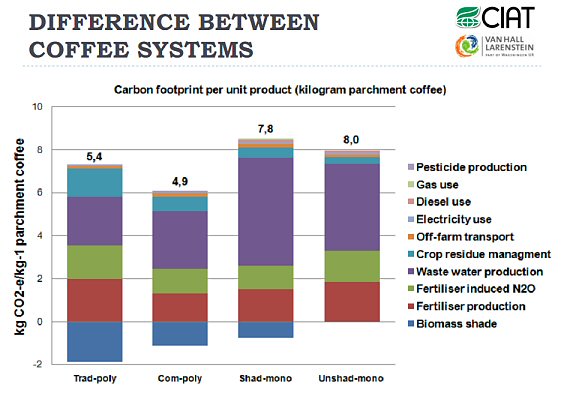
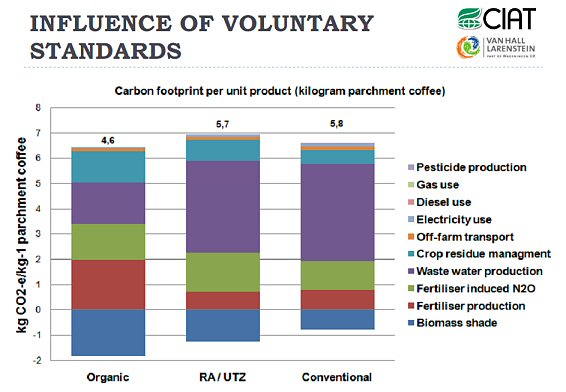
Here are two slides from a presentation to whet your appetite (click to enlarge).

Traditional rustic shade has a larger carbon footprint than commercial polyculture because yields are lower per unit area, and all the contributing factors are allocated to less product. Note that biomass (below 0 on x-axis) denotes “credit” subtracted from factors that add to the carbon footprint.

Certifications other than organic don’t do much to reduce carbon footprint over conventional farming, suggesting that standards need to be modified to encourage footprint-lowering practices. Note that biomass (below 0 on x-axis) denotes “credit” subtracted from factors that add to the carbon footprint.

For an explanation of these interesting graphs take a look at the full report.  While it is over 100 pages, it is not a difficult read and I especially encourage people to take a look at page 68, which outlines coffee production practices that result in lowered greenhouse gas emissions, and page 70, which gives overall conclusions.

Climate change impacts on coffee nations

The Center for Global Development recently released data on the vulnerability of countries around the world to climate change. I’ve taken slices of two maps that show the latitudes where coffee is grown. Both maps rank agricultural productivity loss, with countries having the most impact in darker reds, less impact in oranges and yellows.

The top map shows risks due to physical climate change only. Coffee-growing nations (including those growing primarily robusta coffee) ranked at highest risk (top 15) for agricultural productivity loss due to the physical effects of climate change are Central African Republic and Democratic Republic of the Congo, Bolivia, Burundi, Rwanda, the Dominican Republic, and Haiti.

The second map takes into account vulnerability and adjusts these risks based on a given countries’ ability to cope with climate risks. All of the African countries remain in the top 15, with Burundi moving well up the chart (indicating that there are not policies and infrastructure in place to help farmers cope with climate change). Rwanda just leaves the top 15, but Ethiopia now makes the list. The Latin American countries — Bolivia, the Dominican Republic, and Haiti — all move well down the list, but Cuba comes in at 15.

Coffee and climate change updates

It’s been about six months since I gathered together recent resources on coffee-growing and climate change (you can read past material in the new climate change category). Here are some new resources.

Peer-reviewed research related to coffee and/or agroforestry, and climate change:

Coffee and climate change: updated resources

Here are additional resources related to coffee and climate change, including how climate change may impact coffee production, how growing coffee under shade can buffer against climate change, and how shade coffee and habitat preservation on coffee farms can contribute to carbon sequestration.


Carbon credits with coffee: a how-to guide

Last spring I posted about a lecture I attended at the SCAA conference on coffee and climate change. I focused on the climate module that Rainforest Alliance is adding to its certification. Part of this initiative was to create a methodology for measuring and verifying carbon stored on coffee farms and a mechanism for producers to receive payments for carbon credits.

Rainforest Alliance partnered with the International Finance Corporation (IFC), part of the World Bank Group; ECOM Agroindustrial Corp., the world’s third largest coffee trading company; and coffee farmers in Mexico and Nicaragua to develop and test these methodologies. They produced a document, “Guidance on coffee carbon project development using the simplified agroforestry methodology.”

The guide is in six parts, and I’ll paraphrase the introduction to outline what each is about:

  1. A general overview of forest and agroforest carbon projects to help the reader understand what a ”project” is and what it is not; what is needed to set a project apart from business as usual practice; and why such projects are important and have value.
  2. Preparation and design of a project, requirements for a Project Design Document which identifies and explains each of the project’s key activities, elements, and important data.
  3. Description of risks to carbon projects’ success and how to assess and lower or manage them.
  4. Explains the processes of independent third party evaluation.
  5. An overview of the financial and contractual arrangements associated with carbon projects.
  6. Glossary and resources.

It’s a pretty straight-forward and non-technical document, and if you are interested I encourage you to download it and give it a look. One of my first thoughts was that this is still well out of the realm of many very small producers who might be only marginally literate. Like all certification schemes, we (the consuming “North”) are imposing a lot of rules and erecting a lot of barriers on farmers to in essence prove they are managing their land in an environmentally-responsible manner so that they might be rewarded for it. I don’t think the average Juan Valdez is going to sit down by the light of his wood-burning stove with this guide and be on his way to selling carbon credits. It will require support and partnership, which in turn requires funding, and ultimately boils down to the need for consumers to be willing to pay more for a sustainably-grown cup of coffee. Which I’ve been saying all along.

Photo by DelosJ under a Creative Commons License.

Coffee, climate change, and Rainforest Alliance

At the Specialty Coffee Association of America expo, we attended a lecture on climate change and coffee. Several speakers discussed this topic, but I’ll focus on the climate module that Rainforest Alliance is adding to its certification. This was announced at last year’s SCAA meeting (my post here), and RA’s Jeff Hayward provided more details on the program.

Coffee, especially shade coffee, is a global crop that has a relatively lower impact on greenhouse gas emissions and a more positive impact on carbon sequestration than many other crops.There is potential for shade coffee farms to contribute to the mitigation of climate change and generate income for farmers at the same time; I have a previous post that outlines the basics.

Rainforest Alliance has developed around 100 different criteria used to certify farms. A small number are considered required critical standards. Beyond that, certification is awarded once a particular percentage of the remaining criteria are met. RA is evaluating which criteria represent practices that improve carbon storage and mitigate climate change. If those particular criteria are among those that are met by a farm, they would be eligible to receive a ”Rainforest Alliance Plus” or "Climate Friendly" certification. RA is currently testing some assumptions and developing these criteria in Guatemala.

This will help buyers choose coffee that is climate friendly, but depending on what consumers are willing to pay won’t necessarily generate additional income for producers. A second part of RA’s climate program is to work to develop a mechanism for producers to receive payments for carbon credits within existing carbon markets. Since these must be beyond ”business as usual,” existing shade coffee farms might not be able to greatly increase their amount of carbon sequestration. But this holds promise for farms that are growing sun coffee or shade monoculture as they can gain credits for planting shade trees or for reforestation — the more the better. It could also help discourage the conversion of coffee to pasture or less eco-friendly crops. RA is working on pilot carbon credit projects now in Mexico and Nicaragua.

Green Mountain climate change grant finalists

Last month, Green Mountain Coffee Roasters announced a request for proposals for four $200,000 grants to organizations working on climate change. The grants will be awarded in each of four categories: transportation-related emissions, threats to coffee-growing communities, building political will, and empowering individual action.

They’ve just announced the finalists in each category. While I’m disappointed that a proposal by the Smithsonian Migratory Bird Center (developers of the Bird-Friendly shade coffee criteria) didn’t make the cut, I see that another great organization did. The American Bird Conservancy is one of five finalists in the Threats to Coffee Growing Communities category. Here is a summary of their proposal:

[We] will determine the additional carbon load held by shade coffee plantations over sun coffee plantations, and calculate the income differential per acre for coffee production for shade and sun  growers. We will then test a system to stream carbon offsets credit funding incentives to shade growers to compensate for the difference in income between the two systems. If it can be shown that shade coffee can be economically beneficial due to its additional carbon load (from both a sale of credits and/or consumer interest), then this project stands to benefit farmers across millions of acres of the Andes and could be the land management driver that saves the Cerulean Warbler the fastest declining songbird in North America on its wintering grounds. The project will have multiple additional benefits for famers and local communities in terms of the protection of watersheds and traditional farming techniques which are currently threatened by conversion to sun coffee.

ABC does excellent bird conservation work at home and internationally, and does so very cost-efficiently. They are very familiar with Latin American shade coffee issues. I’ve written about their Cerulean Warbler campaign, which has included working with Colombian partners and shade coffee farmers to preserve wintering habitat for this declining songbird. ABC has continued to work on reforestation projects in South America which includes shade coffee farms. I’ve also written about the potential for coffee farms to provide carbon sequestration services, and think the ABC proposal is very worthy of support.

For the next week, the public can vote for and comment on proposals at JustMeans.

Green Mountain to fund climate change projects

Green Mountain Coffee Roasters will award four grants of $200,000 each to organizations with ideas to combat climate change in four core areas: transportation-related emissions (including GMCR’s product shipping), threats to coffee-growing communities (enormous, given that climate change is already pushing coffee production to higher altitudes), building political will, and empowering individual action. Grant recipients will also be required to meet with GMCR twice a year to help the company work on reducing and mitigating its own carbon footprint.

The last two grant categories seem a little amorphous, but I’m quite enthusiastic about the potential for development of programs that can help farmers adjust to climate change (for those that can; the solution for many farmers may actually be to transition to other crops, unfortunately).

This grant project is part of a larger effort by GMCR to focus on climate change through changing business practices and raising awareness (you can read their statement on climate change here).

Spending $800,000 in the current economic crisis by a company that sells what is essentially a “luxury” item is, I think, a pretty strong statement of commitment to environmental responsibility. Kudos to GMCR.


Rainforest Alliance introduces carbon module

In my post “Coffee farms and carbon sequestration,” I discussed the potential of carbon credits in helping coffee farmers earn extra income, and provided some statistics and references on carbon sequestration on coffee farms in and other tropical agroforestry systems.

As it turns out, Rainforest Alliance (RA) will be adding a carbon module to their certification for farms (coffee, and presumably other crops they certify). This announcement was first made in May at their Sustainable Coffee Breakfast at the SCAA annual conference in Minneapolis. The details are not final, but here is what RA’s Gretchen Ruethling explained to me regarding RA’s past experience and future plans:

We are working with other organizations to help farmers get paid for providing environmental services such as storing carbon and protecting watersheds and biodiversity. The Rainforest Alliance is a registered verifier for leading carbon offset programs including the Climate, Community & Biodiversity Alliance and the Chicago Climate Exchange. We have verified carbon offsets on coffee farms through projects organized by Plan Vivo in Mexico. We verified an ambitious project in Aceh, Indonesia developed by Fauna & Flora International that will reduce deforestation on 750,000 hectares of rainforest. We verified a reforestation project in the highly endangered Atlantic Forest of Brazil as a carbon offset for Jacques Vabre, a coffee brand in France. (That project is managed by a coalition of Brazilian NGOs and led by the Nature Conservancy.)

We are working to offer more incentives to coffee farmers to encourage them to plant more trees. One exciting idea is developing a system that would allow coffee companies to buy carbon from farmers along with their coffee beans — through the existing supply chains. Companies could pay a small carbon premium. In order for this to work, we need a simple, low-cost yet rigorous and highly credible method to estimate the carbon on a coffee farm and verify that it remains year after year. This could be done by auditing the carbon as part of the annual farm inspection by members of the Sustainable Agriculture Network.

I’m thrilled RA is pursuing this concept — it’s a win-win-win situation for the farmer, biodiversity, and the planet.

Coffee farms and carbon sequestration

In my post, “Why certifying shade coffee is so complex,” I ended with a comment regarding the upside-down nature of shade (or organic) certification. That is, the burden of certification costs are on the producers who are doing the right thing, rather than on the producers who are damaging the environment. Small producers, who are more likely to preserve forests and grow coffee under diverse shade (both of which enhance biodiversity) and are less likely to use chemicals, are the least able to afford certification.

I’ve been ruminating about this ever since, and wondered if some sort of “cap and trade” system might be helpful. What I had in mind were “credits” for forest or habitat preservation and enhancement small eco-friendly farms could “sell” to naughty sun coffee growers. This was inspired by a similar system: carbon credits. So while I let this idea simmer, it’s worthwhile to briefly discuss the role of carbon credits themselves, and their potential to generate income for farmers practicing sustainable agriculture, including shade coffee.

Quick primer on terrestrial carbon sequestration
Trees (and other plants) sequester carbon by removing it from the atmosphere through photosynthesis and incorporating into their tissues. Existing forests are carbon sinks (or ”carbon storage units”) and contain over half of the terrestrial carbon in the world. Carbon remains stored in plant tissues until released, in this case most often by burning and decomposition.  Agroforestry systems, including shade coffee farms, that preserve forest are therefore acting as carbon sinks.

Reforestation also contributes to the sequestration of carbon, although the rate in which carbon is taken up and stored by plants varies among species, as well as where they are grown and if and how they are managed. This means that sun coffee farms converted to shade in which the appropriate tree species are planted and managed have the potential to effectively sequester carbon.

Carbon is also stored in leaf litter and other organic matter in the soil. Sustainable coffee agrosystems frequently rely on fallen leaves from their shade trees as well as the application of coffee skins and other organic matter for soil moisture retention and fertilization, providing another means in which these farms can contribute to carbon sequestration.

How much carbon can coffee farms store?
Although measuring carbon storage is difficult due to the multiple variables involved (even plots in the same region with similar tree species composition can vary in their storage capacity depending on microclimate, soil types, etc.), recent research has revealed some encouraging facts. A few examples:

  • In the tropics, potential carbon sequestration rates for smallholder, sustainable agroforestry systems range from 1.5 to 3.5 megagrams (tonnes) per hectare per year, or 2.1 billion megagrams annually worldwide.
  • It has been estimated that each hectare of sustainable agroforestry in the tropics could potentially offset 5 to 20 ha of deforestation.
  • Models have estimated a 5-year-old coffee farm shaded with two common Latin American tree species (Erythrina poeppigiana and Cordia alliodora) could sequester 5.3 megagrams per hectare.
  • Soil carbon stocks in shade coffee were 60% of that expected in primary forest in Sumatra, versus 45% for sun coffee.
  • In El Salvador, carbon sequestration values for various types of shade coffee management were estimated (in tons per ha per year): 174 for rustic shade to 77 for shade monoculture.
  • A study of carbon stocks in Costa Rican coffee farms calculated aerial (above ground) carbon stocks ranging from 11 megagrams per ha for simple shade (one heavily pruned shade species) to nearly 32 for diverse shade.
  • Using these figures, a farmer with 10 ha in diversified shade coffee could receive a one-time $3000 payment (based on previously carbon transactions for the country), as well as a reduction in expenses from chemical inputs and have timber and fruit for additional income. The payment is over three times greater than would be obtained for the carbon stocks in simple shade coffee systems.

The non-profit TechnoServe is exploring the use of carbon credit trading for promoting sustainable agroforestry, using a Guatemalan coffee cooperative (more here). Small holders in Oaxaca and Chiapas, Mexico, are gaining access to carbon credit funds to pay for sustainable agroforestry there, where a great deal of coffee is grown (more here).

It appears sustainable coffee agroforestry can play a role in helping to mitigate global climate change through carbon sequestration, and in the process also provide additional income and further incentive to growing shade coffee. I have a feeling we’ll be hearing much more about this in the future.

More reading, including sources for the figures above:

  • Smallholder agroforestry projects: Potential for carbon sequestration and poverty alleviation. O. J. Cacho, G. R. Marshall, and M. Milne. 2003.  ESA Working Paper No. 03-06. Agricultural and Development Economics Division, The Food and Agriculture Organizationof the United Nations.
  • Carbon sequestration in tropical and temperate agroforestry systems: a review with examples from Costa Rica and southern Canada. M. Oelbermann, R. P. Voroney, and A. M. Gordon. 2004. Agriculture, Ecosystems and Environment 104: 359-377.
  • Carbon sequestration: An underexploited environmental benefit of agroforestry systems. F. Montagnini and P. K. R. Nair. 2004. Agroforestry Systems 61:281-295.
  • Carbon stock assessment for a forest-to-coffee conversion landscape in Sumber-Jaya (Lampung, Indonesia): from allometric equations to land use change analysis. M. van Noordwijk, S. Rahayu, K. Hairiah, Y. C. Wulan, A. Farida, and. B. Verbist. 2002. Science in China (PDF here).
  • Carbon sequestration in coffee agroforestry plantations of Central America. 21st International Conference on Coffee Science, 2006.
  • Sustainability in the coffee sector: exploring opportunities for international cooperation. U.N. Conference on Trade and Development. 2003. (PDF here)
  • Carbon Storage in Coffee Agroecosystems of Southern Costa Rica: Potential Applications for the Clean Development Mechanism. C. Polzot. 2004. M.S. thesis, York University, Toronto.  Includes excellent cited information on the mechanisms of carbon sequestration in agroforestry systems, and Costa Rica’s Payment for Environmental Services programs.

Coffee growing and climate change

Coffee (Coffea sp.) requires quite specific growing conditions.  It grows in subtropical regions that have distinct wet and dry seasons.  Although plants can live and produce fruit for decades, drought or heat in summer can diminish production and quality.  And while coffee requires a dry period in the spring, heavy rains in this season can disrupt flowering.

This sensitivity to climatic variables means that global climate change is likely to have profound impacts on coffee growing and production.  An upcoming article in the journal Climatic Change (1) modeled what could happen to coffee production in Veracruz, Mexico if observed trends in climate change continue and coffee prices remain steady.  The report concludes that coffee production will not be economically viable in Veracruz by 2020 due to lowered yields and many current areas becoming unsuitable for coffee growing.

Although there is some work being done on breeding coffee varieties that are more heat-resistant, it will do little to prevent losses due to the climatic instability brought on by global warming (droughts and floods, unusual cold spells) or the pests whose ranges will also change as temperatures rise.

Farmers will be left with few choices.  Areas at higher latitudes (which although too cool now to grow coffee will become warmer) could be used. However, most small holders do not have the money or credit to buy property, even if it is available to purchase; most land is already under ownership that is passed down in families.  If land upslope is turned into coffee farms, it means some conversion and clearing of existing forest, and the old coffee farms will be converted to other crops, none of which is likely to be as environmentally friendly as shade coffee.  This means a loss of biodiversity, and the deforestation of new and old coffee farms will exacerbate and accelerate warming trends, since trees help sequester carbon and buffer temperature changes.

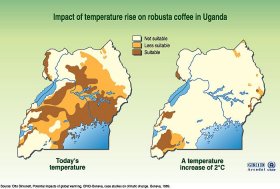
We all have a great deal at stake as the planet warms. Unfortunately, the poor in developing countries, such as coffee growing nations, often bear a large burden.  Even growers of more heat-tolerant lowland robusta coffee, where it is indigenous, stand to lose their livelihoods, as this graphic illustrates.

The authors of the Veracruz report recommend supporting farmers to move into specialty coffee to help to provide some financial security. Purchasing shade coffee and providing incentive for farmers to plant trees rather than cut them down will also help.  As the Fresh Cup article notes,

In the past several decades, roughly half of the world’s coffee plantations have cut down their trees, or cut down forest to plant unshaded coffee. This decreases the ability of vegetation to counteract global warming by absorbing carbon dioxide, and it also raises local temperature.

All the more reason to stay away from corporate technified sun coffee, and enjoy the superior taste of environmentally-friendly coffee.  I’ll be following the research on climate change and coffee, and report further news and suggestions.

(1) Gay, C., F. Estrada, C. Conde, H. Eakin, and l. Villers. 2006. Potential impacts of climate change on agriculture: case study of coffee production in Veracruz, Mexico.  Climate Change 79:259-288.