Rainforest Alliance

New Rainforest Alliance criteria for shade

In 2017, Rainforest Alliance announced they would merge with Utz (another certification), retain the Rainforest Alliance name, and develop a new standard — the set of rules and criteria required for a product to be labeled with the Rainforest Alliance certification seal. This standard was released on 30 June 2020. Here I will summarize, as I have in the past, the criteria in the standard as it applies to coffee and specifically what it means for birds and biodiversity. I focus on the shade criteria because this is the criteria many people have in mind when they are looking for ”shade coffee“ that is eco-friendly and provides habitat for birds and other biodiversity.

Rainforest Alliance has followed a trajectory over the past decade to weaken the criteria for shade. By 2017, the criteria regarding shade cover for Rainforest Alliance certified coffee farms eroded to the point that this certification could no longer assure consumers that coffee was grown on a farm that has habitat for birds or other wildlife. The newest standard reaffirms this.

I’ve moved much of the background information and links to previous posts to the end of this post to reduce some redundance while still keeping much of the relevant information, even if repeated from a previous discussion, all in one place for easier reference.

The 2020 shade criteria

First, the new standard has three types of requirements:

  1. Core: Must be met for certification.
  2. Mandatory Improvement:  Need to be met within three to six years of certification. Some of these are “Mandatory Smart Meters” that are measured each year but “do not have predefined targets set by the Rainforest Alliance. Instead, the producers themselves set the targets for these indicators and define the adequate actions to take to realize these improvements.”
  3. Self-selected Improvement: “Chosen by certificate holders based on their own risk assessment or aspirations” where the ”certificate holder defines if and when to comply.” These may also have Smart Meters.

(Number 2 veers into fox-guarding-the-henhouse territory, and Number 3 seems not to actually be a requirement, by definition!)

Regarding shade specifically:

There is no Core Requirement for shade in the 2020 standard.

There is a Mandatory Requirement that by the 6th year of certification, there is natural vegetation cover on at least 15% of the total area for farms growing shade-tolerant crops (coffee).

NOTE: natural vegetation cover does not mean shade canopy in these criteria!

Here is Rainforest Alliance’s definition of natural vegetation:

Natural vegetation is vegetation made up predominantly of native or locally adapted species, resembling in species
composition and structure the vegetation that occurs or would occur in the absence of human interference. Natural
vegetation can include one or more of the following (not exclusive):
“¢ Riparian buffers
“¢ Conservation areas within the farm
“¢ Natural vegetation in agroforestry systems
“¢ Border plantings, live fences and barriers around housing and infrastructure, or in other ways
“¢ Conservation and restoration areas outside the certified farm that effectively provide for long-term protection of the subject areas (for at least 25 years) and yield additional conservation value and protection status relative to the status quo

There is a Self-selected Smart Meter for coffee farms in which producers can work toward optimal shade (40% canopy cover and 12 native species per hectare). Of course, that’s an option for any coffee farmer, certified or not.

Biological ramifications

The criteria doesn’t specify that the vegetation cover needs to be over the crop. A farm with little or no canopy cover over the coffee could theoretically offer excellent bird and biodiversity habitat if it had an intact forest reserve, for example. However, if the coffee trees themselves are grown without shade, they generally need more inputs (fertilizer, pesticides, herbicides), must be replaced more frequently, and the soil is quickly depleted and subject to erosion.

Even if the vegetation threshold in the new standard was required to be over the crop, a 15% canopy cover is typically what is considered “shade monoculture” which lacks most of the benefits of real shade coffee to birds and biodiversity. For a more in-depth discussion of the impacts of this low level of vegetation/shade, please see this post and make sure to also read the comment section.

One doesn’t need to be an ecologist to conclude that 15% vegetation cover — potentially made up of areas around buildings, scattered across one or more farms, without specific density or structure requirements, and not necessarily even made up of trees — is probably inadequate or reduced-quality wildlife habitat, particularly for forest birds.

Other ramifications

A major focus in the new standard is what Rainforest Alliance calls a reimagining of certification: “Reimagining certification means shifting away from the idea that it is a diploma of compliance indicating whether a farm has met a certain set of requirements.” The philosophy behind certification standards that are process- and progress-oriented (versus benchmark/pass-fail such as Bird-Friendly) is to be more inclusive. I’m all for getting more farmers on the road to good farming practices — it’s vital for their survival. But in the case of product certification, I see two major downsides.

First, it can be misleading. In my talks with coffee consumers, their understanding of product certification is that it is exactly a diploma of compliance. Coffee can be Rainforest Alliance certified, implying to most consumers that it is very eco-friendly, when it in fact may be a far cry from being “grown in harmony with nature.” This leaves the door wide open for greenwashing.

Second, I believe this weakening of shade requirements devalues science-based shade and biodiversity criteria. If low requirements for shade production become mainstreamed and legitimized, and are seen as the true benchmarks for eco-friendly coffee production, habitat quality and biodiversity will suffer.

Bottom line

Maybe your Rainforest Allliance certified coffee came from a terrific farm with a diverse, highly structured shade canopy that supports resident and migratory birds and other biodiversity. Or it might come from a farm that has no shade at all over the coffee, or, conceivably anywhere else. There is no consumer-facing transparency about this. The new standard includes more traceability, including an online platform, but this is apparently only for the supply chain actors and is not for the public.

Positive changes

  • Meeting certification criteria for most schemes costs money, and the burden is on the farmer. Rainforest Alliance now requires that companies in their supply chains “pay a Sustainability Differential—an additional cash payment made to farmers above the market price for their certified product.” There is also a Sustainability Investment that will be “made by buyers of certified product to contribute to the investments needed of farm certificate holders.” For coffee, the first buyer makes these payments. The differential is agreed upon contractually. Rainforest Alliance reserves the right to introduce a minimum amount, but I do not see that one for coffee has been specified.
  • Producers cannot use wildlife to process coffee (e.g., no kopi luwak).
  • Producers receive a list of requirements and plans that are more tailored to their crop, country, and situation, which is a substantial improvement over a one-size-fits-all set of standards. This doesn’t take away from the fact that the requirements themselves may not be adequate. “Customized” does not have to mean “diminished.”
  • Although not part of the new standard, Rainforest Alliance is introducing a new seal and the new labeling requirements have finally done away with the use of their seal when a bag of coffee contained less than 100% certified beans. Now a bag must contain at least 90% certified beans to carry the seal. The lower threshold used to be 30%, although businesses selling less than 90% content were required to scale up over time, I did not see evidence of that on brands I was following.

There are related criteria in the standard on water management, wildlife protection, and agrochemical usage (there is no requirement that Rainforest Alliance certified crops are organic (a common misconception among consumers, I’ve learned; but less than 20% of Rainforest Alliance-certifed coffee is also certified organic), but there is criteria regarding types of chemicals and how they are applied, stored, etc.). The rest of the standard deals with many other important topics that make valuable contributions; I don’t want to minimize that. The entire standard and supporting information is available for download at the Rainforest Alliance certification documentation page.

BACKGROUND

Timeline of relevant shade criteria over time

Here are the most relevant shade/canopy/vegetation requirements over time. I’ve indicated changes I think are especially important in brackets.

2005

Farms located in areas where the original natural vegetative cover is forest must establish and maintain, as part of the conservation program, permanent shade distributed homogenously throughout the plantations; the shade must meet the following requirements:

a. A minimum of 70 individual trees per hectare that must include at least 12 native species per hectare.
b. A shade density of at least 40% at all times.
c. The tree crowns must comprise at least two strata or stories.

A farm without shade can be certified once it has a shade establishment or expansion plan and shade established in at least 25% of the production area. Shade must be established in the remaining 75% of the production area within five years. Farms in areas where the original natural vegetation is not forest must dedicate at least 30% of the farm area for conservation or recovery of the area’s typical ecosystems. These farms can be certified once they have a plan to establishment or recover natural vegetation within ten years. Vegetation must be re-established or recovered in an equivalent of 10% of the total farm area (one-third of the 30%) during the first three years of the plan.

2009

Farms with agroforestry crops located in areas where the original natural vegetative cover is forest must establish and maintain a permanent agroforestry system distributed homogenously throughout the plantations. The agroforestry system’s structure must meet the following requirements:

a. The tree community on the cultivated land consists of minimum 12 native species per hectare on average. [Tree density requirement removed.]
b. The tree canopy comprises at least two strata or stories.
c. The overall canopy density on the cultivated land is at least 40%. [“At all times” removed, indicating pruning can reduce canopy cover part of the year.]

[Substantial changes — reductions — were implimented here on what was required for initial certification as well as continued certification.]

2017

Farms with shade-tolerant crops have at least 15% total native vegetation coverage across the farm or groups of farms or a shade canopy fulfilling the SAN canopy cover and species diversity parameters. Farms or groups of farms with non shade-tolerant crops have at least 10% total native vegetation coverage across the farm or groups of farms.

[This was a radical transformation, more fully explained in this post. In a nutshell, fulfilling this criteria was not required for initial certification (only after 6 years); it did not address shade/canopy cover/density, only native vegetation cover; cover was no longer required to be homogenous; and levels greater than 15% were not required at any point.]

Discussion of previous standards

I encourage you to read through the following posts, because they offer a great deal of detail:


Rainforest Alliance certified coffee: useless to evaluate shade-grown conditions

[Update: Newest 2020 standard discussed here.]

The criteria regarding shade cover for Rainforest Alliance certified coffee farms has eroded to the point that this certification can no longer be considered an assurance that coffee was grown on a farm that has habitat for birds or other wildlife.

I’ve written many posts that outline the changes in the ”standard,” or criteria that must be met for Rainforest Alliance certification. They include not only changes to the criteria themselves, but also which ones must be met for certification and how they are judged or scored. I encourage you to read through the following posts, because they offer a great deal of detail:

We are on the cusp of yet another change — and erosion — in the standard. In 2017, Rainforest Alliance announced they would merge with Utz (another certification), retain the Rainforest Alliance name, and develop a new standard. The first draft has now been released and the “shade criteria” is even more anemic, which I did not think possible for a certification that touts itself as protecting wildlife habitat. I focus on the shade criteria because it is very important for coffee farms, especially as it relates to birds. Importantly, this is the criteria many people have in mind when they are looking for ”shade coffee” that is eco-friendly and provides habitat for birds and other biodiversity. Bear in mind there are related criteria, requirements, and “scoring” methods that have also undergone major changes (often not for the better, in my opinion).

Again, the posts listed above will provide much more detail; here are the most relevant shade/canopy/vegetation requirements over time. I’ve indicated changes I think are especially important in brackets.

2005

Farms located in areas where the original natural vegetative cover is forest must establish and maintain, as part of the conservation program, permanent shade distributed homogenously throughout the plantations; the shade must meet the following requirements:

a. A minimum of 70 individual trees per hectare that must include at least 12 native species per hectare.
b. A shade density of at least 40% at all times.
c. The tree crowns must comprise at least two strata or stories.

A farm without shade can be certified once it has a shade establishment or expansion plan and shade established in at least 25% of the production area. Shade must be established in the remaining 75% of the production area within five years. Farms in areas where the original natural vegetation is not forest must dedicate at least 30% of the farm area for conservation or recovery of the area’s typical ecosystems. These farms can be certified once they have a plan to establishment or recover natural vegetation within ten years. Vegetation must be re-established or recovered in an equivalent of 10% of the total farm area (one-third of the 30%) during the first three years of the plan.

2009

Farms with agroforestry crops located in areas where the original natural vegetative cover is forest must establish and maintain a permanent agroforestry system distributed homogenously throughout the plantations. The agroforestry system’s structure must meet the following requirements:

a. The tree community on the cultivated land consists of minimum 12 native species per hectare on average. [Tree density requirement removed.]
b. The tree canopy comprises at least two strata or stories.
c. The overall canopy density on the cultivated land is at least 40%. [“At all times” removed, indicating pruning can reduce canopy cover part of the year.]

[Substantial changes — reductions — here on what is required for initial certification as well as continued certification.]

2017

Farms with shade-tolerant crops have at least 15% total native vegetation coverage across the farm or groups of farms or a shade canopy fulfilling the SAN canopy cover and species diversity parameters. Farms or groups of farms with non shade-tolerant crops have at least 10% total native vegetation coverage across the farm or groups of farms.

[A radical transformation, more fully explained in this post. In a nutshell, fulfilling this criteria is not required for initial certification (only after 6 years); it does not address shade/canopy cover/density, only native vegetation cover; cover is no longer required to be homogenous; and levels greater than 15% are not required at any point.]

Proposed for 2020

Farms have at least 10% tree canopy coverage across the farm or group of farms, where appropriate in accordance with an agroforestry system that may include: trees in contour hedgerows, trees in strips (corridor system), trees in contiguous area (shade), trees in a mixed system, or trees on plot boundaries.

What 10% versus 40% canopy density looks like, from standard forestry charts (likely similiar to ones used by people that certify these farms!).

Things to know: This is not a core criteria required for certification. The current 2017 standard does include at least a suggestion for 40% shade made up of 12 native tree species per hectare for coffee crops (that’s what the “or a shade canopy fulfilling the SAN canopy cover and species diversity parameters” is all about). That is no longer in the draft document.

In my other posts specifically about shade criteria, as well as in many other posts on eco-friendly coffee growing, I have explained the habitat requirements of birds and wildlife, especially on coffee farms and how various certification criteria impact these needs. As an ornithologist and ecologist for over 25 years, I believe I have a pretty good grasp on these topics. But I don’t think I need to impart my expertise at this point. Most thoughtful people are likely to correctly conclude that 10% tree cover — potentially counted across many farms, without density or structure requirements — is probably not very good wildlife habitat (and certainly not for forest birds). This criteria doesn’t even specify that the cover needs to be over the crop; in fact it specifies that it can be anywhere. By the way, 10% canopy cover over the coffee crop is typically what is considered “sun coffee.”

On their own website, Rainforest Alliance states: ”On Rainforest Alliance Certified™ farms, coffee grows in harmony with nature: … wildlife thrives and migratory bird habitat flourishes.” This is not an accurate statement under the current standard, and may be even less likely under the proposed standard. Maybe your coffee came from a terrific farm with a diverse, highly structured shade canopy that supports resident and migratory birds and other biodiversity. Or it might come from a farm that has no shade at all over the coffee, or anywhere else on the farm if the certification covers a group of farms and there are some trees on one of the others. There is no consumer-facing transparency about this.

One of the underpinning philosophies for creating certification standards that are process- and progress-oriented (versus benchmark/pass-fail such as Bird-Friendly) is to be more inclusive. I’m all for getting more farmers on the road to good farming practices — it’s vital for their survival. The downside of this low bar is that it leaves the door wide open for greenwashing. Coffee can be Rainforest Alliance certified, implying to most consumers that it is very eco-friendly, when it in fact may be a far cry from being “grown in harmony with nature.”

I’ll repeat what I concluded after the last standard was approved. I believe this weakening of shade requirements devalues science-based shade and biodiversity criteria. If low requirements for shade production become mainstreamed and legitimized, and are seen as the true benchmarks for eco-friendly coffee production, habitat quality and biodiversity will suffer.

Daily Coffee News has a post about the new standard, and you can read (and comment on) the entire draft standard via the links at the Rainforest Alliance website.


Rainforest Alliance and UTZ to merge

Rainforest Alliance and UTZ (Certified), two major certifiers of coffee and other products, are merging later this year, and will operate under the Rainforest Alliance name. The current executive director of UTZ, Han de Groot, will head up the new organization. They plan to come out with a new standard, codifying the requirements for certification, in early 2019.

The strengths of UTZ certification are in supply chain traceability and transparency, but overall the environmental criteria are not very specific or quantifiable, and the requirement for shade in coffee is especially loose and subjective.  The standard for Rainforest Alliance certification just underwent a major overhaul that more or less gutted the formerly decent shade requirements for coffee.

Both are process-oriented certifications. That is, certification is granted for farms working towards the criteria in the standard. There is no way to distinguish which or how many of the criteria have been met.

News of the merger didn’t surprise me. In many ways, the standards of the two organizations were becoming more similar, and both have become largely engaged with large coffee and food corporations (which I believe is largely responsible for the downward pressure on the stringency of environmental requirements). Many coffee producers had dual certifications, and this merger will mean they only have to go through one certification process, which is much more efficient and definitely a positive development.

If the new standard contains the best of both current standards (which is hardly a given, considering the simplification and easing of many of the requirements that have taken place over time) I will consider this a solid foundation certification. Currently, the ground floor is occupied by the Baseline Common Code of the Global Coffee Platform (formerly the 4C Code of Conduct), the bare minimum of decent human and environmental practices in coffee production.  If all coffee can instead meet a new, non-waterered-down Rainforest Alliance/UTZ standard, the world will be a better place. But from a habitat and environmental point of view, we will still have a long way to go, as there is a very wide gap between the Rainforest Alliance shade and habitat requirements and those of Bird-Friendly certification. Further, it is not known how requirements for fair prices (such as those in Fairtrade/Fair Trade certification) will be incorporated, as neither RA nor UTZ has any price guarantees built into their current standards.

We will have to see how the new organization develops requirements in the year ahead.

Read more here:

The new Rainforest Alliance shade requirements

[Update: Newest 2020 standard discussed here.]

[This post also appears at Daily Coffee News]

After many months, the latest revision to Sustainable Agriculture Network (SAN) standard, which provides the requirements for Rainforest Alliance certification, have been approved. The 2017 standard will be used for audits beginning in July 2017.

The 2017 standard covers a lot of ground. In addition to various environmental topics, it also addresses management, social, and livelihood aspects (wages, worker rights, etc.). As the standard has gone through periodic updates, it has refined not only individual criterion, but also tweaked the overarching structure and scoring protocols.

My focus here is on the ”shade criteria.” These requirements are what many people have in mind when they are looking for ”shade coffee” that is eco-friendly and provides habitat for birds and other biodiversity.

Background

The SAN criteria regarding shade for coffee farms has slowly changed in the past decade. A full explanation of these changes is provided in the post The (De)evolution of Rainforest Alliance shade criteria. That post provides a timeline and interpretation of the modifications to the shade criteria. It also introduces and explains the changes proposed for the 2017 standard. A follow-up post (Rainforest Alliance drastically revises shade requirement) describes a revised interim draft of the standard, and a final update briefly outlined the public comments and SAN’s response.

For the most concise before-and-after comparison of the changes in the shade requirements for Rainforest Alliance certification, I provide below the criterion for coffee from the 2005 SAN standard. Note that while this was not a critical (required) criterion, it was worded so that certain conditions were mandatory for initial certification; my emphasis highlights these provisions.

Farms located in areas where the original natural vegetative cover is forest must establish and maintain, as part of the conservation program, permanent shade distributed homogenously throughout the plantations; the shade must meet the following requirements:

a. A minimum of 70 individual trees per hectare that must include at least 12 native species per hectare.

b. A shade density of at least 40% at all times.

c. The tree crowns must comprise at least two strata or stories.

A farm without shade can be certified once it has a shade establishment or expansion plan and shade established in at least 25% of the production area. Shade must be established in the remaining 75% of the production area within five years. Farms in areas where the original natural vegetation is not forest must dedicate at least 30% of the farm area for conservation or recovery of the area’s typical ecosystems. These farms can be certified once they have a plan to establishment or recover natural vegetation within ten years. Vegetation must be re-established or recovered in an equivalent of 10% of the total farm area (one-third of the 30%) during the first three years of the plan.

The 2017 standard

The standard lists dozens of critera, broken into four tiers. “Critical” criteria are mandatory. The others are labeled Level C (“good”), B (“better”), or A (“best”) representing increasing levels of sustainablity performance. Farms can be initially certified by meeting all critical criteria plus  50% of the Level C/good criteria. To remain certified, farms have to comply with increasingly higher criteria. By the sixth year of certification, farms must meet all critical criteria, plus 90% of Level C criteria, 90% of Level B criteria, and 50% of Level A criteria.

The standard also has a section of Terms and Definitions. It includes the term “SAN canopy cover and species diversity parameters.” For coffee farms, the definition states there must be 40% minimum canopy cover and a minimum 12 native tree species per hectare. The definition also states that canopy cover is measured when foliage is most dense.

The 2017 “shade” criterion

The criterion covering shade in the 2017 SAN standard is in the topic area “Native Vegetation.”  There are no critical criteria (required for initial certification) in this topic area.

The specific criterion comparable to the 2005 shade criterion is a Level A criterion. It reads as follows (emphasis on section that applies to coffee):

Farms with shade-tolerant crops have at least 15% total native vegetation coverage across the farm or groups of farms or a shade canopy fulfilling the SAN canopy cover and species diversity parameters. Farms or groups of farms with non shade-tolerant crops have at least 10% total native vegetation coverage across the farm or groups of farms.

What this means

Specifically for habitat

As noted, this new criterion is Level A — the highest performance level. However, it is less stringent and not as encompassing of ecological requirements in previous standards.

This new criterion does not address shade density/canopy density. It targets 15% native vegetation cover. Ecologically speaking, these terms represent vegetation structure with very different ramifications for habitat quality. Read why this is important here.

Although there is mention of the minimum 40% canopy cover and 12 native tree species per hectare in the criterion, it states that farms can meet those parameters OR have 15% native vegetation cover.

There is no requirement for vegetation to be contiguous (e.g., not in small fragments that have less value to biodiversity), to be part of the coffee production area, or even to be on each individual farm in a group such as a cooperative.

There are no strata requirements. These strata are the various ”layers” of trees, seen in the shade diagram here. This type of structure is critical to biodiversity in ecosystems; the more the better.

In practical terms

In general, a product certified under this system represents a product somewhere along the path to sustainability, not a product that has necessarily acheived some specific benchmark. Specifically, as a Level A criterion, the 15% native vegetation cover criterion is not required until the sixth year after initial certification, perhaps longer if other Level A criteria make up the 50% that are needed by that time. Contrast with Smithsonian Bird-Friendly standards, which not only encompass shade canopy density, strata, and organic certification criteria — but all of must be met to certify.

In other words, a coffee farm with less than 15% native vegetation cover could be Rainforest Alliance certified and remain so for years as long as they had a management plan to progressively increase this amount. Levels greater than 15% are not required at any point.

Many Rainforest Alliance certified farms may, in fact, have ecologically-significant shade/canopy density and meet many other biodiversity-enhancing measures. And rarms that have existing agroforestry shade cover are required to retain this shade cover. The problem is that there is no way for the public to differentiate between these types of farms and those that have yet to achieve even the far less valuable 15% vegetation cover benchmark.

Broader ramifications

This lack of transparency to a consumer seeking out ”shade coffee” or coffee that is grown using field-tested approaches to maximizing the value of agroforestry to biodiversity is, in my opinion, an enormous problem. It has great potential to erode consumer trust. This seems like an especially treacherous road for an organization such as Rainforest Alliance whose stated mission is conserving biodiversity. It may also be a disservice to other certifications. If Rainforest Alliance certification — with a high public profile and reputation for ”saving the rainforest”– does not deliver what consumers thought it did, it may foster distrust in other certifications as well.

The SAN standard overall has committed to encouraging continuous improvement. However, by lowering the bar (again, focusing on ”shade”), it can have the effect of removing some incentives to truly improve habitat. The main drivers for farmers to obtain certification is access to buyers/markets, forming long-term supplier relationships, and thus added income. Low barriers to certification means farmers may reap benefits without having fully met the requirements implied to the consumer by the certification. These low barriers can be especially appealing because the benefits can be realized before full investment in upgrading production have taken place.

Lower entry barriers to the ”shade coffee” market means coffee quality will span a broader spectrum. The lower sunlight levels of a shade canopy result in physiological changes in the coffee cherry, which can translate into higher cup quality. Since taste is probably the ultimate catalyst for a coffee purchase, diluting the ”shade coffee” market with potentially lower quality beans not actually grown under shade may potentially lower market demand for shade coffee.

Finally and perhaps most troubling to me is that this considerable weakening of the shade requirements devalues science-based shade and biodiversity criteria. If low requirements for shade production become mainstreamed and legitimized, and are seen as the true benchmarks for eco-friendly coffee production, habitat quality and biodiversity will suffer.

The Sustainable Agriculture Network and Rainforest Alliance have made, and continue to make, great contributions to the environmental and economic sustainability of many agricultural products and producers. Therefore it is with regret that I report that I feel the changes in the new standard regarding shade criteria have negative effects and, due to lack of transparency, I can no longer recommend Rainforest Alliance certified coffee to consumers specifically seeking “shade grown” coffee.


Rainforest Alliance impacts report, Part 2

How insightful are impacts attributable to a soon-to-be-modified standard? Has Rainforest Alliance certified most “pre-qualified” farms?

Rainforest Alliance (RA) certified coffee conforms to standards and criteria established by the Sustainable Agriculture Network (SAN). SAN/RA recently released an impacts report. It summarizes the effects of RA certification on farms, farmers, and the environment worldwide for over 100 agricultural crops, and goes into more depth for several important crops, including coffee. I’ll focus, as usual, on issues surrounding biodiversity and habitat on coffee farms.

The report largely presents impacts evaluated through 1) compliance of a sampling of farms to all criteria at the first and most recent audits, and 2) results of studies comparing certified versus non-certified farms.  Part 1 examined compliance for coffee farms. Here, I will discuss the studies.

Field studies: based on criteria to be changed this year

Much of the impacts report is based on studies comparing RA certified farms with non-certified farms. For coffee, the report highlighted three studies from Latin America that included 81 RA certified farms. Later in the report, it also cited at least four more studies that included at least 15 more RA certified farms (some only used evaluations of regional vegetation or non-farm-specific metrics). There are 194,356 RA certified coffee farms worldwide.

The studies themselves are interesting. However, they may be largely irrelevant to our understanding of the effectiveness and impact of RA certification for biodiversity measures going forward. That’s because the farms were certified under the current standard, and the new standard that is to be published in July is likely to be weaker when it comes to tree and shade requirements.  You can read about the relaxing of these criteria over the years at this post, and the even more lax criteria that were proposed for the new standard here.

So we must take the reports of positive impacts of the stricter current standards with a grain of salt, in light of the changes ahead. This is even more important considering that many of the impacts (on biodiversity-related issues) were modest.

For example, the report noted that one study1 found certified farms had higher tree species diversity than the non-certified farms. The difference was a median of nine species versus six species. These are very low numbers. The standard calls for at least 12 native tree species per hectare for certified farms, so there are either certified farms in this sample that are not meeting that criteria, or there is error in the farmer reporting. Further, another study2 mentioned in the impacts report recommended the criteria should be changed to require at least 10 more native tree species per hectare than the local baseline of highly disturbed areas, since even technified “sun” coffee farms had 35 tree species.

Two other factors dilute the usefulness of using the studies to evalute impacts. First are small sample sizes — both the number of studies and the number of farms within the studies. Second, the time periods covered by the studies are too short to adequately track significant ecological change. The authors of one study3 explictly point out both shortcomings, even though they looked at a period of 9 years.

There are other examples, but given those caveats, I won’t discuss them further. What I will point out is that these studies may hint at the real reason why RA/SAN proposed weakening some of their criteria.

Low hanging fruit

RA has been certifying coffee farms for over 10 years now. The first adopters of certification schemes are usually the farms that already meet all or most of the requirements for certification.

Studies provided in the impact reports verify this. One1 used used farmer surveys and interviews, and noted that more certified farmers protected streambanks with vegetation than farmers that were not certified. However, 70% of the former already did so before certification; this scenario was described for other issues. In another study3, the authors stated ”the first cycle of certified farms consisted of those that already had a commitment to environmental and social issues.”

In these cases, it is difficult to attribute positive results on certified farms with the actual certification requirements, as the conditions may have been pre-existing (this is known as self-selection bias). Remaining uncertified farms may not have the resources to invest in the changes that need to occur before they can qualify for certification4. If RA has now certified a large proportion of farms that already met or found it easy to meet their standard, the way to continue the growth of the program may be to lower the requirements.

Parting thoughts

RA has stressed that they believe it is important to bring more producers under the tent of sustainability. I would like to see RA work toward helping their producers reach 100% compliance of all their criteria, rather than having many more farms meet weaker criteria. There are already certifications that fill that role: 4C compliance, followed by UTZ certification. They are the foundations for ethically-acceptable and sustainable coffee production. In other words, the dilution of RA criteria brings them closer to other coffee certification programs with broader and/or weaker standards. Rainforest Alliance should be the next, higher rung in that ladder (which for biodiversity, Smithsonian Bird-Friendly is the top).  I don’t see how this homegenization of standards and “race to the bottom” offers any incentive for serious improvements to exceptional ecological sustainability. Nor do multiple certifications with very similar requirements provide sufficient differentiation in the market to merit higher interest (or prices) from buyers.

More on impact assessments

In these two posts, I have only touched on a couple of the most relevant highlights. I encourage a critical read of the impacts report. It contains a wealth of data and does outline many positive impacts of RA certification, as well as areas that need improvement. I’ll be referring to it in the future, especially when the new version of the SAN/RA standard is published.

As both an ecologist and long-time freelance science writer, I know how difficult it can be to interpret and summarize scientific analyses for public use, and the Rainforest Alliance impacts report is a fine effort. The last decade has seen a proliferation of certification schemes of all types, and there has been a growing effort to develop accurate, efficient, standardized means of assessing their impacts. If you are interested in learning more, here are some resources:

————————

1Rueda X, Lambin EF. 2013. Responding to globalization: impacts of certification on Colombian small-scale coffee growers. Ecology and Society 18(3):21.

2Komar O. 2012. Are Rainforest Alliance Certified coffee plantations bird-friendly? Final technical report for UNDP/RA/GEF Biodiversity Conservation in Coffee Project. Available from http://www.rainforest-alliance.org/publications/komar-bird-study.

3Hardt E, Borgomeo E, dos Santos RF, Pinto LF, Metzger JP, Sparovek G. 2015. Does certification improve biodiversity conservation in Brazilian coffee farms? Forest Ecology and Management 357: 181—194.

4TechnoServe. 2014. Colombia: A business case for sustainable coffee production (PDF). A report for the Sustainable Coffee Program. 18 pp.

Rainforest Alliance impacts report, Part 1

Rainforest Alliance (RA) certified coffee conforms to standards and criteria established by the Sustainable Agriculture Network (SAN). SAN/RA recently released an impacts report. It summarizes the effects of RA certification on farms, farmers, and the environment worldwide for over 100 agricultural crops, and goes into more depth for several important crops, including coffee. I’ll focus, as usual, on issues surrounding biodiversity and habitat on coffee farms.

The report largely presents impacts evaluated through 1) compliance of a sampling of farms to all criteria at the first and most recent audits, and 2) results of studies comparing certified versus non-certified farms.  Here, I’ll look at the farm compliance for coffee farms.

Compliance reports: Revealing an inconsistency

One portion of the report looked at a sample of 68 Central American RA certified coffee farms  (of their 194,356 certified coffee farms worldwide, or 0.03%) and their level of compliance with criteria over time.

Regarding coffee certifications, Coffee & Conservation has been primarily concerned with criteria defining “shade” because those are the guidelines for canopy cover, vegetation structure, and tree species that promote biodiversity-friendly conditions.  In the RA standard, it is Criterion 2.8.

Thus, the most revealing and important fact in the report regarding compliance comes on page 40: “At the initial audit, about 70 percent of certified operations conformed to the requirements of Criterion 2.8 to maintain a diversified shade canopy with at least 12 species per hectare, 40 percent canopy coverage, and two vertical strata.”

Note that this refers to the current shade criterion, but the new standard that is to be published in July is likely to be weaker when it comes to tree and shade requirements.  You can read about the relaxing of these criteria over the years at this post, and the even more lax criteria that were proposed for the new standard here.

The Rainforest Alliance impacts report says 82% of coffee farms comply with current shade requirements. Yet they have said that most farms do not fully implement these requirements, and that’s why they proposed weakening this criterion. The level of conformance increased to 82% by the last (most recent) audit performed. The report goes on to state, ”These results indicate the role of SAN/Rainforest Alliance certification in promoting shade-grown coffee and diversified agroecosystems, which can provide substantial value for biodiversity.”

Seventy to 82% compliance is certainly substantial. Yet in response to my post regarding the weakening of Criterion 2.8 for coffee farms, a Rainforest Alliance representative stated: ”The current criterion 2.8 has not been implemented fully by farms and hence has not been effective in terms of delivering the objective of providing an agroforestry framework that balances both ecosystem services of trees with profitable production scenarios.” A similar statement was made in a document supporting the proposed change, which noted this criterion had proved “impracticable for many producers.”

RA/SAN seem to be contradicting themselves. While the impacts report doesn’t say that the farms examined are representative of all farms, or even Central American farms, RA chose to feature them, implying that they are representative, that the shade requirements are being implemented by a sizable majority of producers, and clearly stating that this indicates the value of RA certification to biodiversity.

Yet to justify lowering the shade requirements in the next version of the standard, RA says that farms are not fully implementing the criterion and it has not been effective. Perhaps the real clue is that RA claims the level of shade now required doesn’t result in “profitable production scenarios.”

However, RA boasts that certification for coffee farms increases income, yield, opens new markets, and provides other economic benefits. In the impacts report, three studies are cited that found revenue was higher on RA certified coffee farms versus non-certified farms.

Is the high compliance presented in the impacts report truly representative? If not, why use it to support a statement that says certification is valuable to biodiversity? If so, why lower the requirements? Are farms that implement the shade requirements really less profitable? If  so, is that due to shade requirements? If not, why lower the criteria?

I think that the high level of compliance with the shade and other biodiversity and environmental criteria as well as the positive economic impacts outlined in the report (which, despite my criticisms, I believe are both considerable and meaningful) demonstrate that RA certification is both achievable, profitable, and beneficial to the environment … at least for the currently certified farms.  The studies reviewed in the impacts report suggest some of the real motivation behind the proposed weakening of some criteria. This will be examined in Part 2.

Update on proposed new Rainforest Alliance standard

SAN-logo[Updates: Since this post, the standard revision, and the merger with UTZ, many of the links in this post have been eliminated; I’ve replaced them with archived links that will hopefully provide historical context. The newest 2020 standard is discussed here.]

Periodically, coffee certification standards and criteria undergo a review process, with modifications made if necessary. The standard used to certify Rainforest Alliance coffee (and other RA-certified products) are developed by the Sustainable Agriculture Network (SAN).

The current SAN standard has been undergoing a fairly long review and revision process. Last year in my post The (de)evolution of Rainforest Alliance shade criteria, I outlined the incremental relaxation of the criteria for shade over agroforestry crops — what the public understands to signify “shade-grown coffee.”

In April of last year, I further described the new proposed standard, which no longer requires a shade canopy over coffee or other shade-tolerant crops for initial certification, and after 3 years only requires “trees and natural areas” covering 20% of total land area. This, in addition to the lowering of other criteria related to tree density and composition, seriously undermines the relevance of the Rainforest Alliance seal for consumers looking for ”shade coffee” that is eco-friendly to birds and other diversity. Please read the previous post and comments for details.

At that time, the public was urged to comment; I did so, as well as consulting with one of the three major bird conservation organizations that also submitted comments. The compilation of the comments shows I was not alone in my dismay at the weakening of the shade standard. Our voices were heard, because this PDF document by SAN summarizing the comments and next steps includes the following section:

ra-shade-comment

This is encouraging — SAN gave the shade tree criterion a second look. The draft the public commented on was version 3.5, and the draft approved last month was reportedly be 4.3. None of the interim drafts were made public (that I know of) and while SAN only stated that the “next standard draft version” would have the shade criterion, we have to assume it will survive through to the the final draft. I’ll be cautiously optimistic that it will also be closer to the current standard, but given the recent trend I don’t want to set my hopes too high. We’ll have to wait and see.

As a result of the comments and additional revisions, the timeline of the whole process was pushed out. The new SAN Sustainable Agriculture Standard will be published in September 2016, and it will be binding for audits on all farms and groups starting July 2017.


Rainforest Alliance drastically revises shade requirement

[Updates: Since this post, the standard revision, and the merger with UTZ, many of the links in this post have been eliminated; I’ve replaced them with archived links that will hopefully provide historical context. The newest 2020 standard is discussed here.]

The Sustainable Agriculture Network (SAN) is revising the standards used for Rainforest Alliance certification; this review process takes place every few years. Over the last decade, revisions have introduced a gradual relaxation of the criteria that deal with shade cover for agroforestry crops, including coffee. The amount, composition, and structure of shade cover is the main proxy for habitat preservation and the conservation of biodiversity, especially birds, in coffee production areas.

The current third and final draft of the standard is very different from previous versions; it is available for download on this page (or click here for a PDF). Once finalized, the new standard will be published in October 2015, and be used in audits beginning in January 2017.

This latest version contains no mandatory criteria for shade cover for shade-tolerant crops such as coffee.

The criterion that deals loosely with shade can be met by things other than shade trees, including gardens, off-site areas, water bodies, and tree cover in pastures. It is not a critical criterion that must be met for initial certification. The overall structure of the criterion means that “shade monoculture” or even “sun coffee” can receive Rainforest Alliance certification.

A history of previous versions of the shade criteria in the SAN standard can be read here. Briefly, the current standard (and therefore Rainforest Alliance certification) requires a canopy density (shade) on the cultivated land of at least 40% and two “layers” of vegetation; 12 of the tree species per hectare have to be native. (Older versions also required a density of at least 70 shade trees per hectare; this was dropped in 2009.)

Here is the current proposed criterion that deals with “shade” or forest cover, with explanations and clarifications given as footnotes.

Trees and natural ecosystems together cover at least 20% of the total land area1 for farms producing shade-tolerant crops or cattle, or at least 10% of the total land area for farms producing non-shade-tolerant crops.

a) Such areas consist of any combination of:

1) Conserved natural ecosystems;
2) Areas being restored to natural ecosystems;
3) Tree cover within agroforestry or silvopastoral production plots2;
4) Gardens, live fences, riparian zones or border plantings; or
5) Off-site compensation areas, including land held in common by farmer groups that is not part of individual member farms3.

b) The overall required percentage is based on the proportion of shade-tolerant or non-shade-tolerant crop or cattle area covered by the SAN certificate scope4;

c) If the required level of tree cover and/or natural ecosystems is not met at the time of the first certification audit based on this standard, a plan to attain the required level within three years of this date is established and progressively implemented5;

d) Restoration and re-vegetation activities use native species and give preference to restoring riparian areas and wildlife movement corridors.

The requirements for “shade” are not as strict or specific as they once were, and there is a great deal of leeway in meeting the reduced requirements. The combination of allowable types of green spaces can result in the required percentage to consist of small and fragmented plots that are not necessarily “natural.” These do not provide the same quality of habitat as a shade agroforestry system which requires canopy cover of adequate density, composition, and distribution.

A supporting document (PDF) states that the specific tree cover parameters of previous versions of the standard were replaced because they had proven ”impracticable for many producers.” Rainforest Alliance certified its first coffee farm in 1995, and now certifies over 5% of global coffee production, in addition to dozens of other crops and products. This scaling up of certification efforts is admirable, but is coming at the cost of maintaining rigorous environmental standards. Instead of (perhaps) fewer producers achieving high standards, it appears the bar is being lowered to make it easier for more producers to become certified.

This is not an indictment of Rainforest Alliance certification as a whole or to say it does not confer benefits.  It  serves as a heads-up that what is behind certifications changes over time, and that Rainforest Alliance certification (despite the impression the name implies) does not mean coffee is shade-grown.

The comment period is open until April 30. Please comment on the new draft standards by taking this survey.

_______

1As noted, previous standards had requirements specifically for the coffee growing production area, not the entire farm unit. Now, what qualifies as “shade” does not have to be over or near the coffee itself. See also note 4 below; the total percentage required may actually be less than 20%.

2Silvopasture = trees in livestock production pastures; these can be counted toward the total percentage.

3In response to a specific query, SAN clarified whether or not the same single “off-site compensation area” could be used by more than one producer. They responded “producer groups could have just one forest reserve, for example, that would count for the required percentage of several producers.”

4This provision seems in conflict with the straightforward wording of the criterion itself, that (for coffee) 20% of the total land area must be covered by trees or natural ecosystems. In response to a specific query, SAN replied that this provision “is the concept that will be adapted for the respective criterion wording.” This indicates that depending on how much of the farm is covered by coffee, the requirement may actually be less than 20% of the total land area.

5Requirement does not have to be met for initial 3-year certification period, only a plan is required. It is unclear if the requirement will need to be met in full beginning with the renewal audit.


The (de)evolution of Rainforest Alliance shade criteria

[Update: Newest 2020 standard discussed here.]

Periodically, the standards criteria of coffee (and other) certifications undergo an overhaul, as they should. The criteria used for Rainforest Alliance certification (the Sustainable Agriculture Network standards) are now being worked on.

Coffee is a major and perhaps the best known RA-certified crop, and one of nine ”agroforestry crops” certified by RA (those that can be grown with a shade tree canopy). However, RA now certifies over 100 crops. This is likely a major reason why the SAN Standard has been modified over time to be more simple and generic — completely understandable.

The proposed Standard, which will replace the current 2010 Standard, continues the trend in this direction. This is the main component (or generic standard), but actually the overall standards and development process is fairly complex. You can read more on the SAN web site.

I am going to try to focus here on the ”shade criteria” which is very important for coffee, especially as it relates to birds. This is the criteria many people have in mind when they are looking for “shade coffee” that is eco-friendly and provides habitat for birds and other biodiversity.

In 2005, the SAN standard did have critical criteria that required a conservation program that included establishment and maintenance of shade trees for traditional agroforestry crops. There was no specific canopy, tree, or shade requirements. Those were included in a separate coffee standard. Here is the original 2005 shade standard included in this separate document; it is criteria #2.8:

2.8 Farms located in areas where the original natural vegetative cover is forest must establish and maintain, as part of the conservation program, permanent shade distributed homogenously throughout the plantations; the shade must meet the following requirements:

a.  A minimum of 70 individual trees per hectare that must include at least 12 native species per hectare.

b.  A shade density of at least 40% at all times.

c.  The tree crowns must comprise at least two strata or stories.

A farm without shade can be certified once it has a shade establishment or expansion plan and shade established in at least 25% of the production area. Shade must be established in the remaining 75% of the production area within five years. Farms in areas where the original natural vegetation is not forest must dedicate at least 30% of the farm area for conservation or recovery of the area’s typical ecosystems. These farms can be certified once they have a plan to establishment or recover natural vegetation within ten years. Vegetation must be re-established or recovered in an equivalent of 10% of the total farm area (one-third of the 30%) during the first three years of the plan.

The separate coffee standard seems to have disappeared by the time the 2008 generic standard was issued. The new 2008 generic standard included the #2.8 shade criteria. The introductory wording slightly changed to “Farms with Agroforestry Crops located in areas where the original natural vegetative cover…” but that was minor.

In the 2009 standard, the language relevant to shade was watered down. The three bullet points changed to:

a.  The tree community on the cultivated land consists of minimum 12 native species per hectare on average.
b.  The tree canopy comprises at least two strata or stories.
c.  The overall canopy density on the cultivated land is at least 40%.

Importantly, the requirement for a minimum of 70 individual trees per hectare was deleted. 

This language was kept in the (latest) 2010 standards.

While not as strong as the original 2005 coffee standard, criteria #2.8 at least sets out some sort of shade and tree diversity requirements. Some of this language change probably occurred to accommodate all nine agroforestry crops. Meanwhile (I said this was complex!) in order to have more specific coffee requirements, SAN had individual countries put together “interpretation guidelines” [now gone from the website] that are used for specific crops. I think this is actually a great approach — coffee growing conditions are different in many regions (perhaps not in every country) and a customized standard might be good from a conservation viewpoint as well as a practical matter for farmers. However, there are only nine countries that have them for coffee. In Latin America, they are Brazil, Colombia, Peru, El Salvador, and Honduras. None are in English, but translations reveal they vary widely in their guidance, and they are not binding for certification. Further, countries such as Mexico, Guatemala, Nicaragua, Costa Rica, Panama, and West Indian producers, do not have such guidelines. Do they just default to the generic standards? If so, we must again be concerned with the changes that have taken place with “shade” criteria #2.8.

And alas, criteria #2.8 is no longer included in the proposed standard in its present form. It has been replaced by two new criteria:

2.4  A five-year plan shall be documented and implemented to conserve or restore a tree cover of:
a.  At least 20% of the total farm area for farms where the majority of the production plots are occupied by shade-tolerant crops.
b.  At least 10% of the total farm area for farms where the majority of the production plots are occupied by non-shade-tolerant crops.

Such areas may consist of any combination of:

“¢  Area set-aside for conservation of existing natural ecosystems or areas under restoration, including movement and dispersal corridors for animal and plant species;
“¢  Tree-covered agroforestry or silvopastoral production plots, gardens, live fences, or border plantings with native plant species; or
“¢  Off-site compensation areas located outside of the farm.

2.5. The shade density of shade tolerant crop production plots shall be managed to reach optimal levels depending on local production systems, climate, altitude, soil characteristics, and slope levels. The tree canopy of these production plots shall be composed of 12 different native shade tree species.

Obvious shortcomings jump out:
  • Requirement has gone from 40% canopy density to 20% tree cover, reduction of shade to a level that is far less beneficial to birds and other taxa. While 2.5 indicates shade density should be managed to optimal levels, it defers to local guidance, presumably given in the interpretation documents mentioned above, which are lacking for many countries, vary widely, and are not binding for certification.
  • ”Tree cover” is not the same as ”canopy density” or “overall canopy density.” Conceivably, a farm could have a limited number of scattered trees and come up with 20% tree cover. Ecologically speaking, these terms are very different.
  • The requirement is to conserve or restore a tree cover of at least 20%. What if there is already 60% cover, for example? Does this give the farm room to REDUCE tree cover (perhaps in the name of higher yield)?
  • There are no strata requirements. These strata are the various “layers” of trees, seen in the shade diagram here. This type of structure is critical to biodiversity in ecosystems; the more the better.
  • ”12 different native tree species” is not the same as ”minimum 12 native tree species per hectare on average.”

That’s just a start — many of the other criteria being proposed trouble me greatly. But already you can see that there are real problems here just pertaining to the shade criteria applicable to coffee.

The criteria for shade for agroforestry crops has been weakened.

There are no over-arching coffee-specific shade standards.

Only a few coffee producing countries even have non-binding coffee growing guidance documents. These are quite variable, and they are not easily accessible by English-speaking consumers.

And perhaps most of all:

This is all very confusing to coffee consumers!

This generic, diluted, convoluted, piecemeal approach has the potential to make the Rainforest Alliance seal useless for consumers looking for “shade coffee” that is eco-friendly to birds and other diversity. It will be truly difficult for me to recommend Rainforest Alliance certified coffee under these circumstances — am I supposed to tell people to check the country of origin then look up, translate, and evaluate the coffee guidelines for that country (if they exist) and see if they exceed the insufficient generic standard?

There are some good additions to the proposed standard. Overall, I applaud the work of Rainforest Alliance and their efforts to bring so many producers of so many products under sustainability guidelines, as well as their excellent public education campaigns. But these changes are truly disappointing to me.

On the bright side, this is not yet a done deal. I will be making many comments online, and you should, too, if only on some of the criteria. Or you can write to SAN at standards@san.ag. The deadline is only a few days away, but I am hopeful further comments will be accepted. I’ve always found RA to be responsive to my inquiries and concerns, so even after the deadline I think it’s worthwhile to give them your thoughts at agriculture@ra.org.


Certification improves access to credit for farmers

ra-sealRainforest Alliance recently announced the release of an important study outlining an overlooked benefit for farmers of achieving certification: the ability to get larger and more frequent small loans. The study, Farmer Bankability and Sustainable Finance: Farm-Level Metrics that Matter, focused on Rainforest Alliance certified coffee and cacao producers, but results are likely to apply to other types of certification.

The study found that loans provided to certified farmers averaged 25% more than those to non-certified producers; the average dollar amount was over $2200 greater. Certified producers were also able to obtain more frequent loans than non-certified producers (1.36 loans annually, versus 0.66).

There is a fairly common group of metrics that lenders require from farmers on loan applications, including information on cash flow, crop volume and production figures, etc. What we as coffee consumers tend to forget is that many coffee farmers have limited literacy and keep very minimal records. For instance, in this study fewer than half of non-certified producers kept revenue records, and not even a third kept expense records. For certified farmers, 90% or more maintained these data.

Certification organizations (in this case Rainforest Alliance and its partners) provide training and technical assistance to farmers to help them achieve certification, as well as to perform the monitoring necessary to continue to renew certification. These improved record-keeping skills are very transferable: with them, the farmer has the ability to not only successfully apply for credit, but show the lender their needs and outcomes. While producers belonging to cooperatives can often obtain this kind of assistance from their organizations, fewer than 10% of small producers (less than 10 hectares) belongs to such an organization. Even so, lenders indicated that these types of records kept at the farm level enhanced the credit-worthiness of cooperatives and improved their access to financing as well.

These types of short-term loans are critical for producers to purchase organic fertilizers, farm equipment, replacement seed and plant stock, and so forth.  Since coffee is a once-a-year crop that is so dependent on weather and market prices, coffee farmers can be particularly handicapped without access to credit. Finally, the more detailed records kept by farmers to maintain certification and obtain loans is really essential for them to improve their sustainable farming methods. Win-win for all!

The study compared Rainforest Alliance certified (63) and non-certified producers (57) in Colombia and Peru growing coffee (84) and cacao (26). Various lenders and finance organizations were also interviewed. The report has a lot of interesting information in it, including recommendations for standardization of records kept by producers and required by lenders. You can download the PDF here.


Rainforest Alliance Cupping for Quality — April 2013

ra-sealThe Rainforest Alliance Cupping for Quality recognizes Rainforest Alliance certified coffees, highlighting the linkage between sustainable farm management practices and cup quality. There are two annual cuppings and awards, divided by geography. In December, coffees from the southern hemisphere compete. The April cupping covers countries in Latin America, as well as Ethiopia and India.  The following results were announced last week at the annual Rainforest Alliance Sustainable Coffee Breakfast at the Specialty Coffee Association of America’s annual event.

This spring’s cupping included 77 coffees from 12 countries. The top scorers were:

  1. Hacienda La Esmeralda (Panama ) – 89.94. This farm is famously known for its “discovery” (or at least popularization) of the Geisha variety, and it used to sweep all awards where it was entered. The last time it was in this competition was in 2009, when it took first place with a score of 88.99.
  2. Banko Gotiti (Ethiopia) – 89.69. This farm that is part of Ethiopia’s Yirgacheffe Coffee Farmers Cooperative Union (YCFCU), which currently represents over 43,794 farmers belonging to more than 300,000 families.
  3. inambariInambari (Peru) – 87.38. Inambari  is one of the organic cooperatives that is part of CECOVASA (Central de Cooperativas Agrarias Cafetaleras de los Valles de Sandia), a group of Fair Trade cooperatives totaling nearly 5000 members. CECOVASA has also been working with Conservation International. CECOVASA has won coffee quality awards before, with members winning Cupping for Quality awards the past several years, as well as an award for their work preserving biodiversity. The Inambari logo is a stylized hummingbird.
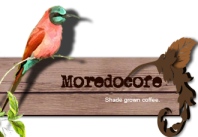
  4. mordo_logoMoredocofe (Ethiopia) – 87.06. Family-owned, also organic and UTZ Certified. Their logo features a Northern Carmine Bee Eater (Merops nubicus).
  5. Teppi Green Coffee Estate (Ethiopia) – 86.84. A very large (10,000 ha) farm managed by Green Coffee Agro Industry. Despite its large size, a portion of the coffee is still grown in fairly rustic conditions, as the company is a major exporter of “forest coffee” in the country.
  6. Ururi (Peru) – 86.05. Another CECOVSA branded coffee.
  7. Manantiales del Frontino (Colombia) – 86.13. Growing 10 varieties (including a Geisha which won the SCAA’s Coffee of the Year in 2011) at 1500-2000 meters; the farm includes 170 ha of forested area. Scored 84.48 in last April’s competition.
  8. Biloya (Ethiopia) – 85.94. Another member of the Yirgacheffe Coffee Farmers Cooperative Union (YCFCU).
  9. Los Cedros (Colombia) – 85.84.
  10. Finca Kassandra (Mexico) – 85.81. In central Veracruz, at 1200 to 1500 m. Scored 85.46 in 2011 competition. Their logo has a stylized bird, perhaps a motmot.

The average score of the 9 past winners from the last 6 years is 87.95, so the winner this spring is above average. The average score of the top ten from the past 6 years is 85.20, while this year it was 87.11.

Previous results are available here in the archives in the Coffee Awards and Competitions category.

Caribou Coffee’s new owners: killing the brand?

This post includes important updates, flagged in the text and at the end of the post.

Caribou Coffee, which sources all its beans from Rainforest Alliance certified farms, was acquired by the Joh. A. Benckiser Group (JAB), a private German holding company, in December 2012. Earlier in 2012, JAB acquired Peet’s Coffee & Tea.

When I wrote about the acquisition earlier this year, I stated,

I can only hope that under JAB, Caribou can continue with its transparency, excellent sustainability record, and its all-Rainforest Alliance coffee sourcing.

Unfortunately, it looks like JAB  is headed toward sourcing less certified coffee by favoring the Peet’s brand over Caribou and alienating many faithful Caribou customers and employees in the process.

Caribou abruptly announced the closing or rebranding of over a quarter of its 600+ stores. Eighty will be permanently closed in less than a week, including all or most in Ohio, Michigan, Pennsylvania, Maryland, Virginia, Georgia, Illinois, eastern Wisconsin and Washington. U.S. states where Caribou will continue to operate (for now) under its own brand will include Minnesota, North and South Dakota, Iowa, Kansas, western Wisconsin, North Carolina, and Colorado.

Another 88 stores will be converted to Peet’s Coffee & Tea stores. Peet’s is not a major purchaser of Rainforest Alliance coffee, or much of any certified coffee, for that matter. Of the 34 varieties currently listed on its website, only one is certified organic, while one is Fair Trade. Peet’s is also known for their very dark roasting (29 of the 34 are designated as “deep roasts”) and rather generically-labeled blends and “single origins.” Just what we need — more over-roasted mystery beans.

These changes have brought the ire of customers, many of whom are taking to social and other online media with responses ranging from dismay to vowing to never set foot in Peet’s to setting up Facebook pages denouncing the abrupt termination of employees. On the company’s own Facebook page, fans are expressing their dislike of the situation, complaining that the company is removing posts and comments, all while corporate Caribou has remained mum on the topic. This ham-handedness demonstrates a lack of sensitivity to Caribou customers, if nothing else. (Update: Forbes published an excellent piece on how poorly the company handled the public in the media, especially Facebook.)

JAB also owns 15% of D.E. [Douwe Egberts] Master Blenders 1753. Douwe Egberts is the Dutch company created when Sara Lee spun off all of its coffee and tea business.  As of April 12, 2013, Douwe Egberts has agreed to be acquired by JAB.  Allow me to be pessimistic and theorize that if this acquisition goes through, coffee sourcing will be streamlined via the supply chain of Douwe Egberts, one of the largest coffee buyers in the world.

The Douwe Egberts certifier of choice is UTZ Certified, not a bad certification, but very lean on environmental criteria and thus one which I do not consider an eco-certification. In 2012, Douwe Egberts sourced 65,000 tons of UTZ Certified coffee. Their goal is to have 25% of their coffee purchases “certified as sustainable” by 2015. Douwe Egberts gets a “D” grade on sustainability from RankABrand.

Regardless of what happens on the Douwe Egberts front, the recent actions by JAB seem to indicate a move towards away from sustainably-sourced and 100%-certified coffees…just what I was afraid of.

More updates: The Forbes piece mentioned above also talks about further potential changes, indicating what’s happened so far “doesn’t bode well for Caribou’s future.”

We also spoke confidentially to an employee of a local store slated to be converted to a Peet’s. He told us that in a team meeting when staff members brought up questions regarding differences in sustainable sourcing and certifications between Peet’s and Caribou, the management declined to discuss the topic.

McDonald’s makes substantial commitment to coffee sustainability

mccafeMcDonald’s Corp. recently announced that their North American operations is investing $6.5 million over  4.5 years to provide technical assistance to Guatemalan coffee farmers to increase their capacity for sustainable coffee production. McDonald’s is partnering with the non-profit TechnoServe (which coordinates many coffee-related projects) and SCAN (Sustainable Commodity Assistance Network), a global consortium of 20 organizations that provide an array of support for sustainable agriculture practices. This is another component in the sustainability efforts of the Golden Arches, a number of which are directly related to coffee. These include:

  • All coffee in the U.K. is from Rainforest Alliance-certified farms (since 2007).
  • All coffee in the rest of their 39 European markets is from Rainforest Alliance-certified or UTZ Certified farms (since 2007).
  • All coffee in Australia and New Zealand is from Rainforest Alliance-certified farms (since 2008-2009).
  • All coffee for espresso-based drinks in the U.S. is sourced from Rainforest Alliance-certified farms (as of March 2013).
  • All coffee for espresso-based drinks in Canada must be certified by a third party, and is currently 100% Rainforest Alliance.

To get an idea of why I find this so significant, we need put all of this in perspective by comparing it to the largest coffee buyer in the U.S., J.M. Smucker Company.

McDonald’s is a fast food restaurant. They do not directly source or roast coffee (it comes through suppliers). Coffee is not their core business, but makes up just 6% of U.S. sales for the company1. Smucker’s is a food manufacturer that owns the coffee brands Folgers, Millstone, Dunkin Donuts bagged coffee, Café Pilon, and Café Bustelo. Coffee makes up 44% of their U.S. sales.

McDonald’s certified coffee purchases in 2011 — Rainforest Alliance, UTZ, and Fair Trade — were about 10,400 metric tons, with three-quarters of it being Rainforest Alliance-certified. Although the McDonald’s restaurants in the U.S. lag behind European markets in offering certified coffee, the company expects to buy around 3800 tons for the domestic market.  Not a lot, but more than Smuckers (1500 tons) and Nestlé (2000 tons) total certified global purchases combined!

The most recent McDonald’s pledge amounts to $1.4 million a year to provide sustainability support to coffee farmers. That’s 0.06% of it’s annual coffee sales of about $2.1 billion on U.S. systemwide sales of just over $35 billion. That doesn’t sound like much until you realize that Smucker has opted to support TechnoServe at $150,000 annually2, or 0.006% of its annual U.S. retail coffee sales of $2.3 billion.  And, as I like to remind everyone, JM Smucker has a dismal environmental sustainability record, and less than 0.5% of the coffee it buys each year carries any type of certification whatsoever.

mcd-love-1

You can let McDonald’s know (on Facebook, for example) that you appreciate their efforts and would like to see more eco-certified coffee in the U.S.

1Figures provided to me by McDonald’s and are the most recent available; total global coffee purchase information not available at this time. The Nestle and Smucker figures are based on the most recently available data — both of those companies are very guarded about releasing any information to the public. In contrast, McDonald’s was helpful and forthcoming about giving me this data, and also has extensive information at their web site.

2This figure is based on statements made by Smucker’s regarding a continuation of support provided to TechnoServe by Proctor & Gamble, which sold its coffee brands to Smucker. The last time donors were listed in TechnoServe’s annual reports was 2009, and Smucker was listed as a donor in the $100,000 to $499,999 level. I wrote to TechnoServe to verify the amount of support they received from Smucker, but did not receive a reply. I’m sure if Smucker had upped the ante, they’d brag about it, because their 2013 Corporate Responsibility Report touted this relationship…by highlighting the work TechnoServe had done with 170,000 coffee farmers, making it sound as if Smucker should receive lots of credit. TechnoServe receives $3.1 million in corporate and foundation support alone.

Rainforest Alliance Cupping for Quality — Dec 2012

ra-sealThe Rainforest Alliance Cupping for Quality award is designed to recognize exceptional coffees carrying the Rainforest Alliance seal and to highlight the linkage between sustainable farm management practices and cup quality. Two annual cuppings and awards are divided by geography. In December, coffees from the southern hemisphere — including Brazil, Peru, Kenya, Tanzania and Indonesia — compete.

The latest cupping evaluated 51 coffee samples from 9 origins, including one from Malawi, the first entry for that country.  Here are the top 10 coffees:

  1. Ndumberi Factory, Kenya — 87.41.  One of the coffee processing mills (factories) utilized by the Ndumberi cooperative. This group of over 2500 smallholders in the Kiambu region is also Fair Trade and UTZ Certified. Many of the members — the average size of their plots is 0.15 ha — do grow under some shade.
  2. Tunki, Peru — 86.91.  Placed first last year, and second in 2010. Also certified organic and Fair Trade. Tunki is one of the coffees from CECOVASA (Central de Cooperativas Agrarias Cafetaleras de los Valles de. Sandia), a group of cooperatives totaling nearly 5000 members. CECOVASA has been working with Conservation International, and has won an award for their work preserving biodiversity. “Tunki” is the local name for the national bird of Peru, the spectacular Andean Cock-of-the-Rock, depicted in their logo. Equal Exchange has a good article on a visit to CECOVASA.
  3. El Silencio – Luis Fernando Arias Alzate, Colombia — 86.88. Also Fair Trade.
  4. Tegu Factory, Kenya — 86.09. Nyeri district, part of the Tekangu Farmers Cooperative, which has around 900 members. Also UTZ Certified. The co-op has engaged in a community tree planting project.
  5. Quechua, Peru — 86.00. Like Tunki, one of the CECOVASA coffees; also organic and Fair Trade. Came in 5th place in 2010.
  6. Santo Tomas 2, Eibar Jose Rojas Pajoy, Colombia — 85.44.
  7. Gichatha-ini Factory, Kenya — 85.18. Also Fair Trade and UTZ Certified.
  8. Ibonia Estate, Kenya — 84.46. Also UTZ Certified. Placed 6th in 2010.
  9. Coop Sol & Café [Coopertiva de Servicios Multiples Sol & Cafe], Peru — 84.25. Also Fair Trade and organic certified. This 1000+ member cooperative includes cacoa and rice producers.
  10. Yadini Estate, Kenya — 84.23. A 131 ha estate (81 cultivated in cofffee) near Ruiru. Also UTZ Certified, and a Starbucks supplier. Placed 9th in 2010. According to a profile on their web site, “Bio- diversity is also being enhanced on the farm by the ongoing planting of coffee friendly shade trees” and they hope to market shade coffee in the future.

Last year, I began tracking the cumulative data on this competition going back to 2007. The average score for the top ten in this current event was 85.68, which is slightly above the previous average of 85.14. The top score of 87.41 was below the average of previous top scores (88.02). Not all countries have competed each year, but of the countries that have had coffees in at least five events, the highest average score goes to Peru at 86.30 (five events). Colombia (86.05, n=6) and Guatemala (86.04, n=5) came in next.

Search for these coffees online — I have seen quite a few of them offered within the last two crop years.

Rainforest Alliance now requires scaling up

Over a year ago, I wrote about an upcoming change to the rules for use of the Rainforest Alliance certified seal. Under the previous (2007) Use of Seal Guidelines, any single-ingredient product, such as coffee, could carry the RA seal so long as it contained at least 30% certified content. The percentage had to be indicated adjacent to the seal.

RA encouraged companies to increase the percentage of certified content over time, even going so far as saying that companies had to agree to these increases. However, there was no specific mandate or requirement in the Guidelines. Thus, we had Yuban Coffee, made by Kraft, that has contained 30% certified beans (and 70% mystery-sourced beans) since 2006.

The good news is that in their new Use of Seal Guidelines, there is explicit language regarding “scaling up” of amounts of certified ingredients. Companies using the RA certified seal on single-ingredient products that have less than 90% certified content must agree to increase the percentage a specific amount over a specific time period. There are two options for doing so. In the first, the amount is increased by 15% of total volume a year. So coffee that starts out at 30% certified goes to 45%, 60%, 75%, and 90% over four years. Terrific!

The “bad” news is that the other option is for companies to sign a “SmartSource” scale-up plan that “allows more flexibility … to work within the realities of sourcing.”  The sample plan provided shows scaling up over six years where some years there is no increase, and other years variable amounts.

The lack of a time limit on the SmartSource plan seems like the weak spot in this option. Why not tell companies they can scale up by less than 15% a year some years, but that they have to get to >90% in no more than 6 or 7 years, for instance.

I understand “the realities of sourcing” and also RA’s rationale for working with these large companies. To rehash: a very large roaster sourcing 30% of many tons of coffee has an arguably larger impact than a small company sourcing 100% of two tons, and allowing less-than-total content gets big corporations to the table. Yet many consumers, roasters, and coffee professionals I’ve talked to think that the ”30% rule” (as well as the “10% slippage” issue) tarnishes a great certification, or confuses or misleads consumers. Allowing it in the first place,  and providing wiggle room in the scaling up process could be (is) perceived as too much concession to corporate interests.

I’m willing to bet Kraft is using the SmartSource plan, given the volume they purchase and their long-standing 30% plateau. It will be interesting to see how they progress, although we will have to wait years to see the end result. I wonder what will happen to companies that do not scale up on schedule. I presume those companies that fail under option 1 will merely be put on a SmartSource plan. I can’t imagine RA terminating a relationship or yanking a seal as long as there is an open-ended option in place.

So while I’m not discounting this clear step forward with the 30% rule, I’m not sure it “solves” the go-easy-on-big-coffee perception problem. In any event, Rainforest Alliance deserves a lot of credit for the great progress they’ve made bringing certified coffee (and many other products) into the mainstream, and their successful efforts at educating the public about coffee sustainability.