Birds and other biodiversity

Know your coffee birds: Baltimore Oriole

The beautiful Baltimore Oriole (Icterus galbula) is a familiar summertime sight across eastern North America (as is its western counterpart, the Bullock’s Oriole, I. bullockii; the two were once considered the same species). Their cheerful whistled notes and distinctive bag-like hanging nests are characteristic of woodland edges, open areas with scattered tall trees, and mature suburban neighborhoods. The brilliant orange and black plumage of adult males (young males, females, and juveniles are all duller) make the Baltimore Oriole one of the most colorful and arresting species of songbird in North America.

One reason these orioles are so beloved is that they are easily attracted to feeding stations which offer grape jelly or oranges sliced in half. Baltimore Orioles are also conspicuous in spring and early summer as they feed on the nectar and pollen of the blossoms of flowering trees. Although during most of the nesting season they feed on insects, as do most songbirds, it is this affection for fruit and nectar that hint at the habits of orioles on their Latin American wintering grounds.

Trees in the large genus Inga are popular shade trees in Latin American coffee farms. They are fast-growing, evergreen, easy to prune, and fix nitrogen in the soil. While their overuse generally does not benefit biodiversity if they are planted at the expense of a variety of other trees, Ingas do have wildlife value. They produce an abundance of flowers in the dry season (our winter) to which many birds are attracted. Nectar and pollen are important food sources for birds during the dry season, when fewer insects are available.

The nearly ubiquitous presence of Inga on coffee farms almost always assures the presence of Baltimore Orioles on these farms in their wintering range as well. In fact, surveys in Chiapas, Mexico found more Baltimore Orioles in coffee farms containing Inga than in farms with more extensive tree cover or in mature forest.

In areas where coffee farms have been converted to sun coffee, Inga-shaded farms have become important refuges for orioles as well as other species. Small flocks of Baltimore Orioles, working their way through coffee farms in the mid-canopy of Inga are a frequent sight from Mexico through Central America. Other flowering trees that are often grown as shade trees in coffee farms, such as Erythrina and Gliricidia, are also visited by orioles and other birds. Many of these trees are pollinated only by birds and provide farmers with fuelwood and fruit in addition to shading their coffee. A fine example of the interconnectedness of coffee, shade trees, birds, and people in Latin America.

Top oriole photo from Wikimedia Commons, bottom by JimGuy, used with permission; map by Cornell Lab of Ornithology.

Research: Andean shade coffee quality habitat for birds

Bakermans, M. H., A. C. Vitz, A. D. Rodewald, and C. G. Rengifo. 2009. Migratory songbird use of shade coffee in the Venezuelan Andes with implications for the conservation of the cerulean warbler. Biological Conservation 142:2476-2483. doi:10.1016/j.biocon.2009.05.018

Most studies of birds in shade coffee have concentrated on numbers, species composition, and foraging dynamics, but none has looked at whether birds using shade coffee improve in body condition during the winter months. Body condition is strongly correlated with annual survival, and thus a crucial metric.

This study took place in Venezuela’s northern Andes near La Azulita in the state of Merida. This region is not very well represented in the literature (either coffee-growing or bird ecology research), yet it is an important wintering site for many North American bird species. These include various flycatchers and thrushes (Contopus and Catharus sp.), and a number of warblers including Cerulean Warbler (Dendroica cerulea). This species, which I have written about before, has declined an estimated 83% in the last four decades. The shade coffee farms examined ranged from 3 to 5 ha with 38 to 63% canopy cover. Nearby primary forest was also included in the study.

The four most common North American migrant species found, all warblers, were American Redstart, Blackburnian Warbler, Cerulean Warbler, and Tennessee Warbler. These species were three to fourteen times more common in shade coffee than in primary forest, even when detectability was factored in (because coffee farms are more open, birds can often be easier to detect, which would introduce bias if not accounted for).

Body condition was measured using various parameters in the five most common species of birds captured for banding in the shade coffee farms. Body condition improved over the winter for three species, including Cerulean Warblers, and was maintained in the other species. Nearly 30% of the individuals of the 15 species of migrants banded were recaptured, meaning they stayed in the coffee farms for prolonged periods of time throughout the season. These are all indications that the shade coffee provided quality habitat for these species.

In addition, 65% of Cerulean Warblers banded the first winter were recaptured or resighted the next winter, a remarkable return rate. Faithfulness to wintering sites is advantageous in that birds are familiar with resources such as food and cover, which can improve survivorship. However, it is also quite risky for birds wintering in areas experiencing high rates of habitat loss. Venezuela has seen nearly 40% of its shade coffee converted other types of agriculture — the authors state that they witnessed several shade coffee farms turned into cattle pasture during the two year duration of this study.

Just noting the sheer numbers, or even diversity of birds, in a particular habitat doesn’t tell the whole story. They may be present, sometimes only briefly, depending on the availability of resources in the larger landscape. This study not only showed that migrant birds were very common in shade coffee even in a region with primary forest, but also demonstrated site fidelity and improvement in body condition — adding  a critical component to the story of the value of shade coffee.

Cerulean Warbler photo by Petroglyph under a Creative Commons license.

Bakermans, M., Vitz, A., Rodewald, A., & Rengifo, C. 2009. Migratory songbird use of shade coffee in the Venezuelan Andes with implications for conservation of cerulean warbler Biological Conservation DOI: 10.1016/j.biocon.2009.05.018

Cerulean Warbler Reserve coffee certified

A coffee farm that is part of the ProAves Cerulean Warbler Reserve in Santander, Colombia was recently certified by Rainforest Alliance (under the cooperative Asociacion de Café Sostenibles de Santander). The 15 ha farm was acquired in 2006 by ProAves, the Colombian partner of the American Bird Conservancy (ABC). These two organizations worked together to secure funding to establish the 220 ha Reserve in 2005. In 2008, the farm covered 18% of the Reserve’s operating costs, and the goal is to cover all operating costs by 2011 through the sales of coffee.

As part of the Save the Cerulean Warbler effort, ABC has also marketed a Cerulean Warbler Coffee, roasted and distributed by Thanksgiving Coffee Company, which we have reviewed here.

Just to avoid confusion, the ABC/Thanksgiving Cerulean Warbler coffee is from a different part of Colombia, not from farms adjacent to or near the Reserve. The Thanksgiving Coffee Company’s Cerulean Warbler Coffee is not Rainforest Alliance or Smithsonian Bird-Friendly certified. According to ABC, the plans are for Thanksgiving to source coffee from these farms in the future. Currently, coffee from farms near the Reserve are being sold to wholesalers and are not being marketed as conservation coffees.

Nicaraguan shade coffee: Finca Esperanza Verde

Last winter, I spent some time in Chiriqui, Panama, and visited some coffee farms. I summarized what I found in my post “What shade coffee looks like.”

I’ve just returned from Nicaragua, where I spent a week at Finca Esperanza Verde doing bird and insect surveys, and especially bird banding. FEV is located near San Ramon in the central highlands of Nicaragua’s Matagalpa department. It consists of about 106 ha, of which 10 are in active coffee production; a handful cover the organic garden, small coffee washing facility, and eco-lodge; and the rest are in native forest, forest restoration, and fallow shade coffee.

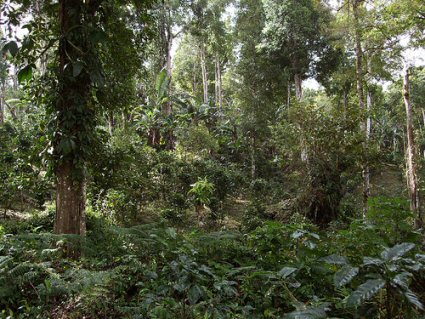
We were participating in the fifth year of a banding project initiated by the North Carolina Museum of Natural Sciences, and the research was done entirely in the coffee production area, shown above.

In the shade continuum from rustic to shaded monoculture described in my introductory post “What is shade-grown coffee,” the production areas I saw fell into the highly desirable traditional polyculture category. Recall that one reason certifying shade coffee can be so complex is that coffee is often grown in a matrix of different crops and land uses and varying levels of shade management depending on location within a farm.  Yet every area I visited at FEV had the same lush growth and diverse shade.

FEV is certified organic, and is being actively courted by Rainforest Alliance for certification and use as a model farm. I believe FEV also qualifies for Smithsonian Bird-Friendly certification, and that is being looked into as well. More on that in a future post.

Leaves from the shade trees provide a thick, natural mulch for the coffee, and help curtail soil erosion and moisture loss while offering nutrients.

Even more so than the areas we visited in Panama, Finca Esperanza Verde and other shade coffee farms are critical to birds and other wildlife in Nicaragua. We were stunned at the deforestation. It’s not due to human development, but to agriculture (mostly non-commercial) and (especially) cattle grazing. Shade coffee farms appeared to be one of the only land uses that preserved a lot of native trees.

During our brief stay, we counted well over 100 bird species, including nearly two dozen species of migratory songbirds that breed in North America. Over 30 species of migrant songbirds have been recorded at the finca, and the overall bird list is approaching 300 species. We observed or banded several species new to the finca ourselves.

You can read more about the migratory bird species we encountered at the Rouge River Bird Observatory’s blog Net Results. I thought I would cover some of the resident species here, focusing on a few of the species that we banded. Bird banding is an excellent complement to bird surveys — some of the most common bird species we saw were rarely captured, and we rarely observed many of the species we captured.

Crimson-collared Tanagers (Ramphocelus sanguinolentus) favor areas of dense shrubs in second growth, but will also come to trays of fruit placed at feeding stations.

White-breasted Wood-wren (Henicorhina leucosticta) is a forest species that favors dense tangles, especially around fallen trees.

Cocoa Woodcreeper (Xiphorhynchus susurrans) prefers gallery forest and older second growth, and forages on large trees by probing the bark, epiphytes, mossy clumps, and vines — which wouldn’t be left on trees in intensively managed coffee farms.

I was happy to band several Black-headed Nightingale-Thrushes (Catharus mexicanus), since they are closely related to the species that I research at home. These shy, elusive birds prefer thick cover and forage mostly near the ground or in the leaf litter, conditions they would not find on a sun coffee farm.

Not only is this farm great for biodiversity, it produces fantastic coffee. It placed 10th in the 2007 Nicaraguan Cup of Excellence. Coffee from Finca Esperanza Verde is sold exclusively to Counter Culture Coffee, where it is the main component of their Cafe San Ramon.