Birds and other biodiversity

Know Your Coffee Birds page

I recently posted the ninth account in the "Know Your Coffee Birds" series, this one on the Rufous-capped Warbler. This series provides mini-profiles of bird species that are commonly found on shade coffee farms, focusing on their use of coffee farms and why these farms are important to them. 

I've now put together a page that lists all the published accounts, as well as species that I anticipate writing up in the future. I'll update it whenever a new account is added.

Know Your Coffee Birds

Know your coffee birds: Rufous-capped Warbler

The Rufous-capped Warbler (Basileuterus rufifrons) is found through much of Central America, north through Mexico. This species is occasionally found in the southwestern U.S., when it creates a sensation among birders.

This warbler is a common resident of shade coffee farms all year long, where it can be the dominant foliage-gleaning species. This is a foraging method where birds pick off insects from the upper and undersides of leaves. Many birds that occupy coffee farms make the most use out of remaining forested patches, the canopy trees, and associated epiphytes — thus the importance of shade-grown coffee to birds. Rufous-capped Warblers are in the minority in that they also forage within the coffee layer as well.

Two of my former Rouge River Bird Observatory student volunteers co-authored a paper on Rufous-capped Warbler foraging habits on a shade coffee farm in Chiapas, Mexico [1]. They knew from previous research that many resident species like the warbler that use shade coffee move to other habitats once wintering migrants from North America arrive, perhaps to reduce competition. Rufous-capped Warblers stay put, but shift from their foraging in all the layers of vegetation to focusing on the coffee and shrub understory in the winter. This is also likely due to competition for resources, since many North American migrants prefer to forage in the canopy layer.

This shift to lower foraging heights was in evidence when we visited Finca Esperanza Verde in Nicaragua, where we caught multiple Rufous-capped Warblers in the coffee production area, including the one photographed above.

This is just another example of the complex interactions between resident and migratory birds in the tropics, an intricate dance coordinated over thousands of years of evolution. The Rufous-capped Warbler has adapted well to shade coffee production. Let’s drink shade-grown coffee, and keep them around.

[1] Seasonal shift in the foraging niche of a tropical avian resident: resource competition at work? Jedlicka, J., R., Greenberg, I. Perfecto, S. M. Philpott, and T. V. Dietsch. 2006. Journal of Tropical Ecology 22:385-395.

Photo by Darrin O’Brien, all rights reserved, used with permission.

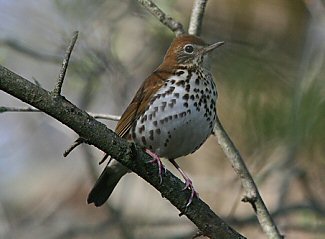
Know your coffee birds: Wood Thrush

The Wood Thrush, a relative of the familiar American Robin, is often considered a symbol of the population declines of birds that nest in North America and winter in the tropics. This species has been declining since the mid-1960s, and is on the National Audubon Society’s 2007 WatchList of declining birds.

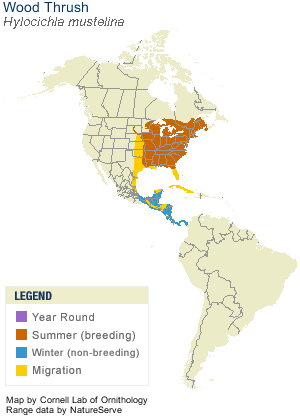
Wood Thrushes nest in forests over much of the eastern U.S. Like most other songbirds, they migrate at night. These thrushes travel an average of 2200 km between their nesting areas and wintering grounds in Central America.

In the winter, Wood Thrushes are most common in primary and mature second growth forests, and they can be a familiar site on polyculture shade coffee farms from Mexico to Panama. For instance, they are the most commonly banded species at the gorgeous shade farm Finca Esperanza Verde in Nicaragua — we caught and saw a number of them when we were there in March 2009.

One reason for Wood Thrush declines may be tropical deforestation. At least one study has found a correlation between reduced numbers of Wood Thrushes and reduction in forest cover in the northern portion of their wintering range [1].

Wood Thrushes will choose and defend a territory in the winter, much as they do when they are nesting. However, as forests are destroyed in the tropics (including for sun coffee), Wood Thrushes are forced to become nomadic — a case of too many Wood Thrushes and other species, and not enough space. These thrushes must move from place to place, or settle in habitat that is low quality. These birds are less likely to survive the winter than individuals who have territories in a good forest patch [2].

Here in North America, habitat fragmentation is considered another cause of Wood Thrush population declines. As in the tropics, Wood Thrushes can be found in small woodlots or low quality habitat, but their chances of successfully raising a brood are greatly diminished in these situations. In fragmented forests, predators are more common, as are Brown-headed Cowbirds, which lay their eggs in the nests of other birds, often targeting Wood Thrushes. These factors contribute to dramatic rates of nest failure in some locations.

The Wood Thrush and coffee connection is so iconic that this bird has been found on the coffee packages or web sites of Birds and Beans, Coffee for the Birds, Audubon Coffee, and Counter Culture Sanctuary Coffee, to name a few. Wood Thrushes are considered “area sensitive,” needing good, intact forests throughout their annual cycle. High-quality shade coffee plantations represent essential habitat for this species, and your choice of coffee has a direct impact on the survivorship of Wood Thrushes and other birds that rely on tropical forests.

Wood Thrush photo by Eddie Calloway under a Creative Commons License.

[1] Rappole, J. H., G. V. N. Powell, and S. A. Sader. 1994. Remote-sensing assessment of tropical habitat availability for a nearctic migrant: the Wood Thrush. In Miller, R. I. (ed.). 1994. Mapping the diversity of nature. Chapman & Hall, London, England.

[2] Deinlein, M. 1998. A “Sing”-ular Sensation. Wood Thrush: Bird of the Month. Smithsonian Migratory Bird Center.

Know your coffee birds: Violet Sabrewing

One of the most enduring memories of my visit to Finca Hartmann is that of passing a spot that was frequently visited by a vivid male Violet Sabrewing (Campylopterus hemileucurus), a large tropical hummingbird found from southern Mexico to western Panama. Many of us in the U.S., especially in the east, think of hummingbirds as diminutive creatures. Violet Sabrewings, however, are big, spectacular birds the size of sparrows. The males are a brilliant dark violet while the females are largely metallic green. Both sexes have white-tipped outer tail feathers that flash as they hover and flit about. They are unmistakable and not soon forgotten.

Violet Sabrewings are most common at 900-1650 meters, the same elevations at which coffee is grown. These hummingbirds like open forests or edge habitats where they can find an abundance of flowering plants, and are found on most bird lists of shade coffee farms within their range.

Hummingbirds are among the most important pollinators, especially in the tropics. Many tropical plants have co-evolved with their specialized hummingbird pollinators, so that the flower is shaped in such a way that only a hummingbird with a matching bill can pollinate it. Violet Sabrewings pollinate a wide variety of flowers, and utilize a foraging strategy known as long distance traplining. They repeatedly visit flowers along a long, fixed route.

Coffee itself is rarely pollinated by hummingbirds (arabica coffee is self-pollinating, although fruit set increases when bees help cross-pollinate). Therefore, sabrewings and other hummingbirds are rarely found in sun coffee farms, but are reliant on the other flowering trees and plants found in shade coffee. Trees in the genus Erythrina are commonly used to shade coffee, and most tropical species are pollinated only by hummingbirds. Bananas and plantains, also frequently used in shade coffee, heliconias, and various ephiphytes are all very important to Violet Sabrewings and other hummingbirds. This plant diversity is not found in sun coffee, but shade coffee farms provide excellent habitat for these dazzling birds.

Another important feature for Violet Sabrewings found in shade coffee farms is nesting habitat. This species inevitably nests on the branch of a tree or shrub over a small stream (we found several nests near creeks at Finca Esperanza Verde). Some source of running water is characteristic of most coffee farms in Latin America, which use the washed or wet processing method. Without streamside vegetation, it’s unlikely Violet Sabrewings could nest successfully.

Another group of organisms depends on hummingbirds to complete their life cycle. Known as hummingbird mites, these tiny invertebrates live and reproduce in flowers, feeding primarily on the nectar. There is only one way for these specialists to move between plants: in the nostrils of hummingbirds. Mites that need to move to another flower of  their specific host plant (when the flower is dying) must clamber onto the bill and into the nostrils of a hummingbird in the brief few seconds the hummingbird is probing the flower. The mites recognize the scent of their host plants, and have an equally brief time to disembark into a new flower.

Hummingbird mites do not harm the birds; in ecological terms this is known as phoretic commensalism, when one species (the mite) uses another (the hummingbird) just for transportation. The mite benefits, the bird is not affected.

Swaths of sun coffee fragment hummingbird habitat, creating barren deserts essentially void of these beautiful birds, all for the want of a cheap cup of coffee. Save hummingbirds (and hummingbird mites!), drink sustainably-grown shade coffee.

Top photo by Jerry Oldenettel, second by Doug Greenberg, under Creative Commons licenses. Violet Sabrewing nest at Finca Esperanza Verde by Darrin O’Brien and Julie Craves, all rights reserved.