Birds and other biodiversity

Know your coffee birds: Emerald Toucanet

The Emerald Toucanet (Aulacorhynchus prasinus) is the most widely distributed member of the toucan family. It can be found from Mexico through Central America south to Bolivia. As might be expected for a species with such as broad geographic range, there are many subspecies — at least 17. They vary by throat color, facial pattern, and the color and pattern of the bill. Some researchers believe that some of these may actually be separate species, with perhaps four different species in Central America, and at least three in South America.

Emerald Toucanets are, as the name implies, smaller than toucans, at a little over a foot long. The sexes look alike, although males have slightly larger bills than females. Nobody is positive why this difference exists, as one study discovered it is not related to differences in diet or foraging (which is often the case when both sexes share territories year round). These toucanets nest in well-concealed tree hollows, and live in small flocks in the non-breeding season. They are found in open woodlands, including shade coffee plantations, from around 900 to over 3000 meters.

While they eat big insects and small lizards, fruit forms a large part of the diet of Emerald Toucanets. Therefore they are important dispersers of the seeds of tropical trees and shrubs. They have large feeding territories, so they encounter many species of trees, up to 47 at one Costa Rican study site alone. Although they are the smallest members of the toucan family, they’ll even consume large-seeded fruits, repeatedly regurgitating and reswallowing a fruit until the seed separates from the pulp and can be discarded. For the most part, seeds pass through the digestive system, though, and it’s been determined that those have a higher germination rate than seeds that merely drop to the ground in the fruit. All these factors make Emerald Toucanets an integral part of tropical forest ecosystems.

Because this species favors open forest habitats and forages in the mid-canopy, shade coffee farms are suitable habitat for them — and likely quite important in regions where other deforestation is high. Counter Culture Coffee chose the Emerald Toucanet for the new label of its Cafe San Ramon coffee because it is found at one of the main suppliers of these beans: Finca Esperanza Verde in the Matagalpa region of Nicaragua. In fact, when Counter Culture was redesigning the label and asked for a recommendation, I suggested this species (and the subspecies on the label is the correct one!). Just to keep myself honest, I’ll will be at Finca Esperanza Verde this week doing some bird surveys and bird banding, and hope to see a few Emerald Toucanets in the process.

Credits and references

Top photo of a “Blue-throated” Emerald Toucanet in Costa Rica by Laura Erickson; used with permission. Middle photo of the nominate form of Emerald Toucanet, in Honduras, by Brian Gratwicke, under a Creative Commons license.

Puebla-Olivares, F., E. Bonaccorso, A. E. de los Monteros, K. E. Omland, J. E. Llorente-Bousquets, A. T. Peterson, and A. G.
Navarro-Siguenza. 2008. Speciation in the Emerald Toucanet (Aulacorhynchus prasinus) complex. Auk 125:39-50.  For an excellent discussion of this paper and the taxonomy of Emerald Toucanets, see Nick Sly’s blog posts on the topic.

Riley, C. M. and K. G. Smith. 1992. Sexual dimorphism and foraging behavior of Emerald Toucanets Aulacorhynchus prasinus in Costa Rica. Ornis Scandinavica 23:459-466.

Wenny, D. May 2000. Seed dispersal, seed predation, and seedling recruitment of a newtropical montane tree. Ecological Monographs / Ecological Society of America, 70 (2): 331-351.

Wheelwright, N. T. 1991. How long do fruit-eating birds stay in the plants where they feed? Biotropica 23:29-40.

Wagner, H. O. 1944. Notes on the life history of the Emerald Toucanet. Wilson Bulletin 56:65-76.

Know your coffee birds: Black-throated Blue Warbler

The North American Wood Warblers are known for their colorful beauty. The male Black-throated Blue Warbler (Dendrioca caerulescens, left) is one of the most beautiful. This species is one of the most sexually dimorphic as well — the female is not blue at all — and was not even recognized as the same species until the late 1800s. The pale “hanky” showing on the lower edge of her wing, which matches that of the male, is the only giveaway.

This eastern warbler nests in large forests in the northeastern United States and southern Canada and in higher elevations of the Appalachian Mountains. They spend the winter mostly in the West Indies, as well as along the Caribbean coast of the Yucatan, Belize, and Honduras. New techniques using a simple laboratory test of the molecular composition of feathers has revealed that Black-throated Blue Warblers from the northern part of the breeding range winter mostly in Cuba and Jamaica, and birds that nest in the Appalachians winter mostly in Hispaniola and Puerto Rico [1].

A common species in shade coffee ecosystems
Wintering Black-throated Blue Warblers are frequently found on coffee farms, with studies noting them using these plantations in Jamaica, Puerto Rico, the Dominican Republic, Haiti, and Chiapas, Mexico. These studies often note that Black-throated Blue Warblers are one of the most common migrants found on the farms.

While wintering in coffee farms, Black-throated Blue Warblers consume primarily small insects, many of which are coffee pests. In Jamaica, Black-throated Blues were the number one predator recorded on the dreaded coffee berry borer.

Like some other species of wintering migrants, Black-throated Blues tend to segregate themselves by sex on their wintering grounds. Males tend to be found in tall, mature forest habitat, and females in shorter, shrubby habitat. Research has shown that in the Dominican Republic, shade coffee farms had more males than females [3,5], indicating that shade coffee farms were a good substitute for tall forest habitats.

Many bird species return to the same places to nest each year, and some also return to regular wintering areas. Black-throated Blue Warblers are very faithful to their wintering sites [2,3]. In fact, they have a stronger fidelity to their winter territories than their nesting territories, making the health of the habitats on coffee farms critical to their survival [4]. Declines in abundance of breeding populations in the southern Appalachians of over 2% a year the last two decades may be linked to severe habitat degradation in parts of the winter range, particularly Haiti [1] where deforestation is particularly severe.

The Black-throated Blue Warbler’s song is sometimes described as sounding like a buzzy “beer-beer-beer!” From its strong affiliation with shade fincas in the winter, we know what it really means is “coffee-coffee-coffee!”

[1] Rubenstein, D. R., C. P. Chamberlain, R. T. Holmes, M. P. Ayres, J. R. Waldbauer, G. R. Graves and N. C. Tuross. 2002. Linking breeding and wintering ranges of a Neotropical migrant songbird using table isotopes. Science 295: 591-593.

[2] Wunderle, J. M., Jr. 1995. Population characteristics of Black-throated Blue Warblers wintering in three sites in Puerto Rico. Auk 112: 931-946.

[3] Wunderle, J. M., Jr. and S. C. Latta. 2000. Winter site fidelity of nearctic migrants in shade coffee plantations of different sizes in the Dominican Republic. Auk 117: 596-614.

[4] Holmes, R. T. and T. W. Sherry.  1992.  Site fidelity of migratory warblers in temperate breeding and Neotropical wintering areas: Implications for population dynamics, habitat selection, and conservation. pp. 563-575. In: J. M. Hagan III and D. W. Johnston (eds.). Ecology and Conservation of Neotropical Migrant Landbirds. Smithsonian Institution Press.

[5] Wunderle, J. M., Jr. and S. C. Latta. 1996. Avian abundance in sun and shade coffee plantations and remnant pine forest in the Cordillera Central, Dominican Republic. Ornithologia Neotropical 7: 19-34.

Top male Black-throated Blue Warbler by Jerry Oldenettel; bottom by Julie Craves.

Know your coffee birds: Jacu

When I conceived the “Know Your Coffee Birds” series, I made up a list of birds often found in shade coffee farms. There was one that was not included that I feel compelled to write about already because it’s being used in a unique way to market coffee: the Jacu bird.

The Dusky-legged Guan, a.k.a. “Jacu”, has found a new career as a coffee picker and processor.

“Jacu” is the Brazilian name given to a group of birds, actually — the guans. Guans are the largest group in the bird family Cracidae — primitive, vaguely chicken-like forest birds found in much of Latin America. There are 15 species of guans in the genus Penelope. All guans are strictly forest birds, preferring primary forest. Due to deforestation and hunting pressure, cracids in general are among the most endangered groups of birds in the Neotropics.

Guans are primarily vegetarians, eating mostly fruit and berries, some flowers and buds, and a few insects. Guans are very important in tropical ecosystems because of their role in dispersing seeds in the forests in which they live. It is this frugivorous diet that leads us to the Jacu’s coffee connection.

Guans eat ripe coffee cherries. While they are unlikely to venture onto sun coffee plantations, they will live in or near coffee farms where coffee is grown in forest-like conditions and/or adjacent to intact forest. Like nearly any animal that eats fruit, guans prefer fully ripe fruit, and that includes coffee cherries. One might imagine this habit would draw the ire of coffee farmers. But at least one enterprising producer is using the philosophy, “If life gives you lemons, make lemonade.” Or in this case, “If life gives you bird crap with coffee beans it it, make coffee.”

In the spirit of kopi luwak, produced from coffee beans collected from the feces of civet cats in southeast Asia, comes Jacu coffee, produced from beans collected from the droppings of guans.

This coffee is currently being offered by Camocim Estate (two farms: Camocin and Alatalia) in Pedra Azul, Brazil. Pedra Azul is in the southern part of the Atlantic state of Espirito Santo. Two species of guan may be found there: Rusty-margined Guan (Penelope superciliaris) and Dusky-legged Guan (P. obscura).

Fazenda Camocim encompasses 500 hectares in total, with 50 planted in coffee, and the rest re-planted in a forest-rejuvenation project. The farms are certified organic and biodynamic, and utilize fruit and nut trees in the coffee plantings, and native habitat patches as well. All of which no doubt provides habitat and other food for the guans.

Supposedly, some of the ”unique” characteristics of kopi luwak come from the civet’s digestive process, which according to tests leach out proteins which cause bitterness. But a bird’s digestive system is different than that of a mammal.

The digestive enzymes in mammals and birds are similar. But while some cracids do have gizzards in which ingested grit helps crack and grind seeds, it is not well developed in guans. So the beans are not getting a lot of deep scratches that would allow for added absorption of chemicals that might alter the properties of the bean. Most importantly, food passes very quickly through birds. Birds typically pass the seeds of fruit within an hour, or at most a few hours. It’s very inefficient for a bird to have their small digestive tracts loaded up with a lot of seeds — especially large ones like coffee beans. I cannot imagine there is any physical reason why they should taste much different than the rest of the crop that is harvested by humans and processed in a more traditional manner.

However it tastes, I love the idea of this coffee. It means the beans are coming from a forested area, from producers that care about working with and preserving — rather than fighting and eliminating — native wildlife. And that’s especially important in this case, because Espirito Santo is smack in the Atlantic Forest biome, one of the most exceptionally biodiverse and endangered habitat types in the world. Large bird species have been severely reduced or extirpated in many of the remaining forest fragments of the Atlantic Forest. This has dire consequences, as up to half of the native tree species require birds, including guans, which have large enough mouths to swallow and disperse their fruits. Rusty-margined Guans are tolerant of disturbed habitats and have been considered important for their role in seed dispersal in these forests and have been suggested for use in conservation efforts.

One day, I wouldn’t mind reviewing some jacu coffee. I’ve seen it offered green at Sweet Maria’s in the U.S. and roasted from Hasbean in the U.K. I’d especially like to try it side-by-side with the more typically-processed organic from Camocim. When I find a U.S. source where I can get both, roasted, I’ll be on it like a duck on a june bug. Or a jacu on a coffee cherry.

Update: Here’s an interesting article on Jacu coffee in Modern Farmer in 2013.

References:

Cardoso da Silva, J. M. and M. Tabarelli. 2000. Tree species impoverishment and the future flora of the Atlantic forest of northeast Brazil. Nature 404: 72-74.

Munoz, M.C. and G. H. Kattan. 2007. Diets of cracids: how much do we know? Ornitologia Neotropica 18:21-36.

Pizo, M. A. 2004. Frugivory and habitat use by fruit eating birds in a fragmented landscape of southeast Brazil. Ornitologia Neotropica 15:117-126.

Photo of Dusky-legged Guan by Jose Claudio GuimarÁ£es.

Research: Woodpeckers and ants in India’s shade coffee

Vishnudas, C. K. 2008. Crematogaster ants in shaded coffee plantations: a critical food source for Rufous Woodpecker Micropternus brachyurus and other forest birds. Indian Birds 4:9-11.

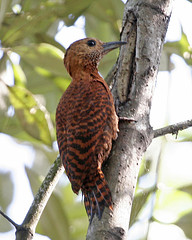
Rufous Woodpeckers are ant specialists.

The Rufous Woodpecker is one of the twelve woodpecker species found in the Western Ghats of India; it is widespread throughout Asia. Rufous Woodpeckers have a particularly interesting life history, as they are ant specialists. They not only feed largely on ants, but they excavate their nests in large paper-wasp-like nests of the stinging tree ants in the genus Crematogaster.

These ants are common in shade coffee plantations in India, and the author reports that 31 of the 37 ant nests he observed being raided by Rufous Woodpeckers over the previous ten years were on shade coffee farms; only six were in natural forest. Other bird species also take advantage of the woodpeckers ripping open the ant nests. Secondary feeding on the ant eggs and pupae by Greater Racked-tailed Drongos, Oriental Magpie-Robins, and Common Tailorbirds and other bird species are described.

The ants, however, are not welcome on the coffee farms. They protect and support mealy bugs, which are pests on the coffee. Although the woodpeckers and other birds can help control the ants (as do other natural predators), many Indian farmers have traditionally used copious pesticides to control the ants. The author notes that the increasing popularity of organic coffee is reducing this practice, and concludes, “It is high time that the conservation value of shaded coffee plantation, as a critical habitat for Rufous Woodpecker and other forest birds, be recognised and proper agro-ecological management practices developed and popularised amongst planters.”

Photo by Lip Kee.