Plainspoken Coffee. A Coffee Review for Ordinary People by Ordinary People, #46.
 I’ve written about Doi Chaang Coffee, a unique Thai/Canadian partnership, before. This is certified organic, certified Fair Trade (although the partnership goes well beyond), single-origin coffee grown in northern Thailand. There is plenty of background information on the company and the coffee in the review of their medium roast that we did in 2008. I won’t rehash everything here, but just provide the basics:
Doi Chaang coffee is grown on over 2400 ha in the vicinity of the village of Doi Chang (20.325, 99.839) in Chiang Rai province at around 1200 meters. It is 50% Caturra, 35% Catimor, and 15% Catuai. The coffee is grown under the shade of various fruit and nut trees, including macadamia, plum, pear, and peach. Reforestation efforts in the area strive for a 50/50 mix of native tree species and cash crop species (both marketable and consumable crops are necessary to replace the income formerly generated by poppy growing).
In 2009, we reviewed Doi Chaang’s civet-processed coffee. Unlike most other civet coffees (often known as “kopi luwak“), Doi Chaang does not farm or raise civets in captivity (see the third photo here for the tiny cages in which these animals are typically held). All beans are gathered from what is left behind by wild civets in the Doi Chaang coffee-growing areas. Two species of civets are found in the area, the Masked Palm Civet (Paguma larvata) and the Asian Palm Civet (Paradoxurus hermaphroditus). The related Binturong (Arctictis binturong) also occurs there and is known to eat coffee fruit as well.
Generally, civet coffees are made from beans that have passed through the digestive tracts of these animals: they eat the ripe coffee cherries, but do not digest the seeds, which are passed in the waste. For more on this, er, process, read our review of typical kopi luwak coffee, and the review of Doi Chaang’s wild civet coffee. As I mentioned in the latter post, Doi Chaang actually offers two types of wild civet coffee: passed and spat. It’s not unusual for animals to regurgitate large seeds from fruit they have just eaten rather than have all the bulk pass through their systems. Modest chemical changes in the coffee beans apparently do occur when they pass through the entire digestive systems of civets. I’m not sure they’d be exposed to digestive enzymes long enough to make a profound difference if they are just held in the mouth and then spit out. However, it’s conceivable that mammals may first swallow the fruit and shortly thereafter regurgitate the seeds, in which case they will have been exposed, at least for a short time, to some of the digestive processes that apparently give “passed” civet coffee its character.
Doi Chaang provided us with a tin of the “spat” wild civet coffee for us to try. Because these are wild civets, the coffee is very limited. This year it is available in 50-gram tins, so we were unable to have a lot of people taste the coffee, so we won’t provide a motmot rating as we usually do. We prepared the civet coffee as a simple pour-over, side by side with their medium roast single estate variety. Later, we also made the medium roast peaberry variety as a drip, and compared notes with another round of the civet as a pourover. We were going to use the peaberry for the side-by-side comparison, but the standard bean version seemed closer in roast level to the civet variety. The latter was, visually, perhaps just a tad lighter.
Now we don’t consider ourselves as having an extremely sensitive palates — we are ordinary people, after all — and I was frankly skeptical that a “spat” coffee could have gone through any flavor-enhancing changes. So we didn’t expect to be able to tell the difference between the two. We were wrong. The civet coffee was markedly smoother, with an understated milk chocolate sweetness. In our previous review (the “passed” civet coffee), we didn’t detect the Sumatran-like profile of earth and leather that we did in the regular and peaberry varieties (which were muted in that crop year, but much sharper this year). This time, we did get a more Sumatran vibe from the wild civet coffee, although it was restrained and very mellow, especially as the cup cooled. Hands down, we liked this better than either the peaberry or the standard single origin. Was it due to the extra care and sorting that might go into the preparation of the civet beans? More careful roasting of the precious beans? Can a civet discern some particular property in ripe coffee cherries, thus making these beans share some special characteristic? Or does even brief consumption by the mammal impart a distinct profile? I can’t say. But I will admit, it was markedly different, and clearly more enjoyable.
Here is a recent review of the Doi Chaang wild civet “spat” coffee by CoffeeReview.
Since we first started reviewing Doi Chaang’s coffees, they have become much more widely available in both retail outlets and online.
One of my absolute favorite things about Doi Chaang is a coffee is the nearly overwhelming amount of information the company freely provides about its history, growing, processing, and people. If people could have this kind of background on all the coffee they buy, nobody would be drinking mystery corporate coffee anymore. Here are a couple resources:
- The Doi Chaang blog.
- A 30-minute documentary produced by Global TV is available in segments on YouTube. Part 3 is a quickie, and deals with the civet coffee as well as other products being produced by Doi Chaang, including macadamia nuts, honey, and soap. I love hearing brother Wicha talk about poop!
The Doi Chaang story is really remarkable. I especially recommend the documentary. The success of Doi Chaang in North America is nothing compared to how successful its been in changing the lives of the hill tribe that produces it. If you feel an urge to drop some cash on an animal-processed coffee, go for the Doi Chaang version. Not only does it avoid exploiting animals, it generates income for a company doing truly good work.
 We have just returned from a 10-day trip to Nicaragua, where we did insect and bird surveys, and bird banding, at two great coffee farms, Finca El Jaguar in Jinotega, and Finca Esperanza Verde in San Ramon. I’ll be posting about that soon. Meanwhile, some coffee news from when I was away.
 The tiny, bright yellow bird that
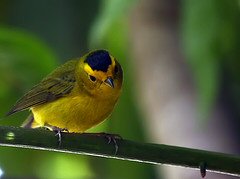 While many bird species tend to be somewhat set in their behavior at certain times of the year, wintering Wilson’s Warblers may be solitary, either roaming through a locality or forming a territory, or found in mixed flocks of other birds. In addition to insects and some fruit, nectar is also consumed in winter. This flexibility in habitat requirements, behavior, and food resources has no doubt contributed to the success of Wilson’s Warblers, which remain one of our most common warblers. Yet recent population trends indicate numbers have declined 2% a year in the U.S., and over 4% a year in the eastern U.S. in recent decades. This is a well-studied species, but we need to know more to understand how to best conserve them. Unfortunately, we often neglect to take action with common species until serious problems are evident.
 Sara Lee and Kraft both announce increases in purchase of certified coffees: what does this mean?
 I’ve written about
 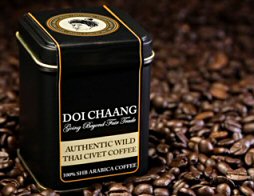 Doi Chaang provided us with a tin of the “spat” wild civet coffee for us to try. Because these are wild civets, the coffee is very limited. This year it is available in 50-gram tins, so we were unable to have a lot of people taste the coffee, so we won’t provide a motmot rating as we usually do. We prepared the civet coffee as a simple pour-over, side by side with their medium roast single estate variety. Later, we also made the medium roast peaberry variety as a drip, and compared notes with another round of the civet as a pourover. We were going to use the peaberry for the side-by-side comparison, but the standard bean version seemed closer in roast level to the civet variety. The latter was, visually, perhaps just a tad lighter.