Introduction
Third-party certifications are great aids to consumers who want to know their coffee was produced under specific standards. Coffee produced under various certification schemes is still a pretty small fraction of total global production. One frequent question I get is why more coffee isn’t certified (Bird-Friendly, organic, etc.), or why the coffee costs more for the consumer. Part of the answer is that certification is expensive for farmers, and often for other players further up the supply chain. If farmers cannot make up these additional expenses in the sale price of their coffee (and, they frequently are not), the added expenses are not worth it.
A number of different types of expenses are involved in obtaining and maintaining certified status. Most producers will have to take steps to conform to the criteria outlined in the standards of the certification they are seeking. This can involve capital outlay, increased labor, etc. Then the farm or production unit has to pass an inspection by an auditor from an authorized certifying agency; these agencies typically charge a per diem fee plus transportation and other costs. There is usually a fee for the certification itself — to the certifying agency and/or to the organization that developed the standards (i.e., Rainforest Alliance, Smithsonian Migratory Bird Center). Finally, all certifications require periodic audits and renewals which incur costs.
Because coffee production systems vary so widely, and certifying agencies all have their own fee schedules, it’s difficult to pin a precise dollar amount on how much it costs a given farm (or unit of production) to get one of the major certifications. Below, I’ll present some guidelines, fees, and variables that give a sense of the cost of obtaining and maintaining certification. I’ve only included the three certifications that are most concerned with ecological standards, and therefore incur costs related to growing methods.
Costs that influence any coffee certification
 Costs to meet the standard. The major coffee certifications have a whole suite of rules and standards that must be met. Some are elaborate and complex, especially the standards set by the U.S. Department of Agriculture for products sold as organic in this country. Few farms will be able to meet all these standards without some adjustments.
- Meeting the various standards could include a wide variety of time, labor, and material outlay. Examples might be starting up a major organic composting program, planting native trees, constructing wastewater treatment facilities, or soil testing.
- For organic certification, there is a three-year conversion period after the farmer stops using prohibited materials. During those three years, the producer farms organically, but cannot sell his crop as organic or receive any price premiums.
- Costs to bring a farm into compliance with ecological criteria such as shade cover, riparian buffers, etc. can be significant. For example, Rainforest Alliance has criteria relating to setting aside or enhancing natural habitat. In one study (CI 2005), two estates in Brazil reported this cost was $10,000 to $50,000 for consulting fees, seed and plant material, planting, and management of these areas. In addition, there was the opportunity cost of losing this land from production. Another study in El Salvador (Romanoff 2010) found the average cost of on-farm investment to achieve Rainforest Alliance or Starbucks CAFE Practices conservation and environmental standards only was $58/ha ($42/ha for farms larger than 100 ha, $61/ha for smaller farms, 43 farms surveyed). Total costs to meet all the standards, plus needed technical assistance, was $111/ha for larger farms, $156/ha for smaller ones.
- Even if a farm produces coffee in a manner that complies with many, most, or all of the requirements set forth by a particular certification, it’s up to the farmer to prove it. This involves forms and paperwork. On the plus side, this typically improves farm management by forcing a fair amount of organization and administrative streamlining. On the downside, literacy levels of many producers can make this challenging.
Auditing expenses. An auditor has to come and inspect the farm, check all the paperwork, and make sure the farm is in complete compliance with the standards. Each certification scheme authorizes various certification agencies around the world to perform this work (e.g., OCIA International, Biolatina). Usually, one agency can perform audits for multiple certifications, if needed. Factors influencing the price of this audit include:
- The number of certification organizations/bodies available in the producer’s area (a higher number leads to more competition and therefore lowers prices).
- The speed with which an auditor works and the size of the operation being audited (most charge a per diem rate, so the longer they are on site, the more it costs to perform the audit).
- Distance to travel to the audit location, as well as they condition of the roads (transportation costs and time add to the cost of the audit).
Continuing indirect costs. Once certification standards are met and the certification is awarded, there are usually on-going costs in addition to annual inspections. All certifications have some sort restrictions that require segregation of coffee and chain of custody documentation, and internal controls and compliance. For organic (and therefore Bird-Friendly) and standards that include environmental criteria, there are the added labor costs of weeding, pruning, pest control, and production of organic compost. Losses in yield are common in both shade and organic production systems after the transition from conventional farming, and may increase as time goes on.
Specific costs for major coffee certifications
Again, I’ve only included the three certifications that are most concerned with ecological standards, and therefore incur costs related to growing methods.
ORGANIC
Direct costs to producer: Organic certification fees vary, since each agency sets its own fee schedule. They are based on the size of the production unit, previous years’ sales, and which or how many different countries (and therefore different standards) the crop will be certified to sell to. In addition, a fee ranging from $150 to $300/day is charged is charged for the inspection itself, plus transportation and other costs. Conversion to organic takes three years once a producer complies with the standards. Initially, there are annual audits the first two years, with a certification audit in year three.
Potential annual direct costs: Annual audits are required. Random audits also occur. As one example, for a single producer with about 20 ha of coffee, the cost was over $3,000 per year (pers. comm.). To help control costs, there is a provision in the National Organic Program (which regulates products sold as organic in the U.S.) that every single producer in a cooperative with many small holders do not need to be inspected every year. Only a percentage of producers are inspected annually on a rotating basis (this ruling has come under fire, as recently as 2007). Thus, total costs are spread over all members, which reduces the cost for each member. In one Mexico case study, the cost was $1300 to $1550 per annum per producer organization (Potts et al. 2010).
Costs further up supply chain: Other players up the supply chain who handle organic coffee must also be certified. As they do with producers, costs to other parties vary depending on the certification agency and size of the operation being certified. This has been estimated at $700 to $3000 a year [SCAA 2010].
RAINFOREST ALLIANCE
Direct costs to producer: In October 2010, Rainforest Alliance changed how it levied fees. The coffee importer is now primarily responsible (see Costs further up the supply chain, below). Previously, RA charged a fee to producers for certification at the rate of $5/ha for group certification and $7.50/ha for individual farms.
Costs of audits are still paid by the producer, although sometimes buyers help with costs. A study from Brazil(CI 2005) for larger producers (Ipanema Coffees was one, and is one of the largest producers in the world) stated that annual audit costs were between $1000 and $5000. A study in El Salvador (Romanoff 2010) found Rainforest Alliance audits cost up to $3.61/ha, but varied depending on the efficiency of the auditor.
Costs further up supply chain: The first buyer of the green coffee pays a Participation Fee of $0.015/lb of green coffee sold.
SMITHSONIAN BIRD-FRIENDLY
Direct costs to producer: BF-certified coffee must be certified organic, so those costs apply. Many organic certification bodies are also accredited to audit for BF certification. There is a “symbolic” fee for the BF certificate.
Potential annual direct costs: Re-certification audits for BF every three years, but are combined with organic audits.
Costs further up supply chain: Importers pay $100 a year to use the BF logo, and roasters pay $0.10/pound to do so (down from $0.25/lb) [SCAA 2010]. Fees go to Smithsonian to support program costs and bird conservation research.
Parting thoughts
Due to the wide range of variables, these guidelines only give a sense of the costs involved in environmental certifications, but nonetheless may be eye-opening to the average consumer. Of course, some context is necessary, and the topic of whether the costs of eco-certification is worth it to a “typical” producer is the subject of another post. Still — it’s worth a quick example. We’ll take some statistics from a paper examining this issue (Valkila 2009):
80% of the farmers in in Nicaragua have less than 3.5 ha of coffee. The average yields of organic small farmers are 329 kg/ha. Thus, the “typical” organic small-holder produces 2539 pounds of coffee. Let’s give that farmer a very good price, reflecting current high prices and assuming it goes right to the farmer: $2/lb. That gives the farmer $5078 gross income for the year to provide for his family, pay for farm inputs and improvements, etc., etc. The cost of the annual audit alone for organic certification puts a pretty big dent in that.
Of course, the variation in yields, farm size, production costs and so on, added to multiple factors in certification costs, make these calculations merely illustrative, but at least provide a bit of context.
Sources and more information
[CI] Consumers International. 2005. From Bean to Cup: How Consumer Choice Impacts upon Coffee Producers and the Environment. Consumers International and International Institute for Environment and Development, London. 64 pp.
Millard, E. 2011. Incorporating agroforestry approaches into commodity value chains. Environmental Management 48:365-377.
Potts, J., J. van der Meer, and J. Daitchman. 2010. The State of Sustainability Initiatives Review 2010: Sustainability and Transparency. International Institute for Sustainable Development.
Romanoff, S. 2010. Shade coffee in biological corridors: potential results at the landscape level in El Salvador. Culture and Agriculture 32:27-41.
[SCAA] Specialty Coffee Association of America, Sustainability Council. 2010. Sustainable coffee certifications comparison matrix.
Valkila, J. 2009. Fair Trade organic coffee production in Nicaragua — sustainable development or a poverty trap? Ecological Economics 68:3018-3025.
Photo from iStockphoto, used under license.

 The last word on Keurig single-cup brewers
 Costs to meet the standard. The major coffee certifications have a whole suite of rules and standards that must be met. Some are elaborate and complex, especially the standards set by the
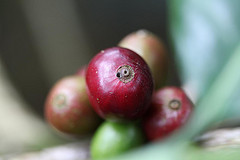 The featured insect of the week at the North Carolina State University Insect Museum blog is the coffee berry borer (Hypothenemus hampei, a.k.a. “la broca”), the extremely tiny insect with the enormous impact on coffee worldwide. The post outlines the life cycle of the CBB, which is frankly fascinating, from an evolutionary and entomological perspective.


